
Font size
 Worksheets
Ecology Review
Total questions: 56
Worksheet time: 34mins

symbiotic relationship in which both organisms benefit
competition
mutualism
predation
commensalism


symbiotic relationship in which one organisms benefits and the other organism is not affected
competition
mutualism
parasitism
commensalism


What are plants that convert energy from the sun called?
decomposer
primary consumer
secondary consumer
producer

Ecology is the study of:
only the living things in the environment
only the nonliving things in the environment
how living things interact with each other and the nonliving things in the environment
scientists who perform research on living things
What is a species?
Different animals that compete for the same resources
A group of similar organisms that can reproduce with each other
A group of organisms that live together
A group of organisms that are physically and functionally very different from each other
Organisms that can make their own food do so by the process of:
decomposition
respiration
photosynthesis
scavenging
What type of consumer eats plants?
Herbivore
Omnivore
Carnivore
Both herbivore and omnivore
The first organism in a food chain is ALWAYS a:
producer
consumer
decomposer
Any of the above
Biotic means:
living organisms and the remains of living organisms
non-living
Abiotic means:
living organisms and the remains of living organisms
non-living
Spiders eat flies. When drawing the food web for this relationship, you should draw the arrow:
FROM the spider, TO the fly
FROM the fly, TO the spider
Select the three things plants need to do photosynthesis.
Water
Glucose
Carbon dioxide
Light energy
Which organisms convert Nitrogen in the atmosphere to a usable for for plants and animals?
Plants
Animals
Bacteria
Converters
Photosynthesis will most likely appear in which of these cycles?
Nitrogen
Carbon
Water
Evaporation and Transpiration will most likely appear in which of these cycles?
Nitrogen
Carbon
Water

Which species will have the largest population?
Hawks
Snakes
Rabbits
Grass
An ecosystem is...
All of the members of a species in the same area.
All of the different species in the same area.
All of the Biotic and Abiotic factors in an area.
Decomposers...
Recycle nutrients in the ecosystem.
Provide most of the Earth's energy.
Can be considered producers because they grow in the ground.
Are mostly Abiotic.
Increased Carbon Dioxide in the atmosphere has formed a blanket around the planet and contributed to an ...
increase in the temperature of the planet.
increase in noise
increase in ice around the planet.
increase in parasites looking for hosts.
A relationship in which both species benefit is called...
Parasitism
Commensalism
Mutualism
How are primary consumers different from secondary consumers?
Primary consumers eat only plants; secondary consumers eat other consumers.
Primary consumers eat other consumers; secondary consumers eat only plants.
Primary consumers eat plants and other consumers; secondary consumers eat plants and decompose matter.
. Primary consumers eat plants and decompose matter; secondary consumers eat plants and other consumers.
Sheep are herbivores. What can you infer from this?
They are primary consumers.
They are producers.
They are secondary consumers
They are decomposers.
Through what process do producers make their own food using sunlight?
Parthenogenesis
Photosynthesis
Meiosis
Mitosis

The original source of energy for a food web is...
plants
sun
producers
decomposers
Primary succession occurs in an area that has:
soil
no soil
some soil
none of these
___ are the first organisms to colonize an area and begin the process of ecological succession.
foundational organisms
introductory organisms
primary organisms
pioneer species
What is the main difference between primary and secondary ecological succession?
Primary begins WITHOUT soil; Secondary begins WITH soil
Primary is the first state and secondary is the second stage
Primary builds plant community; secondary builds animal community
Primary begins WITH soil; Secondary begins WITHOUT soil
What is an example of a disturbance that could bring about secondary succession?
Humans cut down many trees in a small region
A volcanic eruption covers a village in lava.
Which of the following types of organisms would be present during the pioneer community stage of ecological succession?
Lichens and mosses
Grasses and shrubs
Small trees and wildflowers
Tall trees and thick brush
Which
Nitrogen can't be used directly from the atmosphere.
True
False
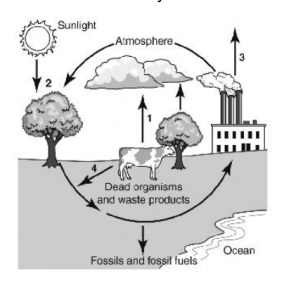
Process where plants take in CO2 from the atmosphere to make their own food.
Respiration
Combustion
Nitrification
Photosynthesis
Process where plants and animals release CO2 back into the atmosphere through exhaling.
Photosynthesis
Decomposition
Respiration
Uplift

An ecosystem is made up of __________.
living things only
non-living things only
both living and non-living things

Why was the songbird population reduced by the presence of too many elk in Yellowstone?
Elk ate young trees, so birds had fewer places to nest.
Elk ate too many songbirds.
Wolves at songbirds when no elk were available.

Why were wolves absent from Yellowstone from the 1920's to 1995?
There was no prey available, so they starved.
When all the elk died, the wolves moved to Canada.
Humans hunted and killed all the wolves in Yellowstone and the surrounding area.
The wolves migrated south to Texas for a warmer climate.
How did the elk population impact the vegetation of Yellowstone?
The elk ate it all, They reduced the vegetation to almost nothing, or they devoured it, leaving it bare.
Nothing at all. the vegetation just grew as normal.
A drought actually caused the vegetation to die and the elk trampled what was left.
The elk ate some of it but lots of the vegetation remained.
Beavers returned to Yellowstone because...
There were more trees. They like to build dams and eat trees. They build many habitats and niches for other animals
They liked the warmer temperatures in the park because of climate change.
They are carnivores and will eat the wolves.
They are carnivores and will eat the elk.

An interconnected web of the flow of energy (and what eats what) through an ecosystem.
trophic level
trophic cascade
food web
food chain

Each step or level in a food chain or food web.
trophic level
trophic cascade
food web
food chain
What is a keystone species?
A species that is most abundant in an ecosystem.
A species that plays a critical role in maintaining the structure of an ecological community.
A species that has no predators in its ecosystem.
A species that can live in a variety of ecosystems.
How can the removal of a keystone species affect an ecosystem?
It can increase biodiversity.
It can lead to a more stable ecosystem.
It can cause a trophic cascade and disrupt the ecosystem balance.
It has no significant effect.
What happens to energy as it moves up the food chain?
It increases exponentially.
It remains constant.
It decreases due to energy loss at each trophic level.
It is completely recycled.
What role do decomposers play in a food web?
They produce their own food through photosynthesis.
They consume living plants and animals.
They break down dead organisms, returning nutrients to the soil.
They are the primary source of energy in an ecosystem.

