
 Worksheets
Year 10 Triple Biology Mock close the gap June 2024
Total questions: 107
Worksheet time: 1hrs 9mins
Which part of a cell is where respiration takes place?
Nucleus
Cytoplasm
Mitochondria
Ribosome
Cell membrane
Which part of a cell is where proteins are made?
Nucleus
Cytoplasm
Mitochondria
Ribosome
Cell membrane
to release energy via respiration
make proteins
controls what goes in and out of cell
vacuole and cell wall

Which type of cell is the bacterial cell as it has no nucleus?
Eukaryotic
Prokaryotic
Multicellular
Unicellular

Both cells are drawn the same length, but the magnification of each cell is different.The real length of the bacterial cell is 2 micrometres.
Calculate the real length, X, of the plant cell.
Magnification = Image size / Real size
2 micrometres
20 micrometres
200 micrometres
2000 micrometres
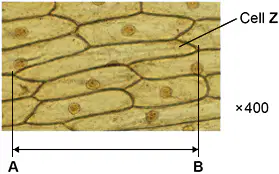
The figure shows what the student saw using the microscope at a magnification of ×400.
Line A–B in Figure 2 shows the length of cell Z.
The length of line A–B in is 49 mm.
Give your measurement of the length of line A–B in micrometres (µm).
1 mm = 1 000 µm
(a)
The figure shows what the student saw using the microscope at a magnification of ×400.
Line A–B in Figure 2 shows the length of cell Z.
The length of line A–B in is 49 mm.
Calculate the real length of cell Z.
Magnification = image size / real size
(a)
Give two ways how onion cells would look different if they were seen using an electron microscope.
The cells would be coloured.
The cells would look more blurred.
The cells would look larger.
The cells would show more internal structures.
A student prepared a microscope slide of cheek cells. The student looked at one cell using a microscope.
What should the student do to get a clear image?
Adjust the focus knob
Make the light dimmer
Put water on the slide
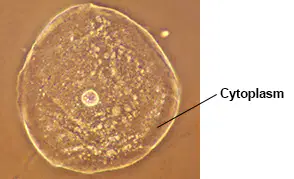
Ribosomes and mitochondria are not shown in the figure.
What type of microscope is needed to see ribosomes and mitochondria?
(a)
What is the advantage of using an electron microscope?
Cheaper
Higher magnification
Lower resolution
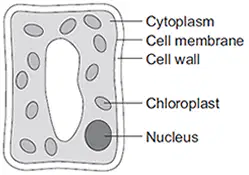
Which two parts in the diagram above are not found in an animal cell?
Cytoplasm
Cell membrane
Cell wall
Chloroplast
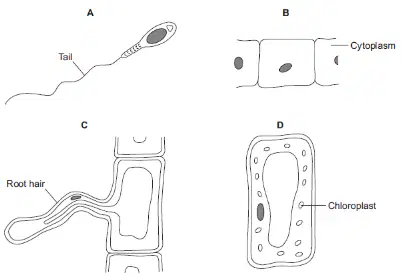
Which two of the cells are plant cells?
A and B
A and D
C and D
Hormone that is released from pituitary gland that causes an egg to mature
Oestrogen
Progesterone
FSH
LH
Hormone that is released from ovaries that causes a uterus lining to thicken
Oestrogen
Progesterone
FSH
LH
Hormone that is released from ovaries that maintains thickening of uterus lining
Oestrogen
Progesterone
FSH
LH
What is a hormone?
A chemical substance transported by neurones
A chemical substance transported by the bloodstream
An electrical impulse transported by neurones
An electrical impulse transported by the bloodstream

The diagram shows the position of some of the glands in the human body which release hormones.
Which label in the diagram shows the position of the pituitary gland?
Tick one box.
A
B
C
D
The diagram shows the position of some of the glands in the human body which release hormones.
Main gland that releases several hormones for different functions.
A
B
C
D
The diagram shows the position of some of the glands in the human body which release hormones.
Which label in the diagram shows the position of the pancreas?
A
B
C
D
Luteinising hormone (LH) is a hormone released by the pituitary gland.
What is the function of LH?
Tick one box.
Controls blood glucose concentration
Controls the formation of sperm
Controls maturation of an egg
Controls the release of an egg

The diagram shows the relative levels of sex hormones of three young people over 30 days.
One person is an 8-year-old girl, one is an 18-year-old boy and the other is an 18-year-old girl. Which person is the 18-year-old boy?
Person A
Person B
Person C
Which of the following statements describes the role of insulin?
lowers blood glucose levels
raises blood glucose levels
breaks down glycogen
increases conversion of glucose to glycogen
Which of the following statements describes the role of glucagon?
lowers blood glucose levels
raises blood glucose levels
breaks down glycogen
increases conversion of glucose to glycogen
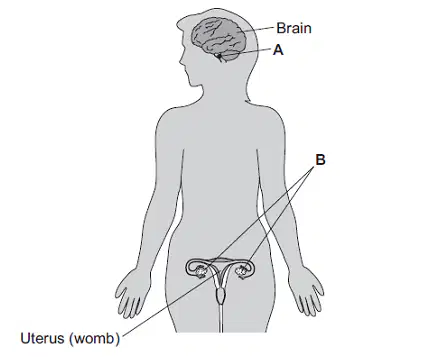
The diagram shows the position of two glands, A and B, in a woman.
Name gland A
Hypothalamus
Ovaries
Thyroid
The diagram shows the position of two glands, A and B, in a woman.
Name gland B
Hypothalamus
Ovaries
Thyroid
What do oestrogen and progesterone do in the menstrual cycle?
They are involved in egg maturation in the ovaries
They stimulate the release of the egg
They are involved in maintaining the uterus lining
How can Type 2 diabetes be caused?
It can be inherited from family members
Lack of exercise and a diet high in carbohydrates
Not enough insulin being released by the pancreas
Why does Type 2 diabetes occur?
Not enough insulin produced by pancreas
Cells no longer respond to insulin produced
Insulin cannot be transported in blood stream
How can Type 1 diabetes be caused?
It can be inherited from family members
Lack of exercise and a diet high in carbohydrates
Not enough insulin being released by the pancreas
Name the three different types of neurone in order from detection to response
Sensory, motor and relay neurones
Sensory, relay and motor neurones
Relay, sensory and motor neurones
What are effectors?
Brain
Muscles
Spinal cord
Glands
What are cells that detect stimuli called?
Response
Stimulus
Receptors
Effector
What are the stimuli detected by the skin?
Touch, temperature and pain
Chemicals (in food and drink, for example)
Chemicals (in the air, for example)
Light
What can Type 1 diabetes be controlled by?
Insulin injections
Low carbohydrate diet
Exercise
High protein diet
What hormone causes an egg to mature in an ovary & stimulates the ovaries to release oestrogen?
Progesterone
LH
FSH
What hormone stops FSH being produced (so that only one egg matures in a cycle), repairs & thickens the uterus lining?
Progesterone
LH
Oestrogen
Which hormone is detected by ovulation test kits
Progesterone
LH
Oestrogen
FSH
The liver will take excess glucose from the blood and change and store the glucose as _____________________ .
starch
lactic acid
glucagon
glycogen

Type 2 diabetes is another form of diabetes. Type 2 diabetes is common in obese people. People with Type 2 diabetes make enough insulin, but still cannot control their blood glucose concentration. This is because the body cells are not sensitive to the insulin. The graph shows information about abdominal fat and insulin sensitivity in body cells. What type of relationship is shown in this graph?
A negative correlation
exponential
No correlation
A positive correlation

The diagram in Figure 1 shows a section through the human heart, seen from the front.
The wall of the heart is made of which type of tissue?
epithelial
glandular
muscular

The resting heart rate is controlled by the pacemaker. At which position is the pacemaker located?
1
6
7

Which chamber of the heart pumps oxygenated blood to the head and body?
2
5
6
7
Which chamber of the heart receives deoxygenated blood from the head and body
2
5
6
7
Which chamber of the heart receives oxygenated blood from the lungs?
2
5
6
7

If a person’s heart rate is irregular, the person may be fitted with an artificial pacemaker.
The artificial pacemaker is
an electrical device
a pump
a valve
A person with Type 1 diabetes can control the concentration of glucose in the blood by injecting insulin. Insulin acts on an organ called the _____________________ .
liver
kidney
pancreas
thyroid
The maintenance of a constant internal state in a changing environment is known as...
Homeostasis
Mitosis
Active Transport
Negative feedback
How does the body lose water?
Exhalation
Urination
Sweating
The organs of our body that control water balance
Liver
Lungs
Kidneys
Brain
Hormone released that helps kidneys control water loss from the body
LH
FSH
ADH
Adrenaline
If the Pituitary gland releases MORE ADH ...
The kidneys reabsorb LESS water
The kidneys reabsorb MORE water
When the kidney filter the blood ALL ____________ is left in the bloodstream.
ions
glucose
protein
water
When the kidney reabsorb substances back into the blood , ALL ____________ is reabsorbed.
ions
glucose
water
urea
What does the sensory neurone send an electrical impulse on to in a reflex action?
Motor neurone
Brain
Relay neurone
Effector
What is the small gap (or junction) where two neurones meet called?
Effector
Receptor
Synapse
B. The chemical (neurotransmitter) diffuses across the gap
How do you measure the size of the zone of inhibition?
π x r 2
π x r 2 x h
length x width
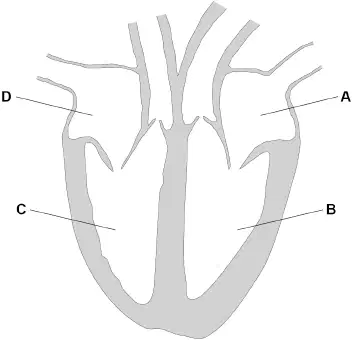
Which part of the heart receives oxygenated blood from the lungs?
A
B
C
D
Which part of the heart pumps deoxygenated blood to the lungs?
A
B
C
D
Which part of the heart receives deoxygenated blood from the body?
A
B
C
D
Which part of the heart pumps oxygenated blood to the body?
A
B
C
D
A group of cells called the pacemaker controls the resting heart rate.
Where in the heart is the pacemaker found?
Left atrium
Left ventricle
Right atrium
Right ventricle
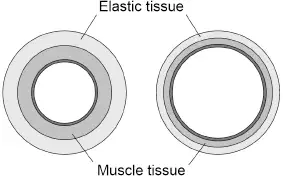
Describe two ways that the structure of an artery is different from the structure of a vein.
artery has a thicker muscle tissue
artery has a narrower lumen
artery has thinner layers of muscle tissue
artery contains valves
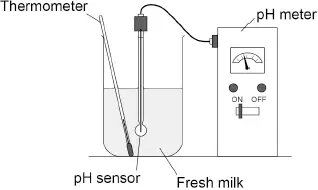
Students investigated the effect of temperature on the decay of milk. The decay was caused by bacteria in the milk.
1. Set up the apparatus as shown in Figure 1 with the milk at 20 °C.
2. Record the pH each day for 7 days.
3. Repeat with more samples of milk at 5 °C and at 30 °C.
What was the dependent variable in the investigation?
The pH of the milk
The type of milk
The volume of the milk
Students investigated the effect of temperature on the decay of milk. The decay was caused by bacteria in the milk.
1. Set up the apparatus as shown in Figure 1 with the milk at 20 °C.
2. Record the pH each day for 7 days.
3. Repeat with more samples of milk at 5 °C and at 30 °C.
What was the independent variable in the investigation?
The pH of the milk
The type of milk
The temperature of the milk
Students investigated the effect of temperature on the decay of milk. The decay was caused by bacteria in the milk.
1. Set up the apparatus as shown in Figure 1 with the milk at 20 °C.
2. Record the pH each day for 7 days.
3. Repeat with more samples of milk at 5 °C and at 30 °C.
What was the control variable in the investigation?
The pH of the milk
The type of milk
The temperature of the milk
Students investigated the effect of temperature on the decay of milk. The decay was caused by bacteria in the milk.
1. Set up the apparatus as shown in Figure 1 with the milk at 20 °C.
2. Record the pH each day for 7 days.
3. Repeat with more samples of milk at 5 °C and at 30 °C.
How could the students keep the milk at 30 °C for 7 days?
Put a lid on the beaker.
Put the beaker in a water bath.
Stir the milk continuously.
Wrap cloth around the beaker.
Students investigated the effect of temperature on the decay of milk. The decay was caused by bacteria in the milk.
1. Set up the apparatus as shown in Figure 1 with the milk at 20 °C.
2. Record the pH each day for 7 days.
3. Repeat with more samples of milk at 5 °C and at 30 °C.
As the milk decays, the bacteria digest lipids in the milk.
What type of acid is produced by digestion of lipids in the milk?
Amino acid
Fatty acid
Hydrochloric acid
Students investigated the effect of temperature on the decay of milk. The decay was caused by bacteria in the milk.
1. Set up the apparatus as shown in Figure 1 with the milk at 20 °C.
2. Record the pH each day for 7 days.
3. Repeat with more samples of milk at 5 °C and at 30 °C.
As the milk decays, the bacteria digest lipids in the milk.
What do the acids produced cause to happen to the pH?
Increase
Decrease
No effect
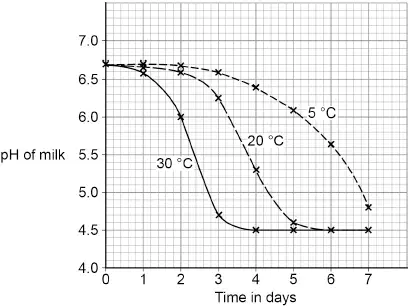
As the milk decays, the bacteria digest fats in the milk.
Figure 2 shows the results.
Why did the pH not fall below pH 4.5 at 20 °C?
All the fat had been digested.
The reaction was too fast.
The temperature was too low.
As the milk decays, the bacteria digest fats in the milk.
Figure 2 shows the results.
Why did the pH not fall below pH 4.5 at 20 °C?
All the fat had been digested.
The reaction was too fast.
The temperature was too low.
The digestion of fat was fastest at 30 °C and slowest at 5 °C.
Give two reasons why the rate of digestion was faster at 30 °C than at 5 °C.
enzyme activity is higher
enzyme activity is lower
there is more kinetic energy
there is less kinetic energy
Which two blood vessels carry deoxygenated blood?
Aorta
Vena cava
Pulmonary artery
Pulmonary vein
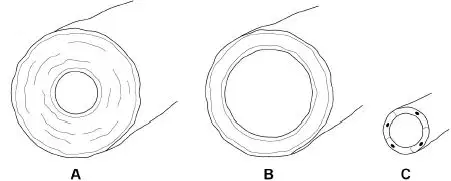
Which type of blood vessel carries blood into the right atrium?
A
B
C
Which type of blood vessel requires a stent inserted to keep the walls open if blocked with fatty deposits, to allow more blood to flow freely?
A
B
C
A is a(an)
Artery
Vein
Capillary
B is a(an)
Artery
Vein
Capillary
C is a(an)
Artery
Vein
Capillary
Glandular tissue
Allows food to be churned around the stomach`
Covers the outside and inside of the stomach
Produces digestive juices
Coordinates nerve impulses
Muscular tissue
Contracts and allows food to be churned around the stomach`
Covers the outside and inside of the stomach
Produces digestive juices
Coordinates nerve impulses
On what day does ovulation occur during the menstrual cycle?
14
1
5
During what day does menstruation occur?
Day 1 - 5
Day 14
Day 15-28

Which blood vessel(s) has a thicker wall or thicker layer of muscle?
Artery
Capillary
Vein
Which blood vessel(s) transports blood under high pressure?
Artery
Capillary
Vein
Which blood vessel(s) doesn’t have valves?
Artery
Capillary
Vein
What type of blood vessel is H?
Artery
Capillary
Vein
What type of blood vessel is G?
Artery
Capillary
Vein
What type of blood vessel is F?
Artery
Capillary
Vein
Malignant tumours are cancers.
Which two sentences describe malignant tumours?
Malignant tumours are only found in the reproductive system.
Malignant tumours have cells that can spread to other parts of the body.
Malignant tumours may form secondary tumours.
Malignant tumours do not change in size.
Tick the rules of aseptic technique
Heat the loop in the top blue part of the flame
Wave the loop around to cool after heating to prevent bacteria being killed
Open the lid of petri dish slightly to add loop
Seal the petri dish all the way round after adding the bacteria
How can we avoid the agar plate being cross contaminated with unwanted microorganisms when it is open? Pick all that apply?
Work near a bunsen
Wipe the surface of the agar with antiseptic
Minimise the time the lid is open and close it as soon as you are finished inoculation
Pass the agar through the bunsen flame
Why is it important that the Petri plates are incubated upside down?
To decrease the growth of bacterial colonies
To keep the nutrients in the agar
To prevent moisture from condensing onto the agar surface
To increase growth of the bacterial colonies
The loop should be sterilised before dipping into the bacterial culture in the
yellow part of flame
top blue part
any
bottom blue part

Which antibiotic is most effective at inhibiting the growth of bacteria?
Left
Top
Bottom
Right
Why is kidney dialysis used?
It is a quick, easy and mobile method readily available
To clean the blood of patients' whose kidneys aren't working properly
For cosmetic reasons
Why does sweat help to cool us down?
It makes your clothes damp and you feel cooler
The sweat sits on your skin and cools you down because it is a liquid
Sweat removes thermal energy from the skin during evaporation
What happens during vasodilation?
Blood vessels narrow and shrink away from the skin's surface
Blood vessels widen so more blood flows through capillaries in the skin
Blood vessels move down in the skin
Why do the hairs on our skin sometimes stand up when we are cold?
To trap air under them in order to keep us warmer
To know when we are frightened
The hairs stand up in order to cool us down when we are too hot
What is phototropism?
Growth stimulated by water
Growth stimulated by light
Growth inhibited by light
What is positive phototropism?
Plants grow towards the light source
Plants grow away from the light source
Plants grow down towards the ground
Where are auxins made in the plant?
In the growing tip of a stem or root
In the older part of a stem or root
All plant cells can make auxins
Which side of a stem contains more auxin?
The shaded side
The side in the light
Both sides (shaded and non-shaded) contain the same amount of auxin

