Worksheets
Reasoning with Functions 1 Unit 2 Review
Total questions: 90
Worksheet time: 5hrs 2mins
zeros of the polynomial
y = 3(x + 4)(x + 1)(x - 3)?

(2x+3)2
Factor: x2+9x-10
(x-5)(x+2)
(x+5)(x-2)
(x+10)(x-1)
(x-10)(x+1)
What is the degree of the function:
f(x) = 6x2 + 4 - 3x4 + 5x - 9x3
1
2
3
4
If f(x) = 4x3 + 5x2 - 3, find f(-2).
-415
-15
-55
-615
What is the vertex of the equation
y=(x−3)2+5(-3, 5)
(3, 5)
(-3, -5)
(3, -5)
What is the vertex of the equation
y=(x+7)2+3(7, 3)
(7, -3)
(-7, 3)
(-7, -3)
y=-(x-4)2-3,
does this parabola have a maximum or minimum value?
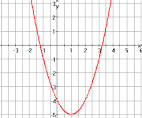
Find the y-intercept of this graph?
(-4,0)
(0,-4)
(4,0)
(0,4)

Does this parabola have a minimum or maximum and what is its value?
minimum: 2
maximum: 2
minimum: 5
maximum: 5
Which of the following is the Factored(Root) Form of a quadratic function?
f(x) = mx + b
f(x) = ax2 + bx + c
f(x) = a(x - m)(x - n)
f(x) = a(x - h)2 + k
What are the x-intercepts of the parabola?
y = -3(x + 5)(x - 9)
(-5, 0) and (9, 0)
(5,0) and (-9, 0)
(5, 0) and (9, 0)
(-3, 0) and (5, 0)and (-9, 0)
Which equation is the standard form of a quadratic function?
f(x) = mx + b
f(x) = a(x - m)(x - n)
f(x) = ax2 + bx + c
f(x) = a(x - h)2 + k
Tyler wants to know HOW HIGH the soccer ball will get if he kicks it straight up in the air.
When looking at the graph on GeoGebra, which value should he find?
x-value at the vertex
y-value at the vertex
where the curve hits the x-axis (positive x-intercept)
What can you find easily using the standard form of a quadratic equation?
The vertex
The x-intercepts
The y-intercept
The axis of symmetry
Ceiran wants to know when his model rocket will HIT THE GROUND.
When looking at the graph on GeoGebra, which should he find?
x-value at the vertex
y-value at the vertex
where the curve hits the x-axis (positive x-intercept)
Neha is trying to find HOW MANY SECONDS it will take a golf ball TO GET TO ITS HIGHEST POINT after being hit on the golf course.
Which should she look for?
x-value at the vertex
y-value at the vertex
where the curve hits the x-axis (positive x-intercept)

Which is the best estimate for when the football hits the ground?
0.5 seconds
4.0 seconds
1.5 seconds
2.7 seconds
Which best describes the HEIGHT of the football at 2 seconds?
10 feet
22 feet
6 feet
31 feet
What is the vertex and what does it mean?
At 1.4 seconds the football is at a maximum height of 31 ft
At 31 seconds the football is at a maximum height of 1.4 ft
The ball is at its maximum height at 2.7 seconds
The hits the ground at 1.4 seconds.
What does the Y-INTERCEPT and what does it mean?
The ball is thrown from an initial height of 1.4 feet.
The ball reaches a maximum height of 6 feet.
The ball hits the ground at 6 seconds.
The ball is thrown form an initial height of 6 feet.
y = x2 + 6x + 2
f(x) = x2 to the graph of
g(x) = (x + 4)2?

If the blue graph is
f(x) = x2
then the red must be...
g(x) = x2 - 5
g(x) = x2 + 5
g(x) = (x - 5)2
g(x) = (x + 5)2
A parabola has a vertex at (1,6) and passes through (3,-18). Write the equation in vertex form.
Formula: f(x) = a(x - h)2 + k
f(x) = 3(x - 1)2 - 18
f(x) = -6(x - 1)2 + 6
f(x) = 6(x - 3)2 - 18
f(x) = -3(x + 1)2 - 6
x = 2−b
x = (2a)−b
x = -2b
What steps transform the graph y = x2 to y = x2 + 8
shifted up 8 units
shifted down 8 units
shifted left 8 units
shifted right 8 units
What steps transform the graph y = x2 to y = (x-4)2
Shifted down 4 units
Shifted left 4 units
Shifted right 4 units
Shifted up 4 units
y = f(x) - 5
Describe the transformation of y = f(x) for the new function y = f(x) + 5
The graph of y = f(x) was shifted to the right 5 units.
The graph of y = f(x) was shifted to the left 5 units.
The graph of y = f(x) was shifted up 5 units.
The graph of y = f(x) was shifted down 5 units.
f-1(x) is written when...
The inverse is not a function
The function fails the HLT
The inverse is a function
There are two different functions

Hint: Use a scratch graph to help you visualize things.


Identify the Range
(- ∞, -2 ]
[ -2, ∞ )
(-∞, 0)
[ 0, ∞)
Which of the following is NOT TRUE about inverse functions?
Inverse functions are reflections of each other over the line y = x.
You find the inverse by switching x and y in the equation.
The domain of a function becomes the domain of its inverse.
The domain of a function becomes the range of its inverse.
x2/3
Suppose a function f(x) has domain [3,∞) and range [0,∞) . What is the domain of f−1(x) ?
(−∞,3]
(−∞, 0]
[0, ∞)
[3, ∞)


1001/2 = ?
50
10
100.5
20
x2/3

Simplify


xy5x3y
y4x2
y4x3
y4x2
y52x2

g-7
Rewrite as a positive exponent: 4-2
16
-16
161
−161
Which of the following can be used to find Average Rate of Change?
x2−x1y2−y1
y2−y1x2−x1
y=mx+b
ΔxΔy
y2−y1=m(x2−x1)
f(x) = 2x2 + 12x + 16
What is the average rate of change of f(x) on the interval [3, 5].
(a)
Average rate of change is also known as...
the y-intercept
slope
a function
domain
Which function needs to have a restricted domain so that its inverse is a function?
quadratic
square root
Find the inverse function of y=x2+9 for a domain of [0,∞)
*Hint. Check in a new tab with desmos
y=(x+9)2
y=x−9
y=x−9
y=x+9
Find the inverse function of f(x)=x−6
*Hint. Check in a new tab with desmos
y=(x+6)2 , x≥−6
y=(x−6)2 , x≥6
y=x2+6 , x≥0
y=x2+36 , x≥0

Are the graphs inverses?
yes
no
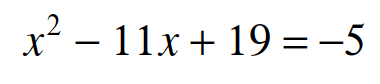
Solve the equation by factoring.
x = {3,8}
x = {-3,8}
x = {3,-8}
x = {-3,-8}
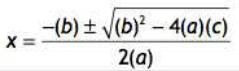
What is the quadratic formula?


Solve the following quadratics equation by quadratic formula.
x2 + 4x + 1 = 0
x = -2 ± √3
x = -3 ± √2
x = 2 ± √3
x = 2 ± √2
2731 is the same as
27 × 31 so the value is 9
327 so the value is 3
831 is the same as
38 so the value is 2
8 × 31 so the value is 38

q(x) = 2x2
Find p(q(x))

If you rewrite this expression to a radical, where would the 5 go?
32 3/5
inside the
outside the
it disappears

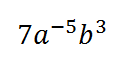
Simplify
7a5/b3
b3/7a5
7b3/a-5
7b3 /a5


Simplify using the 9 Laws of Exponents:


Simplify using exponent rules.
x1/2
x4/2 = x2
x5/4
x6/2= x3

Simplify each expression so that it contains only positive exponents.


Given the function f(x)= 4x2 - 5, find a formula for the average rate of change on the interval, [t, t+2].
Hint: You would need to substitute into the function t+2 and reduce to an expression. Then substitute t. Both expressions will become your y2 and y1 values respectively. Last, use the rate of change, definition x2−x1y2−y1 .
8t + 8
8t
4(t+2)2 - 5
Given the function f(x)= 4x2 - 5, find f(t+2). Don't Simplify.
8t + 8
8t
4(t+2)2 - 5
Simplify 4(t+2)2 - 5. Hint: Use Orders of Operations to Simplify.
4t2 + 64t -5
4t2 + 16t + 11
4t2 + 64t + 59
Solve the equation. Make sure to check for extraneous solutions. x+4=x−2
x = 0
5 is extraneous
x = 5
0 is extraneous
x = -2
3 is extraneous
x = 3
-2 is extraneous
Solve the equation. Make sure to check for extraneous solutions.
4x=x−3
x = 1
9 is extraneous
x = 3
-2 is extraneous
x = 9
1 is extraneous
x = -2
3 is extraneous
What is true about an extraneous solution?
Not a true solution to the original problem that are extra.
It can emerge during the solving process as an additional answer, making the equation false.
It needs to be checked after solving the original problem.
All of the above

Given the y-intercept of the graph being (0,-24) What would be the scale value for the polynomial function? Hint: For visual purposes, the x-intercepts are at -6, 5, and 8. Place these values in factored form and solve for the missing a-value.
a = -1
a = 1
a= -2
Solve using the quadratic formula...
9x2 = 4 + 7x


No solution
What is the "c" value in the equation..
4
18
0
-18
x2−5x −14 = 0
Determine the x-intercepts by completing the quadratic formula.
x= 2(1)5 ±(−5)2−4(1)(−14)
x=25±−31
x = −7, x = 2
x = 7, x = −2
no solution