
 Worksheets
Phy 102 chapter 2
Total questions: 66
Worksheet time: 4hrs 12mins
Electric potential ____________ as distance increases.
Increases
Decreases
Remains Constant
Is 0
The magnitude of electric potential is ______ at an infinite distance.
0
negative infinity
positive infinity
200
Two charged spheres of radii 10 cm and 15 cm are connected by a thin wire. No current will flow, if they have
The same charge on each
The same energy
The same potential
The same field on their surfaces
A hollow metal sphere of radius 5 cm is charged so that the potential on its surface is 10 V. The potential at the centre of the sphere is
0 V
10 V
Same as at point 5 cm away from the surface
Same as at point 25 cm away from the surface
If a unit positive charge is taken from one point to another over an equipotential surface, then
Work is done on the charge
Work is done by the charge
Work done is constant
No work is done
Two plates are 2cm apart, a potential difference of 10 V is applied between them, the electric field between the plates is
20 N/C
500 N/C
5 N/C
250 N/C
Angle between equipotential surface and lines of force is
0
180
90
45
Two charge +Q and -Q are situated at a certain distance. At the point exactly midway between them
Electric field and potential both are zero
Electric field is zero but potential is not zero
Electric field is not zero but potential is zero
Neither electric field nor potential is zero
A charge of 5 C experiences a force of 5000 N when it is kept in a uniform electric field. What is the potential difference between two points separated by a distance of 1cm
10 V
250 V
1000 V
2500 V
Electric force moves a charge of 2 x 10⁻¹⁰ C from point A to point B and does 5 x 10⁻⁶ J of work.
What is the difference in potential energies of A and B? (HINT* PEA -PEB)
What is the potential difference between A nd B? (HINT* VA - VB)
-2x10⁻¹⁰ J
-4.0x10⁻⁵ V
-5x10⁻⁶ J
-25000 V
2x10⁻¹⁰ J
4.0x10⁻⁵ V
5x10⁻⁶ J
25000 V
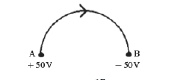
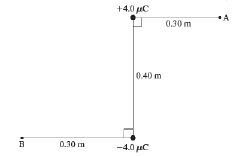
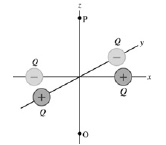
Which is not true: Equipotential lines......
are always continuous and never end
connect the path charge q spontaneously moves toward
connect points where voltage is zero
connect points where no work is done to move a charge q
are perpendicular to E field lines
The ground is often taken to be...
postive
negative
0 V
a capacitor
If a proton is moved from a positive plate to a negative plate then it moves to the plate with....
lower electric potential (V)
higher electric potential (V)
0 V
Electric potential difference is measured in:
V
C
F
N/C
V or J/C

What is the name of the insulator that is between the plates of a capacitor?
polyethylene
dielectric
cabela
permitivity of free space
conductor
What is work done in moving a charge of 4C from one point to another point having potential difference of 5volt
4/5 J
5/4 J
20J
1J
A point charge 2nC is located at origin. What is the potential at (1,0,0)?
12
14
16
18
A point A is at potential +500v and B is a point of potential -500 v the works done by external agent to take a unit positive charge from A to B is
+1000J
-1000J
+500J
-500J
A tin nucleus has charge +50 e if the proton is at a distance of 10-12 m from the nucleus then the potential v at this position is charged on proton= 1.6 x 10⁻¹⁹ C
14.4 x 10⁴ volt
7.2 x 10⁴ volt
7.2 x 10⁸ volt
14.4 x 10⁸ volt
The potential at a point due to an electric dipole will be maximum and minimum when the angles between the axis of dipole and line joining at point to dipole are respectively
900 and 1800
00 and 900
900 and 00
00 and 1800
Three Point charges Q, -2Q and -2Q are placed at the vertices of an equilateral triangle of side r . The work done to increases their separation to 2r is
Zero
12J
20J
40 J
What should be Capacitance of a capacitor capable of storing 1J of energy when potential difference of 100V is applied between the plates
1x10⁻⁴F
2x10⁻⁴F
3x10⁻⁴F
4x10⁻⁴F
Which of the following statement is not true
Electrostatic force is a conservative force.
Potential at a point is the work done per unit charge in bringing a charge from infinity to that point in an electric field
Electrostatic force is non-conservative
Potential is the ratio of work to charge.
The expression for Electric potential due to a point charge at a distance 'r' from it is____________
4πϵ 0 1 rq2
4πϵ 0 1 rq
4πϵ 0 1 r2q2
4πϵ 0 1 r2q
Electric potential at a point due to a dipole is
4πεo1 r3p⃗.r⃗
4πεo1 r2p⃗.r⃗
4πεo1 rp⃗.r⃗
4πεo1 p⃗.r⃗
A spherical charged conductor has surface density of charge as σ . The electric field intensity on its surface is E. If the radius of the surface is doubled, keeping s unchanged, what will be the electric field intensity on the new sphere?
E/2
E/4
2E
E

As shown in Fig. , a dust particle with mass m = 5.0 × 10⁻⁹ kg and charge q0 = 2.0 nC starts from rest at point a and moves in a straight line to point b. What is its speed v at point b ?
26m/s
34m/s
46m/s
14m/s

A small sphere with mass 1.2 g hangs by a thread between two parallel vertical plates 5.00 cm apart. The plates are insulating and have uniform surface charge densities +σ and −σ . The charge on the sphere is q = 9 × 10⁻⁶ C. What potential difference between the plates will cause the thread to assume an angle of 37° with the vertical as shown in Fig. ?
30V
12V
50V
25V
When a charge of 3 C is moved from infinity to a point X in an electric field, the work done is 15 J. What is the electric potential at X?
45 V
22.5 V
15 V
5 V
Which statement about electric potential at a point must be correct?
The potential is given by the rate of change of electric field strength with distance
the potential is defined as the work done per unit positive charge in moving one electron from the point to infinity
alternative units for electric potential are the joule and the volt
the potential due to a system of point charges is given by the sum of the potentials due to the individual charges

The given diagram shows a pair of large plane parallel conducting plates situated 40 mm apart. The potential difference between the plates is V.
Which of the following is the potential difference between point X and point Y?
15 / 40 V
25 / 40 V
20 / 40 V
40 / 40 V
The terms 'electric field strength', 'electric potential' and 'potential gradient' are often used in discussing electric fields. Which of the following statements about these terms is correct?
Electric field strength at a point is the work done in bringing unit positive charge from infinity to the point
Electric potential and potential gradient are both scalar quantities
The potential gradient at a point is numerically equal to the electric field strength at that point.
Unit potential gradient exists between any two points, if one joule of work is done in transporting one coulomb of charge between the points

A uniform electric field exists between two parallel charged plates 0.02 m apart. The given diagram shows how the potential energy Ep of an electron varies with displacement x from one of the plates.
Which of the following is the force on the electron?
1.2 x 10⁻³³ N
6.0 x 10⁻³² N
7.5 x 10⁻¹⁷ N
7.5 x 10⁻¹⁵ N
A capacitor discharge circuit of time constant 45 ms includes a capacitor and resistor. The capacitor has a capacitance of 18 µF
What is the resistance of the resistor?
2.5 x 10³ Ω
2.5 Ω
0.40 Ω
4.0 x 10⁻⁴ Ω
What is the energy given off by a 20V bulb which has 10C passing through it?
200J
2J
0.5J
250J
When lighting happen,25 C charge is transferred from could to the ground and 1.25x10¹⁰ J energy is produced. Calculate the potential difference within cloud and the ground in unit Volt
4.00 x 10⁸
2.00 x 10⁸
3.00 x 10⁸
5.00 x 10⁸
A proton ( q = 1.60 x 10⁻¹⁹ C) moves 10.0 cm on a path parallel to the direction of a uniform electrical field of strength 3.0 N/C. What is the electrical potential energy?
4.8 x 10⁻²⁰ J
1.6 x 10⁻²⁰ J
-4.8 x 10⁻²⁰ J
-1.6 x 10⁻²⁰ J
What will be the electrical potential at a distance of 0.15 m from a point charge of 6.0 µC? (kc = 8.99 x 10⁹ N · m2/C2)
5.4 x 10⁴ V
3.6 x 10⁵ V
2.4 x 10⁶ V
1.2 x 10⁷ V
At what distance from a point charge of 8.0 µC would the electrical potential by 4.2 x 10⁴ V? (kc = 8.99 x 10⁹ N·m2/C2)
0.58 m
0.76 m
1.7 m
2.9 m
At what distance from a point charge of 8.0 µC would the electrical potential by 4.2 x 10⁴ V? (kc = 8.99 x 10⁹ N·m2/C2)
0.58 m
0.76 m
1.7 m
2.9 m
When an electron (e = -1.6 x 10⁻¹⁹ C) moves 0.10 m along the direction of an electric field with a strength of 3.0 N/C, what is the magnitude of the potential difference between the electron's initial and ending points?
4.8 x 10⁻¹⁹ V
0.30 V
0.03 V
30 V
Two point charges of values 3.4 µC and 6.6 µC are separated by 0.20 m. What is the electrical potential energy of this two-charge system?
0.34 J
-0.75 J
1.0 J
-3.4 J
Two protons, each with a charge of 1.6 x 10⁻¹⁹ C, are 2.0 x 10⁻⁵ m apart. What is the change in electrical potential energy between the charges?
1.1 x 10⁻²³ J
3.2 x 10⁻¹⁹ J
3.2 x 10⁻¹⁶ J
1.6 x 10⁻¹⁴ J
The electric field lines between two oppositely charge plates are mostly...
parallel
curved
0
repelling
drawn from low potential to high potential
Two point charges are separated by a distance of 0.008 m. Charge on point A =-8 C and charge on point B = -7 C.
[k = 9 x 10⁹ Nm2C−2]
What is the electric potential energy between these two charges?
7.9 x 10¹³ J
5.7 x 10¹¹ J
6.3 x 10¹³ J
6.3 x 10¹¹ J
Electrostatic potential energy is recorded in units of electron-Volts (eV). What is equivalent to 1 eV?
1.602×10⁻¹⁹ 𝐽
100 𝐽
220 𝐽
0.003 𝐽
What is the electric potential at a distance of 50 cm away from a point charge of +2.0 nC?
ε0 = 8.854 × 10⁻¹² F m−1
3.6 V
36 V
7.2 V
72 V

