
 Worksheets
Cladogram and Phylogenetic Tree Practice
Total questions: 74
Worksheet time: 6hrs 38mins
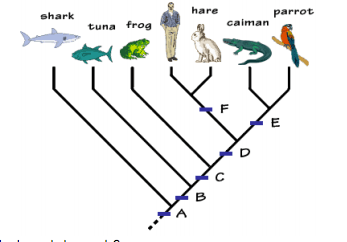
On the cladogram, which organism is the closest relative of the parrot?
Frog
Hare
Caiman
Parrot

What is the common ancestor of Letters C and E?
1
2
3
4

Who is most closely related to Taxidea taxus?
Lutra lutra
Panthera pardus
Canis latrans
Canis lupus

Which group of animals on this tree are most closely related to birds?
Saurischian dinosaurs
Ornithischian dinosaurs
Crocodiles
None of these are related to birds


Which organism is the most distantly related to all the others?
Raccoon
Dog
Giant Panda
Sun Bear
Each node on a cladogram represents...
the last point at which two groups shared a common ancestor.
the point at which one or more species became extinct.
the most recent point at which a trait was lost in a certain clade.
the point at which two clades joined and became monophyletic.

The cladogram shown is a model used by scientists to represent the order in which they hypothesize organisms descended from a common ancestor based on the appearance of derived characteristics.
Which of the following traits do the salamander and the lizard share?
Jaws only
Jaws and Lungs
Claws or nails
Jaws, Lungs, and Claws or nails
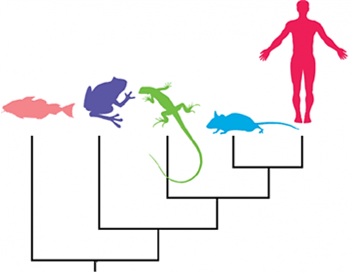
According to this phylogenetic tree, which creature is the least related out of all pictured?
Fish
Frog
Salamander
Human
Which group of animals on this tree are most closely related to birds?
Saurischian dinosaurs
Ornithischian dinosaurs
Crocodiles
None of these are related to birds

From the picture above, What do the species all have in common?
Back bone
Same father
Common ancestor
Feathers
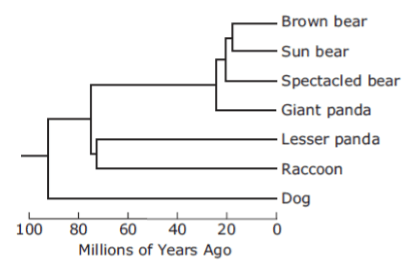
Who is the closest relative to the brown bear?
Giant panda
Dog
Lesser panda
Sun bear

Which trait (adaptation) was developed most recently?
tetrapod limbs
feathers
amnion
They developed at the same time
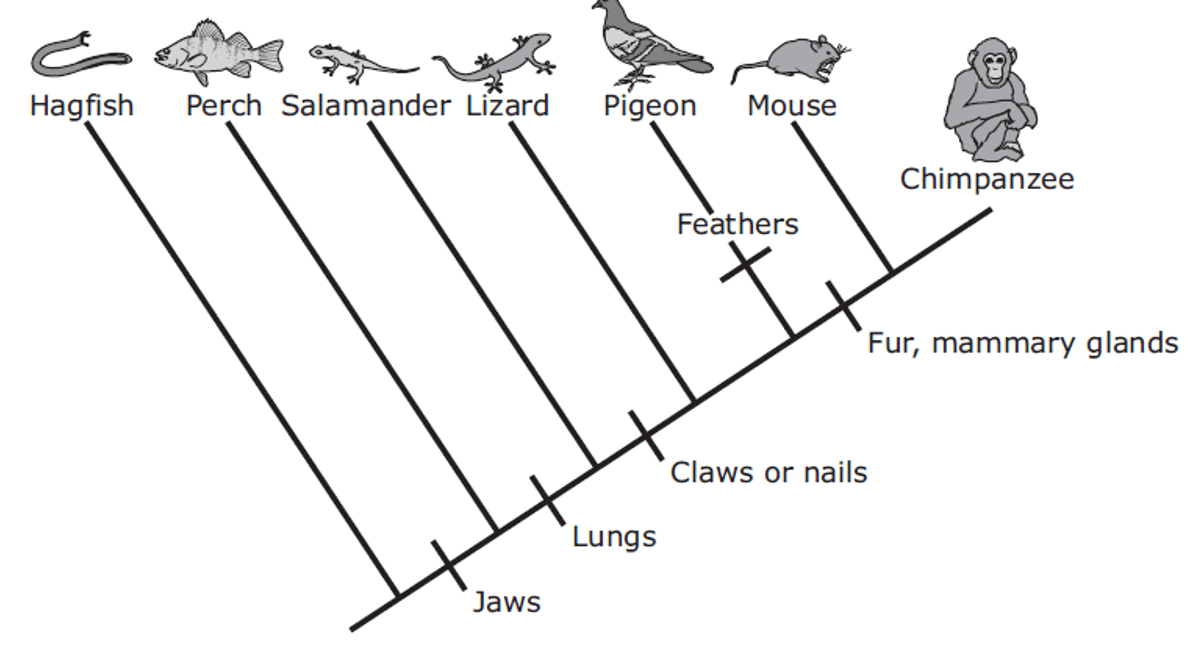
All the animals to the right of the salamander would have the common characteristic of...
Fur
Claws or nails
Lungs
Jaws

In a phylogenetic tree, the branching points represent common ancestors.
Yes
NO

The lizard has all these derived characteristics EXCEPT
Jaws
Lungs
Bipedal
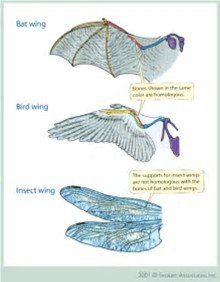
Evolved from the same ancestor, but have different functions
Homologous structures
Analogous structures
Vestigial structures
All of the above
What is the human most closely related to?
Fish
mouse
Salamander
Human

Where is the alligator and T. rex's common ancestor?
Point A
Point B
Point C
Point D

What do amphibians, birds, prosimians and humans all have in common? Check all that apply.
Hair
Endothermic
Eukaryotic
Tetrapod
Vertebrate

Which letter represents the most recent common ancestor of sponges and mushrooms?
A
B
C
D
E

Which trait should go where A is on the cladogram?
eyes
feet
lips
hat

This diagram showing evolutionary relationships between species connected by a common ancestor is called ____.
Genetic Line
Phylogenetic Tree
Photographic Queue
Future Babies
On the cladogram, which organism is the closest relative of the parrot?
Frog
Hare
Caiman
Parrot
All the animals to the right of the salamander would have the common characteristic of...
Fur
Claws or nails
Lungs
Jaws
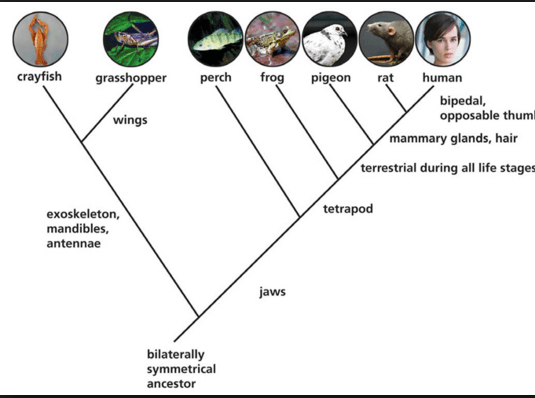
According to the cladogram, which organism is most distantly related to the human?
crayfish
grasshopper
perch
frog
In a phylogenetic tree, the branching points represent common ancestors.
Yes
NO
Which group of animals on this tree are most closely related to birds?
Saurischian dinosaurs
Ornithischian dinosaurs
Crocodiles
None of these are related to birds
Where do all organisms originate from?
From a common ancestor
According to this phylogenetic tree, which creature is the least related out of all pictured?
Fish
Frog
Salamander
Human

According to this image, which two domains of life are most related?
Bacteria & Archaea
Archaea & Eukarya
Eukarya & Bacteria
Phylogenetic trees show...
Evolutionary relationships between different species
How one species has evolved through time
Which species has evolved the most
Which species have evolved from other species

Based on the given cladogram, which organism is the outgroup?
human
chimpanzee
gorilla
orangutan
gibbon

Based on the figure, which organism is most closely related to the polar bear?
black bear
european brown bear
western north american brown bear
asian brown bear
Phylogeny is usually represented by a tree diagram called a _________ - _____
Genetic Line
Phylogenetic Tree
Photographic Queue
Future Babies
In a phylogenetic tree, the branching points represent common ancestors.
True
False
Which best describes traditional classification?
It is based on shared characteristics.
It is based on evolutionary relationships.
It is called phylogenetic classification.
It is called cladistics.
Which best describes traditional classification?
It is based on shared characteristics.
It is based on evolutionary relationships.
It is called phylogenetic classification.
It is called cladistics.
Which describes the modern classification system?
based on evolutionary relationships
called Linnaean classification
based on similar appearances
called Darwinian classification
Why was modern classification invented?
Traditional classification could not classify all living things.
Scientists realized related organisms do not share similar characteristics.
Scientists understood that species share a common ancestor.
Modern classification is faster and easier to use.
A scientist discovers a new organism that is related to clownfish. What can the scientist discover by using molecular clocks?
the date that the organism first appeared in the fossil record
the age of the organism
the amount of time that the two species have been evolving apart
the number of years that fish have existed
Which best describes derived characteristics?
They are newly evolved traits.
They appear in all the ancestors.
They appear at the end of each branch.
They stem from primary characteristics.
Phylogenetic trees are also called (a) .
In a cladogram, what occurs at a node?
A derived trait appears.
Evolution is stopped.
An ancestor dies.
The cladogram ends.
If two organisms are in the same clade, what can you predict about their relationship?
They are not closely related.
They share a common ancestor.
They compete for resources.
One organism evolved into the other organism.

According to the cladogram, which organisms are in the smallest clade with birds?
crocodiles
primates
rodents and rabbits
sharks
Dr. Digger, a paleontologist, finds a fossil that he describes in his journal.
The creature was approximately 1 meter long, with its backbone fused into a large shell covering the body cavity. It had a beaklike mouth, without teeth, and all four limbs were in the form of flippers.
Based on anatomical similarities, to which modern animal is Dr. Digger’s creature most closely related?
zebra
bony fish
sea turtle
snake

A scientist is trying to determine how closely related a moth species is to four other moth species. He examined the DNA of each species and compared it to the study subject. He then created this table.
Which species is most closely related to the original moth species?
species A
species B
species C
species D

Josiah says this is a phylogenetic tree of the dinosaurs. Maleek says it is a cladogram of the dinosaurs. Who is correct?
Josiah is correct.
Maleek is correct.
Both are correct.
Neither is correct.

According to the tree, which primates share the most recent common ancestor with humans?
gorillas
chimpanzees
bonobos and chimpanzees
bonobos and gorillas
Julia is trying to place a duckbilled platypus, lizard, bear, and monkey on a phylogenetic tree. She learns that the duckbilled platypus, bear, and monkey are classified as mammals. She also learns that mammals share a common ancestor with reptiles. Which additional piece of information will be most helpful to Julia to properly build her phylogenetic tree?
The platypus has fur like other mammals.
The platypus does not have feathers like a bird.
The platypus lays eggs like a reptile.
The platypus does not have fins like a fish.

According to the cladogram, which organisms have roundworms as a common ancestor?
mollusks and flatworms
sponges and chordates
flatworms, sponges, and cnidarians
mollusks, echinoderms, chordates, and annelids

Which group of organisms has the derived characteristics of true tissues, bilateral symmetry, and a pseudocoelom?
sponges
roundworms
annelids
chordates
In a phylogenetic tree, the branching points represent common ancestors.
Yes
NO
On the cladogram, which organism is the closest relative of the parrot?
Frog
Hare
Caiman
Parrot
What is the common ancestor of Letters C and E?
1
2
3
4
Who is most closely related to Taxidea taxus?
Lutra lutra
Panthera pardus
Canis latrans
Canis lupus
Which group of animals on this tree are most closely related to birds?
Saurischian dinosaurs
Ornithischian dinosaurs
Crocodiles
None of these are related to birds
Which organism is the most distantly related to all the others?
Raccoon
Dog
Giant Panda
Sun Bear
All bacteria is
prokaryotic and mulitcellular
eukaryotic and multicellullar
prokaryotic and unicellular
eukaryotic and unicellular
Which kingdoms are prokaryotes?
Kingdom Eubacteria
Kingdom Archaebacteria
Kingdom Animalia, Kingdom Plantae
Both Eubacteria and Archaebacteria
They are heterotrophs and reproduce by spores
Heterotrophs
make their own food
get their food from others
are fungi
none of the above
Autotrophs
Make their own food
Get their food from others
are Fungi
are none of the above

