
 Worksheets
QUIZ on CH 16 "Endocrine & Reproductive Health"
Total questions: 50
Worksheet time: 2hrs 40mins
The endocrine system is made up of glands that release hormones into the blood.
True
False
What is the function of the endocrine system?
to filter and eliminate the waste from the blood
to secrete hormones into the bloodstream to regulate body activities
to provide structure and support for the body
to defend the body against pathogens
Hormones travel through the blood and encounter many cells. How do they affect ONLY target cells?
Target cells have receptors that match up with the hormone
Target cells send out signals that attach to hormones and draw them to the cell
Target cells have cell membranes with a different composition
Magic!

Which one here reduces the amount of
glucose in the blood?
(a)
A hormone is _____________________.
a chemical substance produced by a gland and carried by the lymph.
an enzyme produced by a gland and carried by the blood.
a chemical substance produced by an organ and carried by the blood.
a chemical substance produced by a gland and carried by the blood.
Hormones from this gland control other endocrine glands
Pituitary
Thymus
Hypothalamus
Pancreas
A disease in which the body's ability to produce or respond to the hormone insulin is impaired, causing an increase in blood sugar
diabetes
ulcers
asthma
bronchitis
An illness from the underproduction of a hormone produced in the thyroid which decreases metabolism; you gain weight.
diabetes 1
hyperthyroidism
hypothyroidism
diabetes 2
What is the master gland of the endocrine system?
Pineal gland
Hypothalamus
Pituitary gland
Adrenal gland

What structure is this?
Pancreas
Thyroid
Parathyroid
Adrenal glands

What structure(s) shown in the picture above the kidneys?
Thyroids
Adrenal glands
Testes
Parathyroids
Cells that have receptors for a particular hormone.
gland cells
neurons
hormones
target cells

too much thyroid hormones released
Hypothyroidism
Hyperthyroidism
not enough thyroid hormones released
Hypothyroidism
Hyperthyroidism
Insulin is produced by
the liver
the pancreas
the kidneys
the gall bladder
Involved in rhythmic cycles of activity; from pineal gland
melatonin
T3 and T4
calcitonin
PTH
Stimulates growth of long bones and muscles; from anterior pituitary
glucagon
insulin
ADH
GH
Specifically stimulates production of ova and sperm; by anterior pituitary
FSH
LH
estrogen
thymosin
Development/maintenance of female secondary sex characteristics; ovaries
prolactin
oxytocin
estrogen
androgens
Endocrine glands are ductless, while exocrine glands release their products through ducts.
true
false
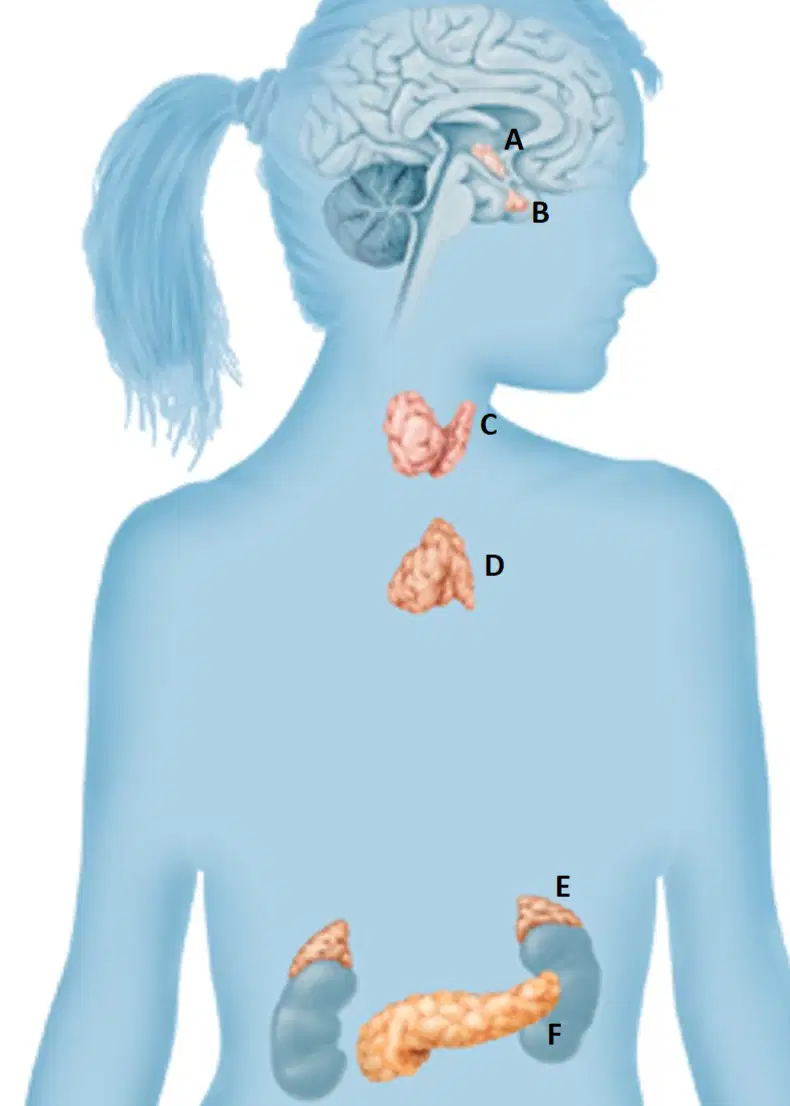
Which gland is indicated by E?
Hypothalamus
Pituitary
Thyroid
Thymus
Adrenal
Which gland is indicated by D?
Hypothalamus
Pituitary
Thyroid
Thymus
Adrenal
Which gland is indicated by C?
Hypothalamus
Pituitary
Thyroid
Thymus
Adrenal
Which gland is indicated by B?
Hypothalamus
Pituitary
Thyroid
Thymus
Adrenal
Hormones travel through the nervous system. True or false?
True
False
Which one here is not a hormone?
luteinizing hormone
testosterone
ovary
estrogen
It is the primary sex hormone in males that gives rise to secondary male characteristics such as deeper voice, facial hair, and muscle development.
estrogen
progesterone
testosterone
inhibin
It is the hormone secreted by the ovaries and responsible for the development of secondary sex characteristics in females such as the widening of hips and development of breasts.
estrogen
progesterone
testosterone
inhibin
What is the periodic shedding of tissues and blood from the inner lining of the
uterus?
menopause
ovulation
pregnancy
menstruation
Which hormone helps control the menstrual cycle and stimulates the growth of
eggs in the ovaries?
follicle stimulating hormone
progesterone
estrogen
testosterone
The fertilized egg, also known as zygote, implants itself to the uterus where it will grow and develop.
True
False
The mature egg cell goes into the fallopian tube where it waits for a sperm cell. Thus, the fallopian tube serves as the site of fertilization.
True
False
The male and female reproductive systems are regulated by...
hormones
sex drive
number of chromosomes
heredity
What is the average length of the menstrual cycle?
14 days
21 days
28 days
35 days
women continually produce eggs throughout their life
true
false
At birth, what hormone is released that stimulates uterine contracts?
FSH
USH
Oxytocin
Relaxin
What is the function of the human female reproductive system?
Produce ovum (egg cell)
Produce ovum, protect offspring before and after birth
Produce ovum, protect and nourish offspring before and after birth
Produce ovum, nourish offspring before and after birth
In an embryo, the process when the cells start becoming the many specialized types of tissues and organs it needs is known as
Fertilization
Differentiation
Genetic recombination
Meiosis
When contractions begin during pregnancy, hormones are released to increase the rate of contractions. This is an example of
positive feedback
negative feedback
The female reproductive system is responsible for the production of the egg cell, estrogen, and progesterone.
True
False
Which of the following is NOT true about estrogen?
It is only found in female bodies
It is responsible for breast development in females
It supports development of female reproductive organs
It promotes bone health
It regulates menstrual cycle in females
If a woman started her menstrual cycle on 1st April, when will her ovulation be?
7 April
14 April
16 April
30 April
How many months does it typically take for a fetus to fully develop?
9 months
7 months
10 months
one year
The fertilized egg, also known as zygote, implants itself to the uterus where it will grow and develop.
True
False

What is the scientific term that refers to sex cells?
autosome
gamete
karyotype
chromosome
The mature egg cell goes into the fallopian tube where it waits for a sperm cell. Thus, the fallopian tube serves as the site of fertilization.
True
False

