wayground logo

Free Printable Worksheets

NEW

Font size

S
M
L
XL
Worksheets

matter Part 1 24.25

Total questions: 46

Worksheet time: 45mins
Name
Class
Date
1.
When the temperature of matter increases the particles...
a)
speed up and move closer
b)
speed up and move farther apart
c)
slow down and move closer together
d)
slow down and move farther apart
2.
A change in the size, shape, or state of matter.
a)
chemical change
b)
physical change
c)
chemical reaction
d)
electron change
3.
One cup of water is left outside for two days when it was checked there was only half a cup left. What happened?
a)
evaporation; chemical change
b)
condensation; physical change 
c)
evaporation; physical change
d)
condensation; chemical change
4.
Dissolving sugar in water is an example of a 
a)
physical change
b)
chemical change
5.
Which is an example of a chemical reaction?
a)
paper cut into small pieces
b)
chocolate melting in a pan
c)
flour and sugar mixed in a bowl
d)
cookies baking in an oven
6.
Gases are described as having a 
a)
definite shape and indefinite volume
b)
indefinite shape and indefinite volume
c)
definite shape and definite volume
d)
indefinite shape and definite volume
7.
What has to happen in order for a phase change to occur?
a)
take away heat
b)
add heat
c)
either add or take away heat
8.
Particles (molecules) in a ______________________ have more energy than the other states of matter.
a)
gas
b)
solid
c)
liquid
9.
The speed of the molecules determines the _____.
a)
volume
b)
density
c)
pressure
d)
temperature
10.
What is condensation?
a)
gas to solid
b)
gas to liquid
c)
liquid to solid 
d)
solid to liquid 
11.
Define a physical property.
a)
Observations made or measured using your senses, without changing the identity of the substance
b)
Can only be measured using specific science equipment
c)
Only observed in situations where the identity of the object is changing
d)
Only measurable if the identity of the object changes  
12.
Matter changing states creates a new substance 
a)
True
b)
False
13.
Sublimation is
a)
when solid turns into gas
b)
when gas turns into plasma
c)
when liquid turns into gas
d)
when gas turns into solid
14.
What kind of properties result in the substance changing into a new substance?
a)
Liquid Properties
b)
Physical Properties
c)
Chemical Properties
d)
Real Properties
15.
Is milk going sour a physical or chemical change?
a)
Physical 
b)
Chemical
16.
Is wood burning a physical or chemical change?
a)
Physical 
b)
Chemical
17.
Is gatorade powder dissolving in water physical or chemical change?
a)
Physical 
b)
Chemical
18.
Is mold growing on cheese a physical or chemical change?
a)
Physical 
b)
Chemical
19.
Is copper tarnishing a physical or chemical change?
a)
Physical 
b)
Chemical
20.
Is sharpening a pencil a physical or chemical change?
a)
Physical 
b)
Chemical
21.

Which of the following is not a clue that a chemical reaction has taken place?

a)

Changing size

b)

Changing color

c)

A gas being formed

d)

Formation of a precipitate

22.
True or false: A gas will expand to fill it's container.
a)
true
b)
false
23.
Gas stations warn customers not to fill their tanks too much because the tank could overflow as the day gets warmer. Which statement BEST explains why the gasoline would overflow?
a)
Heat cause liquids to expand
b)
Heat cause liquid to contract
c)
Heat cause air to leave the tank
d)
Heat causes air to flow into the tank. 
24.
The circles in the bottles represent the same particles of matter. Which answer correctly identifies each state of matter?
a)
1: solid; 2: liquid; 3: gas
b)
1: solid; 2: gas; 3: liquid
c)
1: gas; 2: plasma; 3: solid
d)
1: liquid; 2: solid; 3: plasma
25.
As ice cream melts, its molecules ________
a)
release heat energy and move farther apart
b)
absorb heat energy and move farther apart
c)
absorb heat energy and move closer together
d)
release heat energy and mover closer together
26.
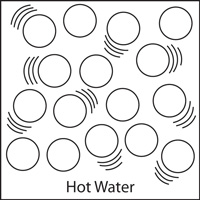
Which statement best describes the motion of the water molecules when heat is added to the beaker? 
a)
The molecules slow down.
b)
The molecules move closer together.
c)
The molecules speed up.
d)
The molecules do not change their motion. 
27.
When Joe put a cheeseburger sealed in a plastic bag into the microwave, there was not much air in the bag. After the cheeseburger was cooked, the plastic bag was full of air. Where did the air come from? 
a)
It came out of the cheeseburger.
b)
It came from the fan in the microwave.
c)
It was already in the bag and it expanded as it was heated.
d)
It came from a chemical reaction whereby energy from the microwave creates O2 molecules. 
28.
Which of these is a change in chemical composition? 
a)
A lake freezes solid.
b)
Gravel, sand, and water are mixed.
c)
A copper bar is rolled into a flat sheet.
d)
Vinegar bubbles when baking soda is added. 
29.
Which of the following is a characteristic of ALL chemical changes? 
a)
A new material is formed.
b)
Some form of light is given off.
c)
Some mass is converted to energy.
d)
Some mass is converted to energy.
30.
A chemical property of silver is: 
a)
 The melting point is 962°C.
b)
Silver is white.
c)
Silver does not react with water. 
d)
The density is 10.49 g/cm3.
31.
Tom places four objects in a tank of water. He makes the following observations.
A cork floats
A rock sinks
A soda can floats
A piece of chalk sinks
Which statement is correct based on Tom’s observations?

a)
The rock and the chalk have a density less than water.
b)
The rock and the chalk have a density greater than water.
c)
 The cork and the can of soda have a density equal to water.
d)
The cork and the can of soda have a density greater than water. 
32.
Which model shows the structure and movement of particles in a solid? 
a)
model 1 
b)
model 2
c)
model 3
d)
model 4
33.
The three jars show the movement of particles in three states of matter Dry ice is solid carbon dioxide As dry ice is heated, it goes directly from a solid to a gas through a process called sublimation Which sequence of jars shows the change in the motion of particles of dry ice as it sublimes? 
a)
jar P to jar Q 
b)
jar P to jar R 
c)
jar Q to jar R 
d)
jar R to jar P 
34.

In a ______________, one substance is dissolved in another substance.

a)

solution

b)

suspension

c)

colloid

35.
The solid, liquid, and gaseous states of water differ form each other in __________.
a)
the mass of the individual atoms
b)
the size of the individual atoms
c)
the net electrical charge of the individual molecules
d)
the average speed of movement of the individual molecules
36.
TRUE OR FALSE: You can look at matter and observe the chemical properties.
a)
TRUE
b)
FALSE
37.

The process of frying an egg indicates a ????

a)

physical challenge

b)

physical change

c)

chemical corrosion

d)

chemical change

38.
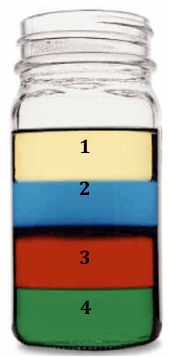
Put the liquids in order from most dense to least dense?
a)
4, 3, 2, 1
b)
1, 2, 3, 4
c)
3, 4, 2, 1, 
d)
4, 3, 1, 2
39.

Which box has a higher density?

a)

A

b)

B

c)

They are the same

40.
What is the formula for density?
a)
density = mass x volume
b)
density = mass / volume
c)
density = mass + volume
d)
density = mass - volume
41.

Calculate the density in the following question: A flower pot has a mass of 95 g and a volume of 92 mL.

a)

1.03 g/mL

b)

0.97 g/mL

c)

1.01 g/mL

d)

0.99 g/mL

42.

The amount of water displaced is the same as the volume of the object. What is the VOLUME of the object?

a)
40 mL
b)
65 mL
c)
20 mL
d)
25 mL
43.
What is the mass of a substance with a volume of 72.5 cm3 and a density of 0.94 g/cm3?
a)
68.15 g
b)
77.13 g
c)
62 g
d)
100 g
44.

The unit for measuring DENSITY is

a)

g

b)

cm3

c)

g/cm3

45.

Mass is measured in what units

a)

grams

b)

centimeters

c)

cubic centimeters

46.

Use the figure above, to answer the following question. Pic the answer that puts the objects in order from MOST DENSE to LEAST DENSE.

a)

B, A, C, D

b)

D, C, A, B

c)

A, B, C, D

d)

D, C, B, A