Wayground logo

Free Printable Worksheets

Font size

S
M
L
XL
Worksheets

Revision unit 1 biology year 7

Total questions: 57

Worksheet time: 54mins

Name
Class
Date
1.

How are reptiles and fish alike?

a)

neither has scales

b)

both breathe with gills

c)

neither has a backbone

d)

both have body temperatures that change with their surroundings

2.

A student wants to research invertebrate animals. Which of these animals should she study? Select 3

a)

frog

b)

fish

c)

clam

d)

worm

e)

spider

3.

Which features can a scientist use to identify an amphibian? Select 3

a)

has a backbone

b)

has no backbone

c)

has smooth, moist skin

d)

has scales or plates on skin

e)

breathes first with gills and then with lungs

4.
Which animal is a bird?
Animal 1: backbone/feathers/warm-blooded
Animal 2: backbone/scales/gills/cold-blooded
Animal 3: cold-blooded
Animal 4: backbone/hair
a)
Animal 1
b)
Animal 2
c)
Animal 3
d)
Animal 4
5.
Ben has noticed an animal when he looks out his window at school.  The animal has a backbone, lives on land, bears live young, and has hair.  What is the classification for this animal?
a)
reptile
b)
bird
c)
mammal
d)
amphibian
6.
Lamprey and hagfish are examples of jawless fishes thus they are cold blooded. 
a)
TRUE
b)
FALSE
7.

There are more cold-blooded than warm-blooded animals in the five groups of animals we learned about.

a)

True

b)

False

8.
Animals that have backbones are...
a)
Vertebrates
b)
Invertebrates
c)
Mollusk
d)
Lobster
9.
What type of animal has fur and feeds its young with milk?
a)
birds
b)
reptiles
c)
amphibians
d)
mammals
10.
What classification of animals are  vertebrae (have a backbone)?
a)
birds only
b)
reptiles only
c)
reptiles and birds but not mammals and fish
d)
mammals, fish, reptiles, amphibians, and birds
11.

What is binomial nomenclature?

a)

system of 3 names

b)

system of 2 names

c)

the names of the kingdoms

d)

the levels of classification

12.

Who created the 2 name system?

a)

Linnaeus

b)

Edison

c)

Darwin

d)

Einstein

13.

What two levels make up a scientific name?

a)

genus and order

b)

genus and species

c)

domain and kingdom

d)

family and genus

14.

What level comes after order?

a)

genus

b)

kingdom

c)

family

d)

species

15.

What level comes before class?

a)

phylum

b)

domain

c)

order

d)

family

16.

The _________ levels that 2 organisms share, the more similar they are to each other.

a)

fewer

b)

more

17.

Which of these has a backbone?

a)

jellyfish

b)

squid

c)

worm

d)

snake

18.

All living things are made of

a)

cells

b)

prokaryotes

c)

autotrophs

d)

heterotrophs

19.

What is the correct order of classification?family

a)

kingdom, domain, phylum, class, order, family, genus, species

b)

domain, kingdom, phylum, class, order, family, genus, species

c)

domain, phylum, class, order, kingdom, family, genus, species

d)

species, genus, family, phylum, order, class, domain, kingdom

20.

What is the proper way to write a scientific name?

a)

Symbion pandora

b)

Symbion Pandora

c)

symbion Pandora

d)

symbion pandora

21.
The 8 levels of classification, most broad to most specific.
a)
Domain, Genus, Family, Order, Class, Phylum, Kingdom, Species
b)
Domain, Species, Kingdom, Genus, Phylum, Family, Class, Order
c)
Domain, Kingdom, Phylum, Class, Order, Family, Genus, Species
d)
Domain, Kingdom, Species, Phylum, Family, Order, Class, Genus
22.
Who first proposed binomial nomenclature as a way of classifying organisms?
a)
Carolus Linnaeus
b)
Thomas Jefferson
c)
Charles Darwin
d)
Albert Einstein 
23.

What is the genus name here:

Canis lupus

a)

Canis

b)

lupus

24.

The science of describing, classifying and naming living things is known as _______.

a)

Biology

b)

Taxonomy

c)

Sortology

d)

Phylogeny

25.
Binomial nomenclature is the ____________ system for naming organisms.
a)
Numerical
b)
Symbolical
c)
two word
d)
alphabetical
26.

Biologist group living things based on ____.

a)

Habitat

b)

Size

c)

Colors

d)

Shared Characteristics

27.

The proper writing of a scientific name includes ___.

a)

Genus Capitalized

b)

Species Lowercase

c)

Underline or Italics

d)

All of the above

28.

What is the species name here:

Canis lupus

a)

Canis

b)

lupus

29.

Moist skin covered in scales

a)

Vertebrate

b)

Birds

c)

Fish

d)

Reptiles

30.

Dry skin with scales

a)

mammals

b)

Fish

c)

Birds

d)

Reptiles

31.

Skin with feathers

a)

fish

b)

mammals

c)

birds

d)

reptiles

32.

moist skin with no scales

a)

mammals

b)

reptiles

c)

amphibians

d)

fish

33.

backbone made of bone or cartilage

a)

mammals

b)

vertebrates

c)

avertebrates

d)

amphibians

34.

choose the field of science that names and classifies organisms based on their similar characteristics

a)

ecology

b)

zoology

c)

genetics

d)

taxonomy

35.

P = Genus

Q = Phylum

R = Class

S = Kingdom

T = Family

U = Species

V = Order


which of the following sequence shows the hierarchy of classification

a)

Q, S, U, V, T, P, R

b)

S, Q, R, V, T, P, U

c)

V, T, P, S, U, Q, R

d)

U, T, Q, P, V, S, R

36.

The characteristics of classification change as they go down along the hierarchy of classification. which of the following statements is an incorrect characteristic

a)

the number of organism increases

b)

the number of organism deceases

c)

the number of similar features of an organism increases

d)

the organism are arranged in an increasing specificity

37.
Which kingdom do humans belong to?
a)
Plantae
b)
Fungi
c)
Animalia
d)
Protista
38.

Members of which of the following groups have the lowest number of features in common?

a)

Family

b)

Kingdom

c)

Species

d)

Phylum

39.

According to the video, what do organisms need in order to be classified in the phylum Chordata?

a)

Sharp Teeth

b)

Retractable Claws

c)

A backbone

d)

Hair of fur

40.

the 2 word naming system

a)

dichotomous key

b)

scientific name

c)

binomial nomenclature

41.
What is the purpose of a dichotomous key?
a)
to find a common ancestor
b)
to show the evolution of organisms
c)
to show relationships between organisms
d)
to identify organisms
42.
The scientific name for an organism is made from the:
a)
class and family name
b)
genus and species name
c)
domain and kingdom name
d)
kingdom and phylum name
43.
Tool used by a taxonomist to identify an unknown organism is a:
a)
dichotomous key
b)
binomial nmenclature
c)
scientific name
d)
binomial key
44.
A dichotomous key for trees is provided. Hikers found a tree that has large brown cones and single sharp needles. What species of tree have the hikers found?
a)
Juniper
b)
Pine
c)
Spruce
d)
Fir
45.
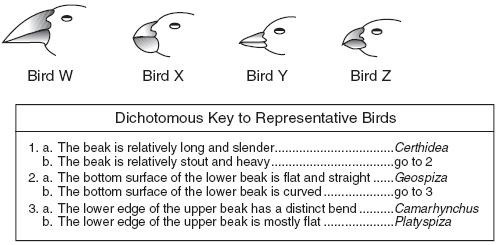
What is the name of bird W?
a)
Certhidea
b)
Geospiza
c)
Camarhynchus
d)
Platyspiza
46.
When using a dichotomous key to identify organisms, what do we look at?
a)
physical features
b)
weather patterns
c)
environment
d)
diet
47.
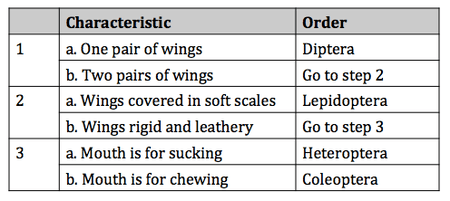
A dichotomous key for insects is given. To what order does an insect with two pairs of scaly wings belong?
a)
Coleoptera
b)
Heteroptera
c)
Diptera
d)
Lepidoptera
48.
A botanist discovers a new plant in the jungle. Which of the
following observations of the plant’s characteristics would be useful in determining its identity with a dichotomous key?
a)
It was discovered in the summertime
b)
It is wet from a recent rain storm.
c)
Its leaves curl up on the edges.
d)
It is eaten by native jungle ants.
49.
Why do we use scientific names to name organisms instead of relying on common names?
a)
Because common names vary regionally
b)
Because everyone understands and speaks Latin
c)
To make scientists sound smart
d)
Because they are the most descriptive
50.
What term refers to the two part naming system used in traditional classification?
a)
binomial nomenclature
b)
systematics
c)
cladistic analysis
d)
taxonomy
51.
Using this dichotomous key, identify the name of the circled Fish, J.
a)
peacock flounder
b)
band-tail puffer
c)
trumpet fish
d)
spotted goat fish
52.

In the scientific naming system, __________________ is capitalized and __________________ is written in lower case.

a)

genus, species

b)

species, genus

53.

Which of these categories would likely NOT appear on a dichotomous key?

a)

Has fur/does not have fur

b)

Has wings/has no wings

c)

Carnivore/herbivore/omnivore

d)

Is mean/is nice

54.

Which of the following is the best definition of "classification"?

a)

The practice of grouping animals randomly and studying their characteristics

b)

The practice of grouping animals based on their characteristics

c)

The practice of studying animals in their natural habitats

d)

The practice of studying animals under a microscope
55.
What is the purpose of a dichotomous key?
a)
to find a common ancestor
b)
to show the evolution of organisms
c)
to show relationships between organisms
d)
to identify organisms
56.
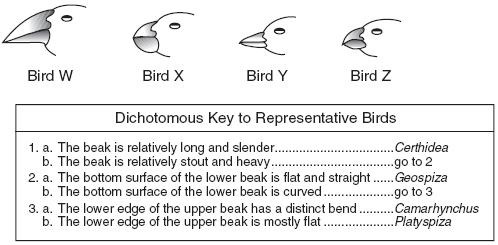
What is the name of bird Z?
a)
Certhidea
b)
Geospiza
c)
Camarhynchus
d)
Platyspiza
57.
What should you do when typing a scientific name?
a)
Capitalize the first word
b)
Capitalize the first word and underline the whole thing
c)
Capitalize the first word and italicize the whole thing
d)
Nothing