
 Worksheets
Unit 1.2 Muscles Exam Review
Total questions: 93
Worksheet time: 1hrs 16mins
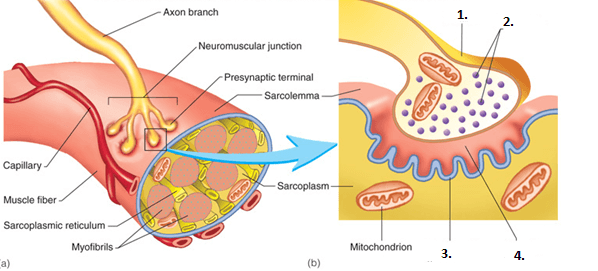
synaptic cleft or synapse
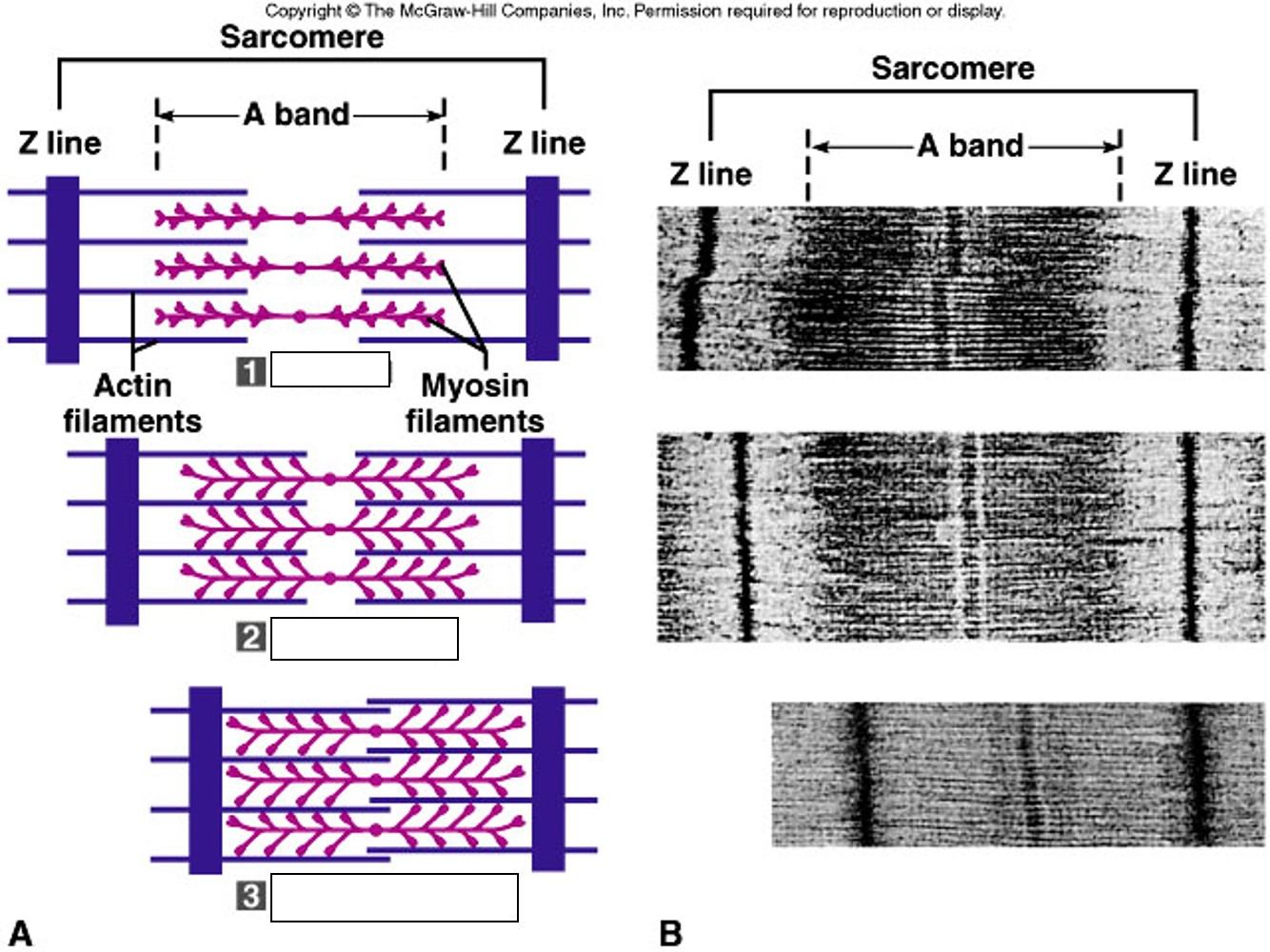
The functional unit of a muscle that contracts is ...
sarcomere
motor unit
fascicle
myofibril

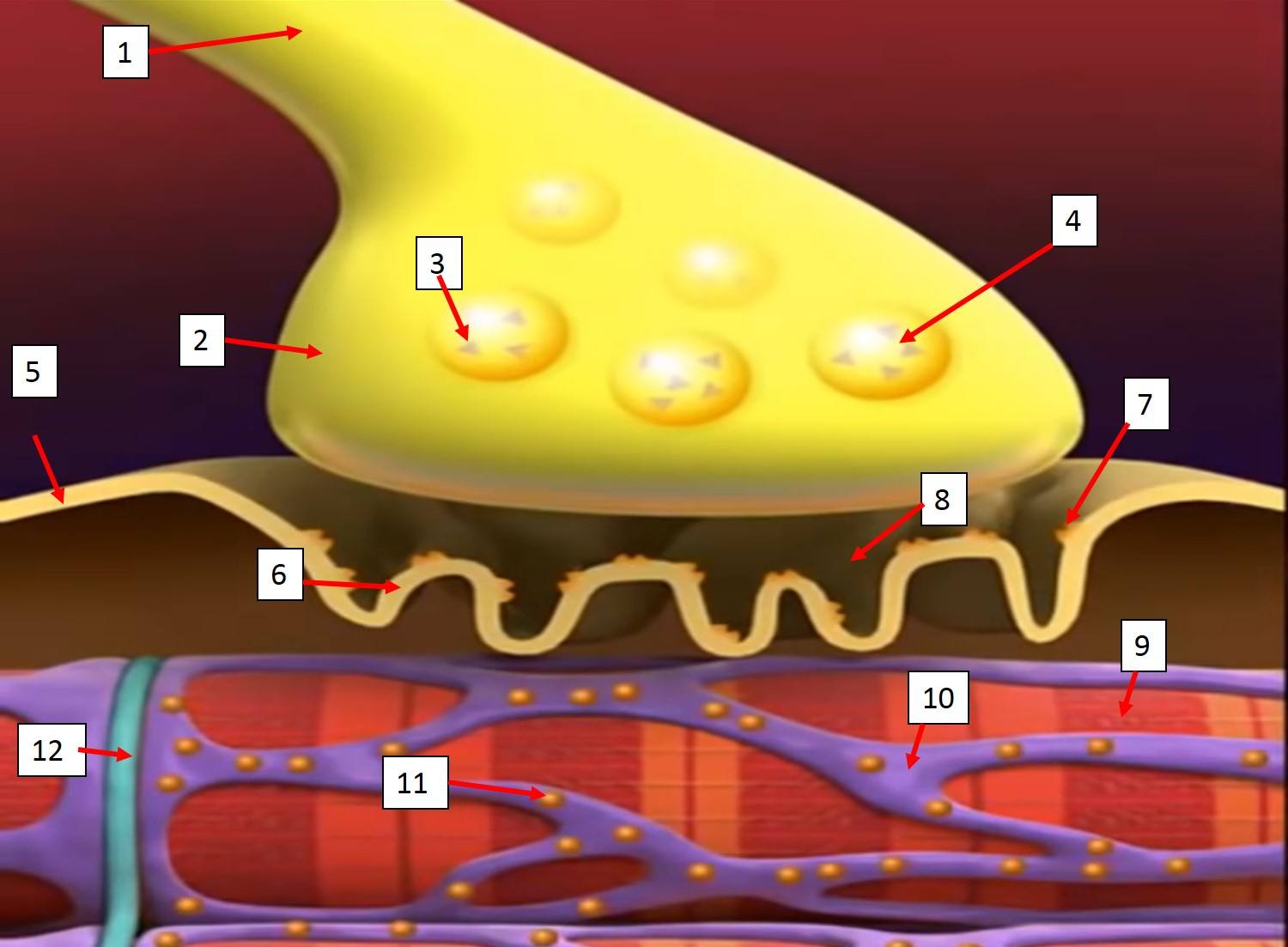
Which number represents the sarcomere?
1
2
3
4

Do the lengths of the thick and thin filaments change during contraction?
Yes
No
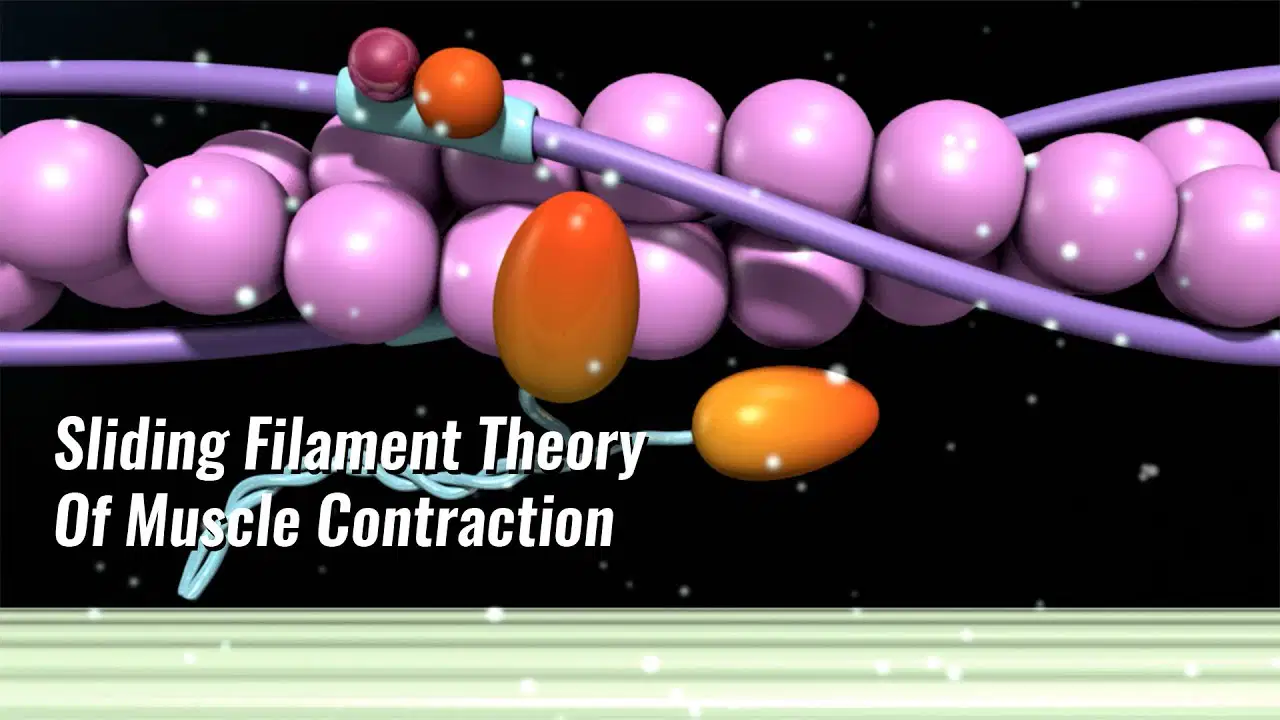
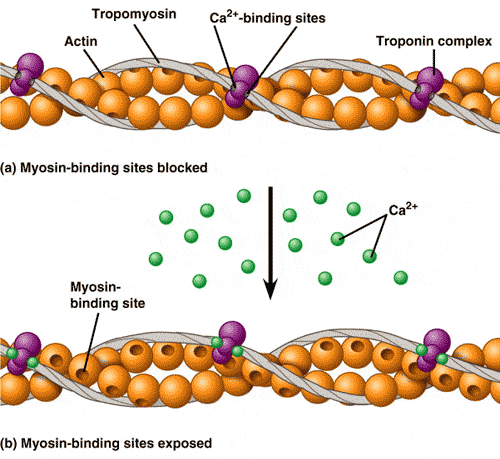
What is the order of the sliding filament theory
Calcium Ca+ is released from Sarcoplasmic Reticulum
Ca+ connects to Actin on the Troponin
Tropomyosin spins to expose binding site
Myosin binds to Actin
Powerstroke occurs when ATP splits
Which is the the Z-line?
Which is the Actin?
Which is the Myosin?
Explain the role of troponin in regulating muscle contraction.
Troponin causes muscle relaxation by increasing the concentration of calcium ions.
Troponin has no role in regulating muscle contraction.
Troponin regulates muscle contraction by facilitating the interaction between actin and myosin filaments in response to calcium ions.
Troponin inhibits muscle contraction by preventing the interaction between actin and myosin filaments in response to calcium ions.
The inner most connective tissue of a muscle is
epimysium
permysium
cardiomysium
endomysium
The epimysium surrounds ...
the muscle
the fasicle
the muscle fiber
the myofilament

Number 5 refers to a bundle of cells known as a:
fascicle
tendon
muscle fiber
myofilament

Number 6 is pointing to a connective tissue that surrounds the individual muscle cells. This is known as the:
epimysium
perimysium
endomysium
tendon

Number 2 refers to a fibrous connective tissue lining that covers the muscle known as the:
epimysium
perimysium
endomysium
tendon
Which muscle types are involuntary?
cardiac
smooth
skeletal
skeletal muscle
voluntary and striated
smooth muscle
involuntary and no striations
cardiac muscle
involuntary and striated

extension
flexion
circumduction
adduction
abduction

extension
flexion
circumduction
adduction
abduction

supination
pronation
circumduction
adduction
rotation

supination
pronation
abduction
adduction
opposition

supination
pronation
abduction
adduction
opposition

inversion
pronation
extension
adduction
circumduction

inversion
plantar flexion
extension
dorsiflexion
circumduction

inversion
plantar flexion
extension
dorsiflexion
circumduction
What are the three types of muscle?
Smooth, Hard, Cardiac
Cardiac, Smooth, Skeletal
Skeleton, Heart, Bladder
Choose which muscle naming rules are used for (check all that apply):
Pectoralis major
Location of muscle
Direction of the muscle fibers
Relative size of the muscle
Number of origins
Location of the muscle's origin and insertion
Choose which muscle naming rules are used for (check all that apply):
Frontalis
Size of the muscle
Shape of the muscle
Action of the muscle
Location of the muscle
Direction of muscle fibers
Choose which muscle naming rules are used for (check all that apply):
Rectus abdominis
Action of the muscle
Number of origins
Location of the muscle
Size of the muscle
Direction of the muscle fibers
Choose which muscle naming rules are used for (check all that apply):
Trapezius
Action of the muscle
Direction of the muscle fibers
Number of origins
Relative size of the muscle
Shape of the muscle
Choose which muscle naming rules are used for (check all that apply):
Adductor group
Relative size of the muscle
Location of the muscle
Number of origins
Action of the muscle
Shape of the muscle
Choose which muscle naming rules are used for (check all that apply):
Sternocleidomastoid
Shape of the muscle
Number of origins
Location of muscle
Location of the muscle's origin and insertion
Direction of the muscle fibers
Choose which muscle naming rules are used for (check all that apply): Gluteus medius
Location of the muscle
Relative size of the muscle
Direction of the muscle fibers
Action of the muscle
Shape of the muscle
The situation in which a muscle loses its ability to contract, due to being used strenuously for a long period of time
muscle pain
muscle cramp
muscle fatigue
oxygen debt
What muscle inserts on the humerus and originates on the clavicle and sternum
deltoid
brachioradialis
pectoralis major
biceps brachii
This muscle is located on the upper chest and function in adduction and flexion of the arm/shoulder
latissimus dorsi
brachialis
deltoid
pectoralis major
The ORIGIN is the muscle attachment to the _______ bone.
Stationary
Movable
The muscle attachment to the movable bone is the:
Muscle belly
Muscle body
Insertion
Fascicle
Tendon
attaches a muscle to a bone
Ligament
attaches a bone to another bone
Fascia
creates a membrane-like covering for muscles

smooth or visceral muscle

cardiac muscle

skeletal muscle
Which elbow muscle provides extension of the elbow and originates on the humerus?
biceps brachii
triceps brachii
brachialis
brachioradialis
Decreases the angle between bones at a joint
flexion
extension
elevation
retraction
Which type of joint makes up most joints in the body?
Synovial
Fibrous
Cartilaginous
Skeletal
Which is an example of a hinge joint
The neck
The knee
The ankle
The thumb
Which is an example of a condyloid/ellipsoidal joint
The metocarpophalangeal joints (the knuckles)
The carpometacarpal joint (the thumb)
The carpals of the wrist
The tarsals of the ankle
Which is a ball-and-socket joint
The thumb
The shoulder
The elbow
The radioulnar joint
A hinge joint allows
A wide range of movements
Circumduction
Rotation
Movement in only one direction (ie. backwards & forwards)
Which type of joint has one bone rotating around a central axis
saddle
condyloid/ellipsoidal
pivot
hinger
Where can a saddle joint be found?
Wrist
Skull
Vertebra
Thumb

What joint is displayed in picture?
hinge joint
plane joint
pivot joint

What joint is displayed in picture
Hinge Joint
Saddle joint
Ball and socket joint

What type of joint is displayed in the picture?
Saddle joint
Ellipsoid joint
Pivot joint

What type of joint is displayed in the picture?
Pivot joint
Ellipsoid joint
Hinge joint

Which is one of the functional ways a joint is classified
Fibrous—tend to be immovable
Amphiarthroses—slightly movable joints
Synovial –tend to be freely movable

Which is one of the structural ways a joint is classified?
Cartilaginous—both immovable and slightly
movable
Synarthroses—immovable joints
Diarthroses—freely movable joints
The joints that allow the most movement are called
Fixed
Fibrous
Cartilaginous
Synovial
What is the primary function of synovial fluid?
To provide oxygen to joint tissues
To allow movement between cartilage
To connect bones together
To produce red blood cells
your friend gets their upper ear pierced. What type of cartilage did they pierce?
hyaline
fibrous
elastic
our pelvis is joined in the front by this type of cartilage
hyaline
fibrous
elastic
A herniated disk is a rupture in this type of cartilage
hyaline
fibrous
elastic
A swallow stud,y using barium, us used to study how well a person is managing food. The therapist is concentrating on the function of this cartilage
hyaline
fibrous
elastic
The job of the PCL is to
keep the femur from moving backwards under the tibia
keep the patella from dislocating
keep the tibia from moving backwards under the femur
prevent a patellar tendon strain
The job of the meniscus is
to provide stability
provide cushion
hold condyles
all of these
Which muscles is the knee flexor?
deltoid
gastroc
hamstring
quad
A blow to the front of the tibia is likely to cause a
meniscus tear
ACL tear
MCL tear
PCL tear
The quadricep is the knee flexor
true
false


