
 Worksheets
Dynamic Earth - Earth´s Surface - Rocks, Weathering, Tectonics
Total questions: 130
Worksheet time: 4hrs 31mins

This German scientist first proposed continental drift theory
Harry Hess
Alfred Wegener
Archimedes
Thomas Warner

These are remains of dead plants or animals preserved in rock.
Glaciers
Dinosaurs
Bones
Fossils

This was the super continent, where all of the Earth’s continents were connected together
Beringia
Pantheon
Pangaea
Continentia

Wegener observed scratches from glaciers in Africa and India where it is currently too hot for glaciers to form. This is considered...
Fossil Evidence
Rock Formation Evidence
Climate Evidence
Objective Evidence

Wegener noticed that the Appalachian Mountains and Caledonian Mountains line up and are made of the same rock types. This was a type of ....
Fossil Evidence
Rock Formation Evidence
Climate Evidence
Objective Evidence

What was the name of Alfred Wegeners Theory?
Seafloor Spreading Theory
Pangaea Theory
Plate Tectonics Theory
Continental Drift Theory

How was Wegener's theory received by other scientists at the time?
They thought it was great
They did not accept it

What does Pangaea mean?
It means an all black panda bear
It means all the universe
It means all earth or entire earth
It means all rock
The Earth is made up of ___________________ which constantly move.
Dirt
Rock
Techtonic Plates
Mantle
What is the correct order of the earth's layers from inside to outside?
inner core, mantle, outer core, crust
outer core, inner core, mantle, crust
crust, mantle, outer core, inner core
inner core, outer core, mantle, crust

Tectonic plates float on top of the ________
Crust
Mantle
Inner Core
Outer Core
Earth’s lithosphere is made up of what layer/s?
Crust
Mantle
Crust and Mantle
Crust and upper mantle

Evidence of what on different continents supports Wegener's hypothesis that animals and plants that now live on different continents were once on the same continent millions of years ago?
Fossils
Glacial Features
Rock Formations
Coal Deposits
Evidence from what shows that when Wegener discovered 290 million year old glacial grooves, or deep scratches in rocks made as glaciers moved across land.
Rock Formations
Coastlines
Glacial Features
Fossils
Evidence of what shows that when Pangaea began to break apart, large geologic structures, such as mountain ranges, became separated as the continents drifted apart?
Fossils
Glacial Features
Coastline
Rock Formations

This piece of evidence that Alfred Wegener used to prove the continents were once connected involved finding remains of once-living organisms on different continents.
jigsaw evidence
fossil evidence
rock evidence

Tectonic plates are always moving. Tectonic plate _______ are places where the edges of two or more plates interact.
boundaries
fossils
countries
rivers

Even the fastest tectonic plates only move tens of ____ every year! Wow! That's a very short distance!
meters
miles
centimeters

The thin, solid, outermost layer of Earth; is either continental (landmasses) or oceanic (ocean floors)
mantle
crust
Pangea
earthquake

The theory that continents were once connected but have drifted apart
plate tectonics
Pangea
continental drift
pyroclastic flows

The mineralized remains of organisms, showing how long-dead organisms lived and how their bodies were structured
fossils
Pangea
lava
magma

The solid layer of Earth between the crust and the core; made of dense silicates. (Convection currents happen here.)
mantle
crust
magma
Pangea

The theory that the crust is divided into large pieces called tectonic plates that slowly move on top of the mantle
seafloor spreading
continental drift
tectonic plate
plate tectonics

Huge piece of crust that slowly moves on the upper, ductile (able to be molded, like plastic) part of the mantle
pangea
continental drift
tectonic plate
plate tectonics

The upper layer of the Earth, consisting of the crust and upper mantle.
mantle
crust
core
lithosphere

Molten rock below the surface of the Earth
magma
mantle
lava
crust

A shaking of the Earth’s surface due to a release of energy within the crust that generates seismic waves
pyroclastic flows
lithosphere
seafloor spreading
earthquake

molten
melted or liquefied
frozen or solid

The driving force of plate tectonics. These circular movements in Earth's mantle cause the tectonic plates on Earth's crust to move.
pyroclastic flows
magma
convection currents
tectonic plates

The supercontinent that included all of Earth’s land surface about about 200-300 million years ago. It's name means 'all the Earth.'
Wonderland
Pangea
Biglandia
Wegenerland
This piece of evidence that Alfred Wegener used to prove the continents were once connected involved finding remains of once-living organisms on different continents.
jigsaw evidence
fossil evidence
rock evidence

This piece of evidence that Alfred Wegener used to prove the continents were once connected involved identical rocks of the same type (and similar mountain ranges) being found on opposite sides of the ocean on different continents.
jigsaw evidence
fossil evidence
rock evidence

One reason why continents are higher than the ocean floor is because oceanic crust is _______ than continental crust.
less dense
denser

This scientist concluded that the continents must move over time. He shared his evidence and scientists gave the process its more familiar name: continental drift.
Neil deGrasse Tyson
Bill Nye
Albert Einstein
Alfred Wegener
Tectonic plates are always moving. Tectonic plate _______ are places where the edges of two or more plates interact.
boundaries
fossils
countries
rivers
Even the fastest tectonic plates only move tens of ____ every year! Wow! That's a very short distance!
meters
miles
centimeters


Indicate the evidence for continental drift theory.
rock formations
glacial features like grooves
coal deposits in Antarctica which means that it had a warmer climate and plant life
South America having evidence of a warmer climate
What was Glossopteris?
A cactus-like plant that can be found on antarctica
An ancient plant, whose fossils have been found on 5 different continents
An ancient plant, whose fossils were found in South America
An ancient plant, whose fossils showed that it was a small plant
What cold environment feature was evidence to support the theory that the continents used to be joined?
Same rocks were found on different continents
Glacial grooves were found on different continents
Fossilized evidence of the same organism found on different continents
Africa and South America look like puzzle pieces that fit together
The youngest rocks on the ocean floor are located ____.
near continents
at mid-ocean ridges
far from mid-ocean ridges
near Asia
What are mid-ocean ridges?
Vast mountain ranges deep below the ocean's surface
Deep underwater troughs on the seafloor
The process by which new oceanic crust is continuously formed and destroyed
molten rock below Earth's surface
What are ocean trenches?
Vast mountain ranges deep below the ocean's surface
Deep underwater troughs on the seafloor
The process by which new oceanic crust is continuously formed and destroyed
molten rock below Earth's surface
The Mariana Trench is the deepest landform on Earth
True
False
Mid-ocean ridges are places where tectonic plates are doing what?
Colliding
Sliding past each other
Spreading apart
None of the above
Order the pictures of Pangaea from oldest to present day.


Glacier grooves match up on neighboring continents
Climate Clues
Plant and animal evidence found on continents seperated by oceans
Fossil clues
Hardened magma of the same chemistry and age
Rock clues
Continents seem to fit together like puzzle pieces
Continental shape clues

Which device was used to map the seafloor?
echo sounder
Sonar
digital camera
magnetic device
string with weights
What is the imaginary line that shows points on the map that have the same age?
isometric
an ionosphere
an isochron
The equator
where two plates move along side each other
transform
divergent
convergent
where two plates move toward each other
transform
divergent
convergent
where two plates move away from each other
transform
divergent
convergent
The OLDEST rocks on the seafloor are located?
Closest to the mid-ocean ridge
Farthest from the mid-ocean ridge
The YOUNGEST rocks on the seafloor are located?
Closest to the mid-ocean ridge
Farthest from the mid-ocean ridge
Who suggested the theory of seafloor spreading?
Harry Hess
Alfred Wegner
Mrs. Bratton
Albert Einstein
Hot magma (melted rock) is ______ dense than the solid crust.
more
What are TWO pieces of evidence for Seafloor Spreading
Youngest rocks are located closest to mid-ocean ridges
Reversals of Earth's magnetic field are recorded by rocks in strips parallel to ridges.
Similar animal fossils are found on continents separated by oceans.
It is very hot in the United States in the summer.
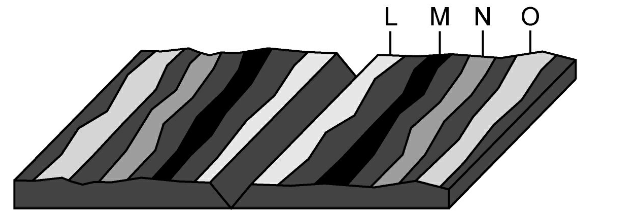
The image shows a diagram of the ocean floor near a mid-ocean ridge. Where would the oldest rock be found?
Put the repeating steps of seafloor spreading in order.
Magma MOVES to the SURFACE
Magma FLOWS from the CRACKS
Magma COOLS to form new SEAFLOOR
The (a) is moving away from the _ (b) while also moving towards the (c)
How do fold mountains form?
When 2 mountains collide & make one mountain
When a mountain erodes & becomes a fold mountain
When 2 plates move towards eachother and collide
When 2 plates move apart from eachother
The (a) formed as the Indian Plate converged with the Eurasian Plate - they are the longest and highest mountain range in the world and still growing.
At a continental-continental convergent boundary,
one continental plate is subducted below the other
fault-block mountains are formed
both continental plates are subducted
folded mountains are formed
The (a) are also fold mountains forming when the denser Nazca Plate collides with the South American Plate which forces the denser Nazca Plate under the South American Plate.

The Sierra Nevadas and the Teton Moutain Range are examples of which type of mountain?
fault block mountains
folded mountains
dome mountains
plateau

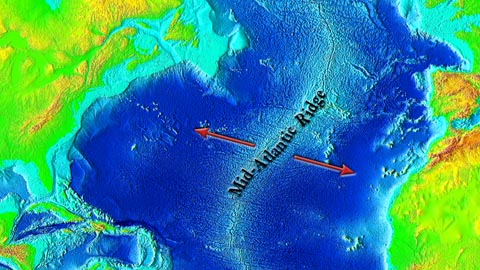
Which of the descriptions below is for an island arc?
a curved chain of volcanic islands usually formed along converging plates where subduction takes place near a deep ocean trench.
a major volcanic belt formed by the many volcanoes that rim the Pacific Ocean.
Geographical regions with very high levels of volcanic activity, formed along the boundaries of Earth's plates
an area where material from within the mantle rises and then melts, forming magma.
A(n) _____is an area of many fractured pieces of crust along a large fault.
mid-ocean ridge
subduction zone
fault zone
The ______ is(are) an example of a transform boundary.
Appalachian Mountains
Himalayas
Mid-Atlantic Ridge
San Andeas Fault
How do landslides change the Earth’s surface?
by torrential rain, machinery blasting, or earthquakes that knock sediments, rocks and vegetation loose to move down a hill rapidly
by bursting hot rocks to the surface and creating new land
by moving rocks to a different area and creating new land
What is a tsunami?
when land falls from a hill or cliff
a large ocean wave
magma coming from underground
a form or precipitation
Finish the sentence to describe the relationship between impactor mass and crater size
As the impactor mass increases, crater size _______
Increases
Decreases
stays the same
is random
Weathering is the process of -
Moving sediment from one place to another
Dropping or leaving sediment in a location
Breaking down rocks into sediment
An example of physical weathering is -
Plant roots and leaves releasing acids
Carbonic acid dissolving limestone
Large temperature changes
Lichens growing on rocks


Waves dropping sand on the beach.
Weathering
Erosion
Deposition

Layers of sediment forming at the bottom of the ocean.
Weathering
Erosion
Deposition
Rocks get (a) by weathering, (b) through erosion, and (c) somewhere else through deposition.
Rock formations hanging from a roof are called ________.
stalactites
stalagmites
troglodytes
minerals

Which type of physical weathering would be responsible for the rock formation shown in the diagram?
Wind Abrasion
Frost Wedging
Root Wedging
Exfoliation
Oxidation
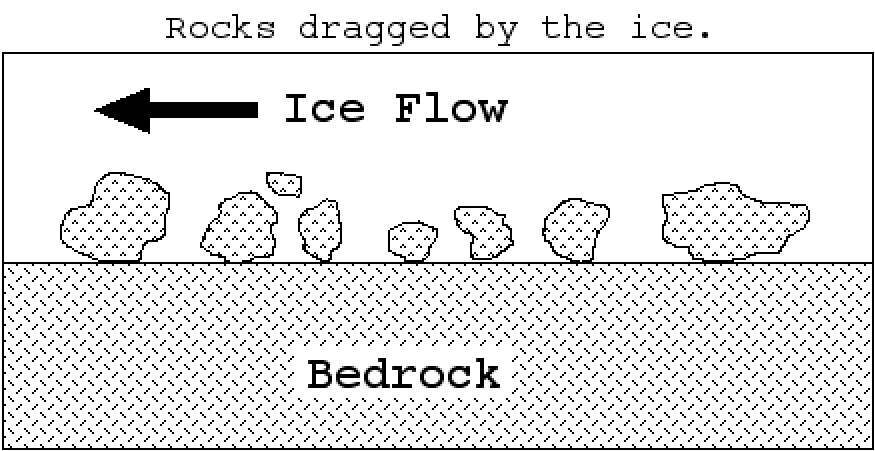
_____ the process in which a glacier scrapes underlying rock. The sediments and rocks frozen in the ice at the bottom and sides of a glacier act like sandpaper. They wear away rock..
Plucking
Abrasion
Weathering
Erosion

Poorly graded (unsorted) rock material deposited directly by a glacier.
glacial drift
stratified drift
Glacial till
glacier
What shape is the valley created by glacial erosion?
U
V
N
A

A sharp, pyramid shaped peak formed by glacial erosion
Horn
Arete
Cirque
Erratic

What are jagged ridges that form on mountains called?
U-shaped valleys
cirques
aretes
horns

Identify the landform in the picture created by a glacier.
arete
cirque
kettle lake
moraine
Which rock group formed from high heat and pressure?
Igneous
Metamorphic
Sedimentary
What are sedimentary rocks made from?
Bits of rock and minerals
Igneous rocks that have been transformed
Metamorphic rocks that have been transformed
Magma
What word goes in the blank?
Erosion, Deposition, (a) , Cementation
Rocks can change from one type to another.
True
False
What type of rock forms from cooled magma or lava?
Metamorphic
Sedimentary
Igneous
Where are metamorphic rocks formed?
On the Earth's surface
In the crust
Deep underground
In space
What two things can change an Igneous rock into a Metamorphic rock?
Erosion and weathering
Compaction and cementation
Heat and pressure
Melting and cooling
What type of rock often has large pieces of material you can see?
Igneous
Sedimentary
Metamorphic
What type of rock can look glassy/shiny or have holes?
Igneous
Sedimentary
Metamorphic
What type of rock are you most likely to find near a volcano?
Igneous
Metamorphic
Sedimentary
What type of rock often has visible wavy bands?
Sedimentary
Metamorphic
Igneous
Igneous rocks that form outside on the Earth's surface...
will cool down faster and have smaller crystals
will cool down more slowly and have smaller crystals
will cool down faster and have larger crystals
will cool down more slowly and have larger crystals
Igneous rocks that form inside the earth...
will cool down faster and have smaller crystals
will cool down more slowly and have smaller crystals
will cool down faster and have larger crystals
will cool down more slowly and have larger crystals
What is an extrusive igneous rock?
a rock that forms outside on the Earth's surface with small or no crystals
a rock that forms outside on the Earth's surface with large crystals
a rock that forms inside the Earth with small or no crystals
a rock that forms inside the Earth with large crystals
What is an intrusive igneous rock?
a rock that forms outside on the Earth's surface with small or no crystals
a rock that forms outside on the Earth's surface with large crystals
a rock that forms inside the Earth with small or no crystals
a rock that forms inside the Earth with large crystals
Sedimentary Rock --> ____________--> Sediment
compaction and cemetation
weathering and erosion
heat and pressure
melting and cooling
Magma --> _____________ --> Igneous Rock
Melting
Cooling
Metamorphism
Compaction

