
 Worksheets
Chemistry and Macromolecules Review
Total questions: 63
Worksheet time: 37mins
Glucose is an example of a
monosaccharide
polysaccharide
disaccharide
What subatomic particles make up the mass of the nucleus?
electrons and neutrons
protons and neutrons
electrons and protons
protons and nucleic acids
The ____ is positively charged, whereas the ___ is negatively charged.
neutron, electron
electron, neutron
proton, electron
proton, neutron
A mystery solution had a pH of 4.5 on the pH scale. Which is true?
There are absolutely no hydrogen ions in that solution, which makes it more basic.
There are more hydrogen ions in that solution, which makes it more acidic.
There are more hydroxide ions in that solution, which makes it more acidic.
There are less hydrogen ions in that solution, which makes it more neutral.
Organic compounds contain mostly ___, ___, and ____ atoms.
oxygen, carbon, and hydrogen
sulfur, phosphorus, and nitrogen
hydrogen, sulfur, and carbon
nitrogen, oxygen, and hydrogen
Macromolecules are built from ____ which link together to form ____.
polymers, monomers
monomers, polymers
monomers, macromolecules
polymers, compounds
The four main types of macromolecules are:
acids, bases, enzymes, and nucleic acids.
carbohydrates, lipids, acids, and bases
nucleic acids, proteins, chemical reactions, and bases
carbohydrates, lipids, proteins, and nucleic acids.
A disaccharide contains ____ joined by dehydration synthesis. (removal of a water molecule) for example: lactose
2 monosaccharides
3 polysaccharides
3 monosaccharides
3 or more sugars
____ are the building blocks, or monomers, that make up proteins.
nucleic acids
fatty acids
amino acids
lipids
How many amino acids are naturally made by the human body?
20
23
32
35
A DNA nucleotide consists of a _____, _____ and ____.
deoxyribose, nucleic, acid
5-carbon sugar, salt, water
5-carbon sugar, base, phosphate
water, base, sulfur
Which type of bonds hold two or more water molecules together?
hydrogen bonds
covalent bonds
ionic bonds
Van der Waals
What are buffers?
Buffers are acids that cause the pH of blood to decrease.
Buffers are bases that cause the pH of blood to increase.
Buffers prevent small amounts of acid or base from changing the pH of blood.
Buffers are catalysts that prevent changes to the pH of blood.
After the enzyme releases its substrate, what MOST LIKELY will occur next?
The enzyme will be degraded, or broken apart.
The enzyme will repeat its function of binding reactants and releasing products.
The enzyme will take on a new function and catalyze a different chemical reaction.
The enzyme will take on a new function that does not involve chemical reactions, such as providing cell structure support.
The attraction of water to itself is called
surface tension
cohesion
adhesion
none of the above
The attraction of water to something else is called
cohesion
adhesion
surface tension
van der Waals
How do any two types of amino acids (monomer of proteins) differ from one another?
The number of amino groups in the molecule
The number of carboxyl groups in the molecule
The chemical structure of the R group in the molecule
The number of chemical bonds formed by the central carbon atom.
Which of the following is true about carbohydrates?
Starch and glucose are reactants that combine to form proteins.
Starch is a monomer that is used to make glucose.
Starch is a polymer made of glucose monomers.
Starch and glucose are reactants that combine to form nucleic acids.
Ice floats and does not sink to the bottom because:
Ice is less dense than water.
Ice is more dense than water.
Ice has a higher temperature than water.
Ice is heavier than water.
Which of these is a primary energy source for living things?
carbohydrates
lipids
nucleic acids
proteins
The monomer of this macromolecule is an amino acid.
protein
carbohydrate
lipid
nucleic acid
This macromolecule makes up things like bread, pasta, and sugars.
carbohydrates
proteins
lipids
nucleic acids
The monomer of ___________ is macromolecule are fatty acids and glycerol.
carbohydates
lipids
proteins
nucleic acids
All organic molecules contain
carbon
phosphorus
nitrogen
chlorine
Enzymes are
proteins that speed up reactions
lipids that slow down reactions
carbohydrates that speed up reactions
nucleic acids that slow down reactions
Polymers are made up on individual subunits called
monomers
sugars
saccharides
nucleotides
This molecules is a LONG term energy storage molecule.
lipid
carbohydrate
nuclein acid
protein
Mrs. Smith can't eat ice cream because her body doesn't make an ____ called lactase.
enzyme
saccahride
fatty acid
glycerol
simple sugar that is a monomer of carbohydrates
monosaccharide
disaccharide
polysaccharide`
macromoleci;e
Which subatomic part of an atom gives it a positive charge?
Neutron
Proton
Electron
Nucleus
What is the smallest 'building block' of the elements that make up the universe?
An atom
An electron
A proton
A cell
What type of bond is formed when atoms share electrons?
Covalent
Ionic
Hydrogen
Polyatomic
A substance with a pH of 8 is a
acid
base
neutral
Carbon has 4 valence electrons which means
it can only form bonds with carbon
it is stable
it can make ionic bonds
it wants to make 4 covalent bonds
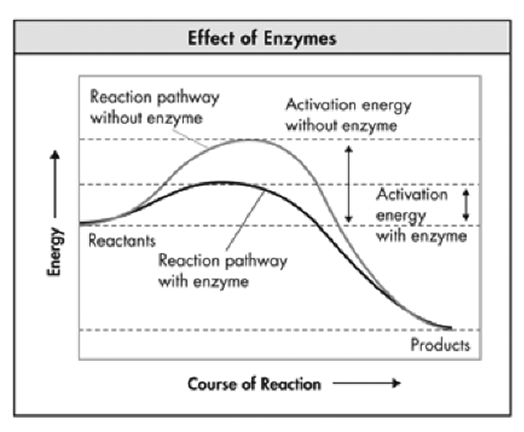
Activation energy is
The energy to start a car
The energy needed to break down CO2
The energy needed to start a reaction
The energy used to digest food
Acids have more ______ ions than bases
OH-
H-
OH+
H+
If salt is dissolved in water, water is the ____________
Solution
Solute
Solvent
Suspension
Which of the following would be considered most acidic?
1
3
7
13
The number of protons is represented by an element's
Isotope
Atomic mass
Atomic number
Symbol
Check the subatomic particle(s) that is/are found in the nucleus of an atom.
Proton
Electron
Ion
Neutron
Isotope
The ___ is the thing being dissolved.
solute
solvent
mixture
solution
What is a solvent
A liquid that will dissolve a solid solute
Another word for solution
A thing that make drinks change colour
Usually the solid about to be dissolved

Water is...
polar
nonpolar
Isotopes are atoms of the same elements with the same number of protons and a different number of
electrons.
ions.
molecules.
neutrons.
What type of electron is available to form bonds?
covalent
ionic
valence
nucleus
Both animal fats and plant oils are made up of glycerol and
amino acids.
fatty acids.
polar molecules.
saturated fats.
The class of macromolecule that would most likely be involve in contracting muscles would be
carbohydrates.
enzymes.
lipids.
proteins.
Which organic compounds would be the best to analyze in order to determine if two species are closely related?
DNA
fats
starches
sugars
The property of water that describes the characteristic of "two of the same substance sticking to itself" would be
adhesion.
cohesion.
high specific heat.
water as a universal solvent.

Contain C, H, O; used for energy and some plant structures; starch, sugar, cellulose, glycogen.
Lipids
Nucleic acids
Proteins
Carbohydrates

Contain C, H, O, N; make up cell structures and control cell functions; enzymes, muscles, hair.
proteins
lipids
nucleic acids
carbohydrates

Contain C, H, O, N, P; code for proteins; genetic code; DNA/RNA.
carbohydrates
proteins
lipids
nucleic acid

Contain C, H, O; long chains; hydrophobic; fats, oils, waxes
carbohydrates
nucleic acids
lipids
proteins
The term ____ means "water-fearing", and these will not dissolve in water.
hydrophilic
hydrophobic
soluble
catalyst

