

wayground logo

Free Printable Worksheets

Font size

S
M
L
XL
Worksheets

Life Science

Total questions: 75

Worksheet time: 2hrs 45mins

Name
Class
Date
1.
What organelle of the cell produces energy?
a)
Mitochondria 
b)
Golgi Body 
c)
Vesicle 
d)
Vacuole 
2.
An organism made of one cell is called
a)
unicellular organism
b)
multicellular organism
3.
This organelle absorbs energy from the sunlight and uses it to make food
a)
Nucleus 
b)
Vacuole
c)
Chloroplasts
d)
Golgi Apparatus
4.
The DNA of a cell can be found here
a)
Nucleus
b)
Cytoplasm
c)
Rough ER
d)
Mitochondria
5.

This is the outside covering of an animal cell

a)

Smooth ER

b)

Cell Wall

c)

Cell Membrane

d)

Cytoplasm

6.
This is the organelle that gives plants the structure they need to stand up tall
a)
Cell Membrane
b)
Smooth ER
c)
Cell Wall
d)
Vacuole
7.
Identify letter H.
a)
nucleus
b)
mitochondria
c)
Golgi complex
8.
Which type of cells are very complex and have membrane bound structures?
a)
eukaryote
b)
prokaryote
9.
Which type of cells are simple and have no membrane bound organelles?
a)
eukaryote
b)
prokaryote
10.
Identify letter B.
a)
Golgi complex
b)
nucleus
c)
cell wall
11.
Which is an accurate difference between plant cells and animals cells?
a)
Plant cells have a cell wall, but animal cells do not. 
b)
Animal cells have a cell wall, but plant cells do not. 
12.
Which diagram represents an organ?
a)
#1
b)
#2
c)
#3
d)
#4
13.

Homeostasis

a)

allows for a wildly fluctuating internal environment

b)

is impossible in vertebrates

c)

is the maintenance of a relatively stable internal environment

14.

Body system that sends and receives electrical signals from the brain

a)

Skeletal System

b)

Nervous System

c)

Muscular System

d)

Digestive System

15.

Body system that transports oxygen and nutrients through out the body

a)

Muscular System

b)

Nervous System

c)

Digestive System

d)

Circulatory System

16.

Body system that receives oxygen and removes of carbon dioxide

a)

Heart

b)

Muscular System

c)

Veins

d)

Respiratory System

17.
How does the digestive system work with all other systems?
a)
The digestvie system transports blood to all the other systems
b)
The digestive system puts oxygen into the body
c)
The digestive system gives the body energy and nutrients
d)
The digestive system allows the body to move
18.
This system defends your body against infection! 
a)
Endocrine
b)
Integumentary
c)
Immune
d)
Circulatory
19.
Mrs. Raynor has a cold but her doctor won't give her an antibiotic to make her feel better. Why? 
a)
a cold is caused by a bacteria and antibiotics don't work on a bacteria
b)
a cold is caused by a fungus and antibiotics don't work on a fungus
c)
a cold is caused by a parasite and antibiotics don't work on parasites 
d)
a cold is caused by a virus and antibiotics don't work on a virus
20.
Vaccines work by:
a)
Killing the virus before it reproduces
b)
It eliminates all traces of the virus
c)
It causes the body to make antibodies so it's ready the next time
d)
puts a protective gel coating around all cells
21.
Which kingdom contains only multicellular autotrophs?
a)
fungi
b)
plant
c)
animal
d)
protist
22.

What are the two parts that make up a scientific name?

a)

Genus and Kingdom

b)

Species and Family

c)

Species and Class

d)

Genus and Species

23.
Which two kingdoms are entirely multicellular?
a)
Animalia and Plantae
b)
Animalia and Protista
c)
Protista and Plantae
24.
To say that an organism is heterotrophic means...
a)
it cannot reproduce asexually
b)
it cannot make its own food
c)
it cannot breathe oxygen gas
25.
How do scientists organize living things?
a)
by looks
b)
by shared characteristics
c)
by size
d)
by differences
26.

This type of trait shows only if BOTH parents pass it on

a)

recessive

b)

dominant

c)

codominant

27.

If the individual has two different genes

a)

heterozygous

b)

dominant

c)

homozygous

28.

If the individual has two of the same genes

a)

heterozygous

b)

recessive

c)

homozygous

29.
the physical look of a trait
a)
phenotype
b)
genotype
c)
recessive
30.

The letters "dd" are an example of _______.

a)

heterozygous recessive

b)

homozygous recessive

c)

homozygous dominant

d)

heterozygous dominant

31.

The letters "Dd" are an example of....

a)

heterozygous genes

b)

homozygous genes

c)

dominant genes

d)

recessive genes

32.
What would the ratio for genotypes be for this Punnett Square?
a)
2Bb:2bb
b)
2BB:2Bb
c)
1BB:2Bb:1bb
d)
4Bb
33.

G = dominant green and g = recessive yellow
A fish has a Gg genotype, what will its phenotype be?

a)
yellow
b)
green
c)
greenish-yellow
d)
red
34.
Which is a true statements about this picture?
a)
Brown is recessive
b)
Brown is dominant
c)
Blue is dominant
d)
Blue is codominant
35.
A new organism is produced from one parent organism.
a)
Sexual Reproduction
b)
Asexual Reproduction
36.
Mitosis is a type of ________________ reproduction.
a)
Sexual
b)
Asexual
37.
What process does a multi-cellular organism use to replace its damaged body cells?
a)
mitosis
b)
meiosis
c)
replication
d)
transcription
38.
In mitosis cells are genetically _______, but in meiosis cells are genetically ______.
a)
diverse, identical
b)
identical, diverse/different
39.
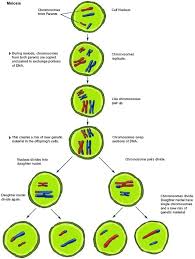
This diagram  shows which cellular process that occurs in organisms?
a)
endocytosis
b)
mitosis
c)
meiosis
d)
phagocytosis
40.
What is one advantage of sexual reproduction?
a)
The offspring are identical to the parents
b)
the offspring are resistant to viruses
c)
the offspring are born live, instead of from eggs
d)
The offspring inherit a wider variety of genetic information
41.
Mutations are important because they bring about
a)
death of the organism in which they develop
b)
genetic variation needed for a population to evolve
c)
benefits for the individual, not for the population
d)
Hardey-Weinberg equilibrium within a population
42.

When organisms are better adapted to their environment they will survive and reproduce more successfully than organisms less adapted. This process is called what?

a)

Selective breeding

b)

Natural Selection

c)

Cloning

d)

Evolution of all species

43.

Which of the following relationships is considered parasitic?

a)

Ticks feeding on a dog

b)

Bees transporting pollen from flowers

c)

Pilotfish swimming under sharks

d)

Birds eating the insects from the back of hippo

44.

Which of these describes a mutually beneficial relationship between two organisms, sometimes called mutualism?

a)

A dog with worms in its intestine

b)

A turtle and a snail that both eat grass live in a river

c)

A honeybee pollinating a plant and receiving nectar for food

d)

A small fish attached to a shark, eating tiny pieces of the shark's food as it floats

45.
Cattle egrets forage (feed) in fields among cattle. The egret gets easy access to flying insects stirred up by the cattle, and the cattle don't care if they are there or not.
a)
mutualism
b)
commensalism
c)
competition
d)
parasitism
46.
an organism that can produce its own food through photosynthesis
a)
consumer
b)
heterotroph
c)
autotroph
d)
herbivore
47.
In this food chain, what will happen if the frogs become extinct?
a)
The snakes will increase.
b)
The grasshoppers will decrease.
c)
The eagles will remain the same.
d)
The grasshoppers will increase.
48.
Use the diagram to answer the question.
The Mayfly is a food source for which 3 organisms?
a)
Frog, Dragon Fly and snake
b)
Frog, trout and dragon fly
c)
Frog, salamander and trout
d)
Frog and phytoplankton
49.
Which event is the best example of competition between species in a pond?
a)
dragonflies landing on lily pads
b)
lizards and snakes lying in the sun
c)
hawks eating mice
d)
frogs and toads eating flies
50.

The fox in this food web would be considered a:

a)

3rd level Consumer

b)

Producer

c)

2nd level Consumer

d)

Primary Consumer

51.
Which one of these does not add CO2 to the atmosphere?
a)
cooking with gas
b)
planting trees
c)
burning wood
d)
riding in a bus
52.
In the carbon cycle, producers take in the gas __
a)
carbon dioxide
b)
oxygen
c)
nitrogen
d)
carbon monoxide
53.

oxygen is a gas produced by ______ and used by _____

a)

plants, animals

b)

animals, plants

54.
All of the carbon in existence is continually recycled in the carbon cycle
a)
True
b)
False
55.

After millions of years, carbon from organisms can be buried and become what?

a)

water

b)

nutrients

c)

air

d)

fossil fuels

56.

Carbon dioxide is added to the atmosphere by the burning of fossil fuels

a)

True

b)

False

57.

Which process converts carbon in the form of sugar into carbon dioxide gas?

a)

Bioremediation

b)

Photosynthesis

c)

Cellular Respiration

d)

Transpiration

58.

Carbon dioxide is a gas produced by ________ and used by __________

a)

plants and animals

b)

animals and plants

59.

How do plants affect the air that animals and people breathe?

a)

Plants use oxygen from the air to make their own food

b)

Plants release pollution into the air

c)

Plants take in carbon dioxide and release oxygen

d)

Plants take in oxygen and release carbon dioxide

60.

Plants use ____________ to make their own food

a)

Water

b)

Sunlight

c)

Carbon dioxide

d)

All of these

61.

Carbon dioxide, water, and sunlight are the needed to do this process.

a)

Mitosis

b)

Diffusion

c)

Photosynthesis

d)

Cellular Respiration

62.

During this process, glucose (a sugar) is broken down by oxygen to produce energy (ATP).

a)

photosynthesis

b)

diffusion

c)

mitosis

d)

cellular respiration

63.
This is the organelle where photosynthesis occurs.
a)
Mitochondria
b)
Chloroplast
c)
Golgi Body
d)
Vacuole
64.
What are the 2 reactants, or ingredients, for cellular respiration?
a)
glucose and sugar
b)
oxygen and water
c)
glucose and oxygen
d)
carbon dioxide and sunlight
65.

ORGANISMS THAT NEED TO INGEST FOOD IN ORDER TO OBTAIN ENERGY.

a)

autotrophs

b)

heterotrophs

c)

producers

d)

plants

66.

ORGANISMS THAT MAKE THEIR OWN FOOD.

a)

autotrophs

b)

heterotrophs

c)

humans

d)

lions

67.

What is the correct equation for cellular respiration?

a)

oxygen + glucose----> carbon dioxide + water + energy

b)

oxygen + glucose+ energy-------> carbon dioxide+ water

c)

carbon dioxide+ water---------> oxygen + glucose+ energy

d)

carbon dioxide+ water + energy--------> oxygen + glucose

68.

Cellular Respiration occurs in what cell organelle?

a)

chloroplast

b)

cytoplasm

c)

mitochondria

d)

animal

69.

Which of these is a product of cellular respiration?

a)

Energy

b)

Carbon dioxide

c)

Water

d)

All of these are a product of cellular respiration

70.
What does chlorophyll capture?
a)
Chlorophyll captures water from the air.
b)
Chlorophyll captures carbon dioxide from the air.
c)
Chlorophyll captures the energy of sunlight.
d)
Chlorophyll captures baseballs.
71.
During photosynthesis, what form does the food take?
a)
The food takes the form of sugar.
b)
The food takes the form of carbon dioxide.
c)
The food takes the form of soil.
d)
The food takes the form of a ham sandwich.
72.

What two materials are needed for photosynthesis?

a)

Water and soil.

b)

Carbon dioxide and water.

c)

Carbon dioxide and chlorophyll.

d)

Oxygen and water.

73.

Which organelle is responsible making food (Glucose) using sunlight?

a)

Cell Membrane

b)

Nucleus

c)

Chloroplast

d)

Mitochondria

74.
What are the products of photosynthesis?
a)
water and carbon dioxide
b)
oxygen and glucose
c)
oxygen and carbon dioxide
d)
oxygen and water
75.

Which of the following is the correct equation for PHOTOSYNTHESIS?

a)

light + carbon dioxide + water --> oxygen + glucose

b)

carbon dioxide + glucose + water --> oxygen + light

c)

oxygen + light + water --> carbon dioxide+ glucose

d)

carbon dioxide + oxygen + water----> Light+ glucose
