Worksheets
Quarter 1 Retake Quizizz
Total questions: 92
Worksheet time: 2hrs 37mins


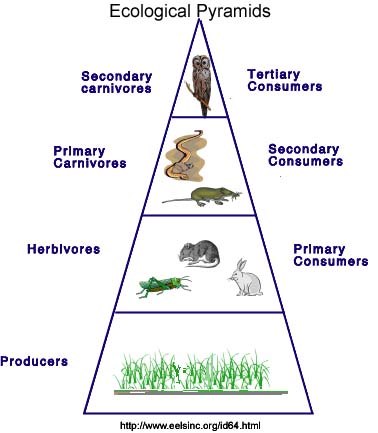

What amount of percentage does the energy decrease as it goes up the pyramid?
100%
1000%
10%
1%

What happens when different species try to occupy the same niche?
The species compete with each other
The species cooperate with each other
The species coexist with each other
All of the above
What is a niche?
The habitat that an organism lives in
An organism’s “role” in an ecosystem
A type of consumer
The relationship between a producer and consumer

If the amount of food or resources available increases, the carrying capacity for an animal.....
Stays the same
Increases
Decreases
Fluctuates

What is the carrying capacity mean?
The number of individuals an area can carry
the number of births
The number of deaths an area has
not sure

parasites, disease, predators, are examples of what type of limiting factors?
density dependent
density independent
survivorship
type 1 curve

What is the arrow pointing at?
carrying capacity
biotic potential
density-independent
density dependent
Why don't populations grow indefinitely?
limiting factors
only biotic factors
only abiotic factors
none of the above
An S-shaped curve is known as
Exponential graph
Logistic Graph
Survivorship curves
Graphs


The graph below shows population growth of a fruit fly population over time.
Point ______________ shows that the fruit fly population has reached carrying capacity.
Point 1
Point 2
Point 3

Otters are important to kelp forests along the northwestern coast of the United States because they feed on sea urchins and control their population. Sea urchins feed on the kelp, and if they overpopulate, they can wipe out whole kelp forests. This is because the kelp can no longer anchor itself and simply float away. In this way, otters not only regulate the sea urchin population, but they also influence the kelp forest. Which statement best describes the role of the otter?
The otter is an invasive species because they move into a new area and compete with native species, therefore harming the balance of the ecosystem.
The otter is a keystone species because they move into a new area and compete with native species, therefore harming the balance of the ecosystem.
The otter is an invasive species because if they are removed from the ecosystem, the food web and ecosystem can collapse.
The otter is a keystone species because if they are removed from the ecosystem, the food web and ecosystem can collapse.
Nonnative zebra mussels were first found in a lake near Detroit in 1988. By 1989, it had colonized all Great Lakes waterways. Which scenario is most likely true regarding the introduction of this species?
Native fish naturally ate zebra mussels.
The higher biodiversity lead to healthier lakes.
Native mussels were outcompeted by Nonnative mussels for food and other resources.
Native mussel populations were growing rapidly.
Which of the following best explains the length of primary and secondary succession?
Primary succession is shorter than secondary succession because primary succession begins with soil left behind after the disaster.
Primary succession takes longer than secondary succession because primary succession begins from scratch.
Primary and secondary succession take the same amount of time.
Secondary succession takes longer than primary succession because secondary succession begins with no soil left after the disaster.
Intraspecific competition is when _____________________
2 different species complete for resources
2 of the same species complete for resources
both species benefit in the relationship
none of the above are correct
Secondary succession can begin with a forest fire. What is left behind after the fire?
nothing
bare rock
a thriving ecosystem
soil
Primary succession may occur________________________.
on an abandoned farm field
on a lot bulldozed for a subdivision
due to deforestation by tree farmers
on an island formed by a volcanic eruption
The final end point of succession is called _________________.
staged community
climax community
climatic change
community development
The very first species to show up at the beginning of succession are called _____________.
introduced species
indicator species
keystone species
pioneer species
Which of the following is not a possible cause of ecological succession?
A. fire
B. flood
C. earthquake
D. change of season
. Which of the following is an example of primary succession?
A.lichens growing on rocks following a volcanic eruption
B.grasses growing after a forest fire
C.oak trees replacing pine trees in a forest
D. non-native species introduced into a climax community
Which of the following describes how an abiotic factor can impact the population dynamics in an ecosystem?
A. A parasite that invades a host can reproduce and cause a decline in the host species population.
B. Organisms that compete for the same resources will keep each other from overpopulating.
C. Predators will prevent herbivores from depleting the plants and other resources in an ecosystem.
D. Seasonal variations in temperature can cause some of the individuals in a population to die.
How is primary succession different from secondary succession?
Primary succession starts with soil.
Secondary succession start with bare rock.
Primary succession starts with bare rock, with lichens and moss.
Fire is an example of primary succession.
A volcano in a mountainous, wooded region erupts, spewing tons of ash and destroying the forested area around the volcano. If the volcano remains dormant during
the next 1000 years, what will probably happen?
The area will be repopulated by trees, eventually becoming a
forest again.
The mountains will erode and remain without life.
The area will remain unchanged, covered by volcanic ash.
The area will turn into a completely different habitat, such as
desert of plains.
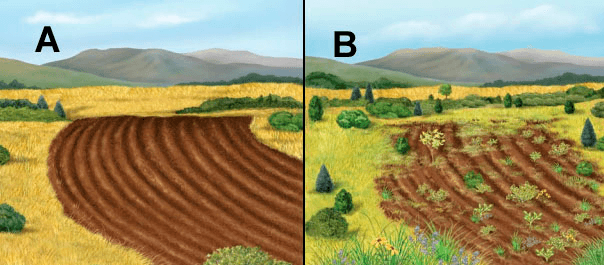
Abandoned railroad tracks are overgrown with weeds. Ten years later there are small aspen trees growing in the middle of the tracks. This change is an example of:
Primary succession
Biological evolution
Secondary succession
Heterotrophic nutrition
Replacement of one type of community by another at a single place over time in a predictable series of change...
symbiosis
succession
competition
cooperation

Amino Acids
Fatty Acids
Nucleotids
Monosaccharides

protein
carbohydrate
lipid
nucleic acid

This is a nucelotide monomer. What polymer is made when these monomers are joined together?
protein
carbohydrate
lipid
nucleic acid
This macromolecule is made of CHO and provides quick energy to the cell.
carbohydrates
proteins
nucleic acids
lipids
This macromolecule can form many highly complex structures. Some of the many functions include structural support, speed up chemical reactions, and cell membrane channels.
carbohydrates
proteins
nucleic acids
lipids
All of the following are functions of proteins EXCEPT
catalyze/speed up chemical reactions
provide quick energy
make up muscles, hair, and bones
support the immune system
hormones/ transport/ enzymes
ELEMENTS THAT MAKE UP LIPIDS ARE: (CLICK ALL THAT APPLY)
C
H
N
O
Elements in Carbohydrates are: (CHECK ALL THAT APPLY)
C
H
N
O
What is the relationship between MONOMERS and POLYMERS?
polymers are bent, monomers are straight
polymers are made of polymers
polymers are made of monomers
monomers are made of triglycerides
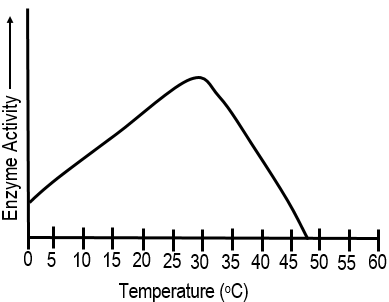
Changes in pH and temperature can ___________________ an enzyme which causes it to lose its shape and affects its function.
puncture
denature
double
delete
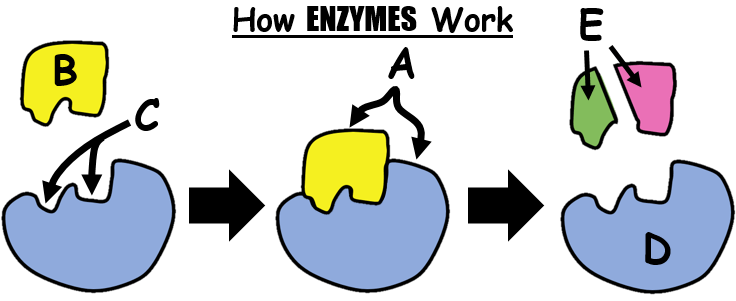


What is a substance called if it speeds up a chemical reaction?
reusable
catalyst
specific
fragile

What happens to the reaction rate if an enzyme is denatured or nonfunctional?
No change in the reaction rate
Increase in reaction rate
Decrease in reaction rate
Decrease then increase in reaction rate
You are carrying out an experiment with an enzyme from the human small intestine. If the enzyme in solution is saturated with substrate, the most effective way to obtain a product more quickly is to
Add more enzyme
Add more substrate
Increase the concentration of the enzyme solution
Heat the enzyme solution above 38 °C

You perform an enzyme-controlled reaction. Based on your results, which of the following is true?
The enzyme works best when the pH is alkaline
The enzyme was most active at pH 4.6
The temperature must have increased and then decreased during the course of the experiment
The salinity was altered during the experiment
Which of the following can be used to determine the rate of an enzyme-catalyzed reaction?
The rate of substrate formed
The decrease in temperature in the system
The rate of enzyme used up
The rate of substrate used up
Fireflies emit light. The production of light by an organism is called bioluminescence. To generate visible light, cells in a firefly’s tail produce thousands of luciferase enzymes. Luciferase binds to a chemical called luciferin. Once bound, the luciferase enzyme speeds up a chemical reaction that combines an oxygen molecule and luciferin to produce oxyluciferin. This reaction requires energy and releases light. Which of the following best describes how the luciferase enzyme speeds up the chemical reaction?
Luciferase increases the amount of time the light is visible.
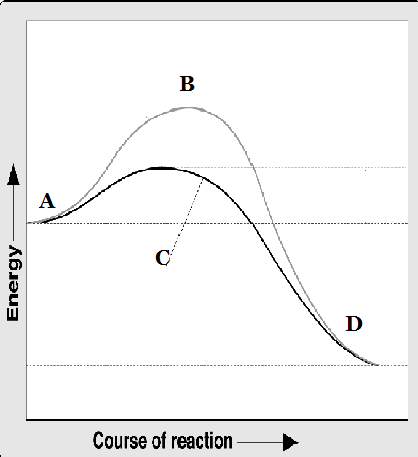
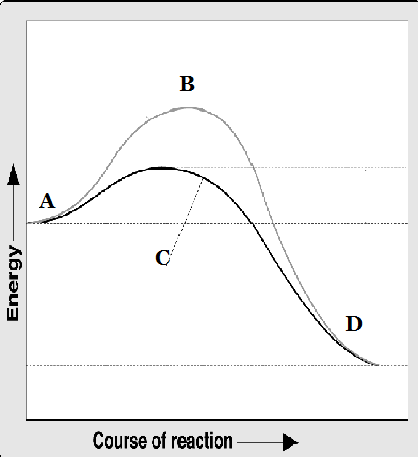
Luciferase decreases the amount of energy required for the reaction to start.
Luciferase increases the number of sites on luciferin that must bind to oxygen.
Luciferase decreases the temperature of the environment inside the body of the firefly.