Wayground logo

Free Printable Worksheets

Font size

S
M
L
XL
Worksheets

REview Quiz

Total questions: 80

Worksheet time: 2hrs 35mins

Name
Class
Date
1.

What happens if a population grows past its carrying capacity?

a)

The population keeps growing

b)

The population starts to die off

c)

The entire species will go extinct

d)

The carrying capacity just increases

2.

The largest number of individuals that an environment can support long term is...

a)

carrying capacity

b)

emigration

c)

immigration

d)

population density

3.

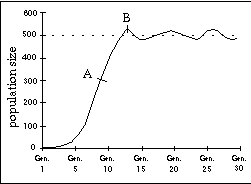
What is the carrying capacity of the graph?

a)

around 500

b)

more than 800

c)

less than 300

d)

around 700

4.
Which of the following would INCREASE the carrying capacity of an ecosystem?
a)
increase in predators
b)
disease
c)
increase in available food
d)
drought
5.

When death rate is equal to birth rate...

a)

population increases

b)

population decreases

c)

population stays the same.

d)

population rapidly increases then becomes stable

6.
If a disease destroying barley plants in a field swept through an ecosystem, what would happen to the barley eating bird population in the the field ?
a)
The bird population would stay the same
b)
The bird population would infinitely increase
c)
The bird population would decrease
7.

If the carrying capacity of a predator decreases, what will happen to the carrying capacity of the prey?

a)

Will Increase

b)

Will Decrease

c)

Will stay the same

8.
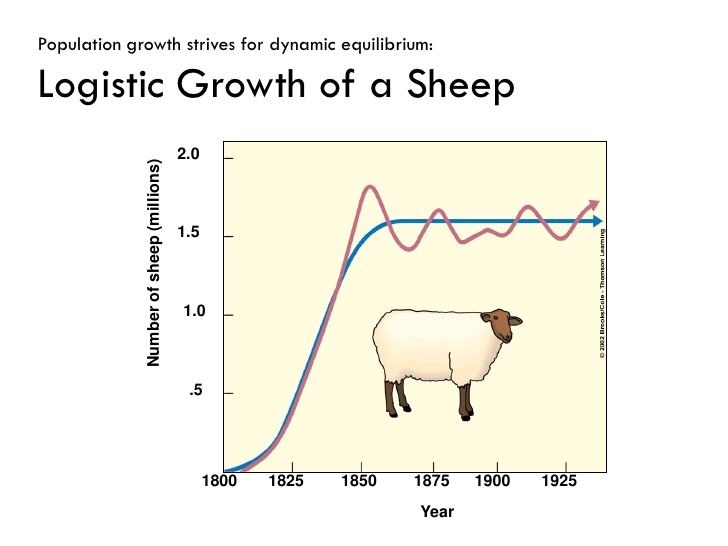
What is the carrying capacity for this sheep population?
a)
1.8 million
b)
1.25 million
c)
1.6 million
d)
1.o million
9.
What point on the graph represents the carrying capacity?
a)
A
b)
B
c)
C
d)
D
10.
What is the carrying capacity of the following graph?
a)
1000
b)
8000
c)
800
d)
600
11.
What is the water cycle?
a)
the 3 forms of water
b)
the movement of water on, above, or below the surface of the Earth
c)
when water melts
d)
when clouds form
12.
What part of the water cycle does this picture show?
a)
condensation
b)
precipitation
c)
evaporation
13.
Which of these is an example of precipitation?
a)
snow
b)
air
c)
clouds
d)
vapor
14.

Water vapor leaves a plant in the biosphere and goes into the atmosphere through

a)

transpiration

b)

respiration

c)

precipitation

d)

evaporation

15.

biosphere

a)

all the water on Earth

b)

regions that contain all the living things on Earth

c)

the envelope of gases that surrounds Earth

d)

living things on land

16.

_____ moves underground to the ocean

a)

sea water

b)

groundwater

c)

lake water

d)

rain drops

17.

What happens when water vapor loses thermal energy?

a)

it expands into millions of droplets that form clouds

b)

it condenses into millions of droplets that form clouds

c)

it condenses into millions of droplets that form lakes and rivers

d)

it expands on the surface of plants and goes into the air

18.

atmosphere

a)

all the water on Earth

b)

regions that contain all the living things on Earth

c)

the envelope of gases that surrounds Earth

d)

living things on land

19.

When is energy absorbed during the water cycle?

a)

during evaporation

b)

during transpiration

c)

during condensation

d)

during precipitation

20.

hydrosphere

a)

all the water on Earth

b)

regions that contain all the living things on Earth

c)

the envelope of gases that surrounds Earth

d)

living things on land

21.

____ happens when liquid turns into a gas on Earth's surface

a)

evaporation

b)

condensation

c)

respiration

d)

transpiration

22.

How does energy from the Sun drive evaporation?

a)

it slows down the water molecules and breaks their bonds

b)

it makes the water molecules too big

c)

it speeds up the water molecules and breaks their bonds

d)

it speeds up the water molecules and creates new bonds

23.

reservoirs

a)

water storage areas during the water cycle

b)

places reserved for water usage by humans and animals

c)

made from water and ice that are too big to remain suspended in air

d)

made up of water droplets or ice crystals that are so small they remain suspended in the air

24.

Which statement does NOT apply to the water cycle?

a)

it has no beginning

b)

it has no end

c)

it is continuous

d)

it very rarely changes

25.

clouds

a)

water storage areas during the water cycle

b)

places reserved for water usage by humans and animals

c)

made from water and ice that are too big to remain suspended in the air

d)

made up of water droplets or ice crystals that are so small they remain suspended in the air

26.

Where does water from mountains or land NOT end up?

a)

lakes

b)

rivers

c)

the ocean

d)

space (unless sent there by a volcanic eruption!)

27.

Which of the following drive the movement of water in the water cycle? (choose all that apply)

a)

sunlight

b)

transpiration

c)

gravity

d)

evaporation

28.

Where is groundwater stored?

a)

in lakes and rivers

b)

in underground lakes

c)

in cracks and pores beneath Earth's surface

d)

in mid-ocean ridges

29.

Evaporation adds water to the

a)

biosphere

b)

atmosphere

c)

lithosphere

d)

geosphere

30.
condensation
a)
water held underground in soil or rock.
b)
the process by which water changes from a gas to a liquid state.
c)
the gaseous state of water.
d)
thermal energy that drives the water cycle.
31.
sun
a)
water held underground in soil or rock.
b)
water that falls from clouds in the form of rain, snow, sleet, or hail.
c)
the path water takes, and the changes it goes through, as it cycles through the environment.
d)
thermal energy that drives the water cycle.
32.
surface water
a)
water found above ground, on land.
b)
water held underground in soil or rock.
c)
the gaseous state of water.
d)
the process by which water changes from a gas to a liquid state
33.

hydrologic (water) cycle

a)

the path water takes, and the changes it goes through, as it cycles through the environment.

b)

the process where plants absorb water through the roots and then gives off water vapor through pores in their leaves.

c)

excess water, not absorbed by the soil, that flows downhill.

d)

the change of water from a liquid state to a gas state, due to an increase in temperature.

34.
evaporation
a)
excess water, not absorbed by the soil, that flows downhill.
b)
the process by which water changes from a gas to a liquid state.
c)
the change of water from a liquid state to a gas state, due to an increase in temperature.
d)
the path water takes, and the changes it goes through, as it cycles  through the environment.
35.
runoff
a)
excess water, not absorbed by the soil, that flows downhill.
b)
water found above ground, on land.
c)
the change of water from a liquid state to a gas state, due to an increase in temperature.
d)
water held underground in soil or rock.
36.
ground water
a)
water that falls from clouds in the form of rain, snow, sleet, or hail.
b)
excess water, not absorbed by the soil, that flows downhill.
c)
water found above ground, on land.
d)
water held underground in soil or rock.
37.
precipitation
a)
water that falls from clouds in the form of rain, snow, sleet, or hail.
b)
water held underground in soil or rock.
c)
excess water, not absorbed by the soil, that flows downhill.
d)
water found above ground, on land.
38.
transpiration
a)
the change of water from a liquid state to a gas state, due to an increase in temperature.
b)
the path water takes, and the changes it goes through, as it cycles  through the environment.
c)
the process where plants absorb water through the roots and then gives off water vapor through pores in their leaves.
d)
the process by which water changes from a gas to a liquid state.
39.
water vapor
a)
the gaseous state of water.
b)
water held underground in soil or rock.
c)
the process by which water changes from a gas to a liquid state.
d)
excess water, not absorbed by the soil, that flows downhill.
40.

A symbiotic relationship where both organisms benefit.

a)

Mutualism

b)

Commensalism

c)

Parasitism

41.

In the ocean, algae lives on the back of spider crabs. Spider crabs then blend in with the environment (thanks to the algae), and the algae gets a home.

a)

Mutualism

b)

Commensalism

c)

Parasitism

42.

Human skin is itchy and cracked from the athele foot fungus. The fungus is feeding on the foot.

a)

Mutualism

b)

Commensalism

c)

Parasitism

43.

Spanish moss will grow on oak trees. They do not have roots, so they will get water from the oak tree but they do not hurt the tree.

a)

Mutualism

b)

Commensalism

c)

Parasitism

44.

A dog's skin hurts because of a tick being on it. A tick gets a meal from the blood of dogs.

a)

Mutualism

b)

Commensalism

c)

Parasitism

45.

The Cleaner Shrimp will rid a Moray Eel of parasites. The Cleaner Shrimp gets a meal, and the eel gets cleaned.

a)

Mutualism

b)

Commensalism

c)

Parasitism

46.

A symbiotic relationship where one organism benefits and the other one doesn't benefit and isn't harmed.

a)

Mutualism

b)

Commensalism

c)

Parasitism

47.

A silverfish will sneak into the home of army ants and share their food. This doesn't hurt the army ants.

a)

Mutualism

b)

Commensalism

c)

Parasitism

48.

If a family of rabbits leaves a crowded clover patch, this would be..

a)

competition

b)

avoiding competition

c)

parasitism

d)

commensalism

49.

Relationship between a moutain lion and a deer.

a)

parasitism

b)

commensalism

c)

mutualism

d)

predator-prey

50.
Cattle egrets forage (feed) in fields among cattle. The egret gets easy access to flying insects stirred up by the cattle, and the cattle don't care if they are there or not.
a)
mutualism
b)
commensalism
c)
competition
d)
parasitism
51.
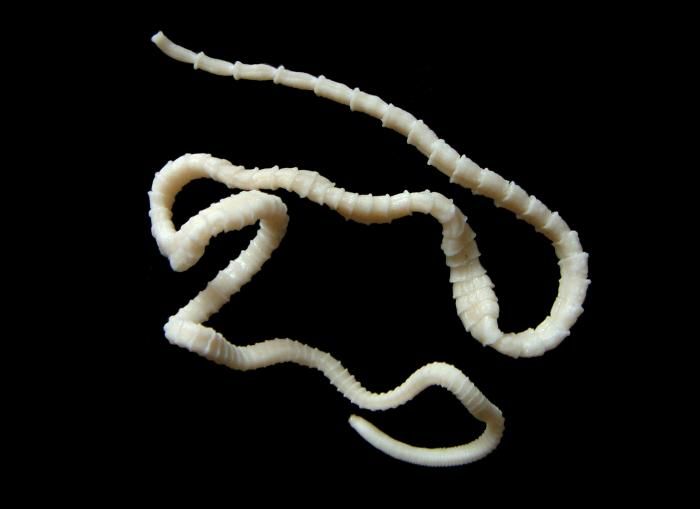
A tapeworm and a cat have this type of relationship.
a)
mutualism
b)
parasitism
c)
commensalism
d)
competition
52.
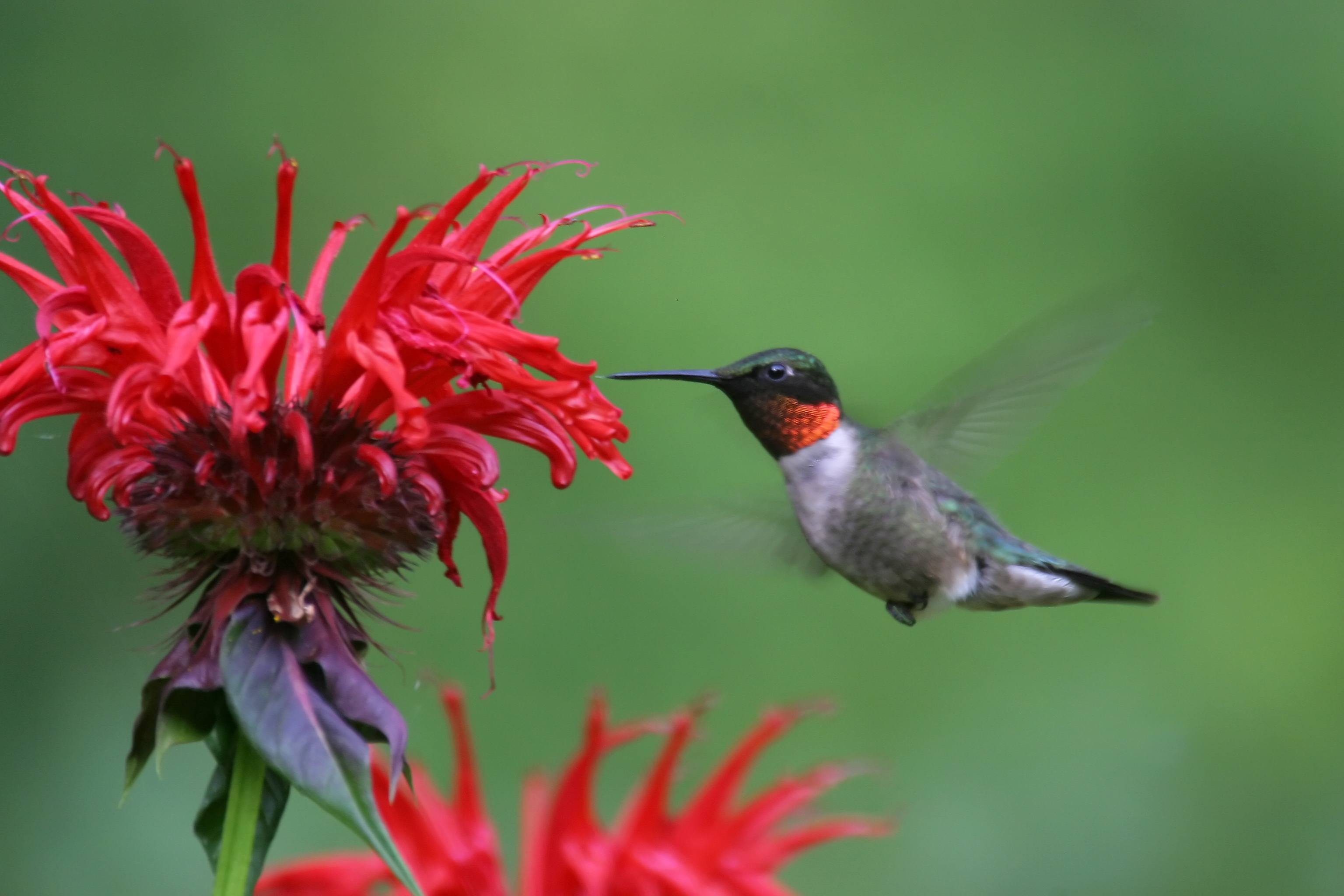
What type of symbiosis?  Hummingbirds feed on nectar from flowers.  The flowers are pollinated by hummingbirds as they move from flower to flower.
a)
commensalism
b)
mutualism
c)
parasitism
d)
predation
53.
Which symbols best describe parasitism?
a)
+,+
b)
+,-
c)
+,0
d)
-,0
54.
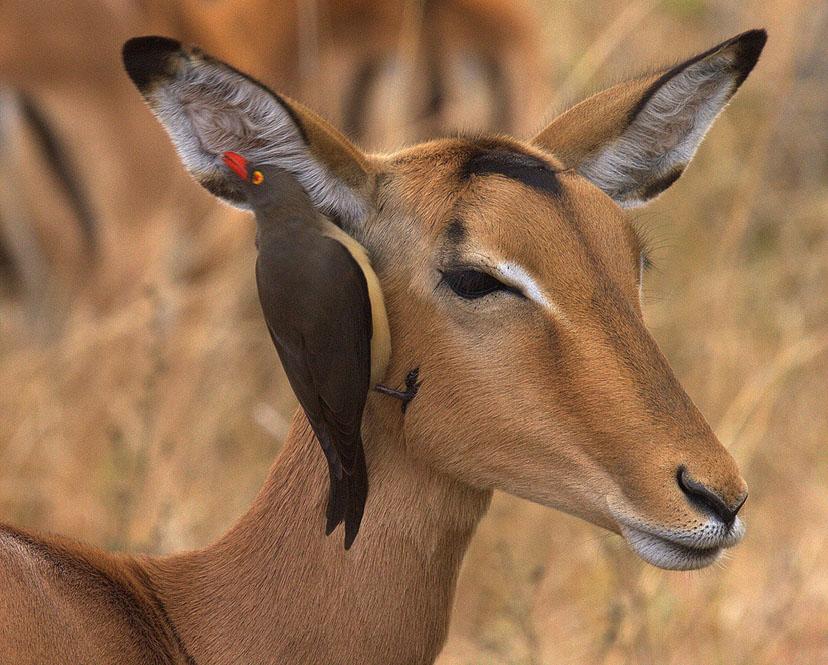
Red-billed oxpeckers are birds that often feed on parasites that infest impala.  This is an example of _______.
a)
commensalism
b)
mutualism
c)
neutralism
d)
competition
55.
A relationship between two organisms in which both organisms benefit. 
a)
Mutualism 
b)
Competition
c)
Parasitsm 
d)
Commensalism 
56.

Aphids are tiny insects that live on and eat the leaves of plants, removing vital nutrients from the plants.

a)

Predation

b)

Parasitism

c)

Commensalism

d)

Mutualism

57.
Barnacles create home sites by attaching themselves to whales. This relationship neither harms nor benefits the whales. 
a)
parasitism
b)
commensalism
c)
mutualism
58.
Yucca flowers are pollinated by yucca moths. The moths lay their eggs in the flowers where the larvae hatch and eat some of the developing seeds. Both species benefit. 
a)
parasitism
b)
commensalism
c)
mutualism
59.
Remoras attach themselves to a shark’s body. They then travel with the shark and feed on the leftover food scraps from the shark’s meals. The relationship neither harms nor benefits the shark. 
a)
parasitism
b)
commensalism
c)
mutualism
60.
Mistletoe extracts water and nutrients from a spruce tree. The spruce tree is harmed. 
a)
parasitism
b)
commensalism
c)
mutualism
61.
 Hermit crabs live in shells made and then abandoned by snails. This relationship neither helps nor harms the snails.
a)
parasitism
b)
commensalism
c)
mutualism
62.
Ticks will feed on a deer’s blood and harm the deer.
a)
parasitism
b)
commensalism
c)
mutualism
63.
A sparrow will build its nest under the nest of an osprey. The smaller birds get protection because other predators will not mess with the osprey. The osprey are not helped nor harmed by the sparrow.
a)
parasitism
b)
commensalism
c)
mutualism
64.

One organism hunts and eats another organism.

a)

predation

b)

mutualism

c)

carnivore

d)

parasitism

65.

When different species live together.

a)

symbiosis

b)

habitat

c)

competiton

d)

predation

66.

Sharks consume (eat) smaller fish they catch in the ocean. Frogs catch and eat flying insects in ponds. What type of relationship is this?

a)

mutulism

b)

predation

c)

parasitism

d)

interspecific

67.
Temperature, light, air, water, and soil are all  _____  parts of the environment
a)
alive
b)
biotic 
c)
abiotic
d)
living
68.
Is a deer an abiotic or biotic factor? 
a)
abiotic
b)
biotic
69.
Is sunlight an abiotic or biotic factor? 
a)
abiotic
b)
biotic
70.
What type of succession is shown going from figure A to figure B?
a)
primary succession
b)
eutrophication
c)
secondary succession
d)
intermediate
71.
After a forest fire, an ecosystem would start regrowth through -
a)
primary succession
b)
secondary succession
c)
climax community
d)
limiting factors
72.
Which catastrophic event will most likely have the effect of returning an ecosystem to primary succession?
a)
A tornado
b)
A volcanic eruption
c)
A flood
d)
A drought
73.
succession that occurs in an area with no soil
a)
ecological succession 
b)
primary succession 
c)
secondary succession
d)
pioneer speciles
74.
succession that occurs in an area where soil is already present
a)
ecological succession 
b)
primary succession 
c)
secondary succession
d)
pioneer speciles
75.
starts with bare rock followed by lichen
a)
primary succession 
b)
secondary succession
c)
both types of succession
76.
this type of succession occurs after a forest fire
a)
primary succession
b)
secondary succession
c)
both
77.

If farmers use a controlled burn to prevent forest fires, what would most likely be the first plants to return?

a)

trees

b)

shrubs

c)

mosses

d)

grasses

78.

Which would result in primary succession?

a)

volcano destroying habitat leaving only soil and ash

b)

Tornado destroying a crop leaving very little soil

c)

Glacier retreating exposing bare rock

d)

limiting factors

79.

Primary succession occurs in areas with:

a)

very little soil

b)

lots of soil

c)

no soil

d)

soil that has been disturbed

80.

What best describes the term succession?

a)

rapid changes that create an ecosystem overnight

b)

gradual changes over time to fully create or restore and ecosystem

c)

forest with the tallest trees

d)

the rate species produce offspring