
Font size
 Worksheets
Physical Science
Total questions: 100
Worksheet time: 3hrs 21mins
A force that opposes motion between objects that are touching is called...
motion
friction
velocity
acceleration
Henry sees a basketball and decides to put in motion. What kind of force does Henry use to move the ball?
small
balanced
equal
unbalanced
When there is an INCREASE in MASS of an object you will have a DECREASE in ______________.
friction
acceleration
force
gravity
If a 20 kilogram object accelerates suddenly at 15 m/s2, how much force was applied to the object?
150 Newtons
300 Newtons
150 kilograms
100 kilograms
A 20 kg bike accelerates at 5 m/s2. what was the force?
100 Newtons

A 5 kg block is pulled across a table by a net force of 30 N. Calculate the acceleration of the object.
160 m/s2
6.0 m/s2
0.16 m/s2
A 10 kg, 15 kg, and 20 kg rock are rolling down a hill. Which rock will require the most force to stop?
10 kg rock
15 kg rock
20 kg rock
All 3 rocks will require the same force
Determine the accelerations that result when a 12-N net force is applied to a 3-kg object.
3 m/s/s
4 m/s
26 m/s
4 m/s/s
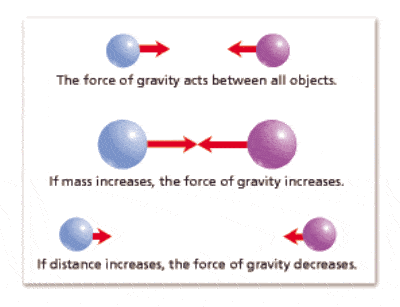
Gravity keeps the moon moving in its ___________ around Earth.
orbit
circle
triangle
dance
The law of universal gravitation is credited to whom?
Einstein
Galileo
Cavendish
Newton

What two variables effect momentum?
mass
weight
height
Velocity
What is the equation for momementum?
p=m×v
p=m×a
p=f÷a
m=p×v
The Law of Conservation of Momentum states:
The total momentum before a collision is equal to the total momentum after a collision.
The total momentum before a collision is greater than the total momentum after a collision.
The total momentum before a collision is less than the total momentum after a collision.
The total momentum before a collision is not related to the total momentum after a collision.
20000 kg * m/s south
The Law of Conservation of Momentum states:
The total momentum before a collision is equal to the total momentum after a collision.
The total momentum before a collision is greater than the total momentum after a collision.
The total momentum before a collision is less than the total momentum after a collision.
The total momentum before a collision is not related to the total momentum after a collision.
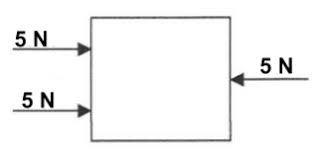
What is the acceleration if the mass of the box is 2 kg?
30 N
2.5 m/s2
10 m/s2
8 m/s2
An object is _____ if its position changes.
in motion
at reset
a frame of reference
magical
A car driving at 50 miles per hour drives for 3 hours. What distance did it cover?
17.5 miles
150 miles
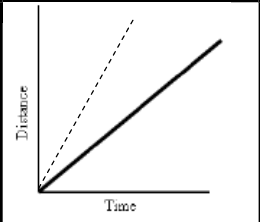

What is the speed of a runner who runs 400 meters in 50 seconds?
10 meters/second
40 meters/second
20000 meters/second
8 meters/second
Michelle drove 300 miles in 6 hours. What was Michelle’s speed?
30 miles per hour
50 miles per hour
60 miles per hour
80 miles per hour

The reading you get on your speedometer is what type of speed?
Instantaneous Speed
Average Speed
What is the difference between Speed and Velocity?
All of the above
Speed is a measure of how fast
Velocity is a measure of how fast and in what direction
Speed is Scalar
Velocity is a Vector
Which statement distinguishes between Velocity and Acceleration?
Only velocity is a Vector
Acceleration is same as velocity
Acceleration is a change in Velocity
Only acceleration is Scalar
How much velocity does a free falling object gain every second?
9.8 m/s
5 m/s
10 m
5 m
If a car is on a racetrack and the starting line is the same as the finish line. The car travels around the track 5 times. What is its total displacement?
1000 m
100 m
10 m
0 m
How can acceleration change?
By changing speed
By changing direction
Both by changing speed and changing direction
Neither by changing speed nor changing direction
What is the acceleration of a car that goes from 40 m/s to 60 m/s in 4 seconds?
2 m/s2
4 m/s2
5 m/s2
20 m/s2
What is potential energy?
moving energy
stored energy
renewable energy
non renewable energy
What is kinetic energy?
moving energy
potential energy
stored energy
renewable energy
Which of these things is an example of potential energy?
a car motor
firewood
battery
a fan
Gravitational potential energy depends on the strength of gravity, ________ and ________ of the object.
height and mass
friction and movement
mass and movement
height and friction

The unit for Energy is
Joule
Potential
Calorie
Kilojoule
What is the formula for Kinetic Energy?
KE = mass x velocity
KE= 1/2 x mass x velocity 2
KE = mass x gravity x height
KE = mass x velocity / 2
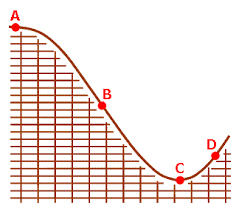

Evaluate the following statement about heat: Heat is released in all energy conversion processes as a byproduct.
A) True.
B) False, heat is never released as a byproduct.
C) False, heat is released as a byproduct only in a few energy conversion processes.
D) False, heat is released in most but not all energy conversion processes.
What is the definition of energy?
A) The capacity to do work
B) The movement of an object
C) Particles moving in waves through a system
D) The amount of order in a system
Water behind a dam has a certain amount of stored energy that can be released as the water falls over the top of the dam. This energy may be enough to turn a mill wheel or an electricity-generating turbine. Choose the term that best describes the type of energy stored in the water at the top of the dam.
A) Chemical
B) Potential
C) Radiant
D) Kinetic
You do work only when you exert a force on an object and move it
if you push a cart with a force of 60 N for 3 m... how much work have you done
180 J
20 J
180 N
20 N
Which of the following is the best example of work being done.
doing homework
lifting a box
pushing a stationary box
holding a box

A weightlifter lifts a 300 newton weight 2 meters off the ground. How much work has he done?

The equation for POWER is
power = mass x time
power = work / time
power = time / work
power = work x time
What is the relationship between Power and Work?
Power is the rate which Work is done
Work is not related to Power
Power is the result of work times the time it takes to complete it
Assume you walked up 10 flights of stairs instead of 1 flight (equal time per flight), but at the same exact rate as all of the other flights of stairs. What would happen to the work you did?
Work would go up because force went up
Work would go up because distance went up
Work would go down because force went down
Work would not change because although distance went up so did time
Assume you walked up 10 flights of stairs instead of 1 flight (equal time per flight), but at the same exact rate as all of the other flights of stairs. What would happen to your power output?
Power would go up because Work went up
Power would go up because distance went up
Power would go down because force went down
Power would not change because although distance went up so did time
Which is not a condition to do work?
a force must be exerted.
the object must move.
The object must accelerate.
The object must move the same direction as the force that is exerted.
What is buoyancy?
The force exerted by gravity on a submerged object
The force exerted by an object on a fluid
Upward force exerted by a fluid on a submerged object
The force exerted by a fluid on a floating object
Who discovered the principle of buoyancy?
Isaac Newton
Albert Einstein
Galileo Galilei
Archimedes
What is the formula to calculate buoyant force?
Buoyant force = Weight of the fluid displaced
Buoyant force = Mass of the object
Buoyant force = Volume of the object
Buoyant force = Density of the fluid
Which law states that the buoyant force on an object is equal to the weight of the fluid displaced by the object?
Newton's third law
Boyle's law
Ohm's law
Archimedes' principle
What is the unit of density?
g/cm^3
lbs/in^3
kg/m^3
m/s^2
Which of the following factors does NOT affect buoyancy?
temperature
density
shape
color
What is the definition of volume?
The amount of matter in an object or substance.
The weight of an object or substance.
How much space an object or substance takes up.
The density of an object or substance.


This principle says that an increase in pressure on a confined fluid is transmitted equally to all parts of the fluid.
Newton's Principle
Bernoulli's Principle
Archimedes' Principle
Pascal's Principle
One application of Pascal's principle is
a hydraulic car lift
the flight of an airplane
a speedboat's bottom slapping against the waves
the buoyancy shown by ducks and other waterfowl
A unit of pressure is called a
bernoulli
pascal
pound
meter
Pressure depends on depth
Where would pressure be the greatest
10 m deep in a lake at sea level
5 m deep in a pond on a mountain
top of a mountain 15,000 feet up
on a hill in Oklahoma City (1,200 ft. above sea level)

What pressure does a 4000N horse exert on the ground if each foot is 10cm2?
40 N/cm2
100 N/cm2
400 N/cm2
10 N/cm2
A force creates a pressure of 12 Pa over an area of 6.0 m2. What is the magnitude of this force?
72 N
12 N
6.0 N
2 N
What is the average atmospheric pressure at sea level in psi?
14.7 psi
1 psi
205 psi
0.547 psi

