
 Worksheets
3.5 Photosynthesis - CFU - Quiz - AP Bio 24-25
Total questions: 60
Worksheet time: 3hrs 58mins
Topic 3.5 Photosynthesis
Daily Video 1
According to the notes:
What will we learn?
1. How do organisms capture and store (a) for use in biological processes?
2. How are the light- (b) reactions involved in the capturing and (c) of energy?
3. What are the products of the (d) -dependent reactions?
4. How are the light-dependent reactions and (e) cycle reactions related?
Topic 3.5 Photosynthesis
Daily Video 1
According to the notes:
Organisms capture and store energy for use in (a) processes.
· Photosynthesis is the biological processes that captures energy from the Sun and produces (b) .
· Evidence supports the claim that (c) photosynthesis by organisms, such as cyanobacteria, was responsible for the production of oxygen in the atomsphere.
· Photosynthetic pathways are the foundation of (d) photosynthesis.
Topic 3.5 Photosynthesis Daily Video 1
Fill in the blank
According to the notes:
Light-dependent reactions of photosynthesis in (a) involve a series of pathways.
Topic 3.5 Photosynthesis
Fill in the blank
Daily Video 1 According to the notes:
Light-dependent reactions capture light energy by using light-absorbing molecules called (a) .
Topic 3.5 Photosynthesis
Daily Video 1
According to the notes:
True or False
Chemical energy is temporarily stored in the chemical bonds of carrier molecules, called NAD+.
A. True
B. False
Overview of Photosynthesis Notes
Select the correct answer:
These reactions take place within and across the membrane of the thylakoids.
A. photosynthesis
B. chlorophyll
C. thylakoid
D. light-dependent reactions
E. light-independent reactions
A. photosynthesis
B. chlorophyll
C. thylakoid
D. light-dependent reactions
E. light-independent reactions
Overview of Photosynthesis Notes
Select the correct answer:
Process by which light energy is converted to chemical energy.
A. photosynthesis
B. chlorophyll
C. thylakoid
D. light-dependent reactions
E. light-independent reactions
A. photosynthesis
B. chlorophyll
C. thylakoid
D. light-dependent reactions
E. light-independent reactions
Overview of Photosynthesis Notes
Select the correct answer:
Use energy from the light-dependent reactions to make sugars. These reactions occur in the stroma of chloroplasts.
A. photosynthesis
B. chlorophyll
C. thylakoid
D. light-dependent reactions
E. light-independent reactions
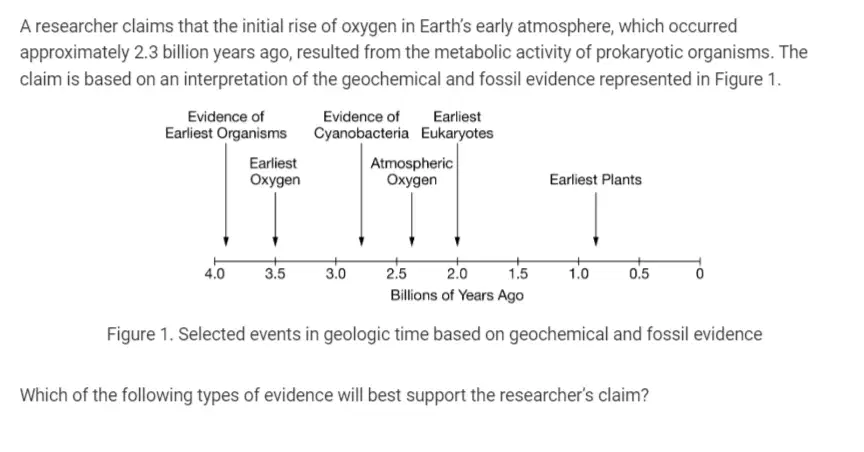
AP Classroom Question
Select the correct answer:
Which of the following types of evidence support the researcher's claim?
A. Evidence that some of the earliest eukaryotes used oxygen to produce ATP by cellular respiration.
B. Evidence that the earliest plants produced oxygen as a by-product of photosynthesis.
C. Evidence that some of the earliest organisms carried out photosynthesis without producing oxygen.
D. Evidence that the cyanobacteria produced oxygen as a by-product of photosynthesis.
Overview of Photosynthesis Notes
Select the correct answer:
The membranes of the _____________ contain chlorophyll, other light-absorbing molecules, and proteins. The stroma is the fluid that surrounds the grana inside a chloroplast.
A. photosynthesis
B. chlorophyll
C. thylakoid
D. light-dependent reactions
E. light-independent reactions
Overview of Photosynthesis Notes
Select the correct answer:
The function of the light-dependent reactions is to
a. build sugars.
b. capture and transfer energy.
c. release carbon dioxide.
d. form water molecules.
A.
B.
C.
D.
AP Classroom Question
Select the correct answer:
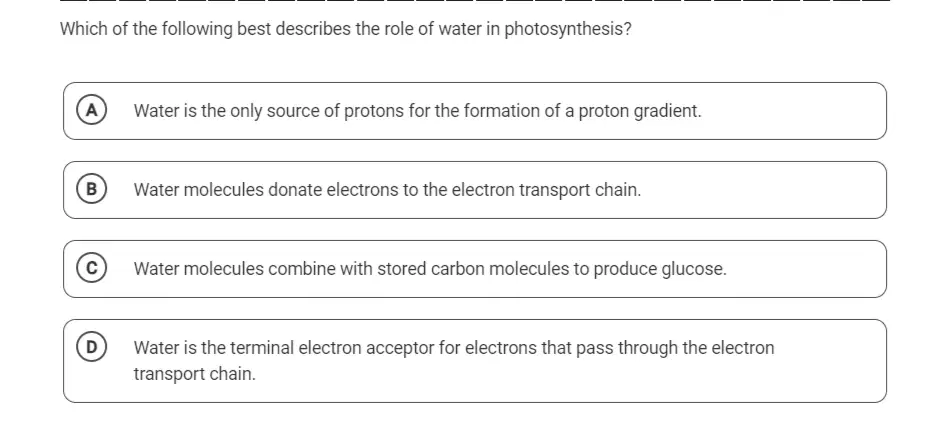
Which of the following best describes the role of water in photosynthesis?
A.
B.
C.
D.
Photosynthesis in Detail Notes
Select the correct answer:
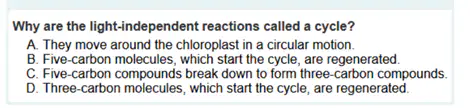
Why are the light-independent reactions called a cycle?
A.
B.
C.
D.
Photosynthesis in Detail Notes
True or False
According to the notes:
In photosystem II, chlorophyll and other-light absorbing molecules in the cell membrane absorb energy from sunlight.
A. True
B. False
Photosynthesis in Detail Notes
True or False
The first stage of photosynthesis captures and transfers energy.
A. True
B. False
Photosynthesis in Detail Notes
Fill in the blank
In photosystem I, chlorophyll and other light-absorbing molecules in the (a) membrane also absorb energy from sunlight.
Photosynthesis in Detail Notes
Select the correct answer:
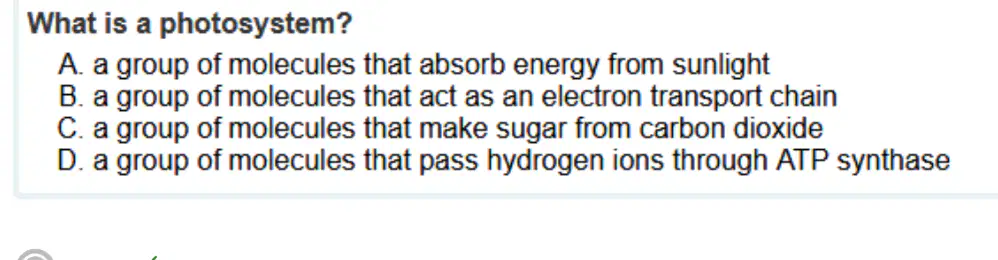
What is a photosystem?
A.
B.
C.
D.
Photosynthesis in Detail Notes
Select the correct answer:
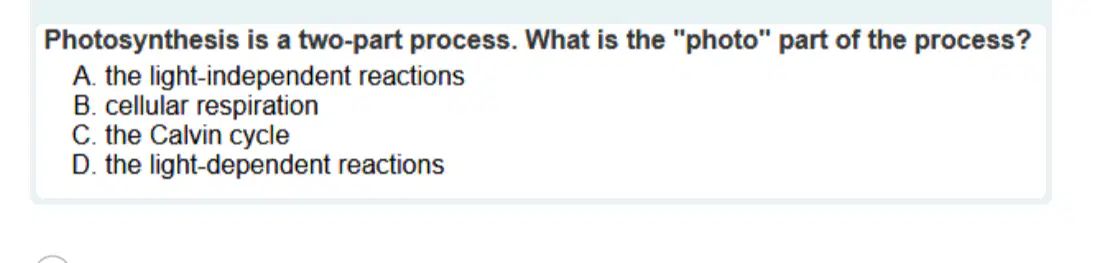
Photosynthesis is a two-part process. What is the "photo" part of the process?
A.
B.
C.
D.
Photosynthesis in Detail Notes
Select the correct answer:
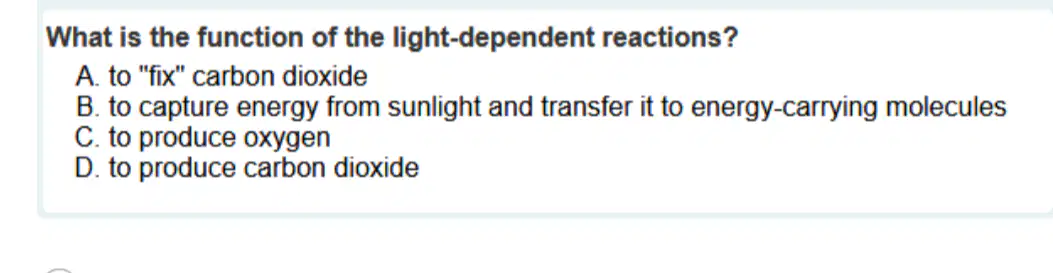
What is the function of the light-dependent reactions?
A.
B.
C.
D.
Photosynthesis in Detail Notes
Select the correct answer:
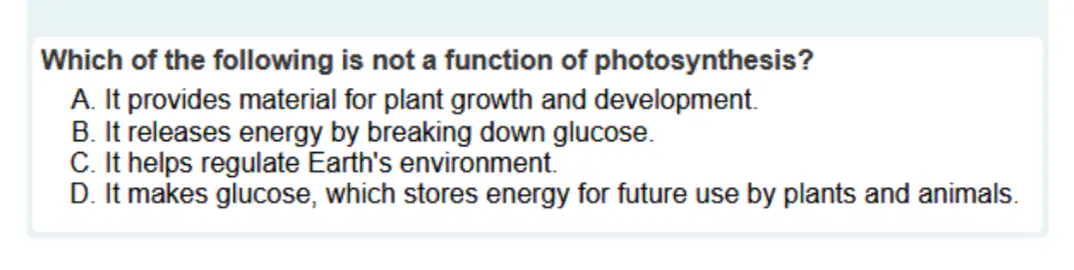
Which of the following is not a function of photosynthesis?
A.
B.
C.
D.
AP Classroom Question
Select the correct answer:
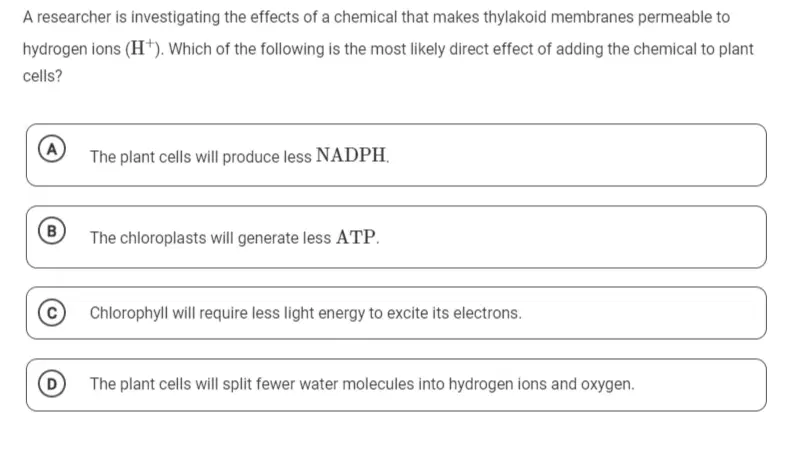
Which of the following is the most likely direct effect of adding the chemical to plant cells?
A.
B.
C.
D.
AP Classroom Question
Select the correct answer:
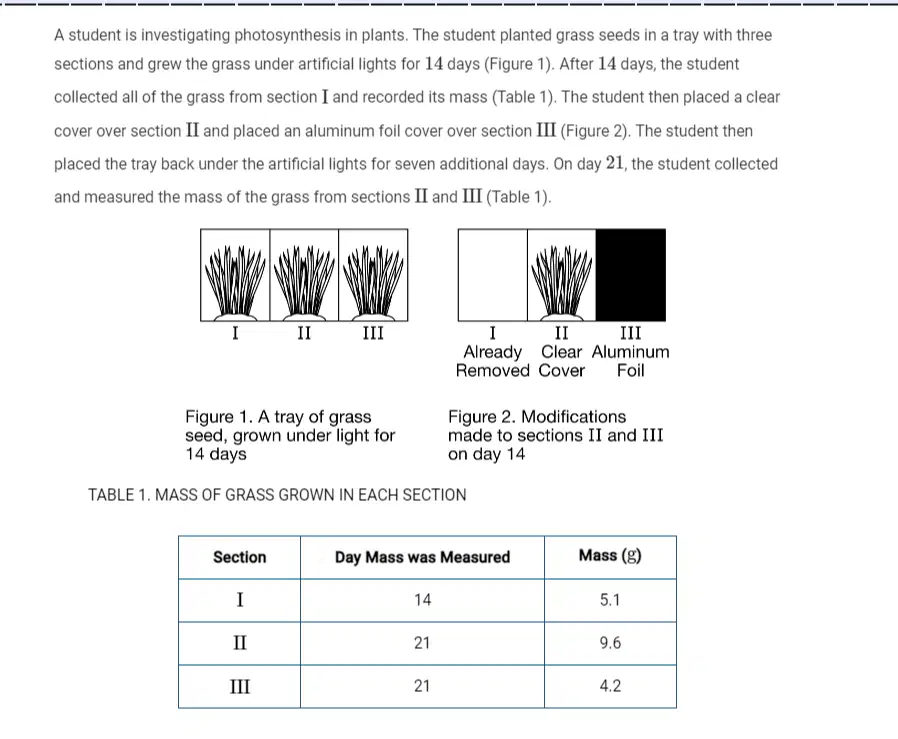
Which of the following best explains the connection between energy, growth, and the maintenance of an ordered structure.
A. Energy input from light is required for grass to grow and maintain an ordered structure.
B. The grass obtains the energy for growth and maintenance of order from nutrients from the soil.
C. The grass couples the release of energy from the light reactions with the production of oxygen used to produce sugars for growth.
D. Energy is required for the growth of the grass but not the maintenance of order.
Overview of Photosynthesis Notes
Select the correct answer:
Where in plant cells are the energy-absorbing molecules for photosynthesis located?
a. stroma
b. thylakoids
c. ATP synthase
d. mitochondria
A.
B.
C.
D.
Overview of Photosynthesis Notes
Select the correct answer:
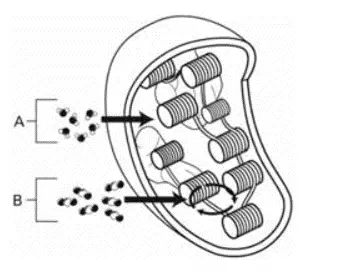
The water molecules labeled A in Figure 4.1 are going to the thylakoids to take part in which process?
a. light-dependent reactions
b. Krebs cycle
c. Calvin cycle
d. light-independent
reactions
A.
B.
C.
D.
Overview of Photosynthesis Notes
Select the correct answer:
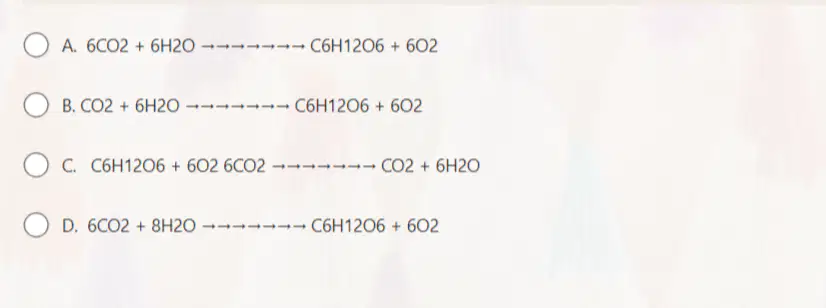
What is the correct chemical equation for photosynthesis?
A.
B.
C.
D.
Overview of Photosynthesis Notes
Select the correct answer:
The main light-absorbing molecules found in plant leaves are called
a. chloroplasts.
b. thylakoids
c. chlorophyll.
d. grana.
A.
B.
C.
D.
Overview of Photosynthesis Notes
Select the correct answer:
Which of the following statements best describes the process of photosynthesis?
a. Plants use oxygen to make simple sugars.
b. Chlorophyll builds sugars in the thylakoid membrane.
c. Light breaks down water molecules and releases carbon dioxide.
d. Chloroplasts absorb sunlight and store chemical energy.
A.
B.
C.
D.
Overview of Photosynthesis Notes
According to the notes:
True or False
Solar-powered calculators, homes, and cars are just a few things that use energy from
sunlight. In a way, you are also solar-powered. Of course, sunlight does not directly
give you the energy you need to play a sport or read this page. That energy comes
from ADP. Molecules of ATP are often made from the breakdown of sugars, but how
are sugars made? Plants capture some of the energy in sunlight and change it into
chemical energy stored in sugars.
A. True
B. False
Overview of Photosynthesis Notes
According to the notes:
True or False
Chlorophyll absorbs energy from sunlight. The energy is transferred
along the thylakoid membrane. Water molecules (H2O) are broken down.
Oxygen molecules (O2) are released.
A. True
B. False
Overview of Photosynthesis Notes
According to the notes:
True or False
Glucose and other simple sugars, such as fructose, are the only carbohydrates
that come from photosynthesis. Plants need the simple sugars to
build starch and cellulose molecules. In effect, plants need photosynthesis for
their growth and development.
A. True
B. False
Overview of Photosynthesis Notes
According to the notes:
True or False
The light-independent reactions use energy from the light-dependent
reactions to make sugars. These reactions occur in the thylakoid of chloroplasts.
Carbon dioxide molecules (CO2) are needed during this stage of photosynthesis.
A. True
B. False
Overview of Photosynthesis Notes
According to the notes:
True or False
The light-independent reactions capture energy from sunlight. These
reactions take place within and across the membrane of the thylakoids. Water
(H2O) and sunlight are needed for this stage of photosynthesis.
A. True
B. False
Overview of Photosynthesis Notes
According to the notes:
True or False
Chlorophyll (KLAWR-uh-fihl) is a molecule in chloroplasts, shown in
Figure 2.1, that absorbs some of the energy in visible light. Plants have two
main types of chlorophyll, called chlorophyll a and chlorophyll b. Together,
these two types of chlorophyll absorb mostly red and blue wavelengths of
visible light. Neither type absorbs much blue light. Plants have other light-absorbing
molecules that absorb green light, but there are fewer of these
molecules. As a result, the green color of plants comes from the reflection of
light’s green wavelengths by chlorophyll.
A. True
B. False
Overview of Photosynthesis Notes
According to the notes:
True or False
Chloroplasts in plant
cells contain a light-absorbing
molecule called chlorophyll.
A. True
B. False
Overview of Photosynthesis Notes
According to the notes:
True or False
Some organisms are called producers because they produce the source of
chemical energy for themselves and for other organisms. Plants, as well as
some bacteria and protists, are the producers that are the main sources of
chemical energy for most organisms on Earth. Certainly, animals that eat only
plants obtain their chemical energy directly from plants. Animals that eat
other animals, and bacteria and fungi that decompose other organisms, get
their chemical energy indirectly from plants. When a wolf eats a rabbit, the
tissues of the rabbit provide the wolf with a source of chemical energy. The
rabbit’s tissues are built from its food source—the sugars and other carbon-based
molecules in plants. These sugars are made through photosynthesis.
A. True
B. False
Topic 3.5 Photosynthesis
Daily Video 1
According to the notes:
True or False
ATP and NADPH transfer stored chemical energy to power the production of organic molecules in another pathway, called the Citric acid cycle
A. True
B. False
Topic 3.5 Photosynthesis
Daily Video 1
According to the notes:
True or False
Key Takeaways - #1 states
Plants and other autotrophs use pigments to trap light energy to make inorangic molecules.
A. True
B. False
Topic 3.5 Photosynthesis
Daily Video 1
According to the notes on:
Light-dependent reactions of photosynthesis in eukaryotes involve a series of pathways.
True or False
Oxygen is produced as a result of water hydrolysis.
A. True
B. False
Topic 3.5 Photosynthesis
Daily Video 1
According to the notes:
True or False
Key Takeaways - #2 states
The pigments used in the light-dependent reactions help transform light energy into chemical energy. The chemical energy is temporarily stored in the chemical bonds of carrier molecules, called NADPH.
A. True
B. False
Topic 3.5 Photosynthesis
Daily Video 1
According to the notes:
True or False
Key Takeaways - #3 states
The products of the light-independent reactions are ATP and NADPH.
A. True
B. False
Topic 3.5 Photosynthesis
Daily Video 1
According to the notes:
True or False
Key Takeaways - #4 states
ATP and NADPH are products that will be used in the Calvin cycle to produce carbohydrates.
A. True
B. False
Topic 3.5 Photosynthesis
Daily Video 2
According to the notes:
True or False
Key Takeaways - #1 states
Chlorophyll captures energy from sunlight and excites electrons.
A. True
B. False
Topic 3.5 Photosynthesis
Daily Video 2
According to the notes:
True or False
Key Takeaways - #2 states
As the electrons pass through the electron transport chain, protons are actively transported across a membrane, establishing a gradient. Protons diffuse through ATP synthase, powering ATP synthesis.
A. True
B. False
Topic 3.5 Photosynthesis
Daily Video 2
According to the notes:
True or False
Key Takeaways - #3 states
ATP, NADPH, and CO2 are used during the Calvin cycle to produce proteins through a series of reactions.
A. True
B. False
Topic 3.5 Photosynthesis
Daily Video 2
According to the notes:
True or False
Why is the hydrolysis of water necessary as it relates to PSII and the light-dependent reactions?
Answer: The hydrogen molecules from the splitting of water are released into the thylakoid space and used to create an electrochemical/proton gradient.
A. True
B. False
Topic 3.5 Photosynthesis
Daily Video 2
According to the notes:
True or False
Where do plants and other organisms mainly get their carbon dioxide from?
Answer: Plants and other organisms mainly get their carbon dioxide from the environment.
A. True
B. False
Topic 3.5 Photosynthesis
Daily Video 2
According to the notes:
True or False
What is the ultimate goal of the Calvin cycle reactions?
Answer: Make organic products that plants need using the products from the light reactions of photosynthesis.
A. True
B. False
Topic 3.5 Photosynthesis
Daily Video 2
According to the notes:
True or False
What is ATP synthase?
Answer: ATP synthase is an enzyme that creates ATP when electrons pass through the enzyme.
A. True
B. False
Topic 3.5 Photosynthesis
Daily Video 2
According to the notes:
True or False
What is an electrochemical/proton gradient?
Answer: It is a difference in concentration of protons (Hydrogen ions) across a membrane.
A. True
B. False
Topic 3.5 Photosynthesis
Daily Video 2
According to the notes:
True or False
How are PSII and PSI functionally related to the electron transport chain (ETC)?
Answer: o PSII and PSI pass high-energy electrons to the Krebs cycle.
A. True
B. False
Topic 3.5 Photosynthesis
Daily Video 2
According to the notes:
True or False
What role do chlorophylls play in this process?
Answer: Capture energy from sunlight and convert it to high-energy protons.
A. True
B. False
Topic 3.5 Photosynthesis
Daily Video 2
According to the notes:
True or False
What is a photosystem?
Answer: Light-capturing unit in a chloroplast's thylakoid membrane.
A. True
B. False
Topic 3.5 Photosynthesis
Daily Video 2
According to the notes:
True or False
What happens to chlorophyll electrons when light absorption occurs, and what is the importance of this?
Answer: Electrons will be energized. The energy from the electrons will be used to established a proton gradient and reduce NADPH to NADP+.
A. True
B. False
Topic 3.5 Photosynthesis
Daily Video 2
According to the notes:
True or False
What will we learn - # 1
What is chlorophyll’s role in boosting electron energy levels?
A. True
B. False
Topic 3.5 Photosynthesis
Daily Video 2
According to the notes:
True or False
What will we learn - # 2
How do photosystem I and II (PSI and PSII) work together to create an electron gradient which facilitates ATP synthesis?
A. True
B. False
Photosynthesis Notes
Select the structure that represents the membrane bound disk responsible for the light dependent reaction.
Photosynthesis Notes
The light dependent reactions take place in the (a) . The products of the light dependent reactions are (b) gas, (c) (energy), and (d) .
Photosynthesis Notes
The conversion of ADP into ATP occurs in the (a) reaction.
Photosynthesis Notes
What is the primary role of chlorophyll in photosynthesis?
Answer: (a)
To absorb water
To produce glucose
To release oxygen
Photosynthesis Notes
Match the following
The first phase of photosynthesis, where water undergoes hydrolysis and electrons are energized.
PHOTOSYSTEM II
The phase of photosynthesis where electrons lose energy by turning a hydrogen pump.
ELECTRON TRANSPORT CHAIN
The phase of photosynthesis where electrons are re-energized.
PHOTOSYSTEM I
The protein found in photosynthesis where ATP is generated.
ATP SYNTHASE

