
Font size
 Worksheets
Miller Biology Chapter 2 study Slides
Total questions: 85
Worksheet time: 1hrs 12mins
What is the chemical formula for water?
HO
2HO
H2O
HO2

Refer to the picture; the meniscus is occurring because of:
Adhesion
Cohesion
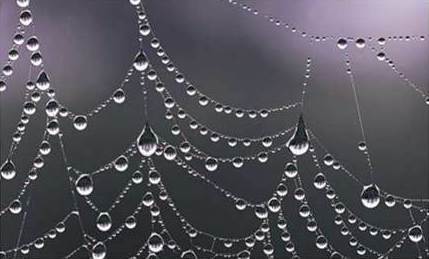
Refer to the picture; the water is sticking to the spider web because of:
Adhesion
Cohesion
Describe COHESION.
Water molecules attracted to other substances.
Water molecules climbing upwards against the force of gravity.
Water molecules dissolving many substances because of its polarity.
Water molecules attracted to other water molecules.
Describe ADHESION.
Water molecules attracted to other substances.
Water molecules climbing upwards against the force of gravity.
Water molecules dissolving many substances because of its polarity.
Water molecules attracted to other water molecules.


Attractions between water molecules are called
Covalent bonds
Ionic bonds
Polar bonds
Hydrogen bonds
Why does ice float?
As water freezes, the molecules move farther apart and its density decreases.
As water freezes, it takes up more hydrogen from the atmosphere
As water freezes, air becomes trapped between the water molecules.
As water freezes, it takes up more oxygen from the atmosphere
How many hydrogens are in THREE molecule of H2O?
2
3
4
6
Why can water striders walk across the surface of water without falling through?
They are light enough so they don't break the hydrogen bonds holding the water molecules together
The insects actually use their wings to hover slightly above the water’s surface
The insect’s feet are non-polar, so they are repelled by the polar water molecules and are pushed away from the water’s surface.
The insects are small enough to see the individual water molecules, so they are able to step carefully from one molecule to the next
Which end of the water molecule has a slightly positive charge?
the oxygen end
the hydrogen end
both ends are slightly positive
neither end is positive
Which term refers to water having a slightly positive and a slighty negative charge on its ends?
cohesion
surface tension
polar
adhesion
Why does water moderate temperature so well?
It does not allow heat in between the hydrogen bonds.
More energy is needed to break all the hydrogen bonds, or rebuild them, between water molecules.
Water has high energy all the time, so it can't heat up any more.
The polarity of the water molecule resists the added energy, causing water to stay the same temperature.
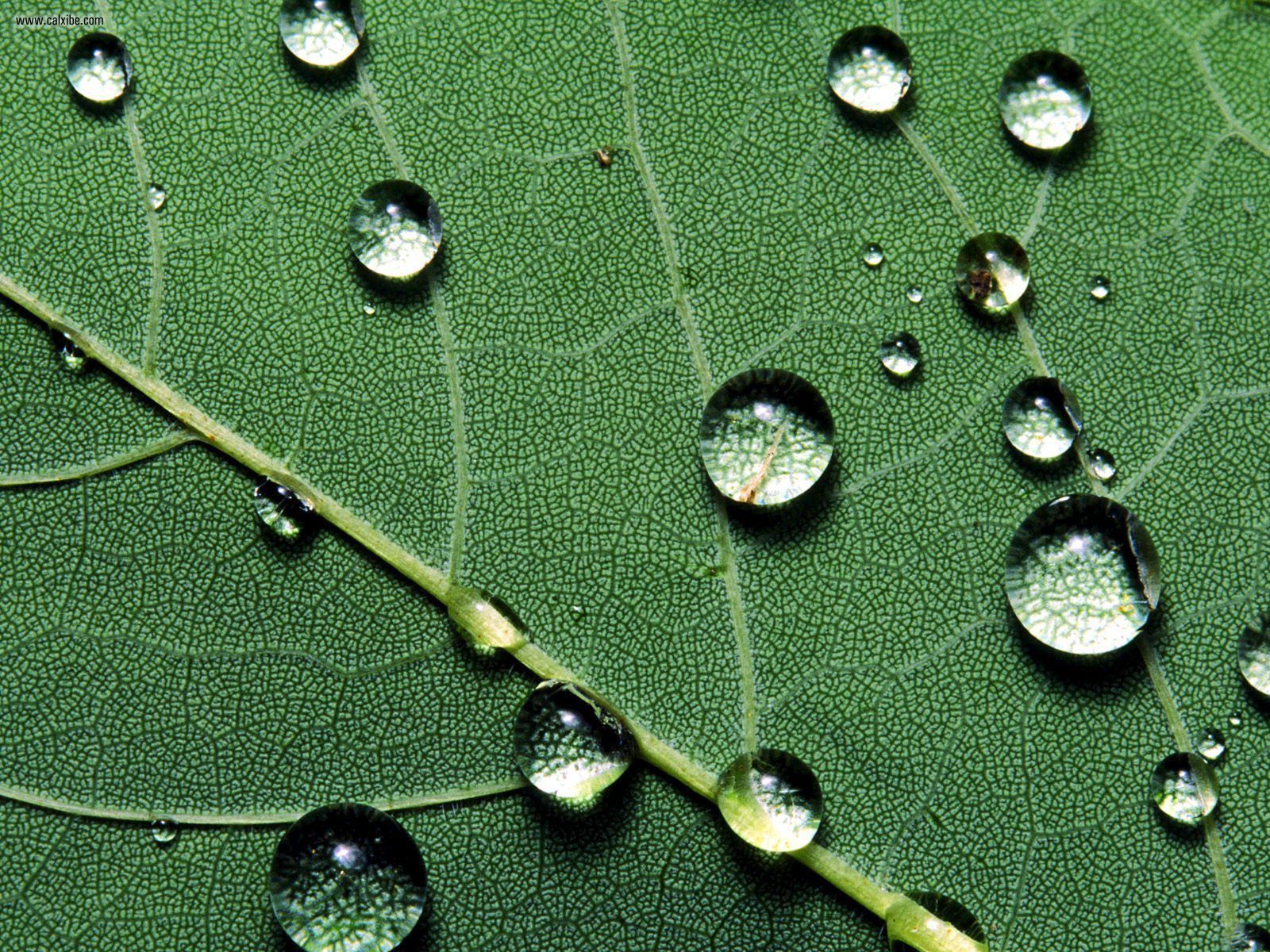
Refer to the picture; the water droplets are sticking to the leaf because of:
Adhesion
Cohesion
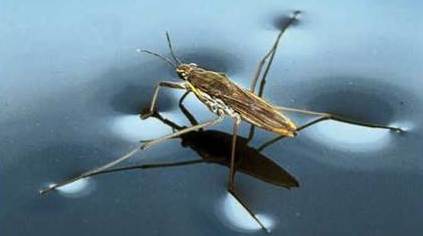
Refer to the picture; the insect is not falling through the water because of:
Adhesion
Cohesion
Which end of the water molecule has a slightly negative charge?
the oxygen end
the hydrogen end
both ends are slightly negative
neither end is negative
Why is water so good at dissolving so many substances?
it is polar
it is less dense as a solid
cohesion
adhesion
Monomers are linked together with this type of reaction, water is lost.
condensation
hydrolysis
double displacement
decomposition
The 1:2:1 ratio of carbon to hydrogen to oxygen is seen in which group of macromolecules?
carbohydrates
proteins
lipids
nucleic acids
Three fatty acids bonded to one molecule of glycerol forms a:
lipid
carbohydrate
monosacharride
amino acid
A molecule composed of many repeating subunits is called:
a polymer
a monomer
an enzyme
a lipid
Which of the following is not an example of a carbohydrate?
wax
sugars
starches
cellulose
The part of an amino acid that gives the amino acid its unique shape and determines its properties is the:
amino group
hydroxyl
carboxyl
R group
In the equation V + XYXZ ----> XY + XZ + V, the enzyme would be:
V
XZ
XYXZ
XY
Which of the following is a function of the nucleic acids?
store and transmit genetic information
used to store energy
used for structural purposes in plants
used to insulate the body
The monomer to proteins are:
amino acids
glycerol
nucleotide
saccharides
Monomer for carbohydrates are:
fatty acid chains
amino acids
nucleotides
monosaccharides like glucose
A monosaccharide is a:
carbohydrate
protein
lipid
nucleic acid
A long chain of amino acids bonded together is called a:
polypeptide
disaccharide
polysaccharide
nucleic acid
Which of the following macromolecules is the main energy source of all living things?
carbohydrates
lipids
nucleic acids
proteins
Which of the following is NOT a function of proteins?
used to store and transmit genetic information
used for structural purposes such as bones and muscles
used to fight disease (antibodies)
they can be used to transport substances (hemoglobin)
Small, simple molecules that are joined together to form much larger molecules are called:
monomers
polymers
ions
functional groups
Which of the following is NOT considered a use for lipids?
used as the structural component of the cell wall of plants
used to insulate the body
important components of the cell membrane
help form waterproof coverings
Small clusters of atoms attached to carbon skeletons that give the molecule a unique shape and determine the properties of the molecule are known as:
functional groups
monomers
enzymes
macromolecules
Giant molecules!
macromolecules
micromolecules
really really big molecules
tiny so small molecules
The functional group that has a cluster of atoms with the formula PO4.
phosphate
carboxyl
hydroxyl
amino
Quick energy foods.
carbohydrates
lipids
proteins
nucleic acids
What class of compounds have carbon atoms bonded to other carbon atoms?
organic
inorganic
Type of protein that speeds up the rate of chemical reactions? It is a catalyst.
enzymes
hormones
antibodies
saccharides
What name is given to a sugar consisting of two saccharides bonded together to form the monomer?
disaccharide
monosaccharide
unisaccharide
polysaccharide
Starch and glycogen are good examples of a polysaccharide because:
both have many saccharides per monomer
both have one saccharide per monomer
both have 2 saccharides per monomer
both do not have a monomer
What type of reaction breaks down large polymers into their monomers?
hydrolysis
condensation
synthesis
double displacement
Type of lipid that is important structural basis for cell membranes.
phospholipid
triglyceride
wax
saccharide
Fatty acid that has no carbon-carbon double bonds.
saturated
unsaturated
polysaturated
peptide
Fatty acid that has at least one carbon-carbon double bond, found in plant oils.
unsaturated
saturated
polypeptide
nucleotide
What name is given to the type of covalent bond that links together the amino acids in a protein?
peptide
glycosidic
glycerol
hydroxyl
Enzymes belong to which group of organic compounds?
proteins
lipids
carbohydrates
nucleic acids
The reactants to an enzyme catalyzed reaction.
substrates
active site
peptide
enzyme- substrate complex
Place on the enzyme where the substrate fits.
active site
peptide
monomer
saccharide
Enzymes are re-useable.
true
false

What monomer is this?
amino acid
saccharide
glucose
nucleotide
What are the two building blocks to a lipid?
glycerol and fatty acids
nucleotides and peptides
amino acids and nucleotides
glycerol and peptides

What group of macromolecule is shown in the diagram?
lipids
carbohydrates
proteins
nucleic acids

What monomer is shown?
nucleotide
saccharide
glycerol
amino acid

What monomer is this?
saccharide
fatty acid
nucleotide
amino acid
What group of macromolecules consists of carbon, hydrogen, and oxygen BUT the ratio of carbon and hydrogen is much higher than oxygen.
lipids
carbohydrates
proteins
nucleic acids
This macromolecule consists of carbon, hydrogen, oxygen, and nitrogen.
proteins
carbohydrates
nucleic acids
lipids
Which of the following is NOT a macromolecule?
carbon dioxide
carbohydrates
lipids
proteins
What characteristics of Carbon allow it to form a variety of biological macromolecules?
has 4 valence electrons available for bonding
readily forms 4 covalent bonds with other carbon atoms as well as a variety of other elements
carbon atoms bond with other carbon atoms to form long chains or rings
in nature, carbon is readily available and very abundant
all are characteristics of carbon that make it the ELEMENT OF LIFE
In the equation V + XYXZ ----> XY + XZ + V, the substrate would be?
XYXZ
V
XY
XZ
In the equation V + XYXZ ----> XY + XZ + V, the products would be:
XYXZ
XY + XZ
V
XY
Organic compounds are compounds that contain ___________ atoms.
carbon
iron
magnesium
helium
Label the parts of the enzyme model
Click on the temperature that this enzyme is having optimum activity.

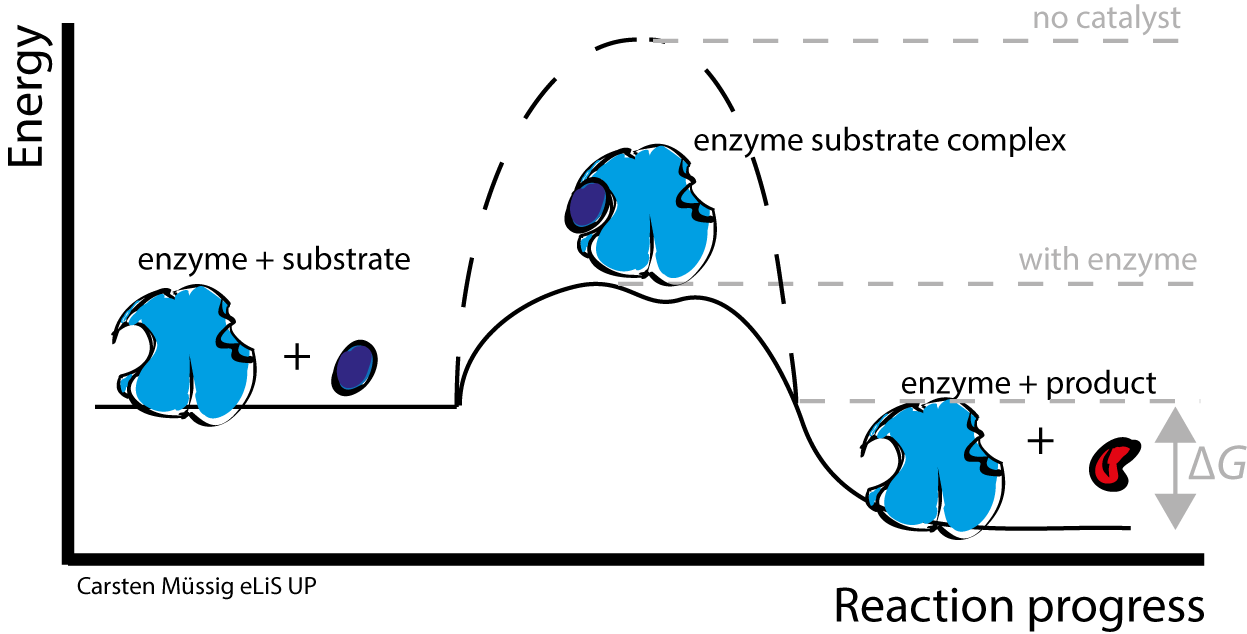
What is the purpose of an enzyme?
control how many reactions occur
raise activation energy
give permission for the reaction
speed up chemical reactions
Enzymes are (a) that (b) chemical reactions by (c) the amount of activation energy required to start the reaction.
Match the following Macromolecules to its structure

Carbohydrate

Lipid

Nucleic Acids

Protein
Enzymes act on many different substrates
True
False
Enzyme can be used again and again
True
False
Substances with a pH of 7 are
Acidic
Basic
Neutral
Saturated

