
 Worksheets
C2W6
Total questions: 106
Worksheet time: 1hrs 24mins
A push or a pull
Force
Applied Force
Normal Force
A force that move an object towards you
Force
Push
Pull
A force that moves an object away from you
Force
Push
Pull
A force applied by a person or object onto another object
Applied Force
Push
Pull
A force that opposes motion
Applied Force
Friction
Normal Force
A force exerted by magnets
Gravity
Electric
Magnetic
A force exerted by electrically charged particles or objects
Gravity
Electric
Magnetic
A force that occurs when two objects do not physically touch each other
Contact Force
Non-Contact Force
A force that occurs when two objects physically touch each other
Contact Force
Non-Contact Force
A force exerted by a surface onto an object resting on that surface
Applied Force
Normal Force
Friction
The combined result of all forces acting on an object
Newtons
Net Force
Contact Force
When the forces acting on an object are equal and balanced
and have a net force of 0N.
These forces do not create motion.
Balanced Forces
Unbalanced Forces
When the forces acting on an object are not equal and balanced
and net force is anything except 0N.
These forces always create motion.
Balanced Forces
Unbalanced Forces
The movement of an object
Unbalanced Forces
Newtons
Motion
A liquid that reduces friction by making the surface smoother
Lubricant
Unbalanced Force
Friction
an act of changing physical location or position of an object
Motion
Movement
Unbalanced Force
A force of attraction between objects with mass
Electric Force
Gravity
Magnetic Force
What is a force?
the PUSH or PULL on an object
The MOTION an object creates
The objects HITTING one another
Going REALLY FAST
A ____ force is the sum of forces felt by an object.
sum
net
strong
balanced


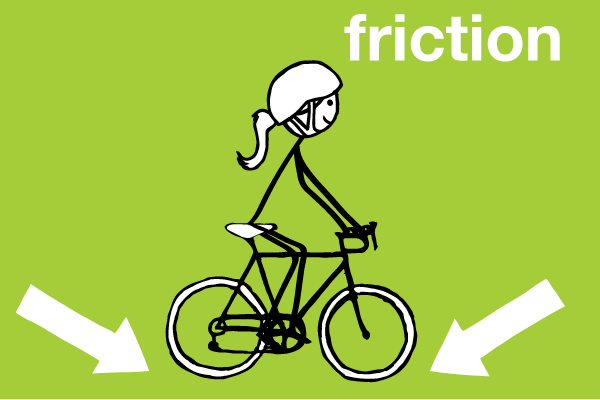
What is Friction?
How much something weighs
When 2 objects slide against each other
How fast something is going
What are EQUAL forces acting on an object in opposite directions that do not change the object's motion?
Friction
Weight
Balanced Forces
Unbalanced Forces
Is a force that pulls objects toward each other and down to the ground
Force
Friction
Gravity
weight

This is an example of _____ because the object WILL move.
Unbalanced Forces
Balanced Forces
Neither

What are 3 ways to describe MOTION? (Unbalance force causes this)
Gravity, Magnetism, Friction
Speed, Direction, Position
Rough, Smooth, Lubricants
The moon orbiting the Earth at a constant speed.
Balanced Force
Unbalanced Force
A lamp sitting on a table.
Balanced Force
Unbalanced Force
A car accelerating around a mountain curve.
Balanced Force
Unbalanced Force
A book sitting on a shelf.
Balanced Force
Unbalanced Force
A rocket lifting off the launch pad.
Balanced Force
Unbalanced Force
The location or place of an object.
Position
Reference Point
Push
Dimension
Idea that the observation of motion depends on the observer.
Position
Reference Point
Relative Motion
Dimension
Measurable quantity of a particular kind such as; length, breadth, (width) depth, or height.
Position
Dimension
Reference Point
Speed
A measure of how fast something moves or the distance it moves, in a given amount of time.
Motion
Position
Acceleration
Speed
A measure of how quickly the velocity is changing.
Acceleration
Speed
Motion
Velocity
A force that moves an object away from another object.
Gravity
Push
Pull
Motion
Speed in a specific direction
Velocity
Motion
Speed
Acceleration
When two forces acting upon each other are equal in size preventing motion.
Push
Motion
Unbalanced Forces
Balanced Forces
Starting point you choose to describe the location (or position) of an object.
Reference Point
Relative Motion
Acceleration
Dimension
Change of position over time, an objects distance and direction from a reference point.
Speed
Acceleration
Motion
Relative Motion
Push or a pull
Force
Gravity
Speed
Motion
Force objects exert on each other because of their masses.
Gravity
Push
Pull
Net Force
Force that moves an object closer to another object.
Pull
Force
Push
Motion
When two forces acting upon each other are not equal in size causing motion.
Unbalanced forces
Balanced forces
Motion
Net force
The resistance of an object to a change in the speed or direction of its motion.
Inertia
Friction
Gravity
Force
Overall force acting on an object when all of the forces on it are combined.
Balanced force
Contact force
Net force
Force
When one object pushes or pulls another by touching.
Balanced force
Contact force
Unbalanced force
Net force
A force that resists motion when 2 surfaces rub together.
Friction
Gravity
Force
Balanced force
Pushing or pulling an object that is ___ already moving can make that object start to move.
not
Pushing or pulling an object that is ___ moving can make the object speed up, slow down, stop, or change direction.
A ___ is required to change the velocity of an object.
temperature
force
How an object changes ___ depends on the direction of the force exerted on that object.
velocity
Forces ___ in strength.
The ___ of a force affects how the velocity of the object changes.
strength
A ___ force can cause a greater change in velocity.
stronger
Friction is a force exerted in the direction opposite to an object's motion, which means friction will cause an object’s velocity to ___.
Understanding a cause-and-effect relationship can help you infer what led to a particular ___.
The same ___ force can affect the velocity of different objects in different ways.
strength
The velocity of an object can be determined by dividing the distance traveled by the ___ it took to travel that distance.
Advances in ___ influence the progress of science and science has influenced advances in technology.
If the same strength force is exerted on two objects but the objects have different masses, the object with less mass will have a greater change in ___.
In a ___ between objects, a force is exerted on each object, and that affects each object’s velocity.
Asking ___ is an important strategy that scientists use when reading to check their understanding.
questions
A natural time to ask a ___ question is when one encounters something in the text that seems unfamiliar, curious, or confusing.
deep
When two objects collide, a force is exerted on each object. The two forces are exerted in opposite directions, but they are the same ___.
strength
Even though the force exerted on each object in a collision is the same strength, if the objects have different ___, their changes in velocity will be different.
masses
Scientists use their understanding about cause-and-effect relationships from one situation to make ___ in other, similar situations.
Scientists consider all available evidence before constructing ___ and making recommendations.
arguments
What is Force
push
pull
both
all of the above
What is the correct example for force
someone letting go of a balloon and it is in the air
A moving bike stops when brakes are applied
non of the above
Motion is the change in the position of an object.
True
False
Push and Pull
Force
Motion
What is an example of motion. #more than one answer
circular
applied force
linear
rotational
Which force is being applied by a vendor when he is pushing the pushcart
Muscular force
Magnetic force
Friction
Electrostatic force
What will happen to the speed of a car when the driver applies the brakes
speed increases
speed decreases
no change in speed
change in direction
What is magnetic force?
a force which is exerted by every object in the universe
a force applied by a magnet
a force applied by muscles of human or animal
What is the unit of measure for force
kilograms
meters
newtons
Newton's first law is also called
Law of Inertia
Law of acceleration
Law of action and reaction
Force and Motion are the same
True
False
Newton’s law states that for every action, there is an ________ reaction.
unequal and opposite
equal and similar
stronger and opposite
equal and opposite

When a small car pushes a big truck, the truck applies an equal and opposite force on the car.
False
True

When a cannon fires a cannonball we observe Newton's third law. Which is the reaction force?
The cannon moving forward
The cannon moving backwards
The cannonball moving backwards
The cannonball moving forward
Action reaction forces never cancel each other out because
They act on different objects.
They act on the same objects
They do not act on objects.

How is this an example of Newton’s Third law?
Only the ball is using the head
They are both exerting an equal force on each other
Only the head is pushing the ball
If two people with the same mass collide, they experience the same amount of force.
True
False
Action-reaction pairs can cause a change in motion.
True
False

Force always come in________
waves
triplets
pairs

When a heavy football player and a light one run into each other, who exerts more force
The light one
Their force are equal
The heavy one

The forces in a force pair are in _______ direction
opposite
same


What will happen if the Action is greater than the Reaction?
The man will fall
The boat will sink
Nothing will happen

What happens to the balloon if the air is released ?
Balloon goes right
Balloon goes up
Balloon goes down
Balloon goes left
if one object A exerts a force on a second object B, then B exerts a force on A, and the two forces are equal in magnitude and opposite in direction
true
false
Are you pulling on the earth
yes
no
maybe
depends on how i'm feeling
Which ISN'T part of newton's 3rd law
Jumping off the ground
Hitting a baseball
Rain in the sky
A car sitting on the road

A book pushes down on a table with a force of 5N, the table..
Pushes back with a force of 5N
Pushes back with a force less than 5N
Pushes back with a forcec greater than 5N
Does nothing. A table has no force.
Newton's are the unit used to measure...
energy
force
weight
mass
All forces occur in pairs
true
false

