

Wayground logo

Free Printable Worksheets

Font size

S
M
L
XL
Worksheets

Year 9 October 2024 Physics Assessment

Total questions: 80

Worksheet time: 2hrs 41mins
Name
Class
Date
1.
If F is force, k is spring constant and x is extension, Hooke's Law tells us that:
a)
F=k/x
b)
x=Fk
c)
k=Fx
d)
F=kx
2.
A spring extends 1.5m under load 10N. What is its spring constant?
a)
0.15N/m
b)
10N/m
c)
6.7N/m
d)
15N/m
3.
Which of the following springs is the stiffest?
a)
A spring that requires a froce of 2000 N to compress it by 6.8 m.
b)
A spring that requires a force of 4000 N to stretch it by 9.0 m. 
c)
A spring that requires a force of 8000 N to compress it by 45 m.  
d)
A spring that requires a force of 4800 N to stretch it by 14 m.
4.
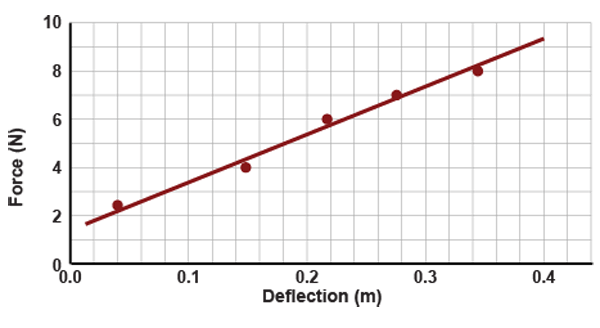
What Quantity can you calculate from the graph and give the magnitude of that quantity.  
a)
distance 4.5 m
b)
Force 15 N
c)
spring constant 20 N/m
d)
spring constant 200 N/m
5.
A net force of 430 N acts to stretch an extension spring.  How far will the spring stretch if its spring constant is 700 N/m?
a)
43.9
b)
0.307 m
c)
1.63 m
d)
0.614 m
6.
A 5-newton force causes a spring to stretch 0.2 meter. What is the potential energy stored in the stretched spring?
a)
1 J
b)
0.5 J
c)
0.2 J
d)
0.1 J
7.
An unstretched spring has a length of 0.10 meters. When the spring is stretched by a force of 16 newtons, its length is increased to 0.18 meters. What is the spring constant of this spring? 
a)
0.89 N/cm 
b)
2.0 N/cm 
c)
1.6 N/cm 
d)
1.8 N/cm
8.
Which statement most accurately represents Hooke's Law?
a)
a) Extension of a spring is proportional to the force applied.
b)
b) Extension of a spring is proportional to the number of coils.
c)
c) Extension of a spring is inversely proportional to the force applied.
d)
d) Thickness of a spring wire is proportional to the force applied.
9.
What force should be applied to compress a spring by 0.013 m if its spring constant is k = 1900 N/m?
a)
1880 N
b)
24.7 N
c)
1900 N
d)
0.127 N
10.
This spring has a constant of 80 N/m.  What is the elastic potential energy stored in the spring?  The dotted green line represents the spring's equilibrium position and the green vector is displacement.
a)
Energy is conserved, it cannot be stored.
b)
5 N
c)
20 N
d)
40 N
11.
Which position shows the spring with maximum elastic potential energy?
a)
A
b)
B
c)
C
d)
D
12.

a spring with a stiffness of 120 N/m is stretched for 15 cm by a heavy back suspended on it. then the elastic potential energy stored by the spring is:

a)

15 J

b)

1.35 J

c)

120 J

d)

9 J

13.
The flow/movement of electric charges 
a)
Voltage
b)
Resistance 
c)
Current 
d)
Circuit 
14.
Resistance is
a)
an objects ability to resist Voltage
b)
an objects ability to resist resistance
c)
An objects ability to resist current
d)
An objects resistance to temptation
15.
What is the resistance, if the voltage is 9 V and the Current is 3 Amps?
a)
.33
b)
27
c)

6

d)
3
16.
Static electricity is defined as
a)
No current
b)
generator
c)
balanced
d)
an imbalance of charge
17.
If two objects repel, what can there charges be?
a)
negative and negative, positive and positve
b)
positive and negative or negative and neutral,
c)
negative and neutral, positive and positive
d)
Your mom
18.
If you transfer all your electrons to a piece of paper, what charge are you?
a)
neither
b)
neutral
c)
negative
d)
positive
19.
What is the current if the resistance is 20 ohms, and the voltage 100 V?
a)
20 Amps
b)
5 Amps
c)
.2 Amps
d)
2000 Amps
20.
Electrical charges are strongest when the charges are
a)
far apart
b)
close together
c)
the same everywhere
d)
"One hunnerd"
21.
If the battery produced 12.6 Volts and what would be the current flow be for a 6 Ohm resistor
a)
2.1 Amps
b)
2.4 Amps
c)
1.71 Amps
d)
15 Amps
22.
What is current measured in?
a)
Ω (Ohms)
b)
V (Volts)
c)
A (Amps)
d)
W (Watts)
23.
What is resistance measured in?
a)
Ω (Ohms)
b)
V (Volts)
c)
A (Amps)
d)
W (Watts)
24.
How do you calculate voltage?
a)
Current X Resistance
b)
Resistance ÷ Current
c)
Current ÷ Resistance
d)
Measure it with a ruler
25.
How do you calculate current
a)
Resistance X Voltage
b)
Voltage X Resistance
c)
Resistance ÷ Voltage
d)
Voltage ÷ Resistance
26.
The accumulation of excess electric charge on an object is called
a)
Static electricity 
b)
Electric discharge
c)
Resistance
d)
Circuit 
27.
Which of the following is caused by static electricity?
a)
a stove getting hot when it is turned on
b)
a magnet being attracted to a refrigerator
c)
a lightning strike during a storm
d)
a light bulb coming on when a switch is turned on
28.
With the engine running the charging system produces 14.5 Volts what would the current flow be if a resistance of 6 Ohms was present
a)
2.41 Ohms
b)
2.52 Ohms
c)
2.1 Ohms
d)
0.3333 Ohms
29.

Which is not a unit we used when learning about Ohm's Law?

a)

ohm

b)

Amp

c)

watts

d)

volts

30.
What is the Voltage of a circuit that has a resistance of 5 Ω and a current of 2 A?
a)
25 V
b)
10 V
c)
2.5 V
d)
0.4 V
31.
If the Voltage is increased and the resistance stays the same, Current will
a)
Increase
b)
Decrease
c)
Stay the same
d)
X
32.

Which Law? An object in motion will stay in motion, An object at rest will stay at rest unless acted upon by an unbalanced force

a)

First Law of Motion

b)

Second Law of Motion

c)

Third Law of Motion

d)

Fourth Law of Motion

33.

Which Law? For every action there is an equal and opposite reaction OR forces occur in equal and opposite pairs

a)

First Law of Motion

b)

Second Law of Motion

c)

Third Law of Motion

d)

Fourth Law of Motion

34.

Which Law? Force is related to mass and acceleration.

Force = mass x acceleration OR (f = ma)

a)

First Law of Motion

b)

Second Law of Motion

c)

Third Law of Motion

d)

Fourth Law of Motion

35.

What is inertia?

a)

The amount of matter in an object

b)

A push or pull resulting from the interaction of an object.

c)

The tendency of an object to resist changes in motion

d)

A ratio of the amount of mass to the amount of acceleration

36.

What is Mass?

a)

The amount of matter in an object.

b)

A push or pull resulting from the interaction of an object.

c)

The change in speed (velocity) with respect to time.

d)

The tendency of an object to resist changes in motion (things want to keep doing what they are already doing).

37.

How much force is needed to accelerate 100 kg at a rate of 2 m/s/s? (F=MA)

a)

100 N

b)

200 N

c)

50 N

d)

120 N

38.

What is the mass of an object moving at 5 m/s/s with a force of 500N (F=ma)

a)

100 N

b)

50 N

c)

2500 N

d)

1000 N

39.

If Spiderman is pulling on a box to the left with 10 Newtons of force, and Iron Man is pulling on the box to the right with 30 Newtons of force, which way is the box going to move?

a)

To the left

b)

To the right

c)

It won't move at all

d)

The box will be smashed

40.

A boy pulls a wagon with a net force of 6 N to the left as another boy pushes it with a force of 4 N to the left. What is the net force?

a)

6 N to the left

b)

2 N to the left

c)

10 N to the Left

d)

2 N to the Right

41.

A resultant force of 4.0N acts on an object of mass 0.50 kg for 3.0 seconds.

What is the change in velocity caused by this force?

a)

4.0 m / s

b)

6.0 m / s

c)

12 m / s

d)

24 m / s

42.

Two perpendicular forces act on an object as shown in the diagram. What is the magnitude of the resultant force on the object?

a)

17 N

b)

13 N

c)

7.0 N

d)

5.0 N

43.

Two forces, A and B, act simultaneously at point O as shown on the diagram. The magnitude of the resultant force is closest to

a)

8.0 N

b)

11 N

c)

15 N

d)

16 N

44.

Two students push on a sled. One pushes with a force of 30. newtons east and the other exerts a force of 40. newtons south, as shown in the topview accompanying diagram. Which vector best represents the resultant of these two forces?

a)

b)

c)

d)

45.
a)
17
b)
149
c)
3
d)
12.2
46.

A 5.0-newton force could have perpendicular components of

a)

1.0 N and 4.0 N

b)

2.0 N and 3.0 N

c)

3.0 N and 4.0 N

d)

5.0 N and 5.0 N

47.

A force of 6.0 newtons north and a force of 8.0 newtons east act concurrently on an object. The magnitude of the resultant of the two forces is

a)

1.3 N

b)

2.0 N

c)

10. N

d)

14 N

48.
How do you combine vectors if they are at a right angle to each other, and you know two sides?
a)
Multiply
b)
Divide
c)
Pythagorean Theorem
d)
Use trigonometry
49.

In practice A of the figure, what is the direction of the resultant displacement?

a)

63 degrees, South of East

b)

27 degrees, North of West

c)

27 degrees, West of North

d)

63 degrees, South of West

50.
In practice A of the figure, What is  the magnitude of the  resultant displacement?
a)
5 km 
b)
8 km
c)
11 km
d)
15 km
51.

A person walks first 10 km north and 20 km east, then the resultant vector is

a)

22.36km

b)

22.46 km

c)

22.36

d)

20.36 km

52.

An airplane flies at 250 m/s to the east with respect to the air. The air is moving at 35 m/s to the north with respect to the ground. Find the resultant velocity of the plane with respect to the ground.

a)

252 m/s

b)

222 m/s

c)

435 m/s

d)

125 m/s

53.

Choose the points that are collinear.

a)

A, B, and C

b)

A, C, and D

c)

A, E, and F

d)

B, C, and D

54.

Are the points D, G, and F coplanar?

a)

Yes

b)

No

55.

Choose the points that are non-coplanar.

a)

D, E, and F

b)

D, H, and F

c)

F, D, and G

d)

G, E, and D

56.
How would you describe points I, L, C?
a)
collinear
b)
non-coplanar
c)
symmetric
d)
coplanar
57.
Give another name for line k.
a)
Line BC
b)
Line BCE
c)
Line ED
d)
Line k is the only name, there isn't another name.
58.
This represents a ...
a)
Plane
b)
piece of paper
c)
line
d)
I don't know
59.

It is a set of points that are on the same line.

a)

Coplanar Points

b)

Collinear Points

c)

Non-collinear Points

d)

Non-coplanar Points

60.
A plane is named by...
a)
Any 1 point on the plane.
b)
Any 3 collinear points on the plane or a lowercase script letter.
c)
Any 3 non-collinear points on the plane or an uppercase script letter.
d)
All points on the plane that aren't part of a line.
61.

The factors that affect the moment are,

a)

Force

b)

Mass

c)

Pressure

d)

Perpendicular distance from axis of rotation

62.

What is the resultant force of the coplanar forces in the picture

a)

7

b)

8

c)

9

d)

13

63.

The girl is not moving even though the table is being pushed and pulled beneath her. Which law explains this motion?

a)

Newton's First Law of Motion (Inertia)

b)

Newton's Second Law of Motion (F=ma)

c)

Newton's Third Law of Motion (Action/Reaction)

64.
If a 10 kilogram object accelerates suddenly at 15 m/s^2, how much force was applied to the object?
a)
150 Newtons
b)
15 Newtons
c)
150 kilograms
d)
100 kilograms
65.

If a force of 50 Newton's was applied to an object with a mass of 500 grams, what will the object's acceleration be? (HINT - UNITS!)

a)

10 m/s^2

b)

.1 m/s^2

c)

100 m/s^2

d)

1 m/s^2

66.
If an object was accelerating at 10 m/s^2, and a force of 10 newtons was required to accelerate it, what was the object's mass?
a)
1 kilogram
b)
10 kilograms
c)
2 kilograms
d)
5 kilograms
67.
45 m/s2 is the... 
a)
Mass
b)
Force 
c)
Acceleration
d)
weight
68.
If a force of 26 N is exerted on two balls, one with a mass of 0.52 kg and the other with a mass of 0.78 kg, which ball will have the greater acceleration?  (F=ma)
a)
The one with a mass of .78 kg will have the greatest acceleration.
b)
The one with a mass of .52 kg will have the greatest acceleration.
c)
They will both accelerate at the same rate.
69.
According to Newton’s first law of motion, a moving object that is not acted on by an unbalanced force will
a)
remain in motion.
b)
eventually come to a stop.
c)
change its momentum.
d)
accelerate.
70.
Unit of mass
a)
m/s 2
b)
m/s
c)
newtons
d)
kg
71.
The mass of a car is 1000 kg.  How much force would be required to accelerate the car at a rate of 3 m/s2? 
a)
1000 ÷ 3
b)
3 ÷ 1000
c)
1000 x 3
72.

Two objects, A and B, move toward one another. Object A has twice the mass and half the speed of object B. Which of the following describes the forces the objects exert on each other when they collide and provides the best explanation?

a)

The force exerted by A on B will be twice as great as the force exerted by B on A, because A has twice the mass of B.

b)

The forces exerted by each object on the other are the same, because interacting objects cannot exert forces of different magnitude on each other.

c)

The force exerted by A on B will be half as great as the force exerted by B on A, because A has half the speed of B.

d)

The forces exerted by A on B will be twice as great as the force exerted by B on A, because A has half the speed of B.

73.

For which of the following objects will be the net force acting on it be zero?

a)

A football is thrown straight up into the air

b)

A hamburger in free-fall.

c)

A crate being pushed uphill at constant speed.

d)

A mine cart traveling uphill and slowing down until it rolls back down the hill.

74.

A teacher drags a suitcase across the ground at Miami International Airport after running away from teaching virtually. The frictional force of the floor on a large suitcase is least when the suitcase is:

a)

dragged by a force parallel to the floor

b)

pulled by a force directed at an angle above the floor.

c)

pushed by a force directed at an angle into the floor

d)

turned on its side and pushed by a force parallel to the floor.

75.

The more massive an object is...

a)

the harder it will be to get moving.

b)

The harder it will be to stop.

c)

the harder it will be to speed up.

d)

all of the above.

76.

An object's tendency to resist (not) change its state of motion is

a)

gravity

b)

friction

c)

inertia

d)

momentum

77.

What is the net force?

a)

65 N left

b)

65 N right

c)

35 N left

d)

35 N right

78.

What is the net force?

a)

11 N left

b)

11 N right

c)

3 N left

d)

3 N right

79.

The diagram below shows a skateboarder pushing himself forward with a force of 25 N while the wind pushes back with a force of 5 N. How will the skateboarder be affected if the force of the wind increases to 8 N?

a)

The speed of the skateboarder will increase.

b)

The speed of the skateboarder will remain constant.

c)

The speed of the skateboarder will decrease.

d)

The skateboarder will come to a stop.

80.

A group of students places weights onto 4 different carts. The students pull each of the carts with the same amount of force. Which cart has the least change in speed?

a)

A

b)

B

c)

C

d)

D
