Wayground logo

Free Printable Worksheets

Font size

S
M
L
XL
Worksheets

Enzymes

Total questions: 61

Worksheet time: 54mins

Name
Class
Date
1.
What is the function of an enzyme?
a)
enzymes break themselves into small pieces
b)
enzymes slow down chemical reactions
c)
enzymes speed up chemical reactions
d)
enzymes combine products to form reactants 
2.

Enzymes are an example of

a)

Lipids

b)

Carbohydrate

c)

Protein

d)

Nucleic Acid

3.
What is the purpose  of an enzyme?
a)
give permission for the reaction
b)
raise activation energy
c)
speed up reactions
d)
control how many reactions occur
4.
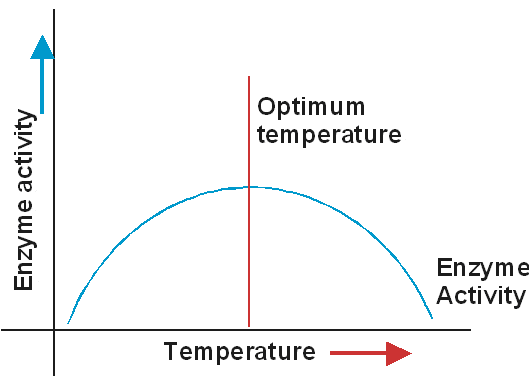
At high temperatures enzyme activity declines because of:
a)
Denaturation
b)
Decreased Kinetic Motion
c)
Increased H-Bonding
d)
Dissociation of Ionic Compounds
5.
What makes an enzyme substrate specific?
a)
Size
b)
Shape
c)
Name
d)
Location it is found in
6.
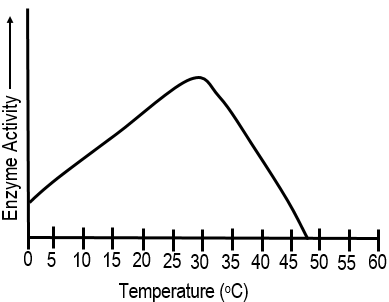
Based on the graph, what is the optimal temperature for this enzyme? 
a)
15oC
b)
40oC
c)
30oC
d)
35oC
7.
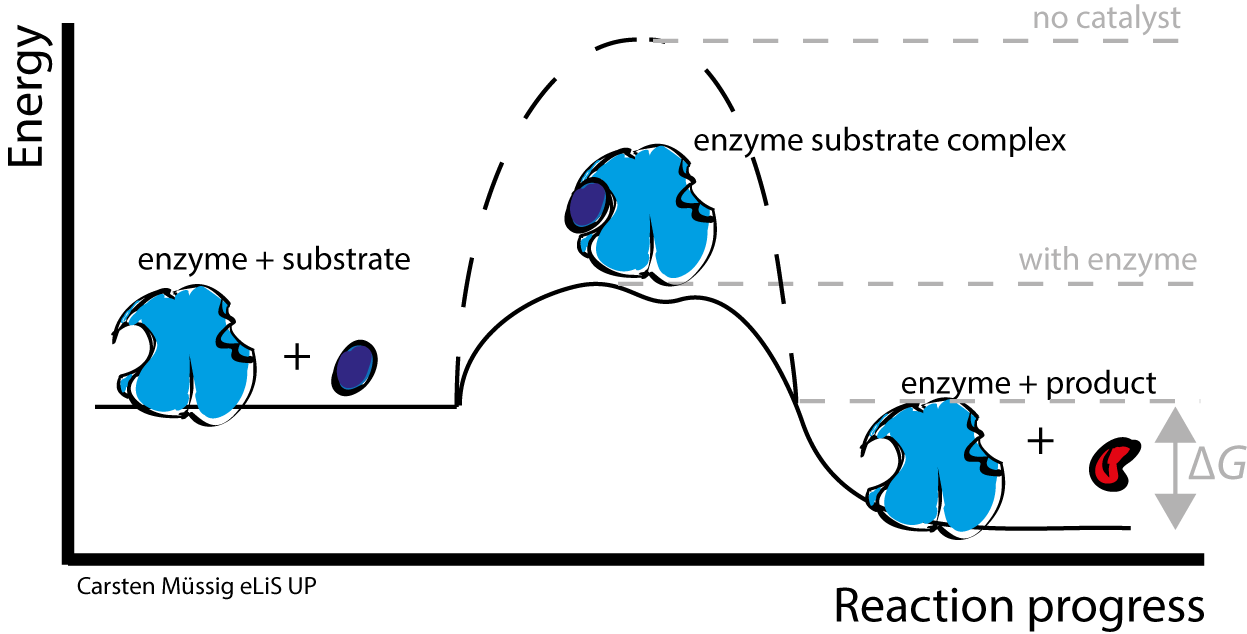
An enzyme speeds up a reaction by
a)
lowering the activation energy.
b)
raising the activation energy.
c)
releasing energy.
d)
absorbing energy.
8.
Enzymes provide a site where reactants called substrates can be brought together in an enzyme-catalyzed reaction. The site is called the
a)
enzyme substrate complex.
b)
reaction site.
c)
active site.
d)
lock and key.
9.
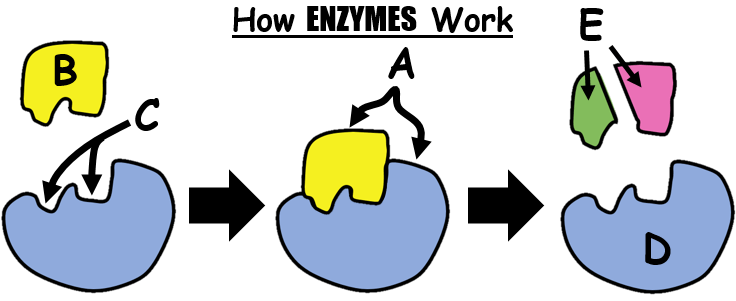
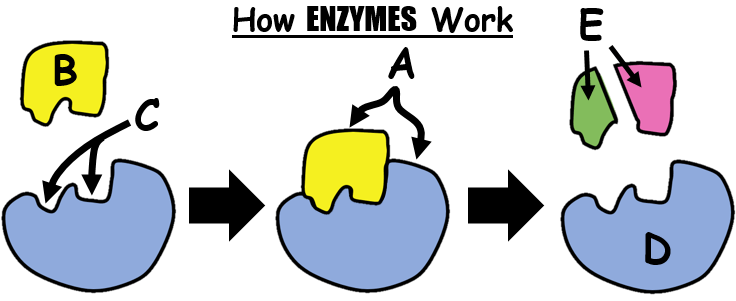
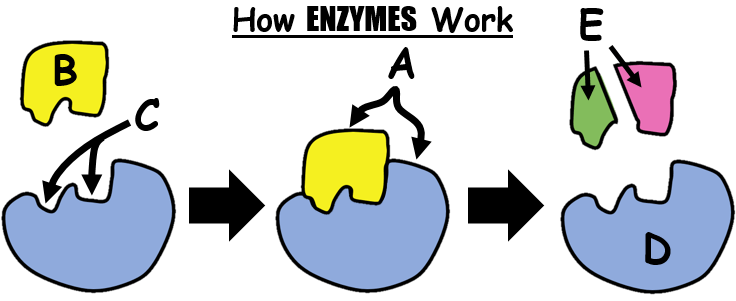
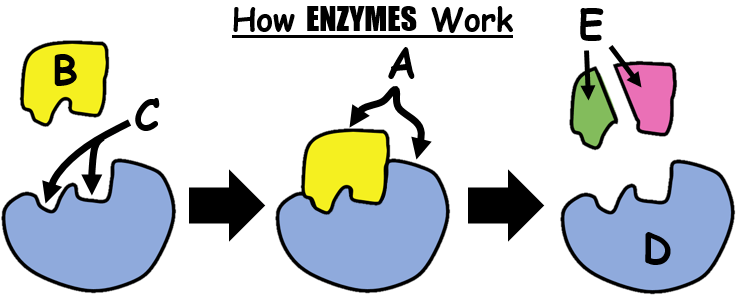
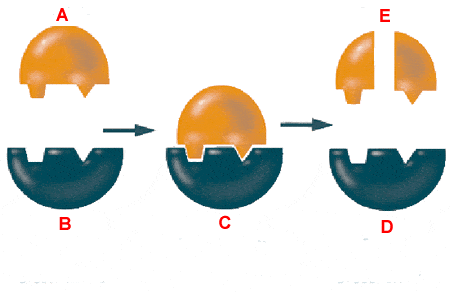
Letter E...
a)
active site
b)
enzyme
c)
substrate
d)
products
10.
Letter C...
a)
active site
b)
enzymes
c)
substrate
d)
products
11.
Letter B...
a)
active site
b)
enzyme
c)
substrate
d)
products
12.
Letter D...
a)
active site
b)
enzyme
c)
substrate
d)
products
13.
Any substance that is acted upon by an enzyme is called a(n)?
a)
Coenzyme
b)
Substrate
c)
Vitamin
d)
Polypeptide
14.
Each enzyme only has 1 substrate that will fit its active site.  What is this called?
a)
reusable
b)
catalyst
c)
specific
d)
fragile
15.
What is the purpose  of an enzyme?
a)
give permission for the reaction
b)
raise activation energy
c)
speed up reactions
d)
control how many reactions occur
16.

Enzymes are an example of

a)

Lipids

b)

Carbohydrate

c)

Protein

d)

Nucleic Acid

17.
What is a substance called if it speeds up a chemical reaction?
a)
reusable
b)
catalyst
c)
specific
d)
fragile
18.

The specific location where the substrates bind to the enzyme is called the

a)

specific site

b)

appropriate site

c)

active site

d)

ignition site

19.

The enzyme and substrates have

a)

adverse shapes

b)

complementary shapes

c)

contrary shapes

d)

similar shapes

20.

Enzymes are an example of

a)

Lipids

b)

Carbohydrate

c)

Protein

d)

Nucleic Acid

21.
What is the purpose  of an enzyme?
a)
give permission for the reaction
b)
raise activation energy
c)
speed up reactions
d)
control how many reactions occur
22.
Enzymes are capable of increasing the rate of a chemical reaction within a living cell.  Enzymes accomplish this through which of the following means?
a)
reducing the number of products   
b)
reducing the activation energy
c)
increasing the temperature of the cell
d)
increasing the concentration of reactants 
23.
What is a substance called if it speeds up a chemical reaction?
a)
reusable
b)
catalyst
c)
specific
d)
fragile
24.
What is a substance called if it speeds up a chemical reaction?
a)
reusable
b)
catalyst
c)
specific
d)
fragile
25.
What happens when enzymes are heated to a high temperature?
a)
The enzymes die.
b)
The shapes of the enzyme are altered denature
c)
The enzymes' amino acid sequence changes.
d)
The enzymes remain the same
26.
Each enzyme only has 1 substrate that will fit its active site.  What is this called?
a)
reusablility
b)
denaturation
c)
specificity
d)
fragility
27.

What is the name of the enzyme found in your saliva?

a)

protease

b)

carbohydrase

c)

lipase

d)

amylase

28.

Where do all enzymes work?

a)

small intestine

b)

large intestine

c)

stomach

d)

liver

29.

What is the function of protease?

a)

break down starch into amino acids

b)

break down protein into fatty acids

c)

break down protein into amino acids

d)

break down protein into urea

30.

What is the function of amylase?

a)

to break down protein into fatty acids

b)

to break down carbohydrates into amino acids

c)

to break down starch into glucose

d)

to break down protein into glucose

31.
Which of these is NOT true?
a)
Enzymes can denature (change shape) when the temperature gets too high.
b)
Enzymes can only be used once in a chemical reaction. 
c)
Extreme pH can denature enzymes.
d)
Enzymes speed up chemical reactions. 
32.
Enzymes catalyze reactions by ___________ Activation Energy.
a)
Increasing
b)
Decreasing
33.
What makes an enzyme substrate specific?
a)
Size
b)
Shape
c)
Name
d)
Location it is found in
34.
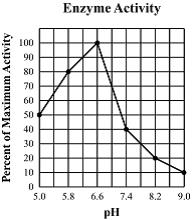
Which of the following conclusions can be drawn from this graph?
a)
The optimum pH of the enzyme is 6.6.
b)
The optimum pH of the enzyme is 5.8
c)
The enzyme’s activity increases as pH increases 5.0 to 9.0
d)
The enzyme’s activity is greater around pH of 8.0 .
35.
At 40 degrees Celsius, your biological enzymes will...
a)
Functional optimally
b)
Denature
c)
Wait until the temp. increases
d)
Wait until the temp. decreases
36.
What is the name for the mechanism of enzyme activity?
a)
Lock and key
b)
jigsaw puzzle
c)
hammer and nail
d)
two hands pattern
37.
What 3 letters do enzymes typically end in?
a)
-ose
b)
-ase
c)
-ese
d)
-tic
38.
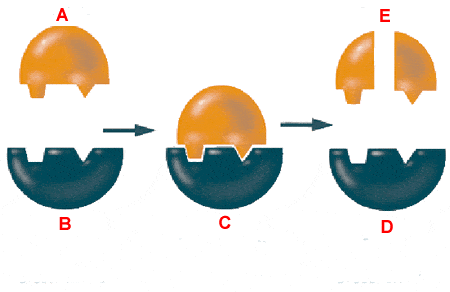
What is structure A?
a)
Substrate
b)
Active site
c)
Enzyme
d)
Products
39.
Enzymes are considered to be 
a)
Lipids
b)
Carbohydrate
c)
Protein
d)
Nucleic Acid
40.

What is indicated by letter B?

a)

enzyme

b)

product

c)

substrate

d)

active site

41.

What is indicated by letter C?

a)

enzyme

b)

product

c)

substrate

d)

active site

42.
What is indicated by letter A?
a)
enzyme
b)
product
c)
substrate
d)
active site
43.
What is another name for enzymes?
a)
chemical catalysts
b)
microorganisms
c)
biological catalysts
d)
inorganic catalysts
44.
Enzymes are composed of which of the following monomers? 
a)
amino acids
b)
carbohydrates
c)
nucleotides
d)
monosaccharides
45.

Can a change in pH alter the active site of an enzyme

a)

yes

b)

no

46.
What is a substance called if it speeds up a chemical reaction?
a)
reusable
b)
catalyst
c)
specific
d)
fragile
47.
Where do substrates bind on an enzyme?
a)
voltage-gated channels
b)
surface receptor
c)
calcium channels
d)
active site
48.
What 3 letters do enzymes typically end in?
a)
-ose
b)
-ase
c)
-ese
d)
-tic
49.
Enzymes are considered to be 
a)
Lipids
b)
Carbohydrate
c)
Protein
d)
Nucleic Acid
50.
Where do substrates bind on an enzyme?
a)
voltage-gated channels
b)
surface receptor
c)
calcium channels
d)
active site
51.
What is the purpose  of an enzyme?
a)
give permission for the reaction
b)
raise activation energy
c)
speed up reactions
d)
control how many reactions occur
52.
Enzymes are considered to be 
a)
Lipids
b)
Carbohydrate
c)
Protein
d)
Nucleic Acid
53.
What happens when enzymes are heated to a high temperature?
a)
The enzymes die.
b)
The shapes of the enzyme are altered denature
c)
The enzymes' amino acid sequence changes.
d)
The enzymes remain the same
54.
Enzymes are...
a)
nucleic acids
b)
proteins
c)
lipids
d)
carbohydrates
55.
With what 3 letters do enzymes typically end?
a)
-ose
b)
-ase
c)
-ese
d)
-tic
56.

Without proper enzyme regulation you would die

a)

true

b)

false

57.

Enzymes

a)

speed up chemical reactions

b)

slow down chemical reactions

c)

do nothing to a chemical reaction

58.

Enzymes are what macromolecule?

a)

Nucleic Acid

b)

Lipid

c)

Protein

d)

Carbohydrate

59.
The current model of enzyme action is referred to as the:
a)
Induced Fit Model
b)
Lock & Key Model
c)
Singer-Nicolson Model
d)
Davson-Danielli Model
60.
The area that the substrate fits into on the enzyme is called the:
a)
Active Site
b)
Allosteric Site
c)
DiSulphide Bridge
d)
β-Pleated Sheet
61.
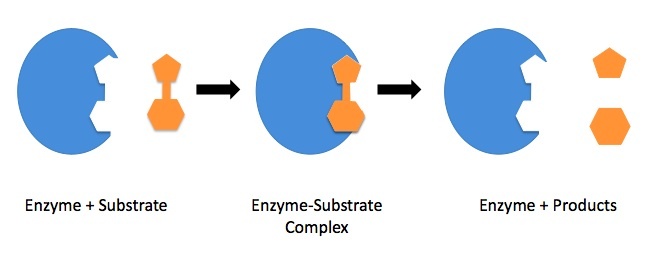
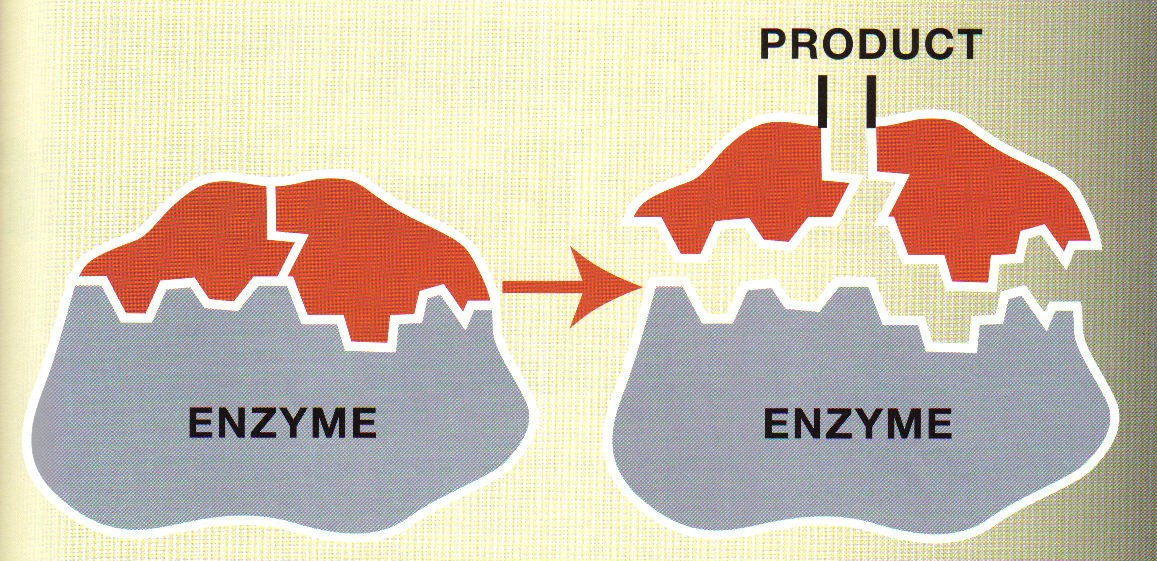
This reaction shows a(n) ____________ reaction
a)
Catabolic
b)
Anabolic
c)
Dehydration Synthesis
d)
Halogenation