wayground logo

Free Printable Worksheets

Font size

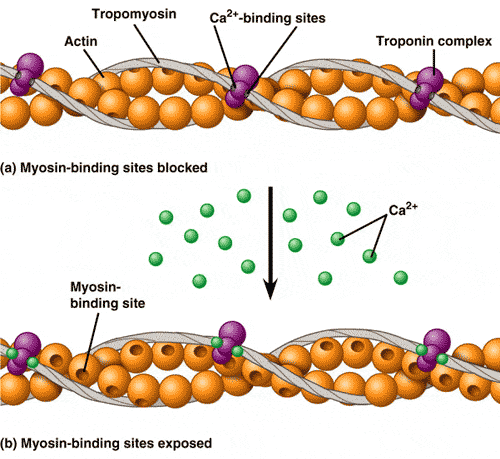
S
M
L
XL
Worksheets

Unit 3 Skeletal & Muscular System Review

Total questions: 154

Worksheet time: 2hrs 38mins

Name
Class
Date
1.

___are thin filaments.

a)

troponin

b)

tropomyosin

c)

actin

d)

myosin

2.

___are thick filaments.

a)

actin

b)

myosin

c)

troponin

d)

tropomyosin

3.

___are regulatory proteins that cover the myosin binding site on the actin.

a)

troponin-tropomyosin

b)

sarcomere

c)

sarcolemma

d)

sarcoplasmic reticulum

4.

Calcium binds to ___of the troponin-tropomyosin complex.

a)

troponin

b)

tropomyosin

c)

actin

d)

myosin

5.

Calcium is stored in the ___.

a)

sarcoplasm

b)

sarcolemma

c)

sarcoplasmic reticulum

d)

transverse tubules

6.

A ___extends from one Z disc to another Z disc.

a)

Sarcolemma

b)

Neuromuscular junction

c)

Sarcomere

d)

Motor end plate

7.

___gets shorter during contraction.

a)

actin

b)

myosin

c)

troponin-tropomyosin

d)

none of these

8.

___forms a crossbridge with actin.

a)

actin

b)

myosin

c)

calcium

d)

ATP

9.

___provides energy for muscle contraction and relaxation.

a)

cAMP

b)

ADP

c)

ATP

d)

M line

10.

___slides inward during muscle contraction.

a)

actin

b)

myosin

11.
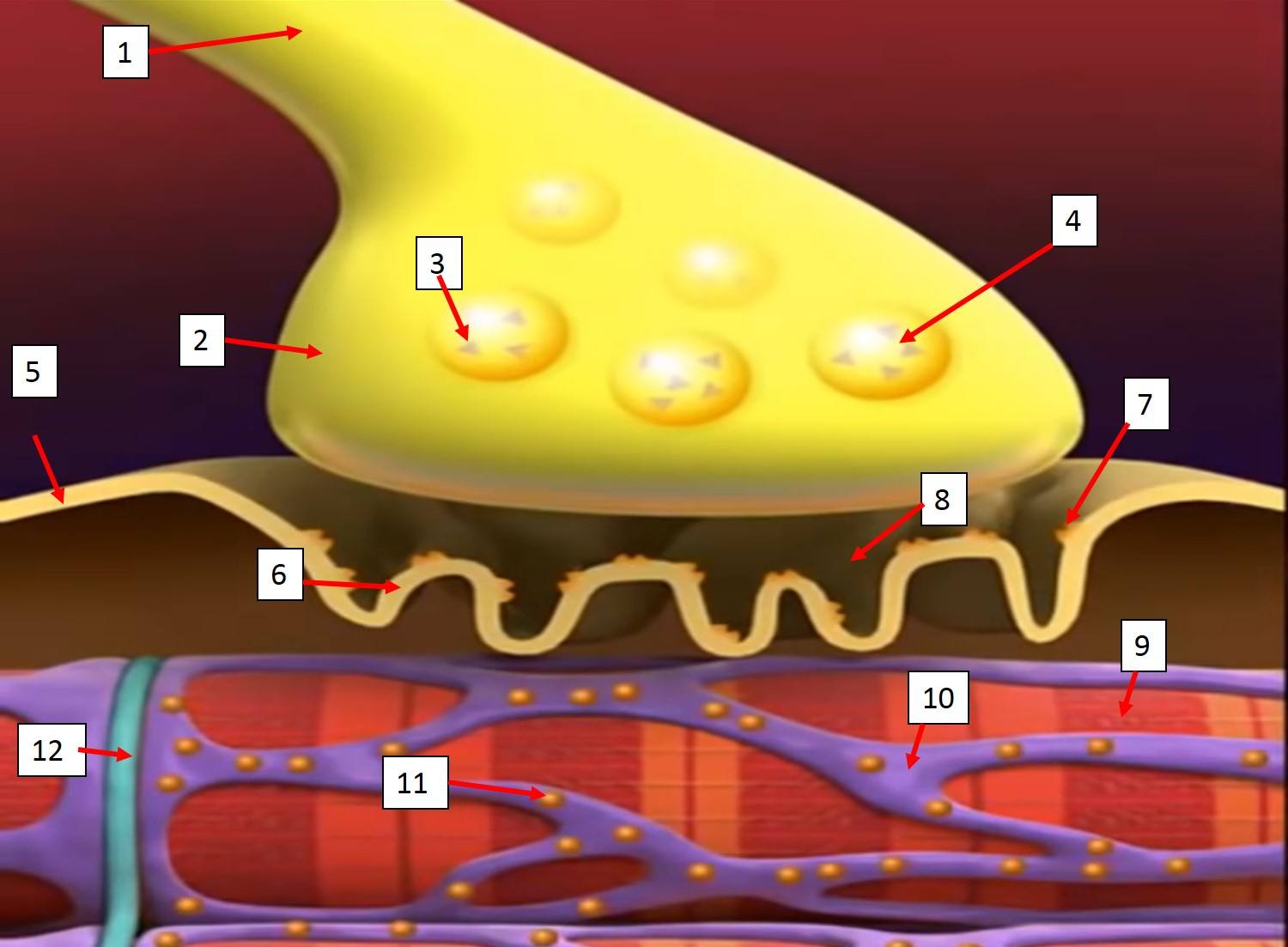
The neurotransmitter stored in the axon terminal identified as #3
a)
Acetylcholine
b)
Protein Channel
c)
Calcium Ion (Ca2+)
d)
Syanptic Cleft
12.
The organelle containing actin and myosin identified as #9
a)
ACh
b)
Sarcolemma
c)
Vesicle
d)
Myofibril
13.
Muscles are attached to bones by _____.
a)
Ligaments
b)
Tendons
c)
Cartilage
d)
Axons
14.
The organelle that contains actin and myosin.
a)
Tendon
b)
myofilament
c)
myofibril
d)
Fiber
15.
Another name for a muscle cell.
a)
Fiber
b)
Sacrolemma
c)
Sacromere
d)
Fascicle
16.
Contractile unit of a muscle.
a)
sarcomere
b)
motor unit
c)
fascicle
d)
myofibril
17.
A bundle of muscle cells.
a)
sarcomere
b)
fiber
c)
fascicle
d)
Tendon
18.
Ribbon like organelle found in muscle cells that have a banded appearance
a)
sarcomere
b)
myofibril
c)
fascicle
d)
actin
19.
Thick filaments are in a myofibril are
a)
ATPase
b)
Sarcoplasmic reticulum
c)
Actin
d)
Myosin
20.
Thin filaments in a myofibril are
a)
Sarcomeres
b)
Sarcoplasm
c)
Actin
d)
Myosin
21.
The functional unit of the muscle cell is the: 
a)
Sarcomere
b)
Osteon
c)
Myofilament
d)
Muscle fiber
22.
What two chemicals are necessary for muscle contraction to occur?
a)
Niacin and Potassium
b)
Calcium and ATP
c)
Sodium and Potassium
d)
Ach and Potassium
23.
Calcium:
a)
causes ATP binding to actin
b)
increases the action potential along the sarcolemma
c)
binds to proteins on myosin
d)
triggers the binding of myosin to actin
24.
What is a crossbridge?
a)
Where myosin binds to actin
b)
Where the calcium crosses into the cytoplasm
c)
Where calcium binds with troponin
d)
None of the answers are correct.
25.
The energy needed to perform a muscle contraction comes directly from
a)
ATP
b)
Oxygen
c)
Glucose
d)
Calcium
26.
Cellular respiration that occurs without oxygen present is called
a)
aerobic
b)
anaerobic
c)
isotonic
d)
isometric
27.
___ and ___ are regulatory proteins bound to actin. 
a)
Troponin and tropomyosin
b)
Myosin and actin
c)
Calcium and Oxygen
d)
Glycogen and hemoglobin
28.
Skeletal Muscle contraction is initiated when the ________ sends a message to the muscle cell.  
a)
Muscle cell
b)
Neuron
c)
Gland
d)
None of the above
29.
The axon terminal is represented by
a)
7
b)
8
c)
9
d)
10
30.
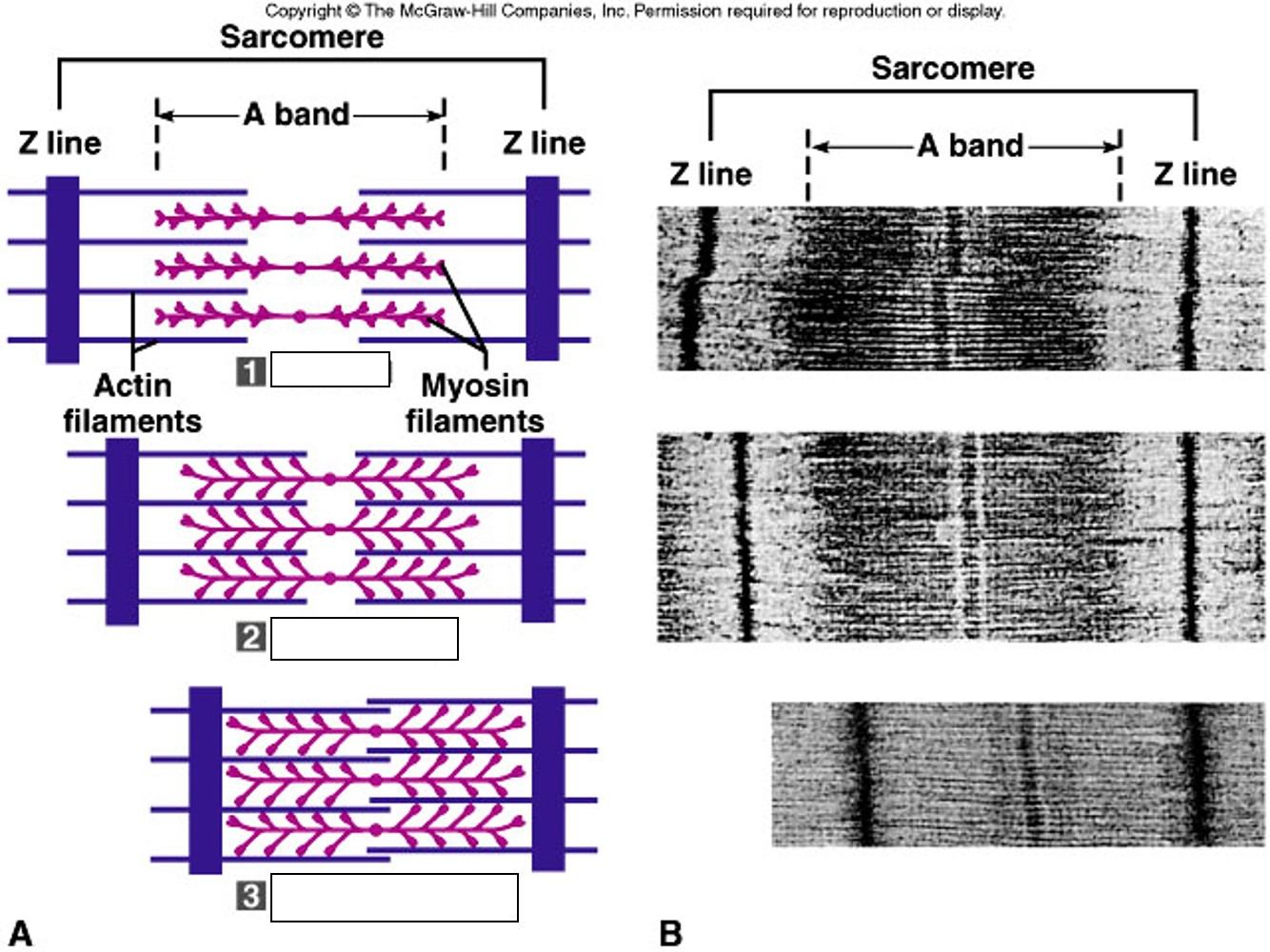
What state is the sarcomere in #1
a)
Relaxed
b)
Contracting
c)
Fully Contracted
d)
None of the above
31.
What state is the sarcomere in #2
a)
Relaxed
b)
Contracting
c)
Fully Contracted
d)
None of the above
32.

The sliding filament theory of muscle contraction says

a)

Actin and myosin filaments condense, thus causing the filament to shorten which in turn shortens the muscle

b)

Myosin rotates and wraps actin around it making the muscle shorter

c)

Friction is reduced between thin and thick filaments causing the thick filaments to move inside the thin

d)

Actin filaments slide over myosin filaments, making the muscle shorter

33.

Which number represents the sarcomere?

a)

1

b)

2

c)

3

d)

4

34.

Which number represents the actin filament?

a)

1

b)

2

c)

3

d)

4

35.

Which number represents the myosin filament?

a)

1

b)

2

c)

3

d)

4

36.

The contractile unit of a muscle:

a)

sarcomere

b)

motor unit

c)

fascicle

d)

myofibril

37.

Number 1

a)

epimysium

b)

fascicle

c)

blood vessel

d)

bone

38.

number 2

a)

tendon

b)

epimysium

c)

fascicle

d)

perimysium

39.

number 3

a)

fascicle

b)

epimysium

c)

bone

d)

blood vessel

40.

number 4

a)

myofibril

b)

perimysium

c)

bone

d)

tendon

41.

number 5

a)

bone

b)

fascicle

c)

endomysium

d)

myofibril

42.

number 6

a)

fascilcle

b)

myofibril

c)

endomysium

d)

tendon

43.

number 7

a)

tendon

b)

myofibril

c)

bonne

d)

blood vessel

44.

number 8

a)

perimysium

b)

tendon

c)

fascicle

d)

bone

45.

number 9

a)

tendon

b)

blood vessel

c)

fascicle

d)

sarcolemma

46.

number 10

a)

sarcolemma

b)

muscle fiber

c)

endomysium

d)

bone

47.

Which number identifies the External obliques?

(a)  

48.

Which number identifies the Biceps brachii?

(a)  

49.

Which number identifies the Rectus abdominus?

(a)  

50.

Which number identifies the Sartorius?

(a)  

51.

Which number identifies the Tibialis anterior?

(a)  

52.

Which number identifies the Trapezius?

(a)  

53.

Which number identifies the Latissimus dorsi?

(a)  

54.

Which number identifies the Gluteus medius?

(a)  

55.

Which number identifies the Gluteus maximus?

(a)  

56.

Which type of muscle is the largest in a muscle group?

a)

Maximus

b)

Minimums

c)

Medius

d)

Longus

57.

Which type of muscle is the smallest in a muscle group?

a)

Maximus

b)

Minimums

c)

Medius

d)

Longus

58.

Which of the following is used to name skeletal muscles?

a)

Direction of the muscle fibers

b)

Relative size of the muscle

c)

Location of the muscle

d)

Number of origins

e)

All of these are true

59.

How many origins does a biceps muscle have?

a)

1

b)

2

c)

3

d)

4

60.

How many origins does a triceps muscle have?

a)

1

b)

2

c)

3

d)

4

61.

How many origins does a quadriceps muscle have?

a)

1

b)

2

c)

3

d)

4

62.

Which type of muscle is shaped like a triangle?

a)

Deltoid

b)

Frontalis

c)

Gluteus maximums

d)

Rectus

63.
A ______________________ attach bones to each other at joints.
a)
Ligament
b)
Bone
c)
Joint
d)
Cell
64.

Name the highlighted muscle

a)

pectoralis major

b)

biceps

c)

triceps

d)

deltoid

65.

Name the highlighted muscle

a)

pectorals

b)

deltoid

c)

trapezius

d)

latissimus dorsi

66.

What is the name of this muscle?

a)

deltoid

b)

brachialis

c)

triceps

d)

biceps brachii

67.
a)
Orbicularis Oris
b)
Orbicularis Oculi
c)
Corrugator
d)
Frontalis
68.

The muscle around your mouth is the

a)

Orbicularis oris

b)

Orbicularis oculi

c)

Corrugator

d)

Platysma

69.
Name this muscle.
a)
Tricep
b)
Trapezius
c)
Bicep
d)
Tres Major
70.
Muscles always work in _____
a)
pairs
b)
groups of 3
c)
bones
d)
joints
71.
What muscle is this?
a)
Pectoralis
b)
Triceps
c)
Obliques
d)
Rectus Abdominus
72.
What muscle is this?
a)
Gastrocnemius
b)
Quadriceps
c)
Pectorals
d)
Trapezius
73.
How do pairs of skeletal muscles work together?
a)
while one contracts, the other returns to original length
b)
both muscles contract at the same time
c)
both muscles relax at the same time
d)
1 muscle pulls on the bone and the other pulls on the first muscle
74.

Moveable attachment of a muscle:

a)

Teniosis

b)

Origin

c)

Insertion

d)

Eversion

75.

The neurotransmitter that is released by the neuromuscular junction of the skeletal/voluntary muscles

a)

epinephrine

b)

dopamin

c)

acetylcholine

d)

norepinephrine

76.

A muscle primarily responsible for the action (movement) is called both the...

a)

prime mover

b)

antagonist

c)

synergist

d)

agonist

77.

Identify the highlighted muscle

a)

Trapezius

b)

Extensor Carpi

c)

Flexor carpi

d)

Extensor Digitorum Longus

78.

Arrange the structures of a muscle from largest to smallest.

a)

Myofibril, muscle fiber, fascicle

b)

Fascicle, muscle fiber, myofibril

c)

Fascicle, sarcomere, muscle fiber

d)

Myofibril, fascicle, sarcomere

79.

When the troponin molecule's binding site is empty the muscle is?

a)

full contraction

b)

complete tetanus

c)

at rest

d)

summation

80.

What holds oxygen in muscles cells?

a)

Myofibrils

b)

Myoglobin

c)

Fascicles

d)

Periosteum

81.

What two chemicals are necessary for muscle contraction to occur?

a)

Niacin and Potassium

b)

Calcium and ATP

c)

Actin and Myosin

d)

Phosphorus and Potassium

82.

The following is NOT one of the 3 Joint Classifications..

a)

Cartilaginous

b)

Cartilage

c)

Fibrous

d)

Synovial

83.

The joints that allow the most movement are called

a)

Fixed

b)

Fibrous

c)

Cartilaginous

d)

Synovial

84.

Examples of a Ball & Socket Joint are found in the

a)

Shoulder

b)

Knee

c)

Hip

d)

Ankle

85.

A hinge joint allows

a)

A wide range of movements

b)

Circumduction

c)

Rotation

d)

Movement in only one direction (ie. backwards & forwards)

86.

An example of a Saddle joint is in the

a)

Knee

b)

Hip

c)

Thumb

d)

Vertebral column

87.

Which of the following is part of a Synovial joint

a)

Synovial membrane

b)

Joint cavity

c)

Ligament

d)

Cartilage

88.

When kicking a football the knee

a)

Flexes

b)

Extends

c)

Abducts

d)

Adducts

89.
Identify the joint action being performed.
a)
Extension
b)
Flexion
c)
Abduction
d)
Adduction
90.
Identify the joint action being performed.
a)
Extension
b)
Flexion
c)
Abduction
d)
Adduction
91.
Identify the joint action being performed.
a)
Extension
b)
Flexion
c)
Abduction
d)
Adduction
92.
Identify the joint action being performed.
a)
Extension
b)
Flexion
c)
Abduction
d)
Adduction
93.
Identify the joint action being performed.
a)
Circumduction
b)
Lateral Rotation
c)
Medial Rotation
d)
Eversion
94.
Identify the joint action being performed.
a)
Inversion
b)
Eversion
c)
Plantarflexion
d)
Dorsiflexion
95.
Hip and shoulder have examples of this type of joint
a)
ball and socket
b)
condyloid
c)
hinge
d)
gliding
96.
The elbows, knees and phalanges are examples of this type of joint
a)
ball and socket
b)
condyloid
c)
gliding
d)
hinge
97.
This type of joint allows the your first two vertebrate to rotate as in shaking your head no
a)
condyloid
b)
gliding
c)
pivot
d)
saddle
98.
Carpals and tarsals (flat bones) are examples of this type of joint
a)
condyloid
b)
gliding
c)
hinge
d)
saddle
99.
The knee joint is
a)
Hinge
b)
Gliding
c)
Ball and socket
d)
Pivot
100.
Name this joint
a)
gliding
b)
saddle
c)
condyloid
d)
pivot
101.
Fibrous joints are?
a)
freely moveable
b)
partially moveable
c)
immovable
102.
Moving a part forward (thrusting the head forward).
a)
protraction
b)
retraction
c)
elevation
d)
supination
103.
This type of joint allows the your first two vertebrate to rotate as in shaking your head no
a)
condyloid
b)
gliding
c)
pivot
d)
saddle
104.
Hip and shoulder have examples of this type of joint
a)
ball and socket
b)
condyloid
c)
hinge
d)
gliding
105.
The elbows, knees and phalanges are examples of this type of joint
a)
ball and socket
b)
condyloid
c)
gliding
d)
hinge
106.
Movement away from the mid-line is called _____________.
a)
abduction
b)
adduction
c)
internal rotation
d)
external rotation
107.
Turning the hand so that the palm is upward or facing anteriorly (in anatomical position).
a)
supination
b)
pronation
c)
flexion
d)
dorsiflexion
108.
 The pivot joints occur in our skeleton at
A) Forearm
B)  knee
C) neck
D) hip 
a)
a) A and B    
b)
b) B and C
c)
c) A and C
d)
d) B and D
109.

The joints that allow the most movement are called

a)

Fixed

b)

Fibrous

c)

Cartilaginous

d)

Synovial

110.

A hinge joint allows

a)

A wide range of movements

b)

Circumduction

c)

Rotation

d)

Movement in only one direction (ie. backwards & forwards)

111.

An example of a Saddle joint is in the

a)

Knee

b)

Hip

c)

Thumb

d)

Vertebral column

112.

Which of the following is part of a Synovial joint

a)

Synovial membrane

b)

Joint cavity

c)

Ligament

d)

Cartilage

113.

Flexion means to

a)

Increase the angle of a joint

b)

Decrease the angle of a joint

c)

Take a limb away from the body

d)

Return a limb towards the body

114.

Adduction means

a)

Increase the angle of a joint

b)

Decrease the angle of a joint

c)

Take a limb away from the body

d)

Return a limb towards the body

115.

When kicking a football the knee

a)

Flexes

b)

Extends

c)

Abducts

d)

Adducts

116.
Identify the joint action being performed.
a)
Extension
b)
Flexion
c)
Abduction
d)
Adduction
117.
Identify the joint action being performed.
a)
Extension
b)
Flexion
c)
Abduction
d)
Adduction
118.
Identify the joint action being performed.
a)
Circumduction
b)
Lateral Rotation
c)
Medial Rotation
d)
Eversion
119.
Identify the joint action being performed.
a)
Circumduction
b)
Lateral Rotation
c)
Medial Rotation
d)
Eversion
120.
Identify the joint action being performed.
a)
Inversion
b)
Eversion
c)
Plantarflexion
d)
Dorsiflexion
121.

Identify the joint action being performed.

a)

Pronation

b)

Supination

c)

Inversion

d)

Eversion

122.
Classifying joints as synarthrotic, amphiarthrotic, or diarthrotic represents  
a)
location in the body
b)
the composition of the joint
c)
the number of bones that joint affects
d)
degree of movement possible at the joint
123.
Which of the following is a joint that can freely move?
a)
fibrous
b)
cartilaginous
c)
synovial
124.
Hip and shoulder have examples of this type of joint
a)
ball and socket
b)
condyloid
c)
hinge
d)
gliding
125.
Movement away from the mid-line is called _____________.
a)
abduction
b)
adduction
c)
internal rotation
d)
external rotation
126.
The elbows, knees and phalanges are examples of this type of joint
a)
ball and socket
b)
condyloid
c)
gliding
d)
hinge
127.
what are functions of the skelton?
a)
protection
b)
Make blood cells
c)
movement
d)
all of them
128.
attaches muscle to bone 
a)
tendon
b)
ligament 
c)
cartilage
d)
bone
129.
attaches bone to bone
a)
tendon
b)
ligament 
c)
cartiliage
d)
bones
130.
what type of bone is the femur
a)
Long bone
b)
Short bone
c)
Flat bone
d)
Irregular bone
131.
What type of bone is the scapula
a)
long bone
b)
short bone
c)
flat bone
d)
sesamoid bone
132.
The site of of bone growth on a long bone is called
a)
epiphyseal plate
b)
diaphysis
c)
periosteum
d)
medullary cavity
133.
Which fracture is common in older people due to osteoporosis?
a)
simple fracture
b)
compound fracture
c)
greenstick fracture
d)
compression fracture
134.
The joints in the skull are called
a)
hinge joints
b)
synovial joints
c)
gliding joints
d)
fibrous joints
135.
A common term for chronic inflammation of a joint is 
a)
osteoporosis
b)
fracture
c)
scoliosis
d)
arthritis
136.
In the second step of bone formation
a)
hyaline cartilage is covered with bone matrix
b)
bone building cells are destroyed
c)
hyaline cartilage is digested away leaving a cavity in newly formed bone
d)
blood vessels "invade" the bone cells
137.
Which fracture is common when a person tries to break their fall with outstretched arms?
a)
greenstick fracture
b)
impacted fracture
c)
compression fracture
d)
spiral fracture
138.
The matrix for the bone cells and the skeletal system includes all of the following except
a)
myelin
b)
collagen
c)
calcum
d)
phosphorus
139.
A ball and socket joint is located 
a)
in the wrist
b)
in the ankle
c)
in the hip
d)
in the foot
140.
Blood cells produced from within the bone are called
a)
yellow marrow
b)
red marrow
c)
osteocytes
d)
osteon systems
141.
The process of bone formation from cartilage is called
a)
growth
b)
ossification
c)
fracture repair
d)
callus zone
142.
The outer covering of bone is called 
a)
spongy bone
b)
compact bone
c)
periosteum
d)
medullary cavity
143.
The shaft of a long bone is called
a)
epiphysis
b)
epiphyseal plate
c)
epiphyseal line
d)
diaphysis
144.
Rickets is caused by a deficiency of which vitamin?
a)
Vitamin A
b)
Vitamin C
c)
Vitamin D
d)
Vitamin E
145.
Which of the following is filled with yellow marrow (adipose tissue)?
a)
medullary cavity
b)
spongy bone
c)
periosteum
d)
compact bone
146.
Spongy bone is located
a)
in the epiphysis
b)
in the diaphysis
c)
in the compact bone
d)
in haversian canals
147.
A part of the bone that protrudes or sticks out is called
a)
foramen
b)
meatus
c)
sinus
d)
process
148.
Which type of bone is a solid matrix with tightly packed cells?
a)
spongy bone
b)
compact bone
c)
skull bone
d)
long bone
149.
Which of the following is not part of a synovial joint?
a)
cartilage
b)
joint capsule
c)
ligaments
d)
sutures
150.
All of the following are synovial joints except
a)
cartilaginous joints
b)
gliding joints
c)
saddle joints
d)
hinge joints
151.
Which of the following are not features of compact bone/
a)
osteocytes
b)
Haversian canals
c)
lamallae
d)
trabeculae
152.
An abnormal curvature of the spine is called
a)
scoliosis
b)
greenstick fracture
c)
osteoporosis
d)
arthritis
153.
The spaces of trabeculae are filled with 
a)
yellow marrow
b)
interstitial fluid
c)
red marrow
d)
Haversian systems
154.
Which of the following is not a function of the skeletal system?
a)
maintain body shape
b)
help transmit impulses from place to place
c)
protect organs
d)
provide levers for movement