
 Worksheets
Integrated Science — L1 To L7 Part 1
Total questions: 150
Worksheet time: 1hrs 15mins
A continuous change between the three states of water on the Earth’s surface within a closed system called the .......... cycle.
Nitrogenous
Carbonaceous
Oxygenation
Hydrological
The percentage of salt water is about ........ from all water shapes on Earth.
1%
3%
70%
97%
All the following from the biotic factors in an environment except ............
Animals
Bacteria
Plants
Light
It is where living organisms are found on, above, and below the Earth’s surface.
Lithosphere
Biosphere
Atmosphere
Hydrosphere
It is a blanket of gases that surrounds Earth. It is held near the surface of the planet by Earth’s gravitational attraction.
Lithosphere
Biosphere
Atmosphere
Hydrosphere
It is the process in which water liquid converts into water vapor.
Condensation
Transpiration
Evaporation
Precipitation
It is the process in which plants release excess water through stomata.
Condensation
Transpiration
Evaporation
Precipitation
An increase in the rate of transpiration in plants indirectly affects the water cycle in nature through:
Reducing rainfall
Increasing water vapor in the atmosphere
Reducing the rate of evaporation from water surfaces
Fixing carbon dioxide in leaves
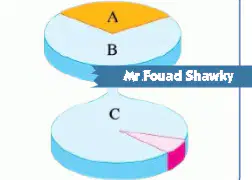
The figure shows the percentage of the distribution of lithosphere and hydrosphere on Earth. Which of the following is correct?
A: Lithosphere • B: Hydrosphere • C: Fresh water
A: Lithosphere • B: Fresh water • C: Salt water
A: Fresh water • B: High amount of oils • C: Salt water
A: Lithosphere • B: Hydrosphere • C: Salt water
Which of the following represents the greatest source of water on Earth’s surface?
Oceans
Ground water
Fresh lakes
Frozen rivers
Which of the following is not related to the hydrological cycle in nature?
Water movement through many pathways
Living organisms have essential role in it
Keeping the stability of Earth’s surface
Is nearly a close system
Which of the following is a consequence for the transpiration through the hydrological cycle?
Evaporation
Leakage
Precipitation
Condensation
Water covers about ........ from Earth’s surface.
50%
60%
70%
80%
The percentage of fresh liquid water is about ........ from all water shapes on Earth’s surface.
1%
30%
70%
97%
All the following from the abiotic factors in an environment except .......
Air
Water
Soil
Human
It is a rigid, rocky outer layer of Earth, consisting of the crust and the solid outermost layer of the upper mantle.
Lithosphere
Biosphere
Atmosphere
Hydrosphere
It refers to all forms of water on Earth. It includes surface water bodies like rivers, oceans, lakes, and ponds, groundwater, water vapor (clouds and fog) in the atmosphere, and ice.
Lithosphere
Biosphere
Atmosphere
Hydrosphere
It is the process in which water vapor converts into water droplets.
Condensation
Transpiration
Evaporation
Precipitation
Which of the following processes, if stopped, would directly disrupt the water cycle on the Earth’s surface and in the atmosphere?
Surface runoff
Evaporation
Soil infiltration
Transpiration
From the importance of the transpiration for the plants:
Increasing the temperature of the plants
Increasing the percentage of CO2
Helping in rising salts and water to upper parts
Decreasing the ability of the plants in rising salts and water to upper parts
The ratio between the fresh liquid water and the frozen fresh water on Earth is equal to
1/2
2/1
3/1
1/1
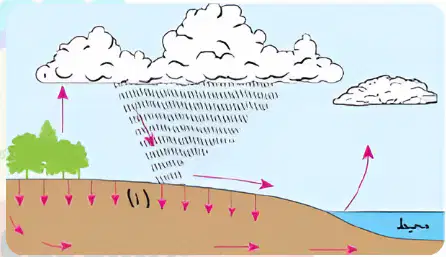
The figure shows a part of the water cycle. The process that is labeled by (1) contributes to
Raining
Forming ground water
Forming clouds
Snow fall
Explain the biological role of plants and animals in the hydrological cycle, mentioning their contribution percentages.
Plants contribute about 90% of biologically sourced water vapor via transpiration; animals contribute about 10% via respiration and perspiration.
Plants contribute about 10% and animals about 90% of biologically sourced water vapor.
Plants and animals each contribute about 50% of biologically sourced water vapor.
Animals contribute all biologically sourced water vapor; plants do not contribute.
Compare saltwater and freshwater in terms of percentage and sources.
Saltwater is about 97% of Earth’s water, mainly in oceans; freshwater is about 3% , found in ice caps/glaciers, groundwater, lakes, and rivers.
Saltwater is about 3% of Earth’s water, mainly in lakes; freshwater is about 97% , found mostly in oceans.
Saltwater and freshwater are each about 50% and are equally distributed among oceans and rivers.
Freshwater is about 97% of Earth’s water and is mostly found in clouds.
Choose the correct answer: What are the two essential elements that make up a water molecule?
Carbon and hydrogen
Nitrogen and oxygen
Oxygen and hydrogen
Chlorine and sodium
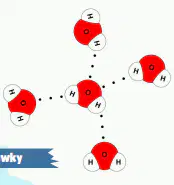
Choose the correct answer: In the opposite figure what is the type of bond? Use the tabled statements as options.
-In the water molecule: Covalent Bond;
- between water molecules: Hydrogen Bond
-In the water molecule: Covalent Bond;
-between water molecules: Covalent Bond
-In the water molecule: Hydrogen Bond;
-between water molecules: Covalent Bond
-In the water molecule: Hydrogen Bond;
- between water molecules: Hydrogen Bond
Choose the correct answer: What type of bonds that connect water molecules?
Ionic bond
Hydrogen bond
Covalent bond
Metallic bond
Choose the correct answer: Which element represents the largest proportion of the mass of a water molecule?
Hydrogen
Oxygen
Both are equal
Cannot be determined
Choose the correct answer: Water is a polar compound because:
The electronegativity of oxygen is greater than the electronegativity of hydrogen.
The electronegativity of hydrogen is greater than the electronegativity of oxygen.
Oxygen carries a partial positive charge; hydrogen carries a partial negative charge.
Oxygen carries a partial negative charge; hydrogen carries a partial positive charge.
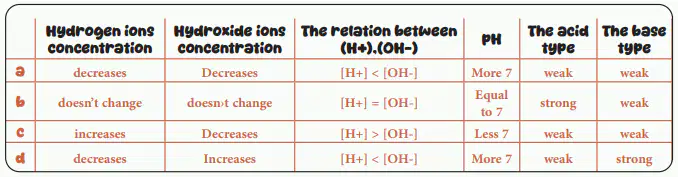
Choose the correct answer: The hydrolysis of ammonium bicarbonate has the following result (select the correct row from the table).
A
B
C
D
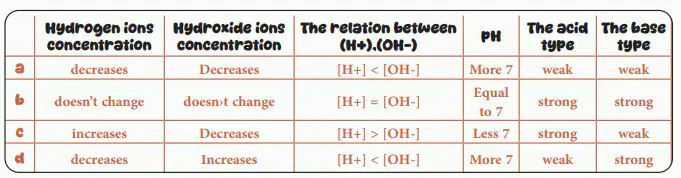
Choose the correct answer: The hydrolysis of sodium bicarbonate has the following result (select the correct row from the table).
A
B
C
D
Choose the correct answer: Which of the following salts its hydrolysis produces an acidic solution?
Sodium chloride
Sodium bicarbonate
Ammonium chloride
Ammonium acetate
Choose the correct answer: The following chemical equation represents the hydrolysis of the salt (WZ):
WZ (s) + H2O (l) → WOH (aq) + H+ (aq) + Z− (aq).
Which of the following represents the pH value of the solution?
12
9
7
4
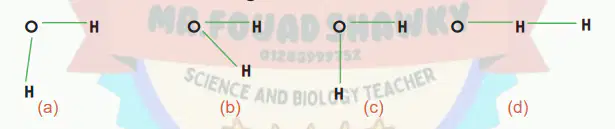
Choose the correct answer: Which of the following diagrams correctly represents the structure of a water molecule and the angle between the two covalent bonds in it?
Diagram (a)
Diagram (b)
Diagram (c)
Diagram (d)
Choose the correct answer: What type of chemical bonds connect the hydrogen and oxygen atoms in a water molecule?
Ionic bond
Hydrogen bond
Covalent bond
Metallic bond
Choose the correct answer: What is the approximate value of the angle between the covalent bonds in a water molecule?
75.5°
90°
100°
104.5°
Choose the correct answer: Which of the following expressions is correct in a water molecule?
the percentage of Hydrogen mass is 66.67%
the percentage of Oxygen mass is 33.33%
the percentage of Hydrogen mass is 11.11%
the percentage of Oxygen mass is 66.67%
Choose the correct answer: All of the following are consequences of the polarity of the water molecule except:
Water molecules are linked together by hydrogen bonds.
The ability to dissolve many mineral salts.
The boiling point of water rises to 100°C.
The ability to dissolve a non-polar organic compound.
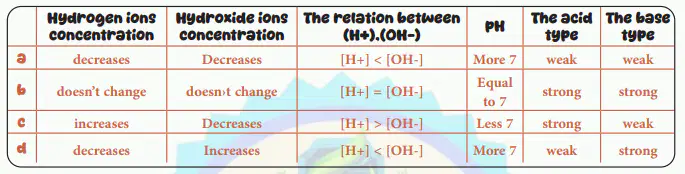
Choose the correct answer: The hydrolysis of ammonium chloride has the following result (select the correct row from the table).
A
B
C
D
Choose the correct answer: The solution resulting from the hydrolysis of sodium bicarbonate is basic because:
the concentration of [H+] is less than the concentration of [OH−]
the concentration of [H+] is more than the concentration of [OH−]
the concentration of [H+] is equal to the concentration of [OH−]
the concentration of [H+] is equal to or less than the concentration of [OH−]
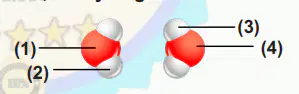
Choose the correct answer: The figure shows two water molecules; the hydrogen bond is formed between….
(1), (2)
(2), (3)
(2), (4)
(1), (4)
Choose the correct answer: Compare the covalent bond within a water molecule and the hydrogen bond between water molecules; select the statement that best expresses the comparison.
Both are intermolecular forces of similar strength and form between different molecules.
A covalent bond is an intramolecular bond formed by sharing electrons between O and H; a hydrogen bond is a weaker intermolecular attraction between a hydrogen atom and a nearby oxygen of another molecule.
Both are ionic interactions; the covalent bond is stronger because full charges are present.
A hydrogen bond is the intramolecular bond; the covalent bond is the intermolecular attraction.
Choose the correct answer: For the aqueous solution of sodium chloride (NaCl), predict the effect on litmus paper and the pH value.
Turns red litmus blue; pH > 7 (basic)
No effect on red/blue litmus; pH ≈ 7 (neutral)
Turns blue litmus red; pH < 7 (acidic)
Turns both litmus papers purple; pH ≈ 9
Choose the correct answer: For the aqueous solution of sodium bicarbonate (NaHCO3), predict the effect on litmus paper and the pH value.
Turns blue litmus red; pH < 7 (acidic)
No effect on red/blue litmus; pH ≈ 7 (neutral)
Turns red litmus blue; pH > 7 (basic)
Turns both litmus papers purple; pH ≈ 5
Choose the correct answer: For the aqueous solution of ammonium chloride (NH4Cl), predict the effect on litmus paper and the pH value.
Turns blue litmus red; pH < 7 (acidic)
No effect on red/blue litmus; pH ≈ 7 (neutral)
Turns red litmus blue; pH > 7 (basic)
Turns both litmus papers purple; pH ≈ 10
Choose the correct answer: The boiling point of water (100°C) is higher than the boiling point of hydrogen sulfide (−60°C) despite their similar molecular structures because:
Water molecules are non-polar and interact only by weak dispersion forces.
Water forms extensive hydrogen bonding between molecules, giving stronger intermolecular forces than in H2S, which lacks significant hydrogen bonding.
Hydrogen sulfide has stronger ionic bonds than water.
Both substances have identical intermolecular forces; atmospheric pressure differences explain the boiling points.
Choose correct answer: The density of water is 1 g/cm^3 at a temperature of 4 °C. This means that:
The mass of 1 cm^3 of water is 1 Kg.
The mass of 1 cm^3 of water is 1 g.
The mass of 1 m^3 of water is 1 g.
The mass of 1 cm^3 of water is 1 L.
Choose correct answer: The maximum density of pure water is at a temperature of ....
0 °C
4 K
90 °C
277 K
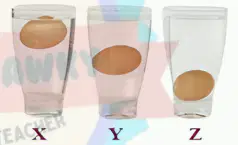
Choose correct answer: The figure shows three cups of water of different salinities, at the same temperature. An egg is placed in each of them (and the eggs are completely identical). The arrangement of the water according to density is:
X = Y = Z
X > Y > Z
Z > Y > X
Z > Y = X
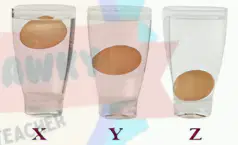
Choose correct answer: Which of the following cups contains the greatest density of water?
X = Y = Z
X > Y > Z
Z > Y > X
Z > Y = X
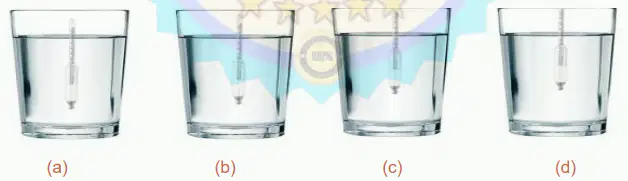
Choose correct answer: Which of the following cups contains the greatest density of water?
(a) image
(b) image
(c) image
(d) image
Choose correct answer: Both volume of water and density of water change with temperature. What happens during each procedure described below? 0 °C → 4 °C
The water volume increases, The water density increases
The water volume decreases, The water density decreases
The water volume decreases, The water density increases
The water volume increases, The water density decreases
Choose correct answer: 4 °C → 23 °C
The water volume increases, The water density increases
The water volume decreases, The water density decreases
The water volume decreases, The water density increases
The water volume increases, The water density decreases
Choose correct answer: 0 °C → 8 °C
The water volume increases, The water density decreases
The water volume decreases, The water density increases
The water volume decreases then increases, The water density increases then decreases
The water volume increases then decreases, The water density decreases then increases
Choose correct answer: The density of water is 1 g/cm^3 at a temperature of 4 °C. It is equivalent to.......
0.001 kg/m^3
1 kg/m^3
4 kg/m^3
1000kg/m3
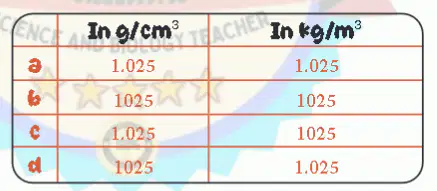
Choose correct answer: The relative density of seawater is 1.025, this means that the density of seawater is equal to:
In g/cm^3: 1.025; In kg/m^3: 1.025
In g/cm^3: 1025; In kg/m^3: 1025
In g/cm^3: 1.025; In kg/m^3: 1025
In g/cm^3: 1025; In kg/m^3: 1.025
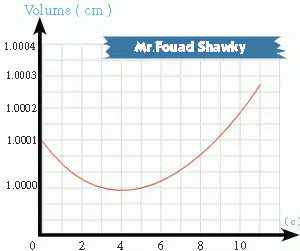
Choose correct answer: From the graph, the density of water is 1 g/cm^3 at a temperature of 4 °C, so the volume of 4 kg of water is equal to:
0.004 m^3
1 m^3
4 m^3
4000 m^3
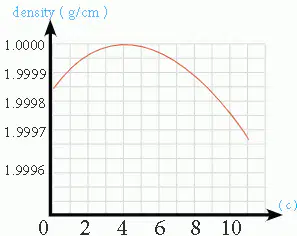
Choose correct answer: From the graph shown, we can conclude that:
The density of water increases when the temperature is raised above 4 °C
The density of water increases when the temperature is lowered below 4 °C
The volume of water increases when the temperature is lowered below 4 °C
The volume of water decreases when the temperature is lowered below 4 °C
Choose correct answer: A sample of water has a density of 1 g/cm^3. This sample is:
Distilled water at 23 °C
Distilled water at 8 °C
Distilled water at 4 °C
Distilled water at 0 °C
Choose correct answer: In the hydrometer scale:
The lower scale indicates zero
The upper scale indicates zero
The lower scale indicates the lowest density
The upper scale indicates the lowest density
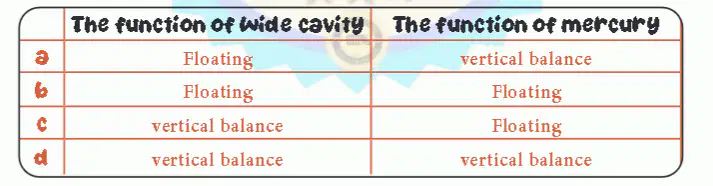
Choose correct answer: In the hydrometer:
The function of wide cavity: Floating; The function of mercury: vertical balance
The function of wide cavity: Floating; The function of mercury: Floating
The function of wide cavity: vertical balance; The function of mercury: Floating
The function of wide cavity: vertical balance; The function of mercury: vertical balance
Choose correct answer: In a hydrometer, the density of the liquid is very high when:
The volume of the immersed part of the hydrometer in the liquid increases
The volume of the immersed part of the hydrometer in the liquid decreases
The coefficient of adhesion of the liquid to the glass decreases
The temperature of the liquid is high
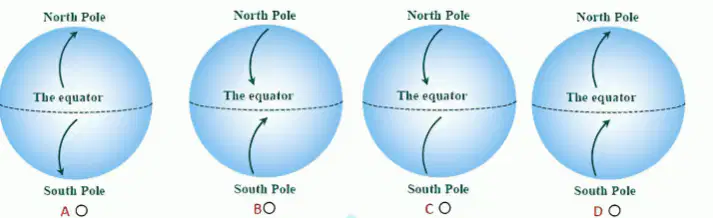
Choose correct answer: Which of the following diagrams has arrows drawn correctly to show the direction of heat and salt transfer by air currents?
A
B
C
D
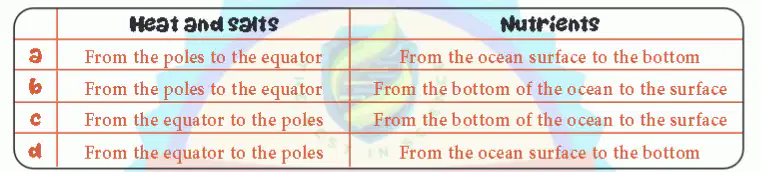
Choose correct answer: The direction in which ocean currents move
Heat and salts: From the poles to the equator; Nutrients: From the ocean surface to the bottom
Heat and salts: From the poles to the equator; Nutrients: From the bottom of the ocean to the surface
Heat and salts: From the equator to the poles; Nutrients: From the bottom of the ocean to the surface
Heat and salts: From the equator to the poles; Nutrients: From the ocean surface to the bottom
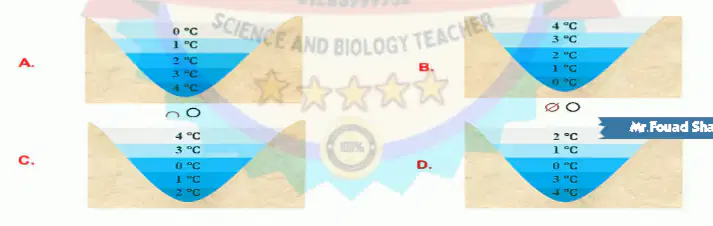
Choose correct answer: Which of the following diagrams correctly shows the temperatures of a lake in a polar region?
A
B
C
D
Choose correct answer: The average of kinetic energy of water molecules is the largest at ........
Zero° C
50° C
80° C
100° C
Choose correct answer: Which of the following affects the specific heat of the substance?
Its physical state
Its mass
Its volume
Quantity of heat lost or gained
Choose correct answer: In ocean depths, where pressure is very high, how does the enormous increase in pressure affect the density of water in large depths compared to its density at the surface?
The increase in pressure has no effect on density because water is completely incompressible.
The density increases, but this effect is completely overcome by the decrease in temperature at the bottom.
The density decreases because the high pressure breaks the hydrogen bonds.
Density increases slightly due to the compression of water under pressure.
Choose correct answer: What is the fundamental relationship between increasing salinity and the density of liquid water at constant temperature and pressure?
The density increases because adding salts increases the total mass per unit volume.
The density increases because the specific heat of the solution decreases.
The density decreases because the dissolved ions introduce between water molecules and increase volume.
The density remains constant because the mass of dissolved salts are compensated by a similar decrease in the volume of water.
Choose correct answer: Two objects are in contact, and thermal energy flows from Object (a) to Object (b). Which of the following explains this state?
Object (a) has a higher specific heat than object (b).
The difference between their masses is the reason of energy transfer.
Object (a) contains less total internal energy than object (b).
Object (a) has a higher temperature than object (b).
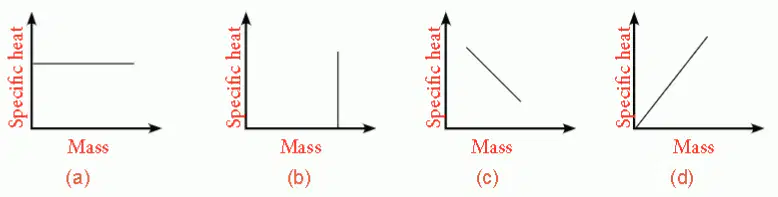
Choose correct answer: Which of the following graphs represents the correct relation between mass of substance and its specific heat..........
(a)
(b)
(c)
(d)
The following figure represents the change that happened to three substances that have equal masses and same initial temperatures and are heated for an equal period of time by the same thermal source. Which of the following is the correct order according to their specific heat?
B < C < A
A < C < B
C < B < A
A < B < C
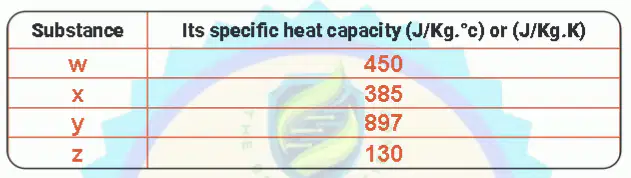
The following table data shows the specific heat of a group of different substances W, X, Y, Z: W = 450 J/kg·°C, X = 385 J/kg·°C, Y = 897 J/kg·°C, Z = 130 J/kg·°C. When equal masses of these materials are given the same amount of heat, which material W, X, Y or Z has a higher change in its temperature?
Substance W
Substance X
Substance Y
Substance Z
The absolute zero is equal to
0 K
273 K
0 °C
273 °C
If you know that the normal human temperature is 37 °C, then on the Kelvin scale it is equivalent to
37 K
273 K
300 K
310 K
If you know that the specific heat of glass is 840 J/kg·°C, it is equivalent to
3.08 J/kg·K
567 J/kg·K
840 J/kg·K
1113 J/kg·K
When the same amount of heat was given to four samples of equal mass but of different materials, the following was observed: the temperature of the sample W increases by 20 °C; the temperature of the sample X increases by 40 °C; the temperature of the sample Y increases by 60 K; the temperature of the sample Z increases by 80 K. Which material has the highest specific heat?
Substance W
Substance X
Substance Y
Substance Z
The density of water is equal to 1 g/cm³ at temperature 4 °C; when the temperature is raised to 8 °C the water volume and water density change as follows. Choose the correct effect:
Volume increases; density decreases
Volume decreases; density decreases
Volume stays the same; density increases
Volume decreases; density decreases
The density of water is equal to 1 g/cm³ at temperature 4 °C, then the mass of 4 m³ of water is equal to
0.004 kg
1 kg
4 kg
4000 kg
Four samples of water each have a mass of 1 kg, which one has a larger volume?
Saltwater at 4 °C
Saltwater at 8 °C
Fresh water at 4 °C
Fresh water at 8 °C
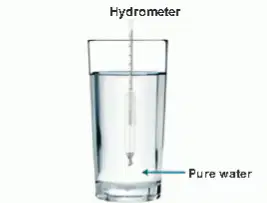
In the diagram shown, when a large amount of salt is dissolved in the pure water, the volume of the immersed part of the hydrometer in the water
increases
decreases
doesn't change
cannot be determined
Which of the following devices is used to measure the density of liquids?
Hydrometer
Barometer
Manometer
Thermometer
In a hydrometer, which of the following materials can be used to help balance?
Mercury or lead balls
Nickel or chromium
Platinum or iridium
Bronze or phosphorus
Ocean currents transport
Heat from the poles to the tropics
Nutrients from the ocean surface to the bottom
Nutrients from the ocean bottom to the surface
Salt from the poles to the tropics
The system international measuring unit of the temperature is
degree Celsius (°C)
degree Fahrenheit (°F)
Kelvin (K)
Rankine (°R)
The freezing point of pure water is
−273 °C
273 °C
0 K
273 K
Which of the following physical quantities is considered as a measure of average kinetic energy of particles in a body?
The amount of heat gained or lost
Body temperature
Work done on the object
Mass of the body molecules
The following data table shows the change in temperature of equal masses of different materials (Δt) when each one gains the same amount of heat: W = 5 °C, X = 10 °C, Y = 15 °C, Z = 20 °C. Which substance W, X, Y or Z has the largest specific heat?
Substance W
Substance X
Substance Y
Substance Z
Which of the following values on the Kelvin scale is equivalent to 10 °C?
263 K
273 K
283 K
303 K
A certain amount of a substance whose temperature rises from 30 °C to 310 K; the change in temperature is
7 K
37 °C
280 K
280 °C
The amount of heat required to raise the temperature of 0.9 kg of copper by 70 °C is (specific heat of copper = 385 J/kg·K)
2.43×10⁴ J
1.19×10^5 J
4.14×10⁴ J
2.03×10^5 J
Two equal masses from different metals (a) and (b) are heated by the same amount of heat; the temperature of (a) increases by 50 °C while the temperature of metal (b) increases by 150 °C. If the specific heat of (a) = 390 J/kg·°C, then the specific heat of (b) is
130 J/kg·°C
260 J/kg·°C
390 J/kg·°C
520 J/kg·°C
Which of the following statements most accurately represents the definition of heat (Q)?
The transfer of energy across a system boundary due to a temperature difference
The state of matter from hotness and coldness
The average latent energy stored in the molecular bonds of a substance
The total thermal energy contained within a system’s boundaries
The concept “latent” refers to
The heat is only absorbed when the substance is impure
The heat is hidden because it causes a significant change in pressure
The heat is absorbed or released without a change in temperature (ΔT = 0)
The heat can only be measured using an indirect method
Which statement best describes the structure of a hydrometer, explaining the function of each part?
A weighted bulb keeps the instrument upright and a graduated stem indicates density by the floating level
A hollow cylinder with a pressure gauge measures liquid pressure directly
A thermometer attached to a glass rod records temperature to compute density
A sealed container with a piston changes volume to measure viscosity
Which comparison accurately distinguishes cold-blooded from warm-blooded organisms?
Cold-blooded organisms have body temperatures that vary with the environment; warm-blooded organisms regulate and maintain a nearly constant internal temperature
Cold-blooded organisms maintain constant internal temperature; warm-blooded organisms’ temperature varies widely with the environment
Both cold-blooded and warm-blooded organisms maintain the same constant temperature in all environments
Warm-blooded organisms cannot survive in cold climates while cold-blooded organisms can
Calculate the amount of heat required to raise the temperature of 0.3 kg of copper from 20 °C to 70 °C, knowing that the specific heat of copper is 385 J/kg·K
5.78×10^3 J
1.16×10^4 J
3.85×10^3 J
7.00×10^3 J
A piece of granite has a mass of 150 g and a volume of 50 cm³. Will this piece float or sink in water?
It sinks because its density is 3 g/cm³, greater than water
It floats because its density is 0.3 g/cm³, less than water
It remains suspended because its density equals that of water
It sinks only in salt water but floats in fresh water
Water was heated from a temperature of 20 °C to 90 °C. What is the change in temperature in Kelvin?
70 K
20 K
90 K
110 K
Choose the correct answer: If pure water freezes at 0°C, so dissolving an amount of salt in water causing its freezing point will be ..........
less than 0°C
equal to 0°C
greater than 0°C
between 0°C and 4°C
Choose the correct answer: Two liquids X and Y are separated by a semipermeable membrane. If the boiling point of X > boiling point of Y, then water...
moves from liquid X to liquid Y.
remains stationary in both liquids.
moves from liquid Y to liquid X.
moves between both liquids at the same rate.
Choose the correct answer: Colligative properties of a solution...
Depend only on the type of solute.
Depend only on the type of solvent.
Depend on both the type and concentration of the solute.
Depend on the concentration of solute, not its type.
Choose the correct answer: If the boiling point of water at the base of a mountain is 100°C, its boiling point at the top of the mountain is...
95°C
120°C
373 K
0 K
Choose the correct answer: As the freezing point of a solution increases, its osmotic pressure...
increases
decreases
does not change
becomes zero
Choose the correct answer: If atmospheric pressure = 1 atm, the boiling point of a liquid at 0.8 atm pressure is.......... that at 1 atm.
equal to
lower than
higher than
Any of the above
Choose the correct answer: Decreasing which of the following leads to an increase in the vapor pressure of a solution?
Number of solvent molecules
Number of solute particles
Temperature
Boiling point
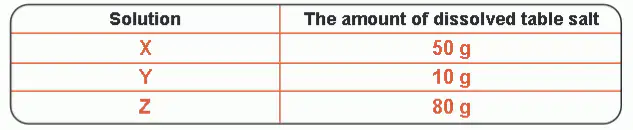
Choose the correct answer using the given data table: Three aqueous solutions of equal volume X, Y, and Z, each containing different amounts of sodium chloride. The correct order of the freezing points of Tx, Ty, and Tz is ........
Tx > Ty > Tz
Tx = Ty = Tz
Ty > Tx > Tz
Ty < Tx < Tz
Choose the correct answer: Dissolving table salt in distilled water, so the osmotic pressure of the solution ........
increases
decreases
becomes zero
remains constant
Choose the correct answer: When a water sample is left exposed to the atmospheric air, then part of water is evaporated, so its boiling point ..........
decreases
becomes zero
increases
does not change
Choose the correct answer: Salt is sprinkled on roads in frozen areas after snowfall ............
To lower the melting point of ice
To raise the melting point of ice
To reduce the amount of evaporation
To reduce the vapor pressure produced by water
Choose the correct answer: The decrease in freezing point is .......... proportional to the number of solute particles, while the increase in boiling point is .......... proportional to solution concentration
direct / direct
direct / inversely
inversely / inversely
inversely / direct
Choose the correct answer: What does the term “the concentration of solution” express?
Total volume of solution
Type of solute and solvent
Amount of solute in a given volume of solvent
Temperature of the solution
Choose the correct answer: Which of the following is not an example of an aqueous solution?
A solution of table salt in water
Lemon juice
Tea
A mixture of sand and water
Choose the correct answer: What is the effect of increasing the concentration of dissolved substances in water on its density?
decreases
increases
does not change
changes randomly.
Choose the correct answer: What is the main effect of adding solute to water; on its vapor pressure?
decreases
increases
is not affected
increases then decreases.
Choose the correct answer: Why are water molecules less likely to evaporate in solutions than in pure water?
Because of the attractive forces between water molecules increases
Because of the attractive forces between water molecules decreases
Because of the attractive forces between water molecules and the solute increases
Because of the attractive forces between water molecules and the solute decreases
Choose the correct answer: What is the relationship between the number of solute molecules in a solution and its vapor pressure?
Inverse relationship
Direct relationship.
No relationship
Variable relationship.
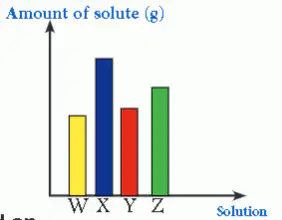
Choose the correct answer using the opposite graph: First: Which solution has the highest concentration?
W
X
Y
Z
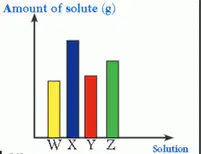
Choose the correct answer using the opposite graph: Second: Which solution has the highest density?
W
X
Y
Z
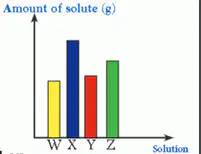
Choose the correct answer using the opposite graph: Third: Which solution has the highest boiling point?
W
X
Y
Z
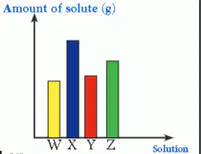
Choose the correct answer using the opposite graph: Forth: Which solution has the highest freezing point?
W
X
Y
Z
Choose the correct answer: The colligative properties of solutions depend on..........
nature of solvent
nature of solute
volume of solution
number of solute particles
Choose the correct answer: Which of the following does its increase lead to decreasing the vapor pressure of solutions?
Temperature
Freezing point
Number of solvent particles
Number of solute particles
Choose the correct answer: What happens to the vapor pressure of a solution with increasing the concentration of the solute?
Increases
Decreases
Vanishes
Remains constant
Choose the correct answer: Liquid starts to boil when its vapor pressure is........
greater than the pressure affecting it
three times the pressure affecting it
less than the pressure affecting it
equal to the pressure affecting it
Choose the correct answer: If the boiling point of water at 1 atm pressure is 100°C, it is expected that its boiling point at 0.7 atm pressure equals........
100°C
102°C
93°C
103°C
Choose the correct answer: Which of the following factors doesn’t affect the boiling point of solution?
Volume of solution
Density of solution
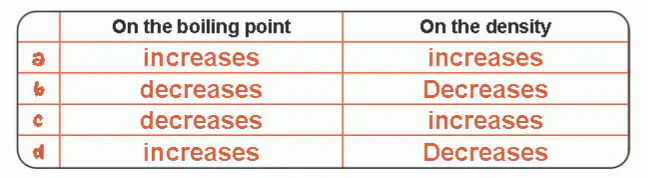
Choose the correct answer using the given table: What is the effect of increasing the number of solute molecules in solution on the boiling point of the solution and its density?
increases / increases
decreases / Decreases
decreases / increases
increases / Decreases
Convert the open question to a scorable item: What is an aqueous solution? And what is the difference between a solvent and a solute?
An aqueous solution is any mixture; solvent is the solid and solute is the liquid.
An aqueous solution is a solution with water as the solvent; solvent is the substance that dissolves other substances and solute is the substance dissolved.
An aqueous solution is a solid mixture; solvent and solute are identical.
An aqueous solution is a solution with alcohol as the solvent; solvent is the dissolved substance and solute is the dissolving substance.
Convert the open question to a scorable item: What are the colligative properties of solutions? And give examples.
They are properties depending on the nature of solute; examples include color and viscosity.
They are properties depending on the number of solute particles; examples include boiling point elevation, freezing point depression, vapor pressure lowering, and osmotic pressure.
They are properties depending on temperature only; examples include density and taste.
They are properties depending on solvent type; examples include mass and volume.
Convert the open question to a scorable item: Mention a practical application of the phenomenon of freezing point depression of a solution.
Adding salt to icy roads to melt ice in winter
Heating water to increase its vapor pressure
Diluting a solution to decrease its concentration
Covering water to prevent evaporation
All the following from the reasons that make “water is essential for life” except
The vital activities in all living cells depend on the water properties.
It is the most abundant chemical substance in living organisms.
It is present in almost all chemical reactions occurring in vital activities.
Water is found inside the cells only.
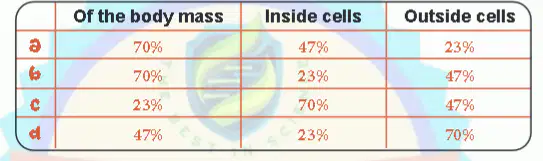
Which of the following correctly describe the percentage of water in mammals? Of the body mass — 70%; Inside cells — 47%; Outside cells — 23%.
70%, 47%, 23%
70%, 23%, 47%
23%, 70%, 47%
47%, 23%, 70%
Which of the following correctly describe prokaryotes?
They are multicellular organisms.
They are unicellular or multicellular organisms.
Their genetic material is not surrounded by a nuclear membrane.
Their genetic material is surrounded by a nuclear membrane.
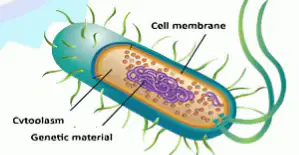
The shown figure represents a ...... cell whose cell wall contains ..........
Bacterial – chitin
Bacterial – peptidoglycan
Fungal – chitin
Fungal – peptidoglycan
Which of the following correctly describe eukaryotes?
They are unicellular organisms only.
They are multicellular organisms only.
Their genetic material is not surrounded by a nuclear membrane.
Their cell contains a nucleus surrounded by a membrane, and specialized organelles.
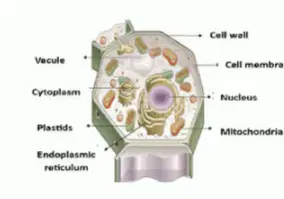
The figure shows the structure of a plant cell, which organelles are not found in an animal cell?
Cell membrane and plastids
Cell wall and mitochondria
Plastids and cell wall
Endoplasmic reticulum and sap vacuole
A thin semi-permeable envelope surrounds the cell in all living organisms and separates the cell components from the surrounding environment is.....
Cell membrane
Cell wall
Nucleus membrane
Endoplasmic reticulum
The organelle that controls the cell’s activities and contains the genetic material that determines the organism’s traits is.....
sap vacuole
mitochondria
nucleus
chloroplast

The figure shows the structure of a plant cell. First: Which organelle is not found in an animal cell?
Cell wall
Mitochondria
Nucleus
Ribosomes
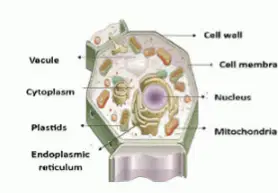
The figure shows the structure of a plant cell. Second: Which organelle is responsible for the storage of food, water, and excess salts?
Vacuole
Mitochondria
Golgi apparatus
Ribosomes
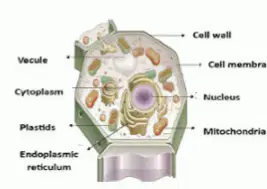
The figure shows the structure of a plant cell. Third: Which organelle that contains chlorophyll substance and carry out photosynthesis process?
Chloroplast
Nucleus
Cell membrane
Lysosome
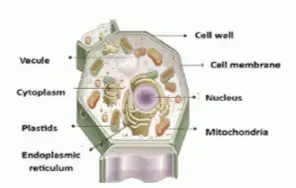
The figure shows the structure of a plant cell. Forth: Which organelles that serve as energy-production centers in the cell?
Mitochondria
Chloroplasts
Ribosomes
Cell wall
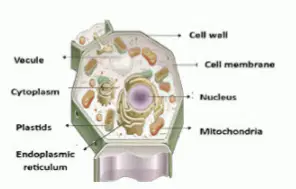
The figure shows the structure of a plant cell. Fifth: Which organelles that are a group of membranes used to transport various materials from one place to another inside the cell?
Endoplasmic reticulum
Golgi apparatus
Lysosomes
Vesicles
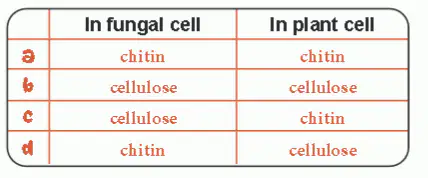
Which of the following correctly describe the structure of cell wall in both fungal cell and plant cell? In fungal cell vs. In plant cell.
chitin — chitin
cellulose — cellulose
cellulose — chitin
chitin — cellulose
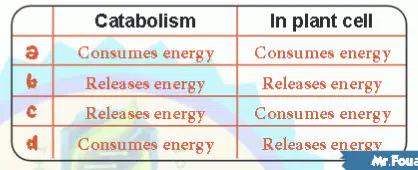
Which of the following correctly describe catabolism and anabolism processes? Catabolism vs. Anabolism.
Consumes energy — Consumes energy
Releases energy — Releases energy
Releases energy — Consumes energy
Consumes energy — Releases energy
All the following are anabolic process except.......
Formation of glucose in Photosynthesis process
Synthesis of proteins
Development of bones and muscles
Breakdown of glucose sugar
All the following are catabolic process except.......
Synthesis of proteins
Breakdown of carbohydrates
Breakdown of protein
Breakdown of glucose sugar

Which of the following structures in a living cell performs the function of the person shown in the picture?
Cell wall
Mitochondria
Nucleus
Plasma membrane
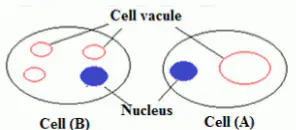
The figure represents two cells (a) and (b). Study it and then answer: Which of the following is true regarding the types of cells?
Cell (a) is animal, while cell (b) is plant.
Cell (a) is plant, while cell (b) is animal.
Both (a) and (b) are animal cells.
Both (a) and (b) are plant cells.

