wayground logo

Free Printable Worksheets

Font size

S
M
L
XL
Worksheets

Biology Q1 Review

Total questions: 82

Worksheet time: 1hrs 4mins

Name
Class
Date
1.
An experiment is performed on plants to see how different liquids affect plant growth. Each plant in the experiment is given a different liquid; water, apple juice, or milk. Each plant has the same amount of soil, sunlight, and listens to the same music. In this investigation, the independent variable is ...
a)
The type of plant
b)
The amount of sunlight
c)
The type of music
d)
The type of liquid
2.
Dependent variable means
a)
the scientist controls what to test
b)
educated guess
c)
ask a question
d)
what is being measured
3.
If you increase the amount of spinach you eat, then you will increase the iron in your blood. 
What's the dependent variable?
a)
increase the amount of iron in your blood
b)
spinach you eat
4.
This is the group that we will compare our experimental group to. This group stays "normal."
a)
Control Group
b)
Experimental Group
c)
 Normal Group
d)
Weird Group
5.

An If/Then statement represents the _________________.

a)

Information

b)

Problem

c)

Hypothesis

d)

Conclusion

6.

The graph below shows atmospheric carbon dioxide levels since the year 1880.Which of the following conclusions can be drawn from this graph

a)

Atmospheric carbon dioxide levels are responsible for global temperature change.

b)

Atmospheric carbon dioxide levels have been rising at about the same rate for the past century.

c)

Atmospheric carbon dioxide levels have remained the same over the past century.

d)

Atmospheric carbon dioxide levels have been rising at an increasingly higher rate as the past century has progressed.

7.

Which type of data involves numbers that are obtained by counting or measuring?

a)

quantitative

b)

qualitative

8.

Which type of data involves descriptions that cannot be counted or measured?

a)

qualitative

b)

quantitative

9.
Large bodies of water do not quickly fluctuate in temperature. Why?
a)
Water is a solvent.
b)
Water has a high heat capacity.
c)
Water acts as a buffer.
d)
Water is non-polar.
10.
What word describes when water is attracted to other substances?
a)
cohesion
b)
adhesion
c)
capillary action
d)
surface tension
11.
Why does water move from the roots to the leaves of plants?
a)
Water is pushed by solutes
b)
Capillary action pulls the water molecules like a chain
c)
Water is pulled by gravity
d)
Water’s cohesion causes it to “pull” towards the leaves
12.
What property of water helps to moderate earth's temperature?
a)
adhesion
b)
chohesion
c)
Specific heat capacity
d)
Latent heat of vaporization
13.
Why does ice float?
a)
As water freezes, it expands and its density decreases.
b)
As water freezes, it takes up more hydrogen from the atmosphere, causing it to have a greater buoyancy.
c)
As water freezes, air becomes trapped between the hydrogen bonds of water molecules.
d)
As water freezes, it takes up more oxygen from the atmosphere, causing it to have a greater buoyancy.
14.
What property of water is being shown?
a)
cohesion
b)
hydrogen bonds
c)
adhesion
d)
polarity
15.

Attractive force between molecules of water

a)

cohesion

b)

adhesion

c)

polarity

d)

capillary

16.

A scientist wants to study some living cells from a piece of onion skin using light. Which microscope would she use?

a)

Compound

b)

Transmission Electron

c)

Dissecting

d)

Scanning Electron

17.

A scientist wants to study a whole feather in a little bit more detail using light...which microscope would be best to sue?

a)

Compound

b)

Scanning Electron

c)

Dissecting

d)

Transmission Electron

18.

This image shows the inner structures of a bone cell. Which microscope was used to produce this image?

a)

Scanning Electron

b)

Dissecting

c)

Compound

d)

Transmission Electron

19.

Choose which 2 microscopes use electrons to produce an image:

a)

Scanning

b)

Compound

c)

Dissecting

d)

Transmission

20.
Which invention from the 17th century allowed for the development of modern cell theory?
a)
x-rays
b)
computers
c)
the light microscope
d)
the scanning electron microscope
21.
Rudolph Virchow's observations helped to disprove was commonly held belief of the time?
a)
evolution
b)
the existence of molecules
c)
spontaneous generation
d)
atomic models
22.
Unlike eukaryotes, prokaryotes do not have:
a)
DNA
b)
cytoplasm
c)
cell walls
d)
a membrane bound nucleus
23.
Who discovered and named cells? 
a)
Captain Hook
b)
Robert Hooke
c)
Zacharias Janssen
d)
Rudolf Virchow
24.
Which of the following controls movement of materials in and out of a cell? 
a)
Cell wall
b)
Cell membrane
c)
Cytoplasm
d)
Nucleus
25.
The jellylike substance that contains proteins, nucleic acids, minerals, ions, and organelles is what?
a)
Prokaryote
b)
Nucleus
c)
Cytoplasm
d)
Eukaryote
26.
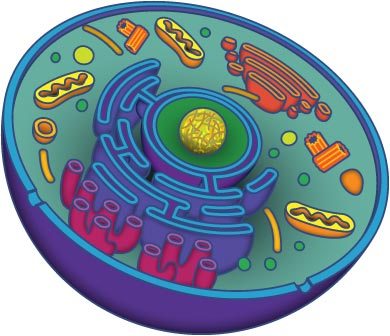
Which organelle is the protein factory? 
a)
Ribosomes
b)

Mitochondria

c)
Centriole
d)
Lysosomes
27.
Microscopic single-cells that do not have a nucleus or other membrane-bound organelles. 
a)
DNA
b)
RNA
c)
Eukaryotes
d)
Prokaryotes
28.
Genetic information is stored in the nucleus of all single or multicellular cells called
a)
Eukaryotes
b)
Prokaryotes
c)
Organelles
d)
Cytoplasm
29.

According to the Cell Theory, all living things are made up of...

a)
cells
b)
cell tissues
c)
organ
d)
organ systems
30.
Which statement is a part of the cell theory?
a)
all cells come from preexisting cells
b)
bacteria are prokaryotic cells
c)
eukaryotic cells are complex
d)
humans are multicellular
31.

What are the specialized structure that performs important cellular functions within a cell called?

a)

cytplasm

b)

ribosome

c)

golgi apparatus

d)

organelles

32.

What organelle in cells modifies, sorts, and packages proteins and other material from the endoplasmic reticulum for storage in the cell or release outside the cell?

a)

vacuoles

b)

endoplasmic reticulum

c)

golgi apparatus

d)

nucleus

33.

What cell organelle stores materials such as water, salts, protein, and carbohydrates?

a)

vacuole

b)

lysosomes

c)

nucleus

d)

Cytoplam

34.

What is the structure that contains the cell's genetic material in the form of DNA?

a)

nucleus

b)

lysosomes

c)

cell wal

d)

vacuole

35.

What organelle found in cells of plants and some other organisms that captures the energy from sunlight and converts it into chemical energy?

a)

chloroplast

b)

cytoplasm

c)

ribosome

d)

mitochodria

36.

What cell organelle converts the chemical energy stored in food into compounds that are more convenient for the cell to use.

a)

golgi apparatus

b)

chloroplast

c)

nuclues

d)

mitochondria

37.

What is the purpose of the cell membrane?

a)

Make proteins for the cell

b)

Controls what comes in and out of the cell

c)

Produces energy for the cell

d)

Transports stuff around the cell

38.

What kind of energy is used in active transport?

a)

ENERGY IS NOT USED IN ACTIVE TRANSPORT!!!!!

b)

Solar Energy

c)

ATP

d)

Mechanical Energy

39.

In passive transport, in what direction do particles move?

a)

High to low concentration

b)

Out of the cell

c)

Low to high concentration

d)

Into the cell

40.

In active transport, in what direction do particles move?

a)

High to low concentration

b)

Out of the cell

c)

Low to high concentration

d)

Into the cell

41.

In a hypotonic solution. (Hint: Draw a picture)

a)

Water goes out of the cell because there is less water outside than inside the cell.

b)

Water goes out of the cell because there is more water outside than inside the cell.

c)

Water goes into the cell because there is less water outside than inside the cell.

d)

Water goes into the cell because there is more water outside than inside the cell.

42.

In a hypertonic solution, the cell...

a)

Gets smaller

b)

Gets bigger

c)

Stays the same

d)

Bursts

43.

If there is more water outside the cell than inside the cell, the solution is...

a)

hypertonic

b)

isotonic

c)

hypotonic

d)

heteromitomonotonic

44.
Which of the following is the best example of osmosis? 
a)
NA/K Pump 
b)
Water moving though the cell membrane 
c)
Kidneys 
d)
Photosynthesis 
45.
What are the 2 parts of a phospholipid? 
a)
Hydrophobic head, hydrophilic tails 
b)
Hydrophobic heads, hydrophobic tails 
c)
Hydrophilic heads, hydrophobic tails 
d)
Hydrophilic heads, hydrophilic tails 
46.
What is an isotonic solution?
a)
When solutions are in equilibrium 
b)
When the solution has more solute 
c)
When the solution has less solute 
d)
Has a greater pressure 
47.
Which means of particle transport is shown in this diagram?
a)
endocytosis
b)
exocytosis
c)
facilitated diffusion
d)
protein pump
48.
What is another term for "selectively permeable"?
a)
porous
b)
completely permeable
c)
permanent
d)
semipermeable
49.
Diffusion allows cells to take in small particles that can pass through the cell membrane. How are large particles taken in?
a)
Endocytosis
b)
Exocytosis
c)
Mitosis
d)
Photosynthesis
50.

two-layer "sandwich" of molecules that surrounds a cell

a)

Phospholipid Bilayer

b)

Concentration Gradient

c)

Simple diffusion

d)

Hydrophilic

51.

Which macromolecule is used as our main source of quick energy?

a)

Lipids/Fats

b)

Nucleic Acids

c)

Proteins

d)

Carbohydrates

52.
Waxes, oils and fats are examples of
a)
Carbohydrates
b)
Lipids
c)
Proteins
d)
Nucleic Acids
53.

Nucleic acids make up which of the two molecules listed below?

a)

FDA

b)

RNA

c)

DNA

d)

FDR

54.

This macromolecule breaks down into sugars such as glucose.

a)

Lipids/Fats

b)

Nucleic Acids

c)

Protein

d)

Carbohydrates

55.

Storing energy is the primary function of two macromolecules. What macromolecule is represented by the structure below?

a)

Carbohydrates

b)

Proteins

c)

Lipids

d)

Nucleic Acids

56.

Which of the following are examples of carbohydrates? (Select all that apply).

a)

Bread

b)

Pasta

c)

Olive Oil

d)

Cheese

57.
Proteins are made of monomers called ___________
a)
Nucleotides
b)
Monosaccharides
c)
Amino Acids
d)
Glycerol and fatty acids
58.
Nucleotides are monomers of
a)
Carbohydrates
b)
Lipids
c)
Proteins
d)
Nucleic Acids
59.

Chitin is found in the exoskeleton of arthropod. What group does this monomer belong to?

a)

Carbohydrates

b)

Lipids

c)

Proteins

d)

Nucleic Acids

60.

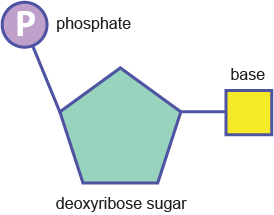
Identify the monomer shown

a)

monosaccharide

b)

amino acid

c)

neucleotide

d)

glucose molecule

61.

Enzymes are an example of

a)

Lipids

b)

Carbohydrate

c)

Protein

d)

Nucleic Acid

62.
What is the purpose  of an enzyme?
a)
give permission for the reaction
b)
raise activation energy
c)
speed up reactions
d)
control how many reactions occur
63.
What 3 letters do enzymes typically end in?
a)
-ose
b)
-ase
c)
-ese
d)
-tic
64.
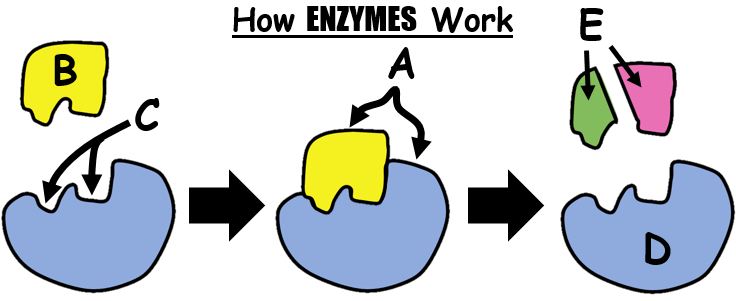
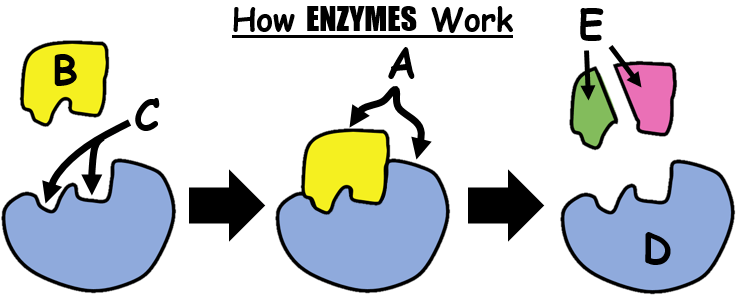
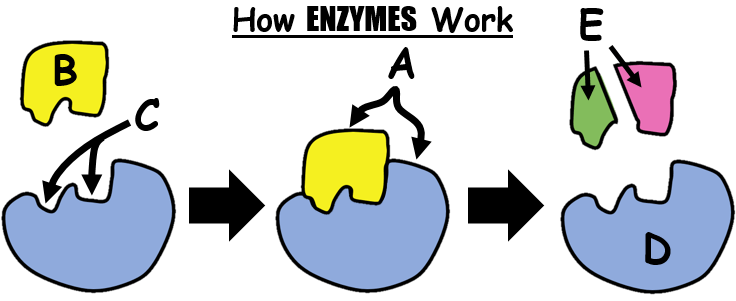
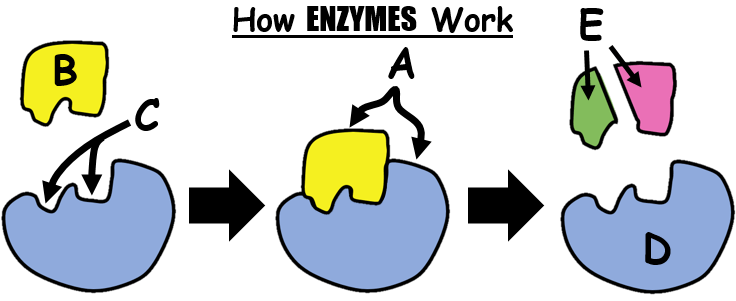
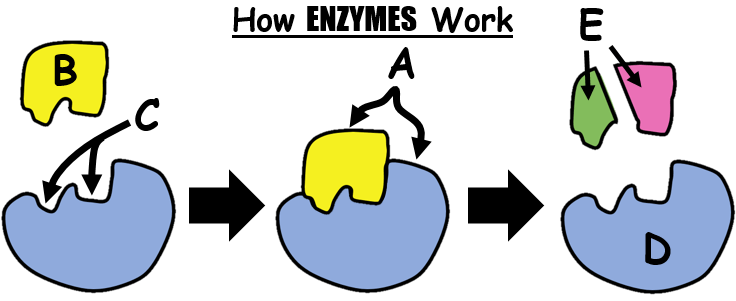
In the diagram, what is letter A? 
a)
product
b)
substrate
c)
enzyme-substrate complex
d)
active site
65.
Letter D...
a)
active site
b)
enzyme
c)
substrate
d)
products
66.
Letter B...
a)
active site
b)
enzyme
c)
substrate
d)
products
67.
Letter C...
a)
active site
b)
enzymes
c)
substrate
d)
products
68.
Letter E...
a)
active site
b)
enzyme
c)
substrate
d)
products
69.

In a chemical reaction, ________ are what you have at the end

a)

Products

b)

Molecules

c)

Reactants

d)

Substances

70.
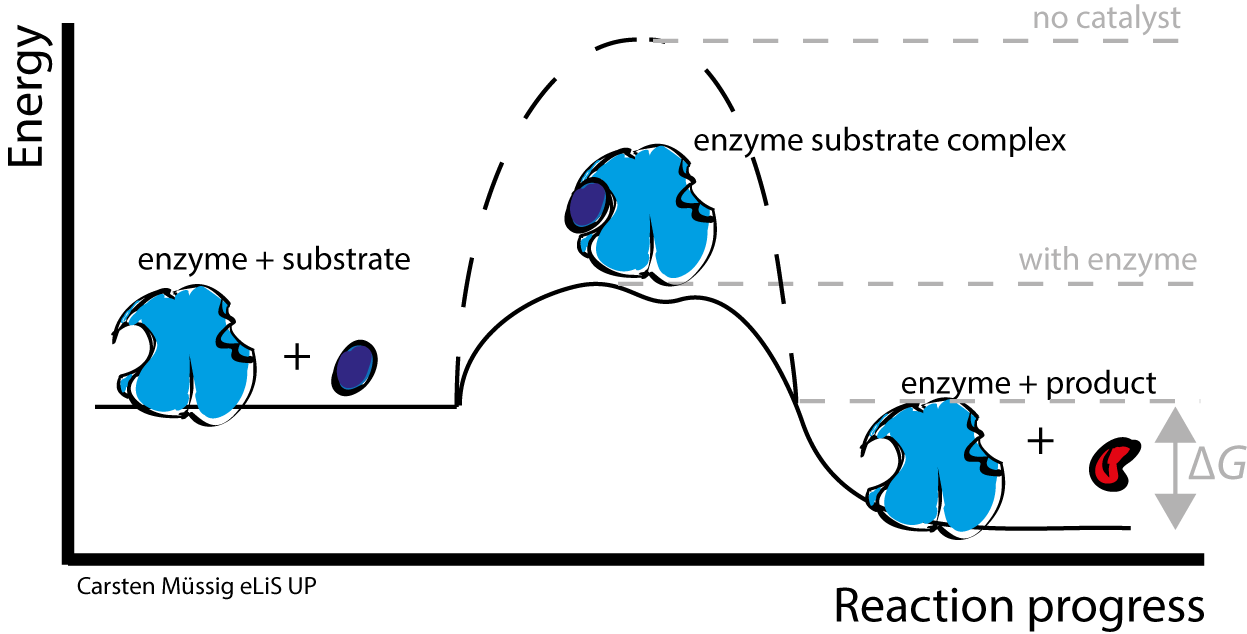
An enzyme speeds up a reaction by
a)
lowering the activation energy.
b)
raising the activation energy.
c)
releasing energy.
d)
absorbing energy.
71.
What happens when enzymes are heated to a high temperature?
a)
The enzymes die.
b)
The shapes of the enzyme are altered denature
c)
The enzymes' amino acid sequence changes.
d)
The enzymes remain the same
72.

What is the first source of energy for living things?

a)

food

b)

glucose

c)

the sun

d)

water

73.

What are the inputs (reactants) of photosynthesis?

a)

glucose and oxygen

b)

glucose and carbon dioxide

c)

carbon dioxide and oxygen

d)

carbon dioxide and water

74.

Where does photosynthesis take place?

a)

mitochondria

b)

nucleus

c)

chloroplast

d)

ribosome

75.

What is the main pigment in plants?

a)

chlorophyll

b)

glucose

c)

oxygen

d)

carotene

76.

What are the outputs (products) of photosynthesis?

a)

carbon dioxide and water

b)

glucose and oxygen

c)

glucose and carbon dioxide

d)

water and oxygen

77.

Where does cellular respiration take place?

a)

chloroplast

b)

lungs

c)

mitochondria

d)

nucleus

78.

What are the outputs (products) of cellular respiration?

a)

glucose, oxygen, and energy

b)

carbon dioxide, water, and energy

c)

water, oxygen, and glucose

d)

water and energy

79.

What is an autotroph?

a)

an organism that can makes its own food

b)

an organism that needs to consume food

c)

an organism that has absorbs food by diffusion

d)

all living organisms

80.

What is a heterotroph?

a)

an organism that absorbs food by diffusion

b)

an organism that uses photosynthesis to make its food

c)

an organism that needs to consume food for energy

d)

all plants

81.

What is the purpose of cellular respiration?

a)

to convert sunlight to glucose

b)

to breathe in oxygen and breathe out carbon dioxide

c)

to have cells grow and develop

d)

to convert glucose to usable energy

82.

What is the purpose of photosynthesis?

a)

to make more plants

b)

to convert sunlight to glucose

c)

to convert glucose to usable energy

d)

to change colors of leaves in the fall