
 Worksheets
review
Total questions: 116
Worksheet time: 2hrs 25mins
Which of the following sequences is correct for atomic size?
Li > Na > K
F > N > B
F > Cl > Br
Mg > Al > S
Which of the following is the most electronegative?
Cl
Se
Na
I
Which of the following is the least electronegative?
Na
K
Rb
Cs
Which of the following has the highest Ionization Energy?
O
N
C
B
Which of the following is the biggest Cation?
Na+
K+
Rb+
Cs+
Which of the following is the smallest Cation?
Na+
K+
Rb+
Cs+
Which of the following is the smallest Anion?
F-
Cl-
Cl-
I-
Which of the following is the biggest Anion?
F-
Cl-
Cl-
I-
Which of the following has the lowest Ionization Energy?
P
As
Sn
Pb
Most elements on the periodic table are classified as ___?
Metals
Metalloids
Nonmetals
Gases
Groups on the periodic table are arranged
Horizontally
Vertically
Diagonally
From left to right
Each horizontal row on the periodic table are called what?
Families
Groups
Periods
Rows
Columns on the periodic table are called what?
Columns
Groups
Periods
Rows
Which is true?
Cations are bigger than Anions
Anions are bigger than Cations
Cations and Anions are the same size.
It depends upon their position on the Periodic Table
Which element in Period 2 has the greatest atomic radius?
Be
C
Na
Li
Of the halogens (group 7A), which has the smallest radius?
F
Br
He
At
Electronegativity __________ from left to right within a period and __________ from top to bottom within a group.
decreases, increases
increases, increases
increases, decreases
stays the same, increases
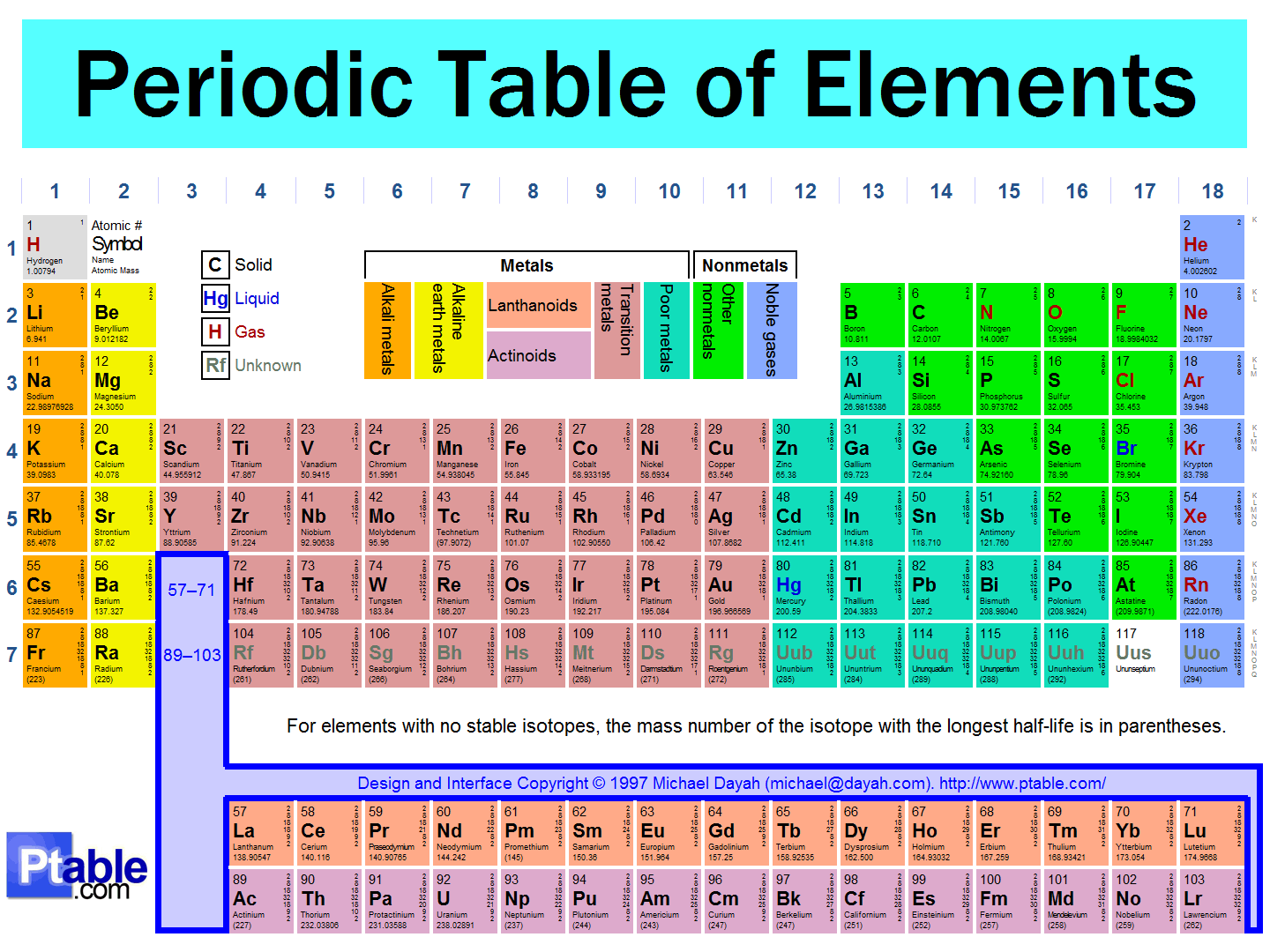
The vertical (up and down) columns in the Periodic Table are called
groups
towers
periods
atomic numbers
The atom with the largest atomic radius in Group 8A is -
Ar
He
Kr
Rn
H or F?
N or C?
How many valence electrons does Carbon have?
4
5
6
8
The ability of an atom to attract electrons in a bond is called
Ionization energy
electronegativity
atomic radius
proton affinity
Which of the following will have a lower ionization energy than Scandium (Sc)?
Helium (He)
Titanium (Ti)
Calcium (Ca)
Magnesium (Mg)
Which of the following will have a higher electronegativity than arsenic (As)?
Carbon (C)
Neon (Ne)
Antimony (Sb)
Germanium (Ge)
As you move left to right across a period, ionization energy
increases
decreases
says the same

This could be the dot diagram of
Mg
Cl
C
O
What is the goal of the Lewis Dot Structure?
To determine the electron position.
To show the element's valence electrons & bonding capabilities.
To find the atomic mass of an element.
To search for the number of electrons in an individual atom.
How many valence electrons should Lithium have in its Lewis dot model?
1
2
3
4

This is a correct dot diagram for nitrogen (N)
true
false

This is a correct dot diagram for neon (Ne)
true
false
How would you draw a Lewis dot diagram for Magnesium?


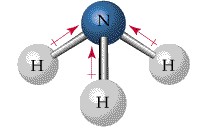
What is the correct Lewis structure for NH3?


Which is the correct Lewis structure for carbon dioxide?


Metals make _____ ions.
positive
negative
neutral
Nonmetals will make _____ions.
positive
negative
neutral
How many valence electrons are in the compound N2O?
(a)

Why is this Lewis Structure incorrect? Select all that appy.
There should be a single bond between H and C.
There should be a triple bond between C and N.
Carbon has too many bonds around it.
Hydrogen needs more electrons.

Why is this Lewis Structure incorrect? Choose all that apply.
There are too many bonds around Si.
There should only be single bonds in this Lewis Structure.
The Structure is missing a triple bond.
Chlorine only has 6 electrons surrounding it.
Give a list of elements that Magnesium would likely form an ionic bond with. What would the transfer of electrons look like? Practice drawing one of your examples on a piece of scratch paper.

Classify the following molecule.
polar
nonpolar

Classify the following molecule.
polar
nonpolar

Is the following molecule polar or nonpolar?
polar
nonpolar

Why is the molecule polar?
There is a nonbonding pair on the central atom.
There are different types of elements bonded to the central atom.
There are no nonbonding pairs on the central atom and all of the atoms bonded to the central atom are the same.
Use your knowledge and electronegativity sheet to predict what the following compound is classified as.
polar covalent
nonpolar covalent
ionic
metallic

Use your knowledge and electronegativity sheet to predict what the following compound is classified as.
nonpolar covalent
polar covalent
ionic
metallic

Use your knowledge and electronegativity sheet to predict what the following compound is classified as.
non-polar covalent
polar covalent
ionic
metallic
In a polar covalent bond, electrons are shared:
equally
unequally
between two metals
between a metal and a non-metal
Electronegativity is a measurement of the ability of a nucleus to:
attract bonding electrons
attract other nuclei
attract electrons in the non-valence energy levels

A covalent bond usually forms between:
a metal and a nonmetal
either metals or nonmetals
two metals
two nonmetals
A diatomic molecule like O2 is always_______ because electrons are shared ________.
nonpolar; equally
polar; equally
nonpolar; unequally
nonpolar; unequally

Classify the following molecule.
polar
nonpolar
Classify the following molecule.
polar
nonpolar
Is the following molecule polar or nonpolar?
polar
nonpolar
Why is the molecule polar?
There is a nonbonding pair on the central atom.
There are different types of elements bonded to the central atom.
There are no nonbonding pairs on the central atom and all of the atoms bonded to the central atom are the same.
Use your knowledge and electronegativity sheet to predict what the following compound is classified as.
polar covalent
nonpolar covalent
ionic
metallic
Use your knowledge and electronegativity sheet to predict what the following compound is classified as.
nonpolar covalent
polar covalent
ionic
metallic
Use your knowledge and electronegativity sheet to predict what the following compound is classified as.
non-polar covalent
polar covalent
ionic
metallic
In a polar covalent bond, electrons are shared:
equally
unequally
between two metals
between a metal and a non-metal
Electronegativity is a measurement of the ability of a nucleus to:
attract bonding electrons
attract other nuclei
attract electrons in the non-valence energy levels
A covalent bond usually forms between:
a metal and a nonmetal
either metals or nonmetals
two metals
two nonmetals
A diatomic molecule like O2 is always_______ because electrons are shared ________.
nonpolar; equally
polar; equally
nonpolar; unequally
nonpolar; unequally
The element Platinum is part of which block on the periodic table?
S block
P block
D block
F block
A student is given the task to determine if an unknown compound contains ionic or covalent bonds. Which of the following groups of tests would be best able to answer that question?
Determine the density, solubility in ethanol, and electrical conduction in the solid state.
Determine the solubility in water, electrical conduction in the solid state, and color of the solid.
Determine the solubility in water, electrical conduction in the liquid state, and melting point.
Determine the electrical conduction in the liquid state, mass needed for a 0.1 M aqueous solution, and color of the solid.
Bohr’s model of the atom is also known as:
The planetary model
The plum pudding model
The atomic model
The postulate model
An isotope is a variant of a particular element that differs in the number of:
Neutrons
Electrons
Protons
Atoms
Which of the following descriptions will most likely give you a covalently bonded binary compound?
an element with a low electronegativity and an element with a high electronegativity
an element with a high electronegativity and an element with a high electron affinity
an element with a low electronegativity and an element with a high ionization energy
an element with a low electron affinity and an element with a high electronegativity
Which of the following statements and reasoning is true?
Lithium and fluorine tend to form an ionic compound because they both have second energy level valence electrons.
Sodium chloride has a smaller lattice energy than magnesium chloride, since the change in potential energy is less due to the lower charge on the sodium ion.
Potassium fluoride has a smaller lattice energy than potassium bromide due to the greater polarizability of the fluoride electron cloud.
Sodium phosphate cannot form an ionic lattice in nature due to the high electronegative state and large size of the phosphate ion.
The results of Rutherford’s gold foil experiment showed very few alpha particles interacted strongly with the gold atoms. Which of the following best describes the results of this experiment?
The atom consisted of a small, dense region of positive charge and a large volume of nearly empty space.
The atom consisted of an even distribution of positive and negative charges (“plum pudding model”).
The electron shell model of the atom needed revision.
The results suggested a quantum model for the atom.
An anion has a charge of 2-(X2-). Which of the following correctly describes the process that resulted in that charge?
The neutral atom gained two electrons.
The neutral atom lost two electrons.
The neutral atom gained two protons.
The neutral atom gained two protons.
Which of the following is the empirical formula for hexane, C6H14?
C12H28
C3H7
C2H
CH2
Which of the following combinations of atoms would most likely result in an ionic compound?
Fluorine and chlorine
Lithium and magnesium
Carbon and oxygen
Barium and bromine
What is the standard unit of measurement for the atomic mass of an element?
Atomic mass unit
Atomic number unit
Atomic weight unit
Subatomic particle
A student is trying to determine the relative strengths of the London dispersion forces for three different non-polar substances. Which of the following experiments would most likely yield results that could answer that question?
Perform a redox titration on equimolar solutions of each substance to determine which requires the highest concentration of KMnO4 to reach the end point.
Perform a gravimetric analysis to determine the elements in the compound as well as its molecular mass.
Heat each of the solids until they boil while recording the temperature in order to prepare heating curves for each of the substances.
Determine the reaction rate for the oxidation of each of the substances in a mixture of oxygen and chlorine gases.
A positively charged ion is also called a(n):
Anion
Cation
Proton
Neutron
Ammonia's unusually high melting point is the result of
covalent bonding
hydrogen bonding
dipole-dipole forces
London dispersion forces
The electronegativity for boron is 2.0 and 4.0 for fluorine. Which of the following statements regarding the polarity of boron trifluoride is correct?
Boron trifluoride is non-polar because the difference in electronegativity indicates a non-polar covalent bond.
Boron trifluoride is non-polar because the molecular geometry indicates that the dipole moment for each bond is canceled due to the symmetry of the molecule.
Boron trifluoride is polar because each bond shows a strong dipole moment in the direction away from boron toward the fluorine atoms.
Boron trifluoride is polar because the 6 unbonded valence electrons on each fluorine atom develop strong electronegative regions surrounding the electropositive region around boron.
Select the type of interaction which best describes the attraction between Mg2+ ions and water molecules.
Ion-dipole
Ion-induced dipole
Ion-hydrogen bond
Dipole-dipole
Which one has the smallest radius?
bromide ion
calcium ion
krypton atom
selenide ion
What is the molecular geometry of ammonia, NH3?
Trigonal planar
Trigonal pyrimidal
Tetrahedral
Bent
The melting points of metals are only moderately high because
metallic bonding is weak.
metals have fewer bonding electrons than non-metals.
metals also have relatively low boiling points.
the melting process does not break the metallic bonds.
Analysis of an unknown substance showed that it has a high boiling point and is brittle. The substance is an insulator as a solid but conducts electricity when melted. Which of the following substances would have those characteristics?
Al
KBr
SiF4
I2
Which of the following period 3 chlorides would be expected to have the highest melting point?
MgCl2
SiCl4
PCl3
SCl2
Arrange the following bonds in order of increasing bond strength.
C-- I < C-- Br < C --Cl < C-- F
C --F < C-- Cl < C-- Br < C-- I
C-- Br < C-- I < C-- Cl < C-- F
C-- I < C-- Br < C-- F< C-- Cl
A chloride ion (Cl-) could be said to have:
10 core electrons and 6 valence electrons
10 core electrons and 8 valence electrons
12 core electrons and 5 valence electrons
12 core electrons and 6 valence electrons
A reaction occurs where 7.0 x 10¹² atoms of hydrogen gas (H2) combines with 3.5 x 10¹² atoms of graphite (C). Which of the following molecular models is inconsistent with this data?
CH4
C2H8
C3H12
CH2
Element Z reacts with oxygen to form OZ2. It also reacts with phosphorous to form PZ3. Predict the formula for a compound that contains Element Z and sulfur.
SZ2
ZS4
SZ
ZS2

