
 Worksheets
Unit 3 Review
Total questions: 56
Worksheet time: 8hrs 50mins
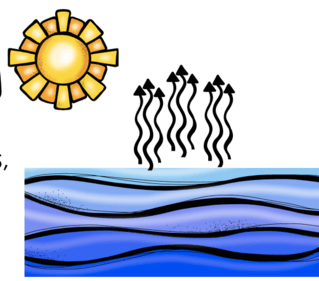

What is the process called when water vapor turns to liquid water?
evaporation
condensation
precipitation
transpiration
During evaporation, water changes from a _________ to a __________.
solid, liquid
gas, liquid
liquid, gas
liquid, solid
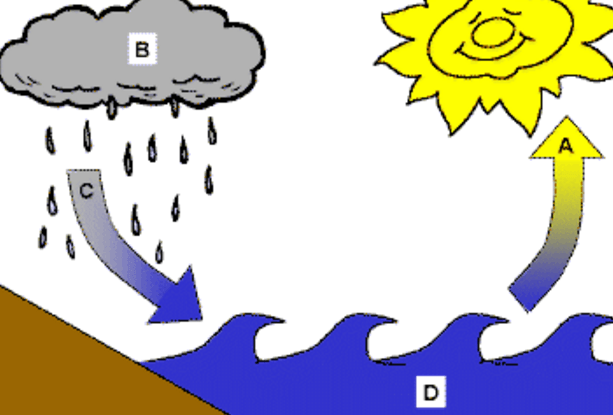

Precipitation which falls from the sky may run-off, then become stored in streams, ponds, rivers, lakes, or oceans. This is called...
collection
runoff
ground water
transpiration


Evaporation occurs when the sun heats up water in rivers, lakes, or the ocean, and turns it into...
snow
water vapor
rain
sleet

The red arrow is pointing to the water drops that have collected on the plastic wrap, what do the water drops represent?
Evaporation
Condensation
Precipitation
Infiltration

What is the role of the sun in the water cycle?
provide heat energy for evaporation
provide heat energy for condensation
dry out the soil for runoff to occur
provide thermal energy for accumulation
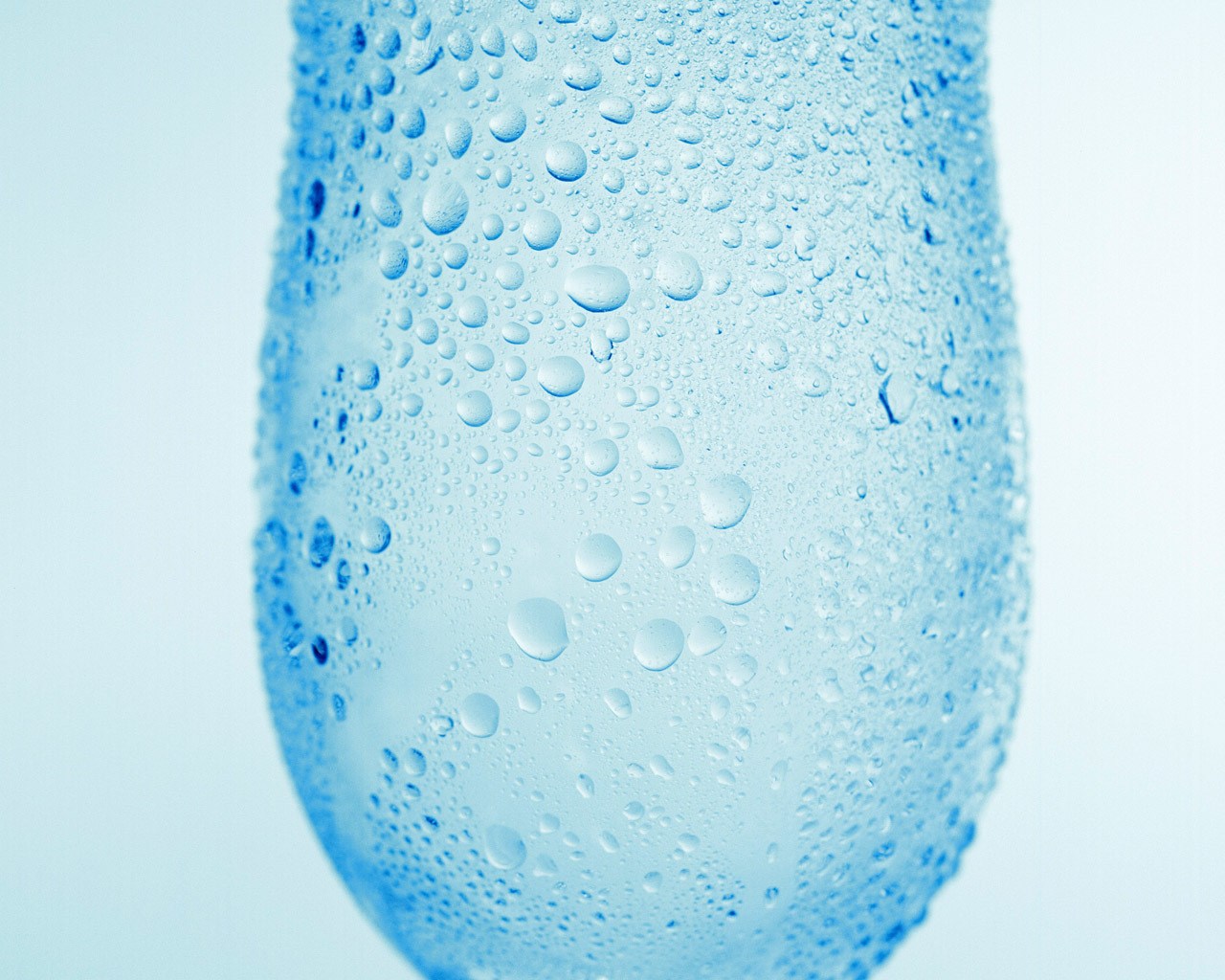
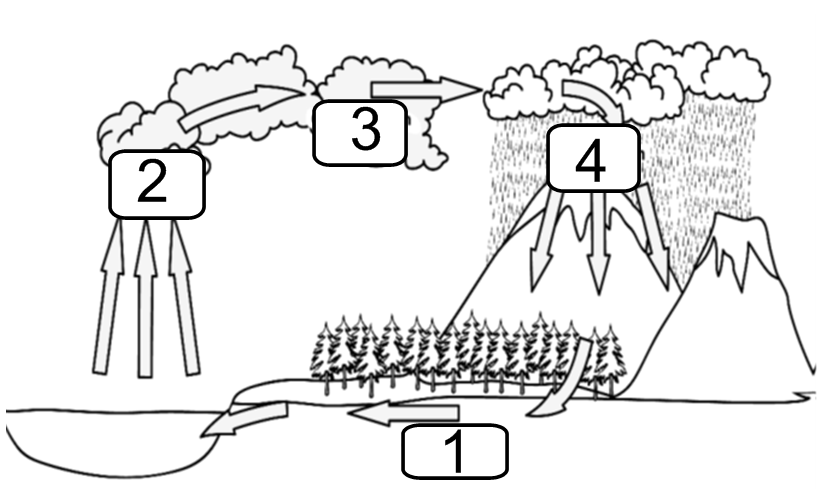
Water will evaporate at a slower rate on cooler days and faster on warmer days.
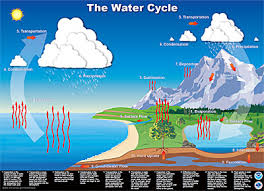
What would happen if the Sun is removed from the water cycle?
The water cycle would not include precipitation but would continue with groundwater flow.
The water cycle would no longer occur because the Sun provides the energy for evaporation and transpiration.
The water cycle would no longer occur because the Sun provides energy for the formation of clouds.
The water cycle would not include evaporation and transpiration but would continue with condensation.

The movement caused within a fluid by the tendency of hotter and therefore less dense material to rise, and colder, denser material to sink under the influence of gravity, which consequently results in transfer of heat. ____________________
Evaporation
Convection
Precipitation
Transpiration
How could we cause water vapor to change into tiny water droplets? (2 answers)
Increase thermal energy
Decrease thermal energy
evaporation
condensation
Which statement is false concerning the water cycle?
Eventually enough water will evaporate and the Earth will loose great amounts of water.
Water on Earth and in the atmosphere moves in a cycle.
Water changes states when we increase or decrease thermal energy.
Due to pollution, we can decrease the amount of drinkable freshwater.
Which 2 statements are true concerning the water cycle?
The water cycle circulates faster in the poles than around the equator.
Although water moves in a cycle we can still loose significant amounts due to infiltration.
When water infiltrates the soil it joins the underground water system.
Because water moves in a cycle, it is renewable.

What weather event is illustrated in this image?
Hurricane
Tornado
Thunderstorm
Flood
What two words describe the temperature and humidity of a maritime polar air mass?
Wet and Warm
Wet and Cold
Dry and Warm
Dry and Cold
Which two locations are you most likely to experience a marine climate?
Western North America
Western Europe
Africa
Eastern South America
Why are weather forecasts limited in their ability to predict weather?
(a)
What is the name for large pellets of ice that form inside of cumulonimbus clouds during thunderstorms?
Rain
Snow
Hail
Sleet
What are the two most important things that people should do to reduce the danger of storms to themselves?
Stay Weather Aware
Seek Appropriate Shelter
Have emergency supplies easily available.
Know the phone number and/or address of a neighbor, relative, or close friend.
What general direction does weather in the United States travel?
South to North
East to West
West to East
North to South
What two words describe the temperature and humidity of a continental tropical air mass?
Wet and Warm
Wet and Cold
Dry and Warm
Dry and Cold

What weather front is illustrated in this image?
Warm Front
Cold Front
Occluded Front
Stationary Front
Isobars differ from isotherms. Which of the following is NOT true about isobars?
Isobars are lines joining places on the map that have the same air pressure.
Isobars are lines joining places on the map that have the same temperature.
Isobars that are close together indicate windy conditions.
Isobars are referenced to the number 1013.


Stormy Weather
Stormy Weather
The fact that it's less dense than cold air.
The fact that it weighs more than cold air.
The fact that it has higher pressure than cold air.
The fact that it's more dense than cold air.
What type of air mass is over land at the equator?
Maritime Tropical
Maritime Polar
Continental Tropical
Continental Polar
What type of air mass is over the Artic Ocean?
Maritime Tropical
Maritime Polar
Continental Tropical
Continental Polar
This tool measures wind speed
(a)


According to the weather map, Florida will be experiencing what kind of weather due to the low pressure system that has moved into the southern United States?
The weather will be hotter than average with low cloud cover.
The weather will be dry with little precipitation moving in.
The weather will be relatively mild and calm.
The weather will be cooler than average with an increased chance of precipitation.
In a high pressure system the weather will likely have
high cloud cover and storms.
low cloud cover with increased amounts of precipitation.
warmer temperatures and storms.
no precipitation and clear skies.
What is the weather instrument that measures air pressure?
wind vane
anemometer
thermometer
barometer

Which type of front is found off the coast of Seattle, making its way inland, bringing lots of precipitation to the area.
a cold front
a warm front
a moderate front
a stationary front

The weather map shows different weather fronts located in the United States on May 4, 2017. According to the weather map, what would you predict the weather in Texas would be like on this date?
Low cloud cover and high temperatures.
High cloud cover, with cool temperatures.
Increased chance for precipitation.
Severe weather such as tornadoes and hail are possible.

