
 Worksheets
On Field Assessment - Acute Care
Total questions: 52
Worksheet time: 26mins
When injuries occur, while generally not life-threatening, they require prompt care. True or False?
True
False
Why is time a factor in emergencies?
Time allows for better planning and resource allocation.
Time is crucial for quick response and minimizing harm.
Time helps in gathering more information about the emergency.
Time is not a significant factor in emergencies.
Mistakes in initial injury management can lead to:
Faster recovery
Chronic issues
No effect
Improved performance
What is the primary concern in an Emergency Action Plan?
Maintaining cardiovascular and CNS functioning
Evaluating the injured athlete
Acting reasonably and prudently
Having a prearranged plan
What is the key to emergency aid according to the Emergency Action Plan?
Maintaining cardiovascular and CNS functioning
Initial evaluation of the injured athlete
Acting reasonably and prudently
Having a prearranged plan
Members of the sports medicine team must at all times act ______ and prudently.
reasonably
recklessly
carelessly
hastily
According to the Emergency Action Plan, what must be prearranged and ready to implement on a moment's notice?
A plan
A team of experts
A communication system
A list of emergency contacts
What should be developed for each facility according to the Emergency Action Plan?
A single plan for all facilities
Separate plans
No plans needed
A plan for every other facility.
What policies and procedures should be established according to the Emergency Action Plan?
Equipment and helmet removal
Food and beverage
Cleaning and maintenance
Scheduling and booking
What should be available according to the Emergency Action Plan?
Access to the internet
Availability of phones and access to 911
Access to a gym
Availability of snacks
What should an athletic trainer be familiar with according to the Emergency Action Plan?
First aid procedures
Emergency contact numbers
Facility layout and access points
All of the above
What type of information should be relayed about the type of emergency?
Location of the emergency
Nature of the emergency
Time of the emergency
Number of people involved
Which of the following should NOT be communicated regarding the suspected injury during an emergency call?
The exact location of the injury
The severity and type of injury
The time the injury occurred
The birthplace of the person injured
What details about the present condition should be provided to medical personnel?
Symptoms and duration
Medical history
Current medications
All of the above
Why is it important to provide the location of the phone being used during an emergency call?
To ensure emergency services can reach you quickly
To verify the identity of the caller
To reduce the cost of the call
To improve the quality of the call
What details about the location of the emergency should be communicated?
Exact address and nearby landmarks
Only the city name
Just the street name
No details are necessary
What must be easily accessible according to the Emergency Action Plan?
Emergency exits
First aid kits
Fire extinguishers
All of the above
Plans should also be in place for which other game personnel?
Coaches
Referees
All options should be included in the EAP
Spectators
What is the role of an EMT in the transportation of an athlete during an emergency?
Provide immediate medical care and stabilize the athlete for transport
Drive the ambulance to the hospital
Ensure the athlete's equipment is safely transported
Communicate with the athlete's family
When an athlete is a minor, what should the ATC try to obtain from the parent prior to emergency treatment?
Parental consent
Medical history
Insurance information
Emergency contact details
What does consent indicate in the context of parent notification for athletic treatment?
Permission for treatment without notifying parents
Agreement to notify parents about the treatment
Authorization for emergency treatment only
Consent is not required for athletic treatment
With no informed consent, what is implied on the part of the athlete to save their life?
Assumed consent
Explicit refusal
Legal waiver
Medical negligence
On-field assessment is divided into ______ and secondary survey.
primary
tertiary
initial
final
Which of the following is a purpose of on-field assessment?
A) Determine nature of injury
B) Provides information regarding direction of treatment
C) Both A and B
Which of the following is assessed during the primary survey?
Airway
Breathing
Circulation
All of the above
The primary survey is used to correct ________ conditions.
life-threatening
minor
chronic
non-urgent
What is the main focus of the secondary survey in on-the-field injury assessment?
What takes precedence in a primary survey?
Minor injuries
Life threatening injuries
Non-urgent injuries
Routine check-ups
Emergency Cardiopulmonary Resuscitation should be certified through organizations such as the American Heart Association, American Red Cross, and the ________.
National Safety Council
American Medical Association
National Institute of Health
Centers for Disease Control and Prevention
What does ABC stand for in the context of treating an unconscious athlete?
ABC stands for Airway, Breathing, and Circulation.
ABC stands for Alertness, Breathing, and Compression.
ABC stands for Assessment, Breathing, and CPR.
ABC stands for Airway, Blood flow, and Consciousness.
True or False: You should assume neck and spine injury when dealing with an unconscious athlete.
True
False
When should you remove the helmet and/or shoulder pads of an unconscious athlete?
What should be done if an athlete is supine and not breathing?
Establish ABC's immediately
Wait for consciousness to resume
Perform a secondary survey
Monitor vitals until emergency personnel arrive
If an athlete is unconscious and breathing, what should be done?
Establish ABC's immediately
Monitor vital signs until consciousness resumes
Log roll and establish ABC's
Perform a secondary survey
If an athlete is prone and not breathing, what action should be taken?
Establish ABC's immediately
Log roll and establish ABC's
Perform a secondary survey
Monitor vitals until emergency personnel arrive
If an athlete is prone and breathing, what should be done until consciousness resumes?
Establish ABC's immediately
Nothing, then carefully log roll and continue to monitor ABC's
Perform a secondary survey
Monitor vitals until emergency personnel arrive
Vitals should be monitored and maintained until ________ arrive.
emergency personnel
the patient recovers
the situation worsens
the equipment fails
Once stabilized, what should be performed?
Establish ABC's
Wait for consciousness to resume
Perform a secondary survey
Monitor vitals until emergency personnel arrive
What is a potential risk of removing equipment from an unconscious athlete?
It may compromise lifesaving efforts
It may improve the situation
It has no effect
It is always beneficial
Which tools are recommended for removing a facemask from an unconscious athlete?
Anvil Pruner
Trainer’s Angel
FM Extractor
Speed Clip Release
All of the above
Why is the use of a pocket mask/barrier mandated by OSHA during CPR?
To ensure effective ventilation
To protect the rescuer from infectious diseases
To improve the patient's survival rate
To comply with legal requirements
What must be done with shoulder pads and helmet when dealing with an unconscious athlete?
Both must come off
Both must remain in place
Both must either come off or remain in place
Only helmet must be removed
Removal should occur if (a) .
Head is not secure
Airway can’t be controlled
Facemask can’t be removed in reasonable amount of time
Helmet prevents immobilization

What is the correct process of using a pocket mask during CPR?
Place the mask over the victim's nose and mouth, seal it, and deliver breaths.
Place the mask on the victim's forehead and deliver breaths.
Use the mask to cover only the victim's mouth and deliver breaths.
Place the mask on the victim's chest and deliver compressions.
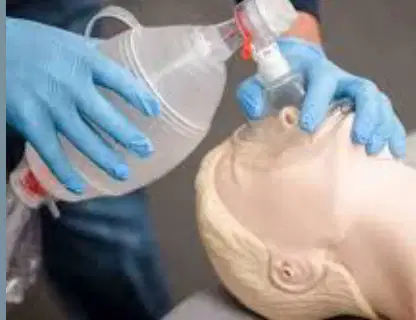
Which of the following is a correct step in using a bag valve mask?
Place the mask over the patient's nose and mouth.
Inflate the bag before placing it on the patient.
Use the mask without checking the patient's airway.
Apply the mask loosely over the face.
What is the color and flow characteristic of venous bleeding?
A) Dark red with continuous flow
B) Bright red with spurting flow
C) Exudes from tissue and is reddish.
What type of bleeding oozes from tissue and is reddish?
A) Venous
B) Capillary
C) Arterial
Arterial bleeding flows in ______ and is bright red.
spurts.
a slow trickle.
a steady stream.
pulses.
What precautions must be taken to reduce the risk of bloodborne pathogens exposure?
Universal precautions must be taken to reduce risk of bloodborne pathogens exposure.
No precautions are necessary as bloodborne pathogens are not harmful.
Only wear gloves when dealing with bloodborne pathogens.
Avoid washing hands after exposure to bloodborne pathogens.
What is the purpose of applying direct pressure on a wound?
To increase blood flow
To reduce pain
To stop bleeding
To clean the wound
Fill in the blank: Elevation reduces hydrostatic pressure and facilitates venous and lymphatic drainage, which ______ bleeding.
reduces
increases
causes
stops
What does EAP stand for?
emergency action plan
early action plan
emergency action play
emergency adduction plan

