
 Worksheets
Plate Tectonics
Total questions: 138
Worksheet time: 2hrs 31mins
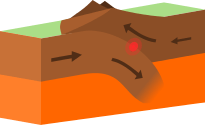

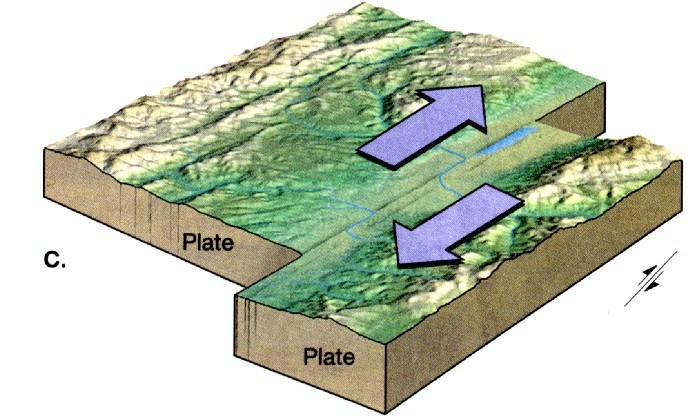
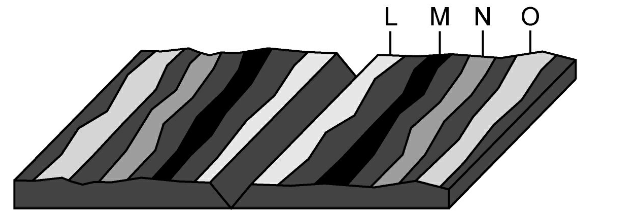
What type of event will occur at this boundary?
Earthquake
Volcano Eruption
Tornado
Mountain Building
Mountains are created when....
Two continental plates collide
Two oceanic plates pull apart
An Oceanic plate subducts under a Continental Plate
Two continental plates pull apart

Which of these events can ONLY happen on a DIVERGENT BOUNDARY?
Rift Valley
Mountain
A peninsula
An Insanely complex, long answer that you will click out of instinct.
Rising magma that results from subduction may produce...
fossil layers
volcanic island arcs
deep-sea sediment
seafloor spreading

Which describes the process of new crust being created?
During seafloor spreading, ocean plates move together forcing ridges of mountains to create new crust.
During seafloor spreading, ocean plates move apart allowing for magma to well up and then move aside.
During seafloor spreading, ocean plates scrape past one another creating friction and forcing magma up through the cracks.
Volcanoes spill lava all over the ocean to create a new crust.
Which statements are evidence of plate tectonic theory? (Check all that apply)
Ocean currents
Glacial Evidence
Continents fit together like puzzle pieces
Weather patterns
Matching landforms
Which statements are evidence of plate tectonic theory? Check what applies
Geological Landforms (mountain chains)
Tidal wave currents
Seafloor Spreading
Fossil Evidence

Identify the boundary in the illustration.
Convergent Boundary
Divergent Boundary
Transform Boundary

Identify the boundary in the illustration.
Convergent Boundary
Divergent Boundary
Transform Boundary

Identify the boundary in the illustration.
Convergent Boundary
Divergent Boundary
Transform Boundary

Identify the boundary in the illustration.
Convergent Boundary
Divergent Boundary
Transform Boundary

Identify the boundary in the illustration.
Convergent Boundary
Divergent Boundary
Transform Boundary

Convergent Boundary - Submarine
Convergent Boundary - Subduction
Divergent Boundary - Submarine
Divergent Boundary - Subduction

Kenya, a country on the African continent, recently saw the Great Rift Valley continue to tear through the countryside. What type of plate boundary would cause this crustal feature?
Convergent Boundary
Convergent Subduction Boundary
Divergent Boundary
Transform Boundary

Iceland is in great distress over the bridge across the Álfagjá Rift Valley because it sits on two plate boundaries that are moving away from one another. What type of boundary could this bridge be sitting on?
Convergent Boundary
Convergent Subduction Boundary
Divergent Boundary
Transform Boundary

The China Piqiang Fault is a transform fault. The bird's eye view below shows the approximation of where the fault line crosses the land. Which answer predicts the likely movement of the land along the fault line over thousands of years?


A mid-ocean ridge separates the North American Plate and the Eurasian Plate through the country of Iceland. Which statement describes the relative motions of the North American and the Eurasian Plates?
The North American and the Eurasian plates are both moving to the east.
The North American and the Eurasian plates are both moving to the west.
The North American plate is moving to the west, and the Eurasian plate is moving to the east.
The North American plate is moving to the east, and the Eurasian plate is moving to the west.

Identify the correct boundary for each letter in the illustration below.
A. Convergent Boundary, B. Convergent Subduction Boundary
A. Convergent Subduction Boundary, B. Divergent Boundary
A. Divergent Boundary, B. Divergent Boundary
A. Divergent Boundary, B. Convergent Subduction Boundary
Subduction zones are best explained by ---
two plates collide and fall below the lithosphere.
an oceanic plate and a continental plate collide with both pushing upward.
two continental plates push past each other.
a continental plate and an oceanic plate collide with the denser oceanic plate moving downward into the mantle.
A subduction boundary that is created with an oceanic plate and a continental plate will result in the formation of --
a trench and/or volcano
a rift valley and/or mountains
a mid-ocean ridge and/or tidal waves
a mountain and/or seafloor spreading

The map shows the location of active volcanoes between the Pacific Ocean and the Bering Sea. What do these volcanoes indicate about plate tectonics in the region?
The volcanoes form an island arc, indicating a convergent plate boundary.
The volcanoes form a line, indicating a divergent plate boundary.
Two plates are moving past each other, causing faulting and magma formation.
Two plates are moving apart, creating new seafloor.

The illustration below shows the movements of two tectonic plates. Where the two plates collide into one another, one plate often moves below the other plate. The rising magma that results from this plate movement will produce --
fossil layers
volcanic islands
great rift valleys
seafloor spreading
Scientists found that the oldest crust material in continental plates is much older than the oldest material in ocean plates. What reasoning would best explain why the continental plate is older than the oceanic plate?
Oceanic plates form rapidly.
Earth’s oceans are younger than the continents.
Oceanic plates are denser, therefore subducted under continental plates when they collide.
Water gradually wears away oceanic plate material and deposits it on land masses.

This illustration of tectonic plates was used to model a plate boundary by a group of kids in their geology class. Which event can be best demonstrated with this drawing?
volcanic eruption
gravitational forces
building of a mountain
earthquake
Based on evidence from land features, fossils and climate, Wegener concluded that continents
sink
rise
move
All of the continents were joined together in a supercontinent that Wegener called
Pangaea
Gondwanaland

In sea-floor spreading, new crust is added at a
mid-ocean ridge
magnetic stripe

Subduction takes place at
mid-ocean ridges
deep-ocean trenches

Which features form the longest mountain ranges on Earth?
the mid-ocean ridges
the deep-ocean trenches
the Rockies
the Andes
Which process adds more crust to the ocean floor?
suction
sea-floor spreading
subduction
magnetic strip

Where does subduction occur?
along the middle of the ocean floors
down the middle of the mountain ranges
on continents
at deep-ocean trenches
Which process or processes change the size and shape of the oceans?
subduction only
sea-floor spreading only
both subduction and sea-floor spreading
both drilling for samples and subduction

Which theory describes the motion of and force driving Earth's plates?
first law of motion
third law of motion
continental drift
plate tectonics
What is the motion of Earth's plates like?
fast and in stages
slow and in stages
fast and constant
slow and constant

The San Andreas fault is an example of which kind of boundary?
transform
divergent
oceanic
convergent

Which feature forms at convergent boundaries?
mountain range
trench
rift valley
mid-ocean ridges

An undersea mountain chain where new ocean floor is produced, in a divergent plate boundary is?
deep-ocean trench
sea-floor spreading
mid-ocean ridge

A valley along the ocean floor beneath which oceanic crust slowly sinks toward the mantle is?
deep-ocean trenches
mid-ocean ridges
sea-floor spreading
subduction

Process by which oceanic crust sinks beneath a deep-ocean trench and back into the mantle at a convergent plate boundary is?
mid-ocean ridge
sea-floor spreading
deep-ocean trenches
subduction

Boundary where two plates slip past each other, moving in opposite directions are?
divergent
transform
convergent

Boundary where two plates collide?
convergent
divergent
transform

Boundary where plates move away from each other are?
convergent
Divergent
transform
The geologist that came up with the Theory of Continental Drift is _______
Albert Einstein
Alfred Wegener
Harry Hess
Ben Franklin
The Theory of Continental Drift states that
Continents gradually move across Earth's surface over time.
The plates move because of the convection currents.
Earth's lithosphere is composed of a number of plates.
A supercontinent that incorporates all landmasses on Earth.
The Theory of Plate Tectonics states that
A supercontinent composed of all the landmasses.
The gradual movement of the continents over the surface.
The Earth's lithosphere is composed of a number of plates.
The plates collide and cause earthquakes.
A supercontinent that is comprised of all landmasses
Gondwana
Laurasia
North America
Pangaea
Why does Pangaea no longer exist?
It still exists today.
Continental Drift shifted the plates causing it to separate.
Convection Currents shift the plates causing it to separate.
Volcanic activity causes the continents to shift.
Two or more tectonic plates that move towards one another is a
Divergent Boundary
Transform Boundary
Subduction
Convergent Boundary
Two or more tectonic plates move away from each other is a
Subduction
Transform Boundary
Divergent Boundary
Convergent Boundary
Two or more tectonic plates shift horizontally alongside each other is a
Divergent Boundary
Transform Boundary
Convergent Boundary
Subduction
When one plate slips underneath another plate is called
Subduction
Transform Boundary
Convergent Boundary
Divergent Boundary
The difference between oceanic and continental plates is
oceanic plates are more dense and lower elevation.
continental plates are more dense and lower elevation.
oceanic plates are less dense and higher elevations.
continental plates are less dense and lower elevation.
An oceanic plate converges on a continental plate, which one subducts under the other?
Continental Plate
Oceanic Plate
What evidence supports the theory of plate tectonics?
Fossils found on different continents
Locations of volcanoes and earthquakes
Similarity in the coastlines of the continents
All of the above
Which reptile's fossils are found in southern Africa and South America?
Tyrannosaurus Rex
Mesosaurus
Stegosaurus
Brachiosaurus
What drives the movement of Earth's lithospheric plates?
Convection currents in the mantle
Volcanic eruptions
Tidal forces from the Moon
Earth's rotation
Which type of plate boundary is associated with the creation of new crust?
Convergent
Divergent
Transform
None of the above
What geological features are associated with convergent plate boundaries?
Volcanoes, mountains, and earthquakes
Islands and deep ocean trenches
Rift zones and mid-ocean ridges
None of the above
What is the process by which the ocean floor sinks beneath a deep-ocean trench and back into the mantle?
Subduction
Convection
Plate Tectonics
Seafloor Spreading
Which of the following is a direct evidence of plate tectonics?
Presence of similar species in different continents
Presence of mountains on the continents
Earthquakes and volcanic activities along the plate boundaries
Change in climate over millions of years
What is the boundary called where two plates move apart?
Convergent boundary
Divergent boundary
Transform boundary
None of the above
What geological features are associated with divergent plate boundaries?
Volcanoes, mountains, and earthquakes
Islands and deep ocean trenches
Rift zones and mid-ocean ridges
None of the above
This type of plate boundary slides past one another and is known for causing earthquakes
Subduction
Convergent
Divergent
Transform


Alfred Wegener noted that fossils from a particular type of reptile were found on both sides of the Atlantic Ocean. Which of the following would be the best explanation of how this occurred?
The reptiles swam across the ocean
The Atlantic Ocean did not exist in earlier times
The reptiles walked across a giant land bridge that has weathered away
The reptiles walked across an ice bridge located near the equator

The map shows some of Earth’s plate tectonic boundaries.
Based on the map, volcanic activity would most likely be found at
Location W
Location X
Location Y
Location Z
Scientists recently discovered that rocks collected from the Franklin Mountains in West Texas and rocks collected from mountains in eastern Antarctica were exactly the same age. Further research showed that the rocks were chemically and geologically the same and came from the same magma source. This discovery provides evidence of —
coastal erosion
plate tectonics
ocean currents
glacial melting
Which type of tectonic plate movement results in the formation of mid-ocean ridges?
Sliding past each other
Pulling away from each other
Pushing together and upwards
One plate sliding under another
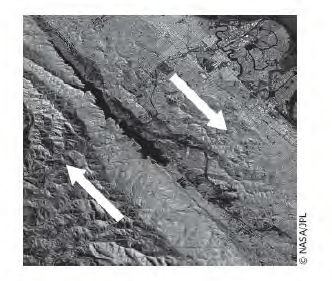
The image shows a plate boundary. Arrows have been added to indicate the movement of the plates.
What plate boundary feature is also shown?
A ridge formed by an inactive convergent boundary
A valley forming at an active divergent boundary
A fault forming at an active transform boundary
A volcano formed by an active transform boundary

The diagram shows a model of the movement of two tectonic plates. When the plates collide, one plate often moves below the other plate.
The rising magma that can result from this type of plate movement may produce —
fossil layer
volcanic islands
deep-sea sediment
seafloor spreading

The map shows the location of four active volcanoes in the Caribbean Sea.
What do these volcanoes indicate about plate tectonics in the region?
The volcanoes form an island arc, indicating a converging plate boundary.
The volcanoes form a line, indicating a diverging plate boundary.
Two plates are moving past each other, causing faulting and magma formation.
Two plates are moving apart, creating new seafloor.
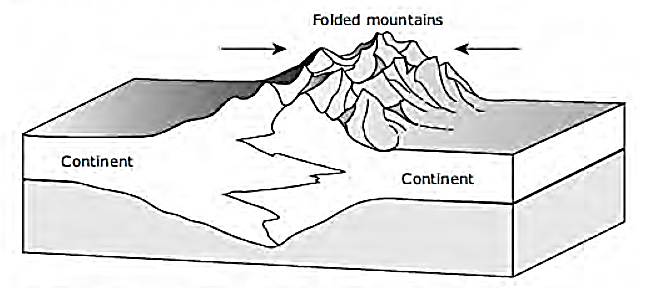
The model shows two continental plates. The folded mountains in this model form at which type of plate boundary?
Transform boundary
Divergent boundary
Subduction boundary
Convergent boundary

Students examine a map that shows the movement of the two tectonic plates.
Each student writes a description of the tectonic activity and why they think it is occurring. Which explanation best describes the impact of Newton’s Laws on the movement of these plates?
The North American Plate is subducting underneath the Eurasian Plate because equal and opposite forces are acting on them.
The forces acting on both plates cause them to diverge until they are acted upon by another force.
The Eurasian Plate and the North American Plate are converging because the forces acting on them are balanced.
Balanced forces are acting on the Eurasian Plate and the North American Plate causing them to diverge.

Alfred Wegener's Theory of Continental Drift states that the continents were once joined together in a giant landmass that broke apart, and that the continents then drifted to their current locations. One piece of evidence supporting this theory is the shapes of the continents, which seem to fit together like pieces of a puzzle. The map shows evidence supporting Wegener's ideas. The shape of the eastern coast of South America appears to fit together with —
eastern North America
eastern Australia
southern North America
western Africa
Which type of plate boundary is most likely to create earthquakes without forming volcanoes?
Transform Boundary
Divergent Boundary
Convergent Boundary
Subduction Zone
What is the name of the process where two continental plates collide and form mountain ranges?
Sea-floor spreading
Transform faulting
Continental collision
Subduction
Which of the following best describes what happens at a divergent plate boundary?
One plate sinks below another
Plates move toward each other
Plates slide past each other
Plates move away from each other

