wayground logo

Free Printable Worksheets

Font size

S
M
L
XL
Worksheets

Unit 5 Review

Total questions: 102

Worksheet time: 6hrs 30mins

Name
Class
Date
1.

What is the formula to calculate speed?

a)

S=t/d

b)

S=d/t

c)

S=d*t

d)

S=d*t

2.

What is the equation to calculate time?

a)

time = speed/distance

b)

time = distance/speed

c)

time = speed x distance

d)

time = distance x speed

3.

What is the equation to calculate distance?

a)

distance = speed/time

b)

distance = time/speed

c)

distance = speed/distance

d)

distance = speed x time

4.
How far will a person go if they jog for 2 hours at a speed of 12 km/hr?
a)
6 km
b)
0.5 km
c)
10 km
d)
24 km
5.

A girl on a bike rides down a hill 500 meters long in 50 seconds. What is her speed?

a)

100 m/s

b)

10 m/s

c)

1,000 m/s

d)

10 mph

6.

A trip to Florida takes 10 hours. The distance is 816 km. Calculate the average speed.

a)

81.6 km/hr

b)

81.6 mph

c)

82 m/s

d)

816 km/h

7.
A car travels 30 miles/hr for 3 hours, calculate the distance it will travel
a)
90 miles
b)
10 miles
c)
600 miles
d)
90 km
8.
A boat travels at 22 km/hr for 10 hrs, what distance will it travel?
a)
220 miles
b)
2.2 km
c)
220 km
d)
22 km
9.
Mr. Rudman drives his speed boat 22 km at 45 km/hr how, how long will it take him to go the 22 km?
a)
48 hrs 
b)
0.48 hrs
c)
990 hrs
d)
45 min
10.
How long will your trip take (in hours) if you travel 350 km at an average speed of 80 km/hr? 
a)
80 hours
b)
.22 hours
c)
4.38 hours
d)
6
11.

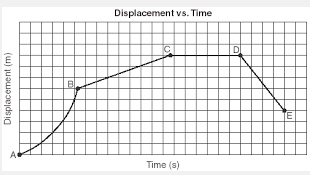
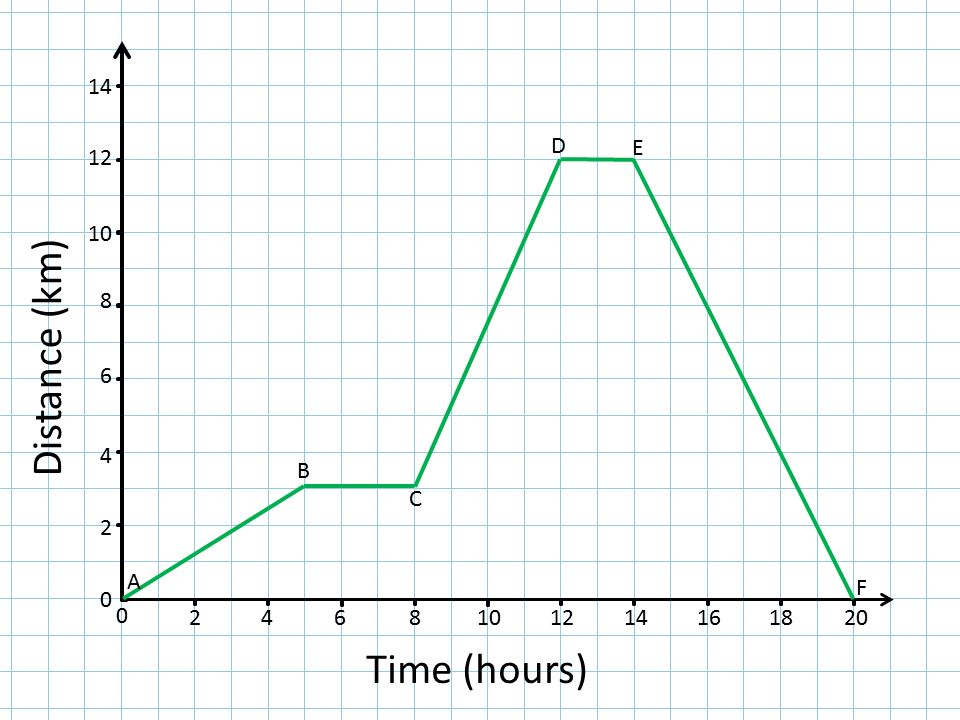
During which segment did the car come to a complete stop?

a)

Segment A to B

b)

Segment B to C

c)

Segment C to D

d)

Segment D to E

12.

During which segment did the car travel back toward its starting position?

a)

Segment A to B

b)

Segment B to C

c)

Segment C to D

d)

Segment D to E

13.

During which segment did the car travel the fastest?

a)

Segment A to B

b)

Segment B to C

c)

Segment C to D

d)

Segment D to E

14.

What distance had the car traveled at 10 hours?

a)

60km

b)

50km

c)

60

d)

50

15.

The two variables used in the graph are:

a)

speed and time

b)

distance and time

c)

going fast and slowing down
16.
Acceleration is
a)
increasing speed
b)
decreasing speed
c)
changing direction
d)
all of the above
17.
Velocity is
a)
speed and acceleration
b)
constant speed
c)
a frame of reference
d)
speed in a given direction
18.
Which runner won the race?
a)
Albert
b)
Bob
c)
Charlie
19.
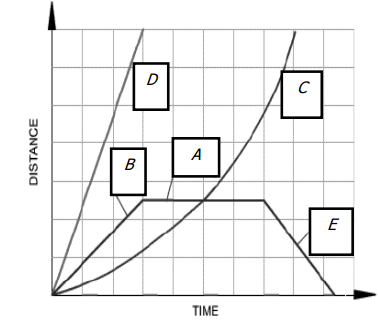
Which line represents an object moving at a faster speed?
a)
A
b)
B
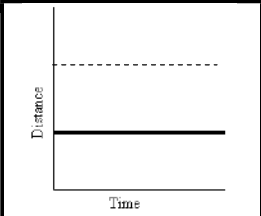
20.
This graph demonstrates an object that is -
a)
Increasing speed
b)
At a constant speed
c)
Decreasing speed
d)
Stationary
21.
This graph demonstrates an object that is -
a)
Increasing speed
b)
At a constant speed
c)
Decreasing speed
d)
Stationary
22.
What two measurements are necessary for calculating speed?
a)
Mass and time
b)
Temperature and mass
c)
Mass and distance
d)
Distance and time
23.
Can be measured in seconds (s)
a)
Distance
b)
Time
c)
Speed
d)
Acceleration
24.
Can be measured in meters per second (m/s)
a)
Distance
b)
Time
c)
Speed
d)
Acceleration
25.
Can be measured in meters (m)
a)
Distance
b)
Time
c)
Speed
d)
Acceleration
26.
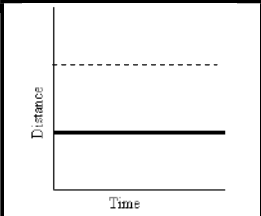
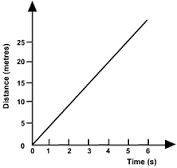
What does this graph represent?
a)
Constant speed
b)
Acceleration
c)
Not moving
27.
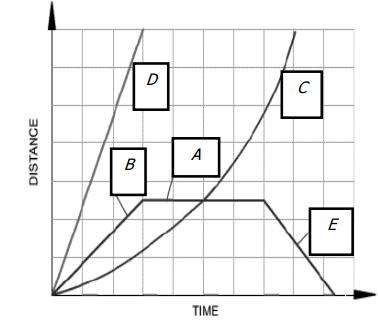
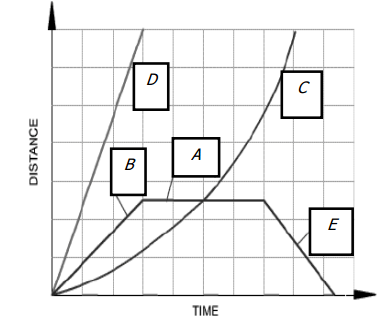
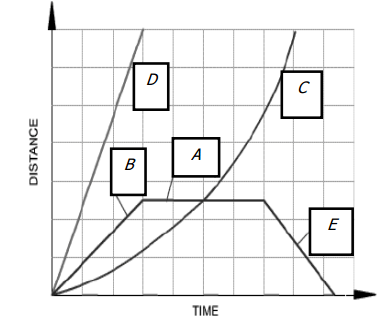
What is happening at C?
a)
Stationary
b)
Accelerating
c)
Fast steady speed; moving away from the starting position
d)
Slower steady speed; moving away from the starting position
28.
What is happening at D?
a)
Stationary
b)
Accelerating
c)
Fast steady speed; moving away from the starting position
d)
Slower steady speed; moving away from the starting position
29.
What is happening at A?
a)
No motion
b)
Accelerating
c)
Slower steady speed; moving away from the starting position
d)
Steady speed; returning to start position
30.
What is happening at B?
a)
Stationary
b)
Accelerating
c)
Slower steady speed; moving away from the starting position
d)
Steady speed; returning to start position
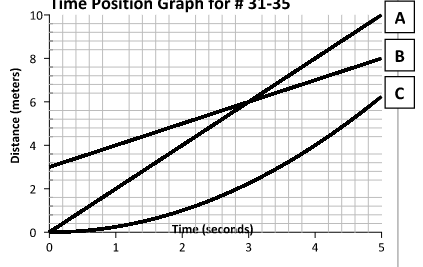
31.
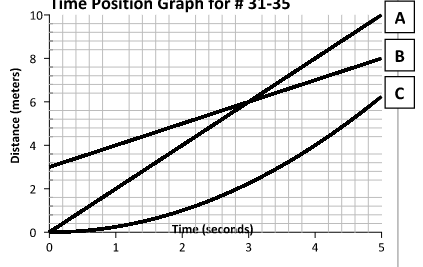
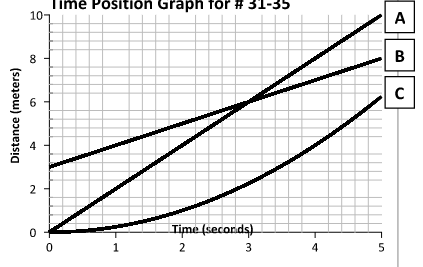
Which runner won the race?
a)
A
b)
B
c)
C
32.
Which runner had a head start?
a)
A
b)
B
c)
C
33.
At what time did runner A pass runner B?
a)
0 seconds
b)
1 second
c)
2 seconds
d)
3 seconds
34.
What is the formula to calculate speed?
a)
v = t/d
b)
v = d/t
c)
v = d x t
d)
v = t x d
35.
What is the speed of an object that travels 60 meters in 4 seconds?
a)
240 m/s
b)
15 m/s
c)
0.067 m/s
d)
15 mph
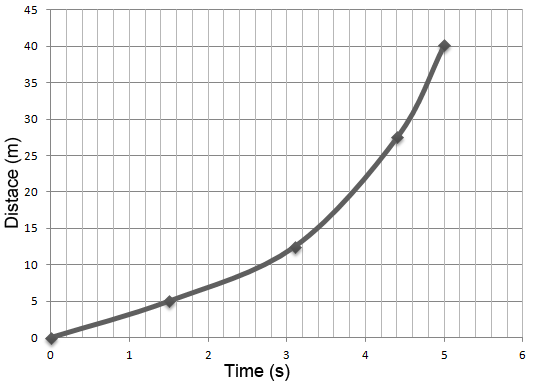
36.
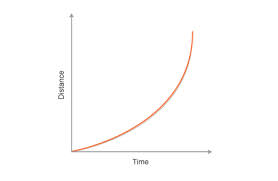
What is this graph representing?
a)
Constant Speed
b)
Acceleration (speeding up)
c)
Deceleration (slowing down)
d)
No motion
37.
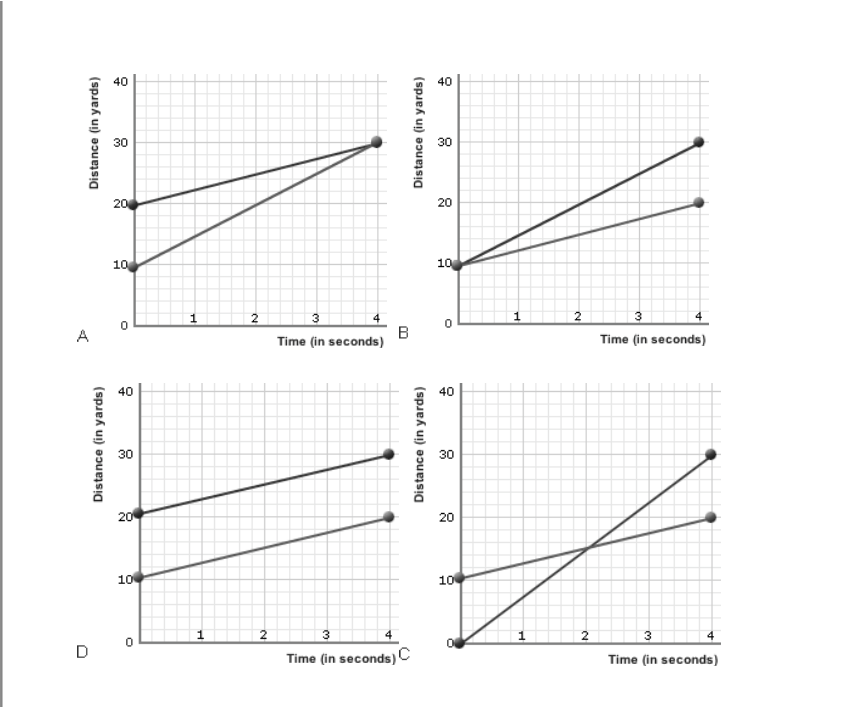
In which of the following graphs (click the image) are both runners moving at the same speed (note that graph c is the bottom right graph, and graph d is the bottom left graph)? 
a)
Graph A
b)
Graph B
c)
Graph C
d)
Graph D
38.
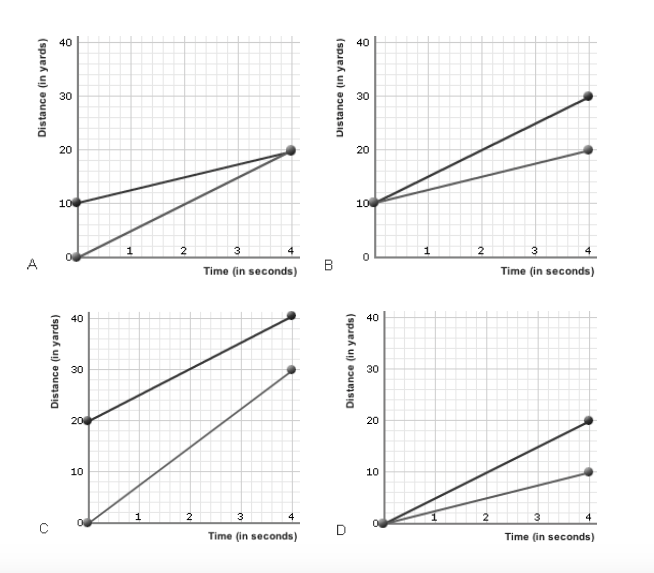
Which of the graphs shows that one of runners started 10 yards further ahead of the other (note that graph c is the bottom left and graph d is the bottom right)? 
a)
Graph A
b)
Graph B
c)
Graph C
d)
Graph D
39.
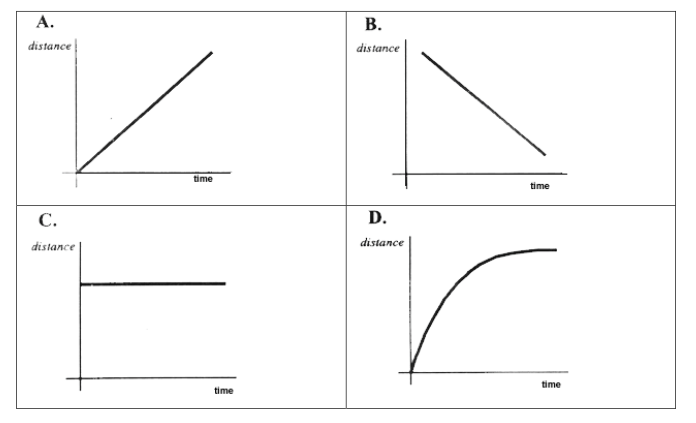
The distance-time graphs shown represent the motion of a car. Which of the following graphs represents the car at constant speed moving in the positive direction?
a)
graph A
b)
graph B
c)
graph C
d)
graph D
40.
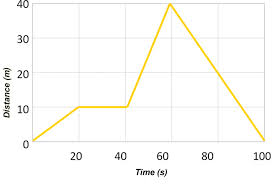
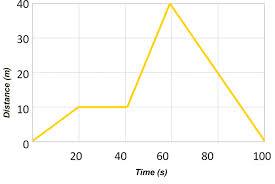
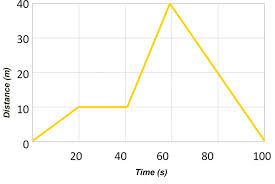
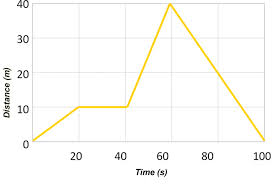
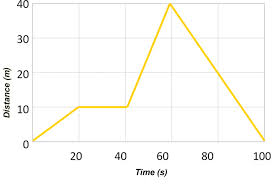
At 60 seconds, how far had this object traveled? 
a)
0 m
b)
10 m
c)
20 m
d)
40 m
41.
How long did it take this object to travel back to its reference/starting point?
a)
20 s
b)
30 s
c)
60 s
d)
100 s
42.
How long did it take this object to travel 10 m?
a)
0 s
b)
10 s
c)
15 s
d)
20 s
43.
How many times does this object STOP moving?
a)
None
b)
Once
c)
Twice
d)
Three times
44.
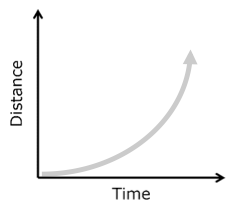
What does this graph represent?
a)
Constant speed
b)
Acceleration
c)
Not moving
45.
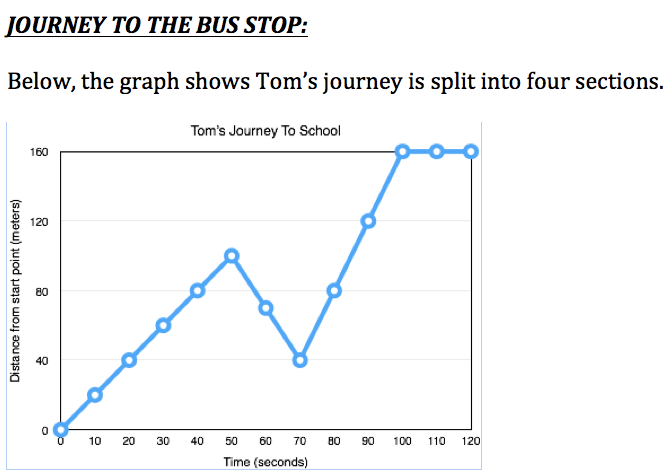
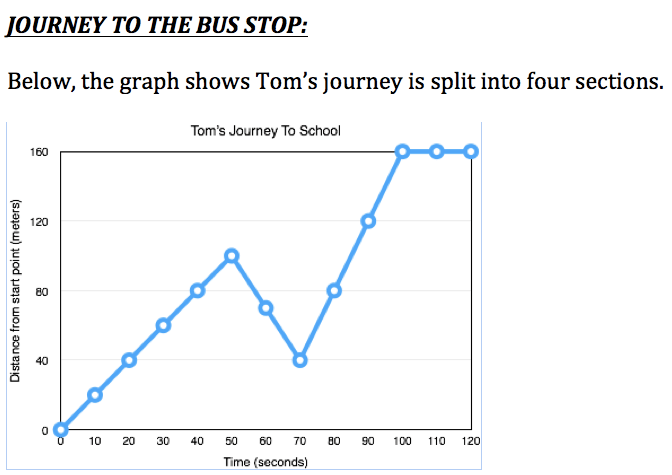
Every morning, Tom walks along a straight road from his home to the bus stop. Below, is a graph representing Tom’s trip to school.
What is the distance covered through the first segment if the first segment is between 0 seconds and 50 seconds?
a)
100 meters
b)
80 meters
c)
60 meters 
d)
120 meters
46.
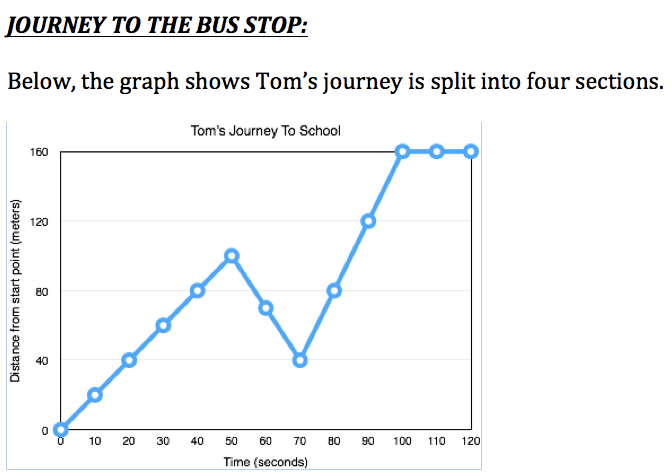
Every morning, Tom walks along a straight road from his home to the bus stop. Below, is a graph representing Tom’s trip to school.
What is the average speed of Tom’s journey throughout the first segment, which is between 0 seconds, and 50 seconds?
a)
3 m/s
b)
5 m/s
c)
2 m/s
d)
2 miles per second
47.
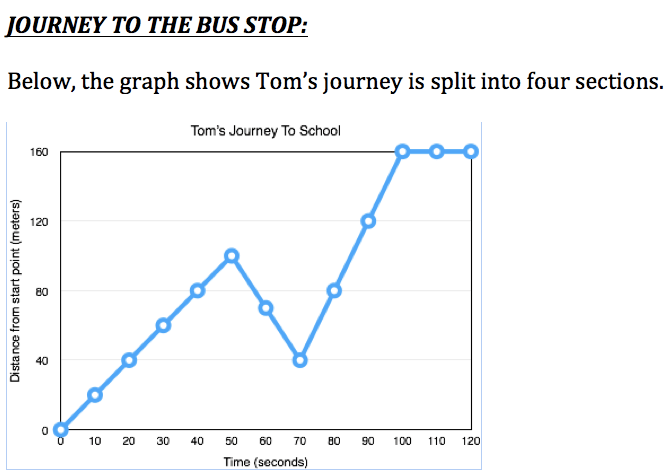
Every morning, Tom walks along a straight road from his home to the bus stop. Below, is a graph representing Tom’s trip to school.
Was Tom walking, jogging, or sprinting during segment 1, which is between 0 seconds and 50 seconds?
a)
walking
b)
jogging
c)
sprinting
48.
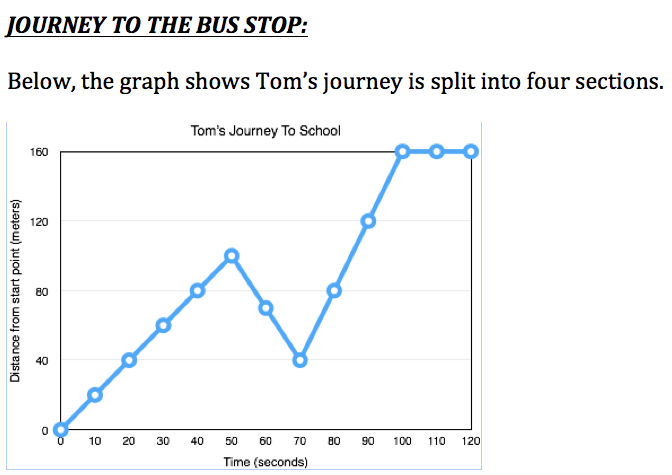
Every morning, Tom walks along a straight road from his home to the bus stop. Below, is a graph representing Tom’s trip to school.
What is the distance covered through the second segment, which is between 50 seconds, and 70 seconds?
a)
40 meters
b)
60 meters
c)
80 meters
d)
20 meters
49.
. Every morning, Tom walks along a straight road from his home to the bus stop. Below, is a graph representing Tom’s trip to school.What is the average speed of Tom’s Journey throughout the second segment, which is between 50 seconds and 70 seconds?
a)
5 m/s
b)
4 m/s
c)
3 m/s
d)
2 m/s
50.
During the second segment, which is between 50 seconds and 70 seconds, which direction is Tom moving?
a)
Tom was moving back towards his house
b)
Tom was moving down a hill
c)
Tom was moving towards the bus stop
d)
Tom was not moving
51.
On a distance vs time graph, a straight line ALWAYS indicates that an object’s speed is _____.
a)
constant
b)
zero
c)
increasing
d)
decreasing
52.
The slope of a distance vs. time graph shows an object's
a)
frame of reference
b)
speed
c)
acceleration
d)
favorite food
53.
The speed at any single instant of time?
a)
speed
b)
average speed
c)
instantaneous speed
d)
velocity
54.
When something has speed in a certain direction it is called ___________.
a)
motion
b)
position
c)
velocity
d)
speed
55.
100 km/hr is an example of 
a)
speed
b)
velocity
56.
2,560 m/s west is an example of 
a)
speed
b)
velocity
57.
What is speed?
a)
how far you go
b)
how much distance is covered over a period of time
c)
how fast you accelerate
d)
the change in the location of a object
58.
What is the average speed of this object?
a)
8 s/m
b)
0 m/s
c)
8 m/s
d)
0 s/m
59.
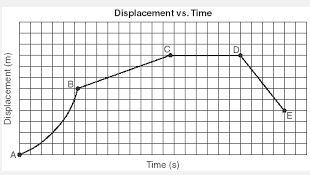
In which segment does the object have the fastest constant speed?
a)
A to B
b)
B to C
c)
C  to D
d)
D to E
60.
In which segment is the object returning to the reference point?
a)
A to B
b)
B to C
c)
C to D
d)
D to E
61.
At 60 seconds, how far had this object traveled? 
a)
0 m
b)
10 m
c)
20 m
d)
40 m
62.
What is happening in the graph from point A to B?
a)
The object is moving away from the reference point at a constant speed.
b)
The object is moving toward the reference point at a constant speed
c)
The object is NOT moving
d)
The object is speeding up
63.
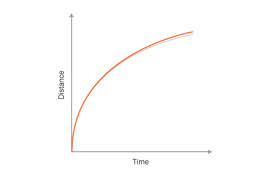
What is this graph showing?
a)
Constant Speed
b)
Acceleration (speeding up)
c)
Deceleration (slowing down)
d)
No motion
64.
What is this graph showing?
a)
Constant Speed
b)
Acceleration (speeding up)
c)
Deceleration (slowing down)
d)
No motion
65.
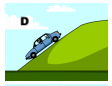
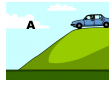
What type of energy is in this picture?
a)
Kinetic
b)
Potential
c)
Chemical
d)
Sound
66.
On a roller coaster, where is maximum potential energy?
a)
At the bottom of a big hill
b)
When going around a corner
c)
When going upside down
d)
At the top of a big hill
67.
On a roller coaster, where is maximum kinetic energy?
a)
At the bottom of a big hill
b)
When going around a corner
c)
When going upside down
d)
At the top of a big hill
68.
A baseball held by a pitcher has _____________energy.
a)
Kinetic
b)
Chemical 
c)
Potential
d)
Thermal
69.
At what position does the rock have the greatest kinetic energy?
a)
A
b)
B
c)
D
d)
E
70.
Wood, batteries, gasoline, and  food are all examples of ________________________.
a)
gravitational potential energy
b)
elastic potential energy
c)
chemical potential energy
d)
None of the above
71.
The faster an object moves, the ________ kinetic energy it has. 
a)
more
b)
less
c)
none of the above
d)
all of the above 
72.

When you compress a spring, you are storing __________ energy.

a)

sound

b)

elastic

c)

light

d)

chemical

73.
What kind of energy is in a moving skateboard?
a)
Potential
b)
Kinetic
74.
Energy due to motion is ____________ energy. 
a)
Potential 
b)
Energy
c)
Kinetic
d)
Friction
75.
__________ is stored energy. 
a)
Potential
b)
Kinetic
c)
None of the above 
d)
All of the above 
76.
Gravitational potential energy depends on the ________ and ________ of the object. 
a)
Height and mass
b)
Friction and movement
c)
Mass and Movement
d)
Height and Friction 
77.
Energy can not be created or destroyed, only converted from one form to another.
a)
true
b)
false
78.
Explain what happens to the potential energy of a rock as it falls off the side of a cliff.
a)
The kinetic energy decreases as the potential energy increases.
b)
The kinetic energy decreases as the potential energy decreases.
c)
The potential energy decreases as the kinetic energy increases.
d)
The potential energy decreases as the kinetic energy decreases. 
79.
When riding a roller coaster, you go up and down many hills. As you get to the top of a roller coaster, what energy change is taking place.
a)
Potential energy is changed into kinetic energy.
b)
Kinetic energy is changed into potential energy.
c)
Chemical energy is changed into heat energy.
d)
Heat energy is changed into chemical energy. 
80.

Which passenger has the most potential energy?

a)

A

b)

B

c)

C

d)

D

81.

The formula for calculating the gravitational potential energy in an object is shown above. Which object will have the largest value for its GPE

a)
b)
c)
d)
82.

If these are all moving at the same speed, the vehicle with the greatest KE would be

(Think about their sizes)

a)
b)
c)
d)
83.

Determine whether the following example is Potential Energy (PE) or Kinetic Energy (KE):


flashlight turned off

a)

Potential Energy

b)

Kinetic Energy

84.
a)
Potential Energy
b)
Kinetic Energy
85.

A lamp that plugs into a wall socket draws energy, which flows through a thin wire in the bulb, causing it to heat up until it glows. What energy transformations are taking place?

a)

Chemical → light → electrical

b)

Mechanical → sound → light

c)

Thermal → solar → electrical

d)

Electrical → thermal → light

86.

An electric pencil sharpener uses electricity to make its motor spin. The pencil sharpener also makes noise and heats up. Which observation of the pencil sharpener demonstrates the law of conservation of energy?

a)

The amount of electrical energy used equals the total amount of mechanical, sound, and thermal energy produced.

b)

The amount of energy used by the electric pencil sharpener is greater than an electric lamp.

c)

The electric pencil sharpener only uses energy when it is being used to sharpen a pencil.

d)

The electric pencil sharpener is easier to use than the older version that was cranked by hand.

87.

Turning the handle makes a current that causes the light bulb to glow. What are the energy transformations that happen in this hand generator?

a)

Thermal → solar → light

b)

Mechanical → electrical → light

c)

Electrical → mechanical → light

d)

Solar → light → electrical

88.

When energy enters a system and then comes out of the system later, the law of conservation of energy states that–

a)

some of the energy that entered the system will remain in the system.

b)

the energy will always create a change in the properties of the parts of the system.

c)

the form of energy that comes out of the system must be the same form that entered.

d)

the amount of energy coming out of the system must equal the energy that entered the system.

89.

In which of the following scenarios would this energy transformation be observed?

chemical → light → heat

a)

Plucking a guitar string

b)

Lighting a match

c)

Turning on a fan

d)

Starting a car

90.

Which of the following is a form of potential energy?

a)

sound energy

b)

chemical energy

c)

mechanical energy

d)

thermal (heat) energy

91.

The law of conservation of energy states ___.

a)

electrical energy can be transformed into other forms

b)

energy can be created and destroyed

c)

energy is never created nor destroyed

d)

what goes up must come down

92.

There are ___ forms of kinetic energy.

a)

3

b)

5

c)

4

d)

2

93.

There are ___ forms of potential energy.

a)

3

b)

5

c)

4

d)

2

94.

During energy transformations, energy is never ___.

a)

released as heat

b)

used to increase an object's potential energy

c)

created or destroyed

d)

completely transformed

95.

A baseball is hit into the air with a bat. When does baseball have the greatest gravitational potential energy?

a)

when it hits the ground

b)

when it reaches its highest point

c)

when it leaves the bat

d)

when the mechanical and kinetic energies of the baseball are equal

96.

___ is energy stored by things that stretch or compress.

a)

Gravitational potential

b)

Elastic kinetic energy

c)

Chemical kinetic energy

d)

Elastic potential energy

97.

What type of energy is stored in a battery?

a)

electrical

b)

thermal

c)

radiant

d)

chemical

98.

Which energy transformation occurs in a toaster?

a)

electrical → thermal

b)

chemical → thermal

c)

nuclear → electrical

d)

thermal → electrical

99.

A battery converts what type of energy to another?

a)

electrical → thermal

b)

chemical → electrical

c)

kinetic → nuclear

d)

light → heat

100.

Energy transformations occur when ___.

a)

a chemical reaction takes place

b)

energy changes from one form to another

c)

energy is created through conduction

d)

two forces slide together that are touching

101.

Which items would have this energy transformation: chemical → mechanical

a)

a candle burning

b)

eating a big breakfast before a race

c)

a ball bouncing

d)

using a hairdryer

102.

Which of the following is not a source of stored chemical energy that can be turned into a form of kinetic energy?

a)

a battery in a toy car

b)

food

c)

the nucleus of an atom

d)

fossil fuels