

Wayground logo

Free Printable Worksheets

Font size

S
M
L
XL
Worksheets

Biology IGCSE Midcourse Exam

Total questions: 89

Worksheet time: 1hrs 29mins
Name
Class
Date
1.
Which of the following is a use of energy in living organisms?
a)
Energy storage in the form of fat
b)
Passage of nerve impulses
c)
Energy storage in the form of starch
d)
Production of enzymes
2.
What is aerobic respiration?
a)
The release of energy using water
b)
The chemical reactions in cells using oxygen to release energy
c)
The breakdown of fat molecules
d)
The release of energy in muscles without nutrients
3.
What is the word equation for aerobic respiration?
a)
oxygen + glucose → water + carbon dioxide
b)
glucose + oxygen → carbon dioxide + water
c)
glucose → oxygen + carbon dioxide + water
d)
carbon dioxide + oxygen → glucose + water
4.
What is the balanced symbol equation for aerobic respiration?
a)
C₆H₁₂O₆ + O₂ → CO₂ + H₂O
b)
C₆H₁₂O₆ + 6O₂ → 6CO₂ + 6H₂O
c)
C₆H₁₂O₆ + 2O₂ → 2CO₂ + 2H₂O
d)
C₆H₁₂O₆ + O₂ → 2CO₂ + 2H₂O
5.
What is anaerobic respiration?
a)
Respiration using oxygen
b)
Respiration without oxygen
c)
The use of oxygen for energy
d)
Respiration using lactic acid
6.
Why does anaerobic respiration release less energy than aerobic respiration?
a)
Because it produces water
b)
Because glucose is only partially broken down
c)
Because it uses lactic acid
d)
Because it uses oxygen inefficiently
7.
What is the word equation for anaerobic respiration in muscles during vigorous exercise?
a)
glucose + oxygen → carbon dioxide + water
b)
glucose → lactic acid
c)
glucose + water → carbon dioxide + lactic acid
d)
glucose → carbon dioxide + water
8.
What happens to lactic acid during vigorous exercise?
a)
It is used to produce energy directly
b)
It builds up in muscles and blood
c)
It evaporates as sweat
d)
It is excreted from the body
9.
How is oxygen debt removed after exercise?
a)
By slowing heart rate to conserve oxygen
b)
By transporting lactic acid to the muscles for breakdown
c)
By storing lactic acid in the blood
d)
By aerobic respiration of lactic acid in the liver
10.
Which structure is present in plant cells but not in animal cells?
a)
Cell membrane
b)
Cytoplasm
c)
Chloroplast
d)
Nucleus
11.
What is the role of ribosomes in cells?
a)
Energy production
b)
Protein synthesis
c)
Transport of oxygen
d)
Cellular respiration
12.
What is the primary function of chloroplasts in plant cells?
a)
Transport of nutrients
b)
Photosynthesis
c)
Storage of energy
d)
Energy production
13.
Which structure in bacterial cells contains circular DNA?
a)
Ribosomes
b)
Plasmids
c)
Cell wall
d)
Nucleus
14.
How are new cells produced?
a)
Through budding
b)
Through cell division
c)
Through fusion
d)
Through fission
15.
What is the function of ciliated cells in the trachea and bronchi?
a)
Absorption of nutrients
b)
Movement of mucus
c)
Conduction of electrical impulses
d)
Photosynthesis
16.
What is the formula for magnification?
a)
magnification = (actual size) / (image size)
b)
magnification = (image size) × (actual size)
c)
magnification = (actual size) × (image size)
d)
magnification = (image size) / (actual size)
17.
How many micrometres (µm) are there in 1 millimetre (mm)?
a)
100
b)
1,000
c)
10,000
d)
100,000
18.
What is diffusion?
a)
The movement of particles against a concentration gradient
b)
The net movement of particles from high to low concentration
c)
The absorption of water into cells
d)
The excretion of waste from cells
19.
What type of substances move in and out of cells by diffusion?
a)
Proteins only
b)
Substances dissolved in water
c)
All substances in the cell
d)
Nutrients and gases
20.
Why is diffusion important in living organisms?
a)
It helps in the absorption of food in the gut
b)
It helps in excretion of waste products
c)
It helps in the exchange of gases in respiration
d)
It prevents loss of nutrients in cells
21.
Which factor increases the rate of diffusion?
a)
Decreasing the temperature
b)
Decreasing the surface area
c)
Increasing the distance of diffusion
d)
Increasing the concentration gradient
22.
What is osmosis?
a)
The movement of water from high concentration to low concentration
b)
The movement of water through a permeable membrane
c)
The movement of water from high water potential to low water potential through a partially permeable membrane
d)
The movement of water through active transport
23.
What happens to plant cells when placed in a hypertonic solution?
a)
They become turgid
b)
They shrink and become flaccid
c)
They stay the same size
d)
They swell and burst
24.
What is the importance of water potential in osmosis?
a)
It determines the solute concentration
b)
It drives osmosis across membranes
c)
It determines whether a cell gains or loses water
d)
It keeps cells hydrated
25.
What is active transport?
a)
The movement of particles down a concentration gradient
b)
The net movement of particles through osmosis
c)
The movement of particles against a concentration gradient using energy
d)
The movement of particles using passive diffusion
26.
Why is active transport important for root hair cells?
a)
It removes waste products from the roots
b)
It provides water for photosynthesis
c)
It prevents the loss of nutrients from the roots
d)
It allows ion uptake from the soil
27.
What are the chemical elements that make up carbohydrates?
a)
Carbon, hydrogen, oxygen
b)
Carbon, hydrogen, nitrogen
c)
Carbon, nitrogen, oxygen
d)
Carbon, hydrogen, sulfur
28.
What smaller molecules form proteins?
a)
Glucose molecules
b)
Fatty acids and glycerol
c)
Amino acids
d)
Nucleotides
29.
Which test is used to detect starch in food?
a)
Benedict's solution test
b)
Iodine solution test
c)
Ethanol emulsion test
d)
Biuret test
30.
What are enzymes?
a)
Proteins that provide energy
b)
Proteins that function as biological catalysts
c)
Proteins that store genetic information
d)
Fats that act as catalysts
31.
What happens to enzyme activity as temperature increases to an optimal point?
a)
It decreases steadily
b)
It increases until the optimal temperature
c)
It remains constant
d)
It stops immediately
32.
What is the role of the active site in enzyme action?
a)
It breaks down the enzyme
b)
It binds to the substrate to form an enzyme–substrate complex
c)
It produces energy directly
d)
It prevents substrate from binding
33.
Why are enzymes specific to their substrates?
a)
Because they are present in small amounts
b)
Because their active site complements the substrate
c)
Because they interact with all molecules
d)
Because their shape changes constantly
34.
What happens to enzymes when exposed to extremely high temperatures?
a)
They become more reactive
b)
They denature and lose function
c)
They form stronger bonds with the substrate
d)
They dissolve in water
35.
How does a change in pH affect enzyme activity?
a)
It changes the substrate
b)
It denatures the enzyme
c)
It increases activity indefinitely
d)
It has no effect on activity
36.
What is meant by a balanced diet?
a)
A diet high in carbohydrates and fats
b)
A diet that provides all nutrients in the right amounts
c)
A diet high in vitamins and minerals
d)
A diet rich in roughage and water
37.
Which nutrient is the primary source of energy?
a)
Fats and oils
b)
Carbohydrates
c)
Proteins
d)
Vitamins
38.
What is the cause of scurvy?
a)
Deficiency of vitamin D
b)
Deficiency of vitamin C
c)
Lack of calcium
d)
Deficiency of iron
39.
Which organ is part of the alimentary canal?
a)
Gall bladder
b)
Small intestine
c)
Liver
d)
Pancreas
40.
What is the function of the pancreas in digestion?
a)
Secretes bile
b)
Secretes digestive enzymes
c)
Absorbs water
d)
Stores food
41.
What is absorption in the digestive system?
a)
The removal of undigested food
b)
The movement of nutrients from intestines into the blood
c)
The breakdown of food into smaller molecules
d)
The storage of nutrients in the liver
42.
What is egestion in the digestive system?
a)
The uptake of nutrients by cells
b)
The movement of nutrients into the blood
c)
The removal of undigested food as faeces
d)
The breakdown of food molecules
43.
What ensures one-way flow of blood in the circulatory system?
a)
The heart's pumping action
b)
Valves
c)
Arteries
d)
Capillaries
44.
What type of circulation is found in fish?
a)
Double circulation
b)
Single circulation
c)
Open circulation
d)
Double-loop circulation
45.
What is double circulation in mammals?
a)
Blood passes through the heart once per complete circuit
b)
Blood passes through the heart twice per complete circuit
c)
Blood is pumped through capillaries only
d)
Blood circulates only in the lungs
46.
What is an advantage of double circulation?
a)
It increases blood flow to the body
b)
It separates oxygenated and deoxygenated blood
c)
It reduces the workload on the heart
d)
It increases oxygen uptake
47.
Which structure separates the left and right sides of the heart?
a)
Coronary arteries
b)
The septum
c)
The atria
d)
The ventricles
48.
How is blood pumped away from the heart?
a)
Through veins
b)
Through arteries
c)
Through capillaries
d)
Through lymph
49.
What is a method to monitor heart activity?
a)
Measuring blood pressure
b)
Listening to the sounds of valves closing
c)
Observing the color of blood
d)
Checking body temperature
50.
What is the effect of physical activity on heart rate?
a)
It decreases the heart rate
b)
It increases the heart rate
c)
It has no effect on the heart rate
d)
It increases oxygen demand in the lungs
51.
What causes coronary heart disease?
a)
High blood pressure
b)
Blockage of coronary arteries
c)
Increased heart contractions
d)
Dehydration
52.
How does exercise reduce the risk of coronary heart disease?
a)
It increases stress on the heart
b)
It strengthens the heart muscles
c)
It decreases oxygen supply to the muscles
d)
It improves lung capacity
53.
Which feature is present in veins but not in arteries?
a)
Thick walls
b)
Valves
c)
Large lumen
d)
No valves
54.
What is the main function of capillaries?
a)
Transport nutrients only
b)
Exchange of materials between blood and tissues
c)
Transport oxygen and carbon dioxide
d)
Store oxygen
55.
How does the structure of arteries support their function?
a)
They have valves to prevent backflow
b)
They have thick elastic walls to handle high pressure
c)
They have thin walls to allow diffusion
d)
They have a large lumen to reduce resistance
56.
Which blood vessel carries oxygenated blood from the lungs to the heart?
a)
Pulmonary artery
b)
Pulmonary vein
c)
Aorta
d)
Vena cava
57.
What is a component of blood?
a)
Bone marrow
b)
Red blood cells
c)
Neurons
d)
Chloroplasts
58.
What is the role of red blood cells in the blood?
a)
To engulf pathogens by phagocytosis
b)
To transport oxygen using haemoglobin
c)
To transport nutrients to cells
d)
To transport ions in plasma
59.
What is the function of lymphocytes?
a)
To engulf pathogens
b)
To produce antibodies
c)
To transport oxygen
d)
To transport carbon dioxide
60.
What is the purpose of blood clotting?
a)
To remove waste products from the blood
b)
To stop bleeding and prevent pathogen entry
c)
To transport hormones in the blood
d)
To store nutrients for cells
61.
What is the definition of respiration in living organisms?
a)
The removal of waste products of metabolism
b)
The intake of materials for growth and development
c)
The chemical breakdown of nutrient molecules to release energy
d)
The permanent increase in size and dry mass
62.
What is sensitivity in living organisms?
a)
The ability to move from one place to another
b)
The ability to detect and respond to changes in the environment
c)
The production of more of the same kind of organism
d)
The removal of excess substances from the body
63.
What part of the breathing system connects the throat to the bronchi?
a)
Diaphragm
b)
Trachea
c)
Alveoli
d)
Larynx
64.
What happens to limewater when exposed to expired air?
a)
It remains clear
b)
It turns milky
c)
It forms a precipitate
d)
It becomes colorless
65.
How does the composition of expired air differ from inspired air?
a)
Expired air has more oxygen and less carbon dioxide
b)
Expired air has less oxygen and more carbon dioxide
c)
Expired air has more oxygen and water vapor
d)
Expired air has less oxygen and water vapor
66.
What is a feature of gas exchange surfaces in humans?
a)
Thick surface
b)
Large surface area
c)
Poor blood supply
d)
Thick surface with good ventilation
67.
Why does the rate and depth of breathing increase during physical activity?
a)
To increase oxygen levels in the blood
b)
To remove water vapor from the lungs
c)
To compensate for energy loss
d)
To reduce carbon dioxide levels in the blood
68.

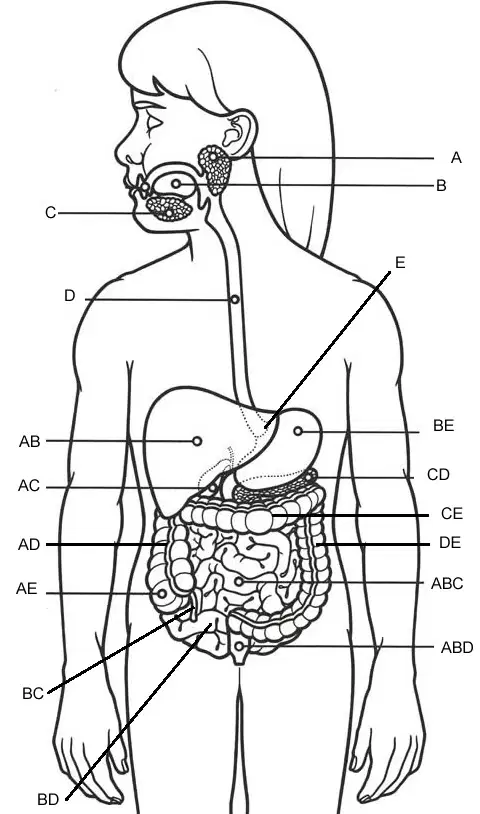
What is the name of the part of the digestive system labelled D?

(a)  

69.

What is the name of the part of the digestive system labelled AB?

(a)  

70.

What is the name of the part of the digestive system labelled BE?

(a)  

71.

What is the name of the part of the digestive system labelled ABD?

(a)  

72.

What is the name of the part of the digestive system labelled CD?

(a)  

73.

What is the name of the part of the digestive system labelled C

(a)  

74.

What is the name of the part of the digestive system labelled ABC?

(a)  

75.

What is the name of the part of the digestive system labelled AC?

(a)  
76.

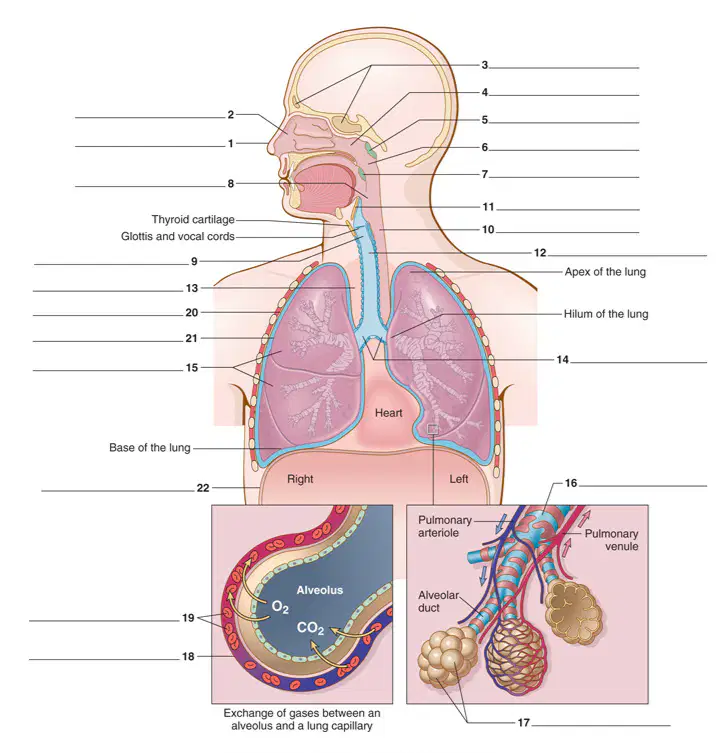
What is the name of the structure numbered 12?

(a)  

77.

What is the name of the structure numbered 14?

(a)  

78.

What is the name of the structure numbered 15?

(a)  

79.

What is the name of the structure numbered 17?

(a)  

80.

What is the name of the structure numbered 22?

(a)  

81.

The muscles in between the ribs are called the:

(a)  
82.

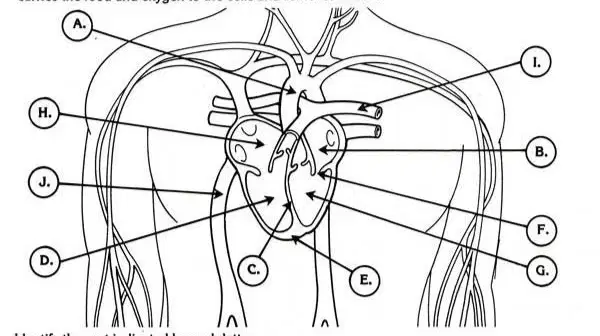
What is the name of the structure labelled A?

(a)  

83.

What is the name of the structure labelled B?

(a)  

84.

What is the name of the structure labelled F?

(a)  

85.

What is the name of the structure labelled G?

(a)  

86.

What is the name of the structure labelled D?

(a)  

87.

What is the name of the structure labelled H?

(a)  

88.

What is the name of the structure labelled J?

(a)  

89.

What is the name of the structure labelled I?

(a)
