
 Worksheets
General Physics 1 Review ( STEM -Tenacity)
Total questions: 85
Worksheet time: 1hrs 24mins
Which of the following is NOT a correct unit for work?
erg
watt
ft·lb
newton·meter
A boy holds a 40-N weight at arm’s length for 10 s. His arm is 1.5 m above the ground. The work done by the force of the boy on the weight while he is holding it is:
0
6.1 J
40 J
60 J
If the displacement is perpendicular to the force, the work done by the force is:
Maximum
Minimum
Zero
Infinite
Which of the following does not affect the work done by a constant force?
Magnitude of the force
Direction of force
Displacement
Speed of the object
Work done to compress a spring is stored as:
Gravitational energy
Chemical energy
Potential energy
Kinetic energy
An object moves in a circle at constant speed. The work done by the centripetal force is zero because:
the average force for each revolution is zero
there is no friction
the magnitude of the acceleration is zero
the centripetal force is perpendicular to the velocity
An object of mass 1 g is whirled in a horizontal circle of radius 0.5 m at a constant speed of 2 m/s. The work done on the object during one revolution is:
0
1 J
2 J
4 J
A 1-kg block is lifted vertically 1 m by a boy. The work done by the boy is about:
1 ft · lb
1 J
9.8 J
0.1 J
If the angle between force and displacement is 0°, the work done is:
Maximum
Minimum
Zero
Undefined
The amount of work required to stop a moving object is equal to:
the velocity of the object
the kinetic energy of the object
the mass of the object times its acceleration
the mass of the object times its velocity
Which of the following five units represents a quantity that is NOT the same as the other four?
joule
watt
erg
foot·pound
The work done by a variable force can be determined using:
Algebraic addition
Graphs and integration
Multiplying force and displacement
Vector Subtraction
A piece of fruit falls straight down. As it falls,
the gravitational force does positive work on it and the gravitational potential energy increases.
the gravitational force does positive work on it and the gravitational potential energy decreases.
the gravitational force does negative work on it and the gravitational potential energy increases.
the gravitational force does negative work on it and the gravitational potential energy decreases.
An object is moving to the right on a frictionless surface with a constant speed when a force is applied to it at an angle of 150° relative to its direction of motion. Which of the following statements is correct about the work done by the force on the object?
The work done by the force is positive because the object is in motion.
The work done by the force is zero because the force is perpendicular to the motion.
The work done by the force is negative because it has a component opposite to the object's motion.
The work done by the force depends on the mass of the object.
A 2-kg object is moving at 3 m/s. A 4-N force is applied in the direction of motion and then removed after the object has traveled an additional 5 m. The work done by this force is:
12 J
15 J
18 J
20 J
Camping equipment weighing 6000 N is pulled across a frozen lake by means of a horizontal rope. The coefficient of kinetic friction is 0.05. The work done by the campers in pulling the equipment 1000 m at constant velocity is:
3.1 × 10⁴ J
1.5 × 10⁵ J
3.0 × 10⁵ J
2.9 × 10⁶ J
A man pulls a sled along a rough horizontal surface by applying a constant force Fn at an angle θ above the horizontal. In pulling the sled a horizontal distance d, the work done by the man is:
F d
F d sin θ
F d cos θ
F d/ cos θ
A watt is:
kg · m/s3
kg · m2/s3
kg · m2/s
kg · m/s
Which of the following bodies has the largest kinetic energy?
Mass 3M and speed V
Mass 3M and speed 2V
Mass 2M and speed 3V
Mass M and speed 4V
A kilowatt·hour is a unit of:
power
energy/time
power/time
work
What will happen when a force is exerted on an object for work to be done?
The object moves.
The object stays still.
The object is heavy.
None of these.
A 50-N force is the only force on a 2-kg object that starts from rest. When the force has been acting for 2 s the rate at which it is doing work is:
75W
100W
2500W
1000W
The work done by a force is graphically represented by:
The slope of the force vs. time graph
The area under the force vs. displacement graph
The y-intercept of the force vs. displacement graph
The area under the force vs. velocity graph
A force applied varies with position as F(x) = (8x − 2x2) N. Find the work done by the force as the object moves from x = 1 m to x = 3 m.
12.7 J
18.7 J
14.7 J
30.7 J
The spring constant k of a spring is doubled. How does this change the work required to stretch the spring by a fixed distance x?
Work is halved
Work is doubled
Work is quadrupled
It remains the same
For a spring with k=200 N/m, what is the work required to stretch it 0.5 m?
25 J
50 J
12.5 J
100 J
What does the spring constant of an object tells you?
What type of spring you are dealing with.
How long the spring will stretch or compress.
It gives you a value on how easy or hard it is to change the objects length.
A spring constant gives you a number which tells you what material the spring is made of.
Which of the following is a rotational quantity that is described using a vector?
Angular velocity
Angular displacement
Torque
All of the above
For a system to be in static equilibrium under the action of torque, the net torque must:
be maximum
be zero
equal the net force
depends on the rotational axis.
Torque is maximum when the angle between r and F is ______.
0°
90°
180
360°
Which of the following is always TRUE for a body in equilibrium?
It is at rest.
It is moving at constant velocity
There are no forces acting on it.
There are no unbalanced force acting on it
Which force arises from direct physical contact between two objects?
Field force
Friction
fundamental force
gravitational force
A ball is dropped from the top of the building. As it falls, what happens to its gravitational potential energy and kinetic energy?
Its gravitational potential energy and kinetic energy increases.
Its gravitational potential energy increases while its kinetic energy decreases.
Its gravitational potential energy decreases while its kinetic energy increases.
Its gravitational potential energy and kinetic energy decreases.
Which of the following statements in TRUE?
the center of mass of an object must lie within the object
all the mass of an object is actually concentrated at its center of mass
the center of mass of an object cannot move if there is zero net force on the object
none of the above
The center of mass of a system of particles has a constant velocity if:
the forces exerted by the particles on each other sum to zero
the external forces acting on particles of the system sum to zero
the velocity of the center of mass is initially zero
the particles are distributed symmetrically around the center of mass
Which of the following is TRUE about an inelastic collision?
momentum is not conserved but kinetic energy is conserved
total mass is not conserved but momentum is conserved
neither kinetic energy nor momentum is conserved
momentum is conserved but kinetic energy is not conserved
A 1,500-kilogram car is moving to the right at a constant velocity of 25m/s. What is the net force exerted on the car?
50N
0N
100N
250N
Given the two vectors, A = (8i - 4j - 6k ̂)m and B = (2i ̂ + 3j ̂ - 7k ̂) m, what will be the angle between vectors A & B?
57º
77º
67º
87º
Which of the following statements best describes the conservation of mechanical energy?
Energy can neither be created nor destroyed; it can only be converted from one form to another.
Mass can neither be created nor destroyed but is transformed from one form to another.
In the absence of conservative forces, the total energy in an isolated system remains constant.
In the absence of non-conservative forces, the total energy in an isolated system remains constant.
If the velocity of a system increases to twice its original value while its mass remains constant, what happens to the momentum of the system?
decreases to one-fourth
decreases to one-half
increases to twice
increases to four times
A baseball is hit high into the upper bleachers of left field. Over its entire flight the work done by gravity and the work done by air resistance, respectively, are: ____________.
positive; positive
positive; negative
negative; positive
negative; negative
The following statements are true about conservative force EXCEPT
The work done by a conservative force is independent of the path taken by the object.
In any closed loop, the amount of work done by a conservative force is equal to zero.
The amount of work done by a conservative force depends only on the initial and final positions of the object.
Gravitational force, electrostatic force, and tension force are typical examples of conservative forces.
Which of the following situation best describes how nonconservative forces affect mechanical energy?
When a car is brought to a stop by friction on level ground, it loses kinetic energy, which is dissipated as thermal energy, reducing its mechanical energy
The force of gravity works on a ball kicked from the ground into the air. When the ball reaches the ground the net work done by gravity is zero.
When you grab an object attached to a spring, pull it a distance from its equilibrium position, and release it, the spring force will pull the object back to equilibrium.
All of the above
What is work done by or against a conservative force in a round trip?
zero
minimum
maximum
constant
Which of the following statements does not describe a characteristic of conservative forces?
Path is dependent.
Path is independent.
Work done is reversible.
Work done in a closed path is zero.
Which of the following refers to the point where the entire mass of an object is concentrated for calculations?
Center of geometry
Geometric center
Center of mass
Balance point
What is the primary factor/s to consider when determining the geometric center of an object?
Weight
Density
Mass distribution
Shape and dimensions
What happens to the motion of the center of mass when there is no net external force acting on a system?
The center of mass comes to rest.
The center of mass accelerates indefinitely.
The center of mass exhibits periodic motion.
The center of mass continues moving at a constant velocity.
Which of the following statements best describes the impulse-momentum theorem?
The force on a moving object is equal to the magnitude of the impulse.
The impulse on an object is equal to the change in momentum it causes.
The impulse on an object is less than the change in momentum it causes.
The impulse on an object is greater than the change in momentum it causes.
What will happen to the colliding bodies in a completely inelastic collision?
Both stopped at the collision point and both momentum and total kinetic energy are conserved.
Maintains its initial velocity after colliding and neither momentum nor kinetic energy is conserved.
Bounce away from each other after collision and the initial kinetic energy is equal to the final kinetic energy.
Stick together and move as one body after collision and the initial kinetic energy is greater than the final kinetic energy.
The momentum of a system commonly depends on what physical quantities?
mass and shape
mass and velocity
mass and energy
mass and speed
An object is in static equilibrium if _____.
When the net force acting on the object is zero.
When the net torque on the object is zero.
Both A and B
None of the above
Which of the following examples satisfies the condition of static equilibrium?
A balanced seesaw
Running on a treadmill at 3 m/s
A ball falling from a table
A child sliding down a water slide.
What can we infer if the two vectors are perpendicular?
The dot product is zero.
The cross product is zero.
Both are zero.
Both are not necessarily zero.
Which of the following is TRUE about the definition of work?
Work is the dot product of force and distance.
Work is the cross product of force and distance.
Work is the dot product of force and displacement.
Work is the cross product of force and displacement.
Which of the following situations shows a decrease in gravitational potential energy?
A car ascends a steep parking ramp.
Bingo’s puppy jumps down the chair.
Water is forced upward through a pipe.
Caroline stretches horizontally with a rubber band.
A force F is applied to a spring, causing it to stretch by a distance x. If the applied force will be doubled, how long will the spring be stretched?
Doubled
Halved
Quadrupled
Quartered
The center of mass of a system of particles remains at the same place if:
no friction acts internally.
it is initially at rest and the external forces sum to zero.
it is initially at rest and the internal forces sum to zero.
the sum of the external forces is less than the maximum force of static friction.
If a system experiences a change in velocity with zero net external force acting on it, what can be inferred about the system's momentum?
Momentum decreases.
Momentum increases.
Momentum becomes zero.
Momentum remains constant.
If the impulse experienced by a system is zero during a collision, what implication does this have for the system's behavior?
The force applied is zero.
The time of contact is infinite.
There is no change in momentum
A. Momentum remains constant.
the impulse experienced by a system is zero during a collision, what implication does this have for the system's behavior?
The force applied is zero.
The time of contact is infinite.
There is no change in momentum.
Momentum remains constant.
In the context of momentum conservation, how do elastic and inelastic collisions differ?
Elastic collisions conserve momentum, while inelastic collisions do not.
Inelastic collisions conserve momentum, while elastic collisions do not.
Neither elastic nor inelastic collisions conserve momentum.
Both elastic and inelastic collisions conserve momentum.
In rotational dynamics, what scalar quantity is related to an object's resistance to changes in its rotation?
Angular velocity
Angular displacement
Torque
Moment of inertia
For a body to be in equilibrium under the combined action of several forces:
all the forces must be applied at the same point.
all of the forces form pairs of equal and opposite forces.
any two of these forces must be balanced by a third force.
the sum of the components of all the forces in any direction must equal zero.
A 50,000 kg 10-wheeler truck loaded with sugarcane is traveling to Busco, Quezon, Bukidnon with a speed of 45 km/hr. What must be the speed of a 15,000 kg bus to match the momentum of the truck?
100 km/hr
200 km/hr
150 km/hr
250 km/hr
Which of the following statements best describes the impulse-momentum theorem?
The force on a moving object is equal to the magnitude of the impulse.
The impulse on an object is equal to the change in momentum it causes.
The impulse on an object is less than the change in momentum it causes.
The impulse on an object is greater than the change in momentum it causes.
A moving car collides with a stationary car, and the two cars become entangled after the collision. The total momentum of the two cars immediately after the collision:
is zero, because the cars become entangled.
is less than the momentum of the car before the collision.
is equal to the momentum of the car before the collision.
is greater than the momentum of the car before the collision due to the collision force.
The center of mass of a system of particles remains at the same place if:
no friction acts internally.
it is initially at rest and the external forces sum to zero.
it is initially at rest and the internal forces sum to zero.
the sum of the external forces is less than the maximum force of static friction.
The physical quantity “impulse” has the same dimensions as that of:
Force
Power
energy
momentum
A student’s life was saved in an automobile accident because an airbag expanded in front of his head. If the car had not been equipped with an airbag, the windshield would have stopped the motion of his head in a much shorter time. Compared to the windshield, the airbag:
causes a much smaller change in momentum
exerts a much smaller impulse
causes a much smaller change in kinetic energy
exerts a much smaller force
An inelastic collision is one in which:
momentum is not conserved but kinetic energy is conserved
total mass is not conserved but momentum is conserved
neither kinetic energy nor momentum is conserved
momentum is conserved but kinetic energy is not conserved
Two objects collide in a two-dimensional plane. Object M has a mass of 10 kg and an initial velocity of 6 m/s, while object N has a mass of 6 kg and an initial velocity of −4 m/s. After the collision, both objects move at different angles and speeds. Which of the following must be true for the coefficient of restitution e?
The coefficient of restitution will be 0.
The coefficient of restitution will be 1.
The coefficient of restitution will be less than 1 but greater than 0.
The coefficient of restitution is undefined for two-dimensional collisions.
A 10-kg block of ice is at rest on a frictionless horizontal surface. A 1.0-N force is applied in an easterly direction for 1.0 s. During this time interval, the block:
acquires a speed of 1 m/s
moves 10 cm
acquires a momentum of 1.0 kg · m/s
acquires a kinetic energy of 0.1 J
A 30-Mg railroad car moving at a speed of 0.6 m/s to the right collides with a 55-Mg car which is
at rest. If after the collision the 55-Mg car is observed to move to the right at a speed of 0.4 m/s,
calculate the coefficient of restitution between the two cars.
1
0.98
0.88
0.78
A 1.0-kg ball moving at 2.0 m/s perpendicular to a wall rebound from the wall at 1.5 m/s. The change in the momentum of the ball is:
zero
0.5 N · s away from wall
0.5 N · s toward wall
3.5 N · s away from wall
A 2.5-kg stone is released from rest and falls toward Earth. After 4.0 s, the magnitude of its momentum is
98 kg · m/s
78 kg · m/s
39 kg · m/s
A. 24 kg · m/s
A 0.5-kg ball is moving with a velocity of 10 m/s when it is struck by a bat, causing its velocity to change to 15 m/s in the opposite direction. What is the impulse experienced by the ball?
2.5 N·s
-12.5 N·s
12.5 N·s
-2.5 N·s
If an object is rotating with constant angular velocity, which of the following is true?
The angular acceleration is zero.
The object experiences no net torque.
The object’s moment of inertia remains constant.
The linear velocity of a point on the object is constant.
Three particles of masses m1 = 2.0 kg, m2 = 3.0 kg, and m3 = 5.0 kg are located at distances r1 = 2.0 m, r2 = 3.0 m, and r3 = 1.0 m from an axis of rotation. Calculate the total moment of inertia of the system.
30 kg·m2
40 kg·m2
50 kg·m2
60 kg·m2
If r ⃑= 4i - 2 j + k and F =- i + 3j -2k , the torque τ is ______.
i + 9j + 14k
-i -9j -14k
i +9j- 14k
-i +9j - 14k
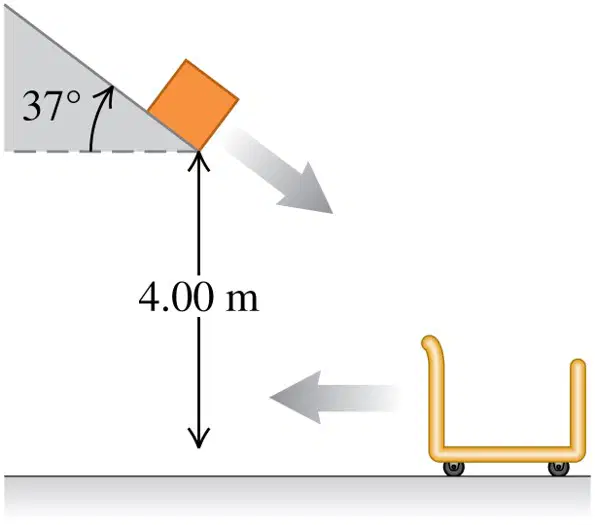
An open cart is rolling to the left on a horizontal surface. A package slides down a chute and lands in the cart. Which quantities have the same value just before and just after the package lands in the cart?
the horizontal component of total momentum
the vertical component of total momentum
the total kinetic energy
two of A., B., and C.
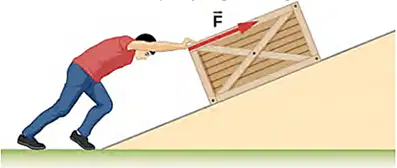
A 60.0-kg man pushes a 30.0-kg cart 5.00 m up along a ramp that makes an angle of 25.0° with the horizontal. She exerts a force of 400 N on the cart parallel to the ramp and moves at a constant speed. The coefficient of kinetic friction between the cart and the incline is μk=0.35. Determine the work done by the applied force.
1800 J
1900 J
2000 J
2100 J
A physics book slides off a horizontal tabletop with a speed of 1.10 m/s and strikes the floor in 0.350 s. Neglecting air resistance, what is the height of the tabletop above the floor?
0.400 m
0.600 m
0.500 m
0.700 m
The tool used to locate the center of mass of an irregular object in the suspension method.
(a)
It is the upward force that the exhaust gases exert on the rocket.
(a)

