
 Worksheets
The Solar System Reteach Unit 6
Total questions: 144
Worksheet time: 5hrs 50mins
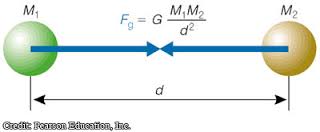
What is gravitational force?
an elastic force that causes planets to expand
an attractive force between all objects that have mass
a destructive force that creates radiation in the solar system
a conductive force that helps light travel through the solar system
A solar system is a system
in which only planets travel around a star.
that includes only the sun, Earth, and moon.
that includes a star, planets, and their moons.
made up of a star and all the objects that travel around it.
What does the strength of gravitational force depend on?
mass and distance
mass and speed
shape and speed
shape and distance
Which gravitational force is strongest?
The force on a baseball from Earth.
The force on a baseball from the moon.
The force on a baseball from a nearby book.
The force on a baseball from a person’s hand.
Which of these is NOT a requirement for a celestial object to be considered a planet?
It has to have a moon.
It has to clear its neighborhood.
It has to attract matter as it moves.
It has a nearly spherical shape.
Why does Earth constantly revolve around the sun?
Earth is attached to the sun by a gravitational force that operates like a rigid pole.
Earth is pushed away from the sun due to the heat waves that are produced by the sun.
Earth’s speed allows it to resist the pull of the gravitational force between Earth and the sun.
Earth is caught in the gravitational force between Venus and Mars, causing it to rotate.
Why do planets have a nearly spherical shape?
A planet’s rotation causes it to become round over time.
Gravitational forces around large objects push matter outward.
Planets will form in the shape of the stars they revolve around.
Gravitational forces in large objects pull matter toward their centers.
At about what speed does the Earth move around the sun?
1 km/s
30 km/s
100 km/s
4,000 km/s
Which of these would be considered a natural satellite?
Saturn
a GPS satellite
Saturn’s moon
the Hubble Space Telescope
Which of these statements is true regarding the number of moons in the solar system?
There are no planets that do not have a moon.
All moons in the solar system have been discovered.
Planets in the solar system never have more than five moons
Planets in the solar system have different numbers of moons.
Which planets are more likely to form systems of moons?
massive planets
smaller planets
planets closest to the sun
planets farthest away from the sun
Which planet exerts the strongest gravitational force in our solar system?
Earth
Jupiter
Mars
Saturn
Which of these statements is NOT true of dwarf planets?
Dwarf planets are in direct orbit around the sun.
Dwarf planets have a nearly round shape.
Dwarf planets share their orbit with many large objects.
Dwarf planets have cleared the neighborhood around their orbit.
Most asteroids are found in our solar system between the orbits of
Mars and Jupiter in the main asteroid belt.
Venus and Earth in the main asteroid belt.
Saturn and Uranus in the main asteroid belt.
Mercury and Mars in the main asteroid belt.
What is an astronomical unit (AU)?
A unit of measurement that is about the distance of Earth to Polaris.
A unit of measurement that is about the distance of Earth to the moon.
A unit of measurement that is about the distance of Earth to the sun.
A unit of measurement that is about the distance of the sun to the edge of the outer solar system.
Why is a scale model of a system helpful to scientists?
Scale models help to understand why moons fall into orbit around planets.
Scale models, while not an accurate measure for relative size, help to understand distance.
Scale models help to understand the relative sizes and distances of planets in actual systems.
Scale models, while not an accurate measure for relative distance, help to understand size.
Mercury is so difficult to see from Earth because it is
hidden by the glare of the sun.
too small to be seen from Earth.
blocked from view by other planets.
too far away to been seen from Earth.
Neptune is the hardest planet to see because it is
too close to the sun.
blocked by an asteroid field.
blocked from view by its moons.
very dim and similar in appearance to the stars.
What makes Jupiter easier to see than Mars?
It is closer to Earth than Mars.
It is on the same orbital plane as Earth.
Its orbit passes Earth more closely than Mars’s orbit.
It is larger than Mars, so it appears to be brighter.
Why do Mercury and Venus appear to have phases?
They have properties that are similar to natural satellites.
They follow the same orbit around Earth as Earth’s moon.
The sun shines only on the half of each planet that is facing the sun.
They are so bright that objects blocking their view from Earth create phase-like phenomena.
A student made a model of how the planets orbit the sun. She used a tennis ball to represent the sun. She used ping-pong balls to represent each planet and painted each one a different color. Then, she placed all the ping-pong balls equal distances apart in a line extending out from the sun.
What are two limitations of the student's model? (Limitations are things about the model that limit its accuracy.)
She used the same size balls to represent the planets.
She made planets orbit the sun.
The planets are not the correct distances from the sun.
The solar system can't be modeled using actual objects.
How do the sizes of the inner planets (4 closest to the sun) compare to the sizes of the outer planets (4 farthest from the sun)?
The inner planets are larger.
The outer planets are smaller.
There is no size difference between the inner and outer planets.
The inner planets are smaller.
Describe how the distances between the orbits of the inner planets (1st four from the sun) compare to the distances between the orbits of the outer planets (four farthest from the sun).
The distances between orbits of the outer planets are much smaller.
The distances between orbits of the outer planets are much larger.
The distances between orbits of the inner planets are much larger.
There is no difference between the distances of the orbits of the inner planets and the outer planets.

This model shows...
the size differences among the planets accurately.
the distances between the planets accurately.
both the sizes of the planets and the distances between them accurately
What is the center of our solar system?
The sun
Uranus
Jupiter
Saturn
Our Solar System_________
Has 8 planets that are very close together
Has 8 planets, but is mostly empty space
Has 9 planets that are very close together
Has 9 planets, but is mostly empty space
Why do scientists use scale models to study the Solar System?
The solar system is too large to study without using models
The solar system is too small to study without using models
Scientists don't need to use models because we have satellites
All of these options are true
Why is making a model of the solar system difficult?
Don't have the right materials
The solar system is so big and the objects in it are so small in comparison
There are too many parts in a model
Because the science concepts are too difficult

Which planet in the Solar system orbits the sun in the shortest amount of time?
Mercury
Earth
Jupiter
Neptune

The graph shows the average temperatures of the planets in our solar system. Which planet has the highest average temperature?
Mercury
Venus
Earth
Jupiter

If you were going to make a scale model of the Solar system what planet should be the second largest?
Jupiter
Saturn
Earth
Uranus


What planet is spinning the fastest on its axis?
Mercury
Jupiter
Venus
Earth

What planets year (Period of Revolution) is shorter than its day (Period of Rotation)?
Venus
Jupiter
Earth
Uranus
One similarity between asteroids, comets and meteoroids is that they all:
are made of the same materials
come from the Asteroid Belt
have long tails that follow behind them
orbit the sun
Which is true of the dwarf planets? (Select all that are true.)
have cleared their orbit of other objects
made of ice
orbit the Sun
spherically shaped
Imagine that a new object is found in our solar system. It is small and made of rock and orbits the dwarf planet Eris. How would scientists classify this object?
A moon
A comet
An asteroid
A meteoroid
Which of the following bodies in our solar system orbit the sun? (Select all that are correct)
Meteoroids
Moons
Dwarf Planets
Comets
Asteroids
According to a livescience.com headline from earlier in the week, "On Wednesday (Sept. 22), the fall equinox will bring the Earth about 12 hours of daylight, 12 hours of night, and a renegade space rock measuring about three times the size of the Statue of Liberty."
This object would be classified as a...
comet
asteroid
meteoroid
moon
What is the center of our solar system?
The sun
Earth
Jupiter
Saturn
This shows
Size difference between the planets accurately
Distance between the planets accurately
Both size and distance accurately
If you were going to make a scale model of the Solar system what planet should be the second largest?
Jupiter
Saturn
Earth
Uranus

If you were to make a scale model of the Solar system what planets in the solar system should be most similar in size?
Earth and Venus
Mars and Mercury
Uranus and Neptune
Jupiter and Saturn
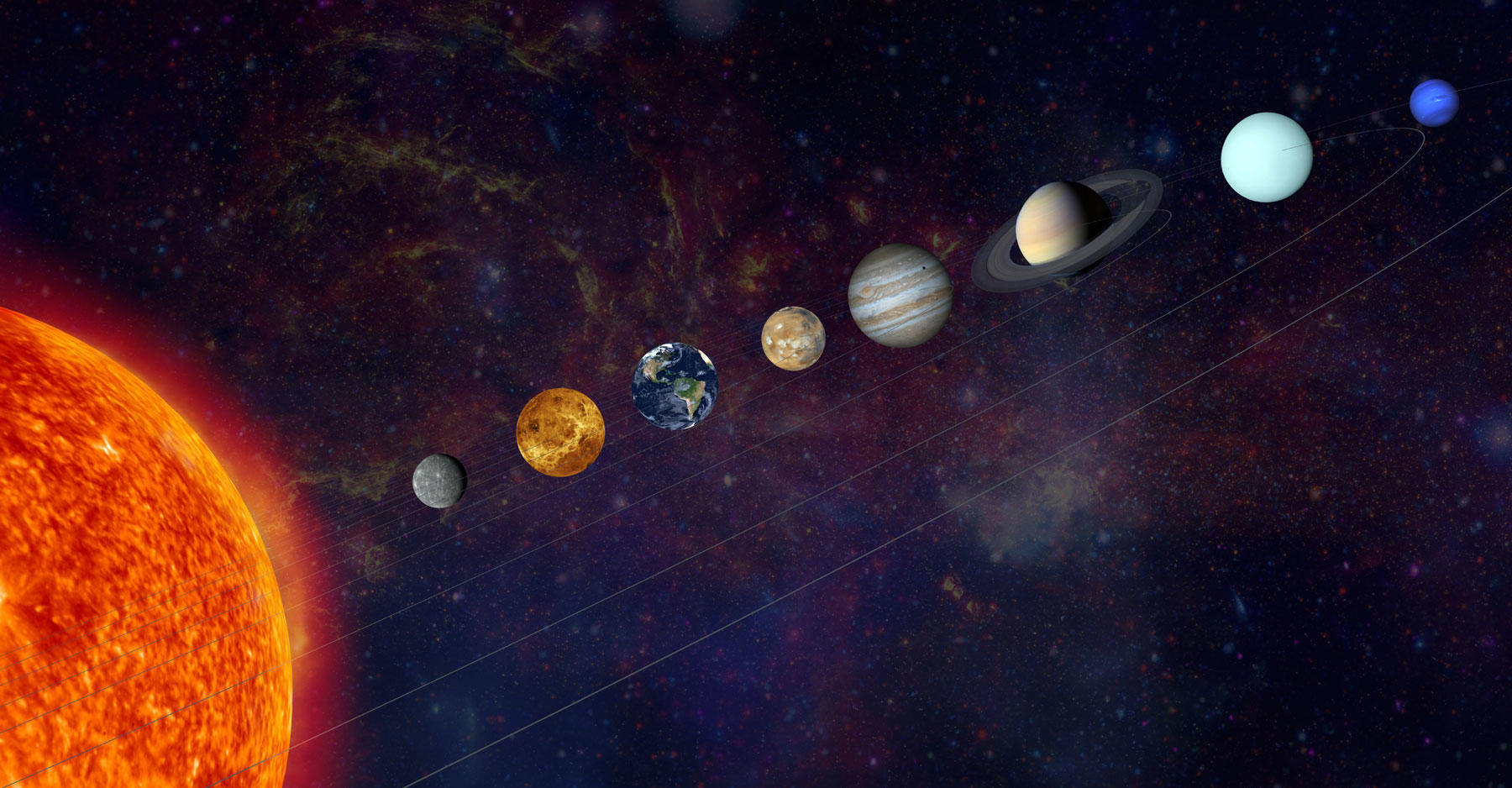
The planets are all equally distanced from each other.
Representation used to study objects or ideas that are too complex, distant, large or small to study firsthand...
Miniature
Model
Magnified
The ratio between the measurement on a map or model and the actual measurement of an object
gravity
weight
scale
ruler
The Milky Way is the galaxy that contains our Solar System.
True
False



the path a body follows as it travels around another body in space
revolution
rotation
orbit
hemisphere
a cloud of gas and dust from which bodies in space are formed
revolution
photosphere
nuclear fusion
nebula
The planets of the solar system formed as
the center of the gas cloud cooled.
planetesimals flattened into a rotating disk.
planetesimals collided into one another.
the sun absorbed extra gas and dust from the solar system.
What happens during nuclear fusion in the sun?
Helium nuclei combine to form hydrogen.
Helium nuclei combine to form oxygen.
Hydrogen nuclei combine to form helium.
Oxygen nuclei combine to form helium.
As a nebula collapses it also begins:
Expand
Spin or Rotate
Shake
Turn to ice
A nebula collapses down into a disk known as :
A compact disk
An irregular cloud
An protostellar disk
An circular disk


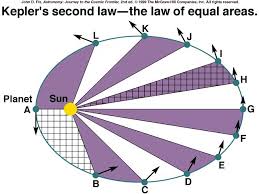


Which of Kepler's laws states that planets travel faster when they are close to the sun then they do when they are farther from the sun?
Kepler's 1st law
Kepler's 2nd law
Kepler's 3rd law

Which of the following list the correct hierarchy in the Universe from biggest to smallest?
¿Cuál de las siguientes enumera la jerarquía correcta en el Universo de mayor a menor?
Universe, galaxies, solar system, stars and planets
Planets, stars, solar system, galaxies, universe
Solar system, galaxies, stars, planets, universe
Universe, solar system, galaxies, planets and stars
Astronomical units are used for....
Distances within a solar system
Distances between solar systems
Distances within galaxies
Distances between galaxies
The distance that light can travel in a year is called....
A light second
A light minute
A light month
A light year
_________would be the best unit to use to measure the distance between our sun and Proxima Centauri (our nearest star neighbor).
Astronomical units
Light seconds
Light years
An astronomical unit is...
The average distance between the Earth and the Sun
The average distance between the Sun and Neptune
The diameter of the sun
The time it takes light to travel across our solar system
This geometrically derived unit equals about 3.26 light years
Astronomical Unit
Light year
Parsec
Light second
_______________ would be the best unit to use to measure the distance between the asteroid belt and Pluto
Astronomical units
Light seconds
Light years
Parsecs
What's wrong with Han Solo's claim of making "the Kessel Run in less than 12 parsecs"
Even the Millennium Falcon can't travel that fast
He should have used 'astronomical units'
Parsec is a measure of distance, not time
He should have used 'light seconds'


If the adult is pushing both children with the same force, which of the following is true?
The smaller child will have more acceleration
The bigger child will have more acceleration
Both children will have the same acceleration
What are TWO things that happen on the surface of the Sun?
Sunspots
Explosions
Solar Flares
Greenspots


How many inner layers does the sun have?
3
9
6
934
How many outer layers does the sun have?
3
9
103
6
What Inner layers of the sun?
Core, Radiative zone, and the Convection zone
Corona, Photosphere, and Chromosphere
Core, Corona, and Chromosphere
Corana, Core, and Radiative zone
What are the outer layers of the sun?
Core, Radiative zone, and the convection zone
Corona, Radiative, and Chromosphere
Corona, Photosphere, and Chromosphere
Photosphere, Corona, and Core
The more arrow heads in a region shows a greater speed.
Which of the following models below best represents the Sun's rotational pattern?


#4 Photosphere



