
 Worksheets
Fall Science Topics Review-W.E.D. Earth Layers, Cont. Drift
Total questions: 146
Worksheet time: 2hrs 32mins

The crust and the uppermost mantle make up the solid layer of hard rock called the
inner core
asthenosphere
lithosphere
outer core

How does temperature change as you move from the crust to the core?
it gets cooler
it gets hotter
it stays the same
the core is frozen


What layers work together to create the earth's magnetic field?
the convection currents in the asthenosphere
the lithosphere sliding on the asthenosphere
the Inner core spinning in the outer core

Scientists who study the layers of the Earth are called...
biologists
astrologists
geologists

Which layer of Earth is in the liquid state of matter?
Crust
Inner Core
Lithosphere
Outer Core

Which is the best description of the characteristics of the asthenosphere?
Solid, but flowing
Brittle, but shifting
Hot, but solid metal

According to scientific data, which layer of Earth is the thickest?
Crust
Inner core
Mantle
Outer Core

What layer of the earth is composed of material of the highest density?
Outer core
Inner core
Crust
Mantle

Which of the following models would best represent the inner and outer core of Earth, based on the physical characteristics of each layer?
A metal ball bearing (solid) suspended in oil (liquid).
Gelatin (red semi-solid) on top of a cracker (brittle solid).
A ball of clay (solid) filled with water (liquid).
Rubber ball (flexible solid) painted red (thin solid covering).

The layer of Earth that is found directly below the lithosphere is called the -
Crust
Asthenosphere
Inner core
Outer core

Which of Earth’s layers would be best modeled as a metallic sphere?
Mantle
Outer core
Crust
Inner core

Which of Earth’s layers has the lowest density?
Crust
Inner core
Mantle
Outer core

Which layer of Earth is characterized by rock that is like fudge, solid but can flow ?
asthenosphere
crust
inner core
lithosphere

Temperature _____________________ as you go deeper into the earth.
increases
decreases
stays the same

Pressure ______________________ as you go deeper into the Earth
increases
decreases
stays the same

The lithosphere combines what two layers?
Athenosphere & Crust
Crust & Upper Mantle
Mantel & Asthenosphere

Scientists determine what Earth’s interior layers looks like by using:
Convection Currents
Seismic (earthquake) Waves
Continental Drift
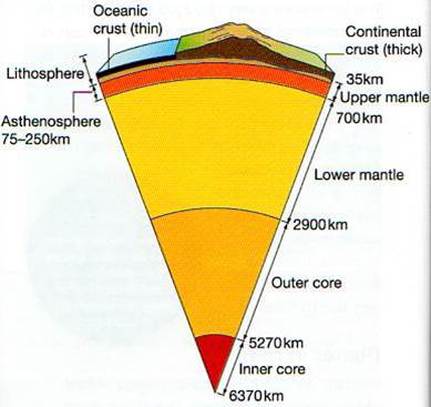
Large pieces of lithosphere that move around on the asthenosphere are called
Crust plates
Tectonic plates
Mantle pieces
Core plates

Oceanic crust is _____ than continental crust.
denser
less dense

The ____ is the largest layer of the Earth
inner core
crust
mantle
outer core

The inner and outer core are composed of what two elements?
Iron and Nickel
Iron and Helium
Hydrogen and Helium

What layer is the hottest?
Core
Crust
Mantle

What effect does the spinning of the earth’s core have?
It creates the earth's magnetic field
It creates matter
It creates mass

If the earth’s mantle were completely solid, ______ plates could not move around.
Tectonic
Technical
Titanic
Tidal

Temperature, pressure, and density all______________________ as you go deeper into the Earth
increases
decreases
stays the same

What are the two kinds of crust that the Earth has?
Oceanic and Crustatious Crust
Oceanic and Continental Crust
Optic and Continental Crust

Which of the following occurs because of convection currents?
Tectonic plates on the crust move.
The mantle increases in size.
Pressure in the crust increases.
Pressure in the crust decreases.


Oceanic crust is primarily composed of
Basalt
Granite

Which layer of Earth is broken up into giant moving plates?
Asthenosphere
Inner Core
Outer Core
Lithosphere

The core heats up the mantle like a _________.
stove heats up a pot of soup
electricity goes through a cord
switch turns on a lightbulb

Based on the information in the table, what can you conclude about the density of the Earth’s layers?
The density of the layers decreases as the pressure increases.
The density of the layers increases as the temperature decreases.
The density increases in layers that are closer to the core of the Earth.
The density increases in layers that are closer to the surface of the Earth.

Scientists the figured out the cores must be made of spinning metal because that is the only explanation to how we can have ___________ .
a strong magnetic field
night and day
tides in the ocean

This picture shows
convection currents
hot spots
circular water

Scientists can find evidence of earth's layers from studying__________.
Rocks that may have uplifted or come out of volcanos from the mantle
tree layers
what minerals can combine to make rocks

Our magnetic field protects our planet from________.
solar wind
cosmic rays
the suns deadly rays
all of the answers

The farthest man has drilled down in the earth is the Kola borehole that is _________.
7 1/2 miles deep
77 miles deep
700 miles deep

At the top of a convection current the mantle rock will_____.
start to fall
continue to rise
go up or down depending on the area

Mars used to have layers like our planet because_______.
It had volcanoes-evidence of magma.
It has magnetic rock crystals-a magnetic field must of existed.
It has evidence of water.
All of the answers are evidence

The distance to the center of the earth is like flying from Tulsa, Oklahoma to_____________.
Dallas, Texas about 315miles
London, England about 4,000 miles
New York, NY 1,600 miles

What did Wegener name the large supercontinent where all the continents were joined together?
Wegenerland
Gondwanaland
Laurasia
Pangaea

Most geologists rejected Wegener's idea of Continental Drift because _________.
He used too many pieces of evidence to support the idea.
He wanted to know what Earth looked like millions of years ago, which is impossible.
He couldn't identify "how" continents to move around.
They were afraid of the new idea.

Wegener used the fit of the continents as evidence to support his hypothesis of Continental Drift.
true
false

Wegener used matching mountain ranges across different continents as evidence to support his hypothesis of Continental Drift.
true
false

Wegener used evidence of glaciers in places now too warm as evidence to support his hypothesis of Continental Drift.
true
false

Wegener used matching matching fossils of the same organisms on different continents as evidence to support his hypothesis of Continental Drift.
true
false

What were 2 kinds of evidence were used to prove that the seafloor spread?
rock formations, WWII shipwrecks,
magnetic seafloor stripes, WWII ship logs
magnetic seafloor stripes, age of rock samples

What technology was used during WWII to detect enemy submarines and produce the first map of the seafloor?
Sonar
Radiam
GPS

Process by which new ocean crust forms.
Seafloor spreading
Continental drift
Mid-ocean ridge
Rift

The zone where one plate slides under another is called the
Convergent zone
Subduction zone
Transform zone
Mantle zone

Undersea mountain ranges are called a_________.
Rift
Mid-ocean ridge
seafloor spreading
Continental drift

Wegener used matching rock types and ages across different continents as evidence to support his hypothesis of Continental Drift.
true
false

Wegener used evidence of convection currents in the mantle as evidence to support his hypothesis of Continental Drift.
true
false

The OLDEST seafloor is located?
Closest to the mid-ocean ridge
Farthest from the mid-ocean ridge

Sea-floor spreading begins at the
Deep ocean trench
Mid-ocean ridge
Continent's edge

Older crust is found towards the...
Mid-ocean ridge
Deep-ocean trench
Asthenosphere

Why does oceanic crust (density 3ish) sink below the continental crust (density 2.6ish) during subduction
oceanic crust is less dense
oceanic crust is more dense
oceanic crust is older
oceanic crust is warmer

Wegener's idea of Continental Drift was rejected by geologists because _________.
He used too many pieces of evidence to support the idea.
He wanted to know what Earth looked like millions of years ago, which is impossible.
He couldn't identify how or even why the continents to moved around.
They were afraid of the new idea.

Who came up with the theory of seafloor spreading?
Harry Hess
Alfred Wegner
Mrs. White
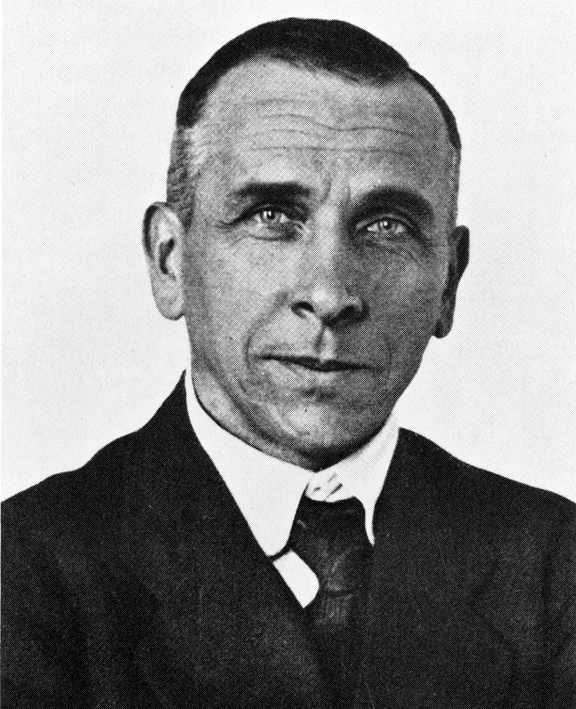
Who is the person credited with developing the theory of continental drift?
Harry Hess
Albert Einstein
Alfred Wegener
Isaac Newton

What are the two types of crust?
continental and oceanic
ocean and basin
lower and upper
thick and thin

Younger sea floor crust is located...
farther from the mid-ocean ridges
at the mid ocean ridges
near the continents

What causes the crust to move?
convection currents
conduction
tension
radiation

Why were magnetic patterns found on the ocean floor puzzling?
They showed alternating bands of rock crystals pointing north and south.
No rocks were magnetic.
They did not show alternating bands of rock crystals pointing north and south.
All rocks were magnetic.


What are Mid-Ocean Ridges?
A chain of underwater waterfalls
A chain of underwater mountains where the magma oozes out.
A chain of underwater rocks

Which is NOT evidence of sea-floor spreading?
Molten magma constantly erupting
Drilling samples of rock
Magnetic stripes
Fossil evidence
What is label D
Trench
Mid ocean ridge
abyssal plain
sea mount

How long did it take the continents to move into their current position?
Hundreds of years
Thousands of years
Almost a million years
Hundreds of millions of years

What do you call the evidence of Wegener's Theory that tells about the remains of an organism that lived long time ago?
ashes
follicles
bones
fossils

What causes continents to move?
seafloor spreading
convection currents swirling
magma oozing out of a mid ocean ridge
all of the above

True or False: Our continents will eventually become a supercontinent (like Pangaea) again, far in the future
False
True

What is the rate at which the Atlantic Ocean is expanding?
5-10 cm per year- like how our fingernails grow
5-10 feet per year
5-10 km per year

True or False: The plates will never stop moving
True
False

Alfred Wegener proposed his theory of Continental Drift in the early 20th century. Why did scientists refuse to believe him?
He was not a REAL scientist
He could not explain HOW the plates moved
Scientists did not think his evidence was real

Which layer of Earth contains the tectonic plates?
crust and the uppermost mantle
lower and middle mantle
outer core
inner core

What is this image trying to show?
How the shape of the continents match
Rock evidence showing that the continents were connected
Fossil evidence suggesting that the continents were connected

The force in the MANTLE that makes the plate move is called _________
Convection currents
conduction
condensation

During WWII the navy mapped the ocean floor with _______.
a robotic rover
radiation evidence
SONAR waves
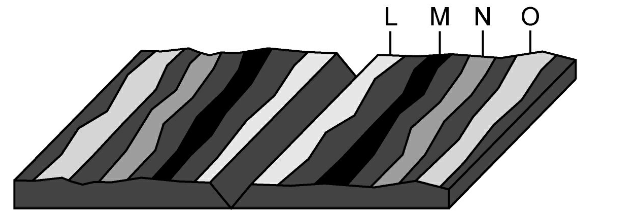

The average density of continental crust is 2.8 g/cm3 and the average density of oceanic crusts is 3.2 g/cm3. If these two plates came together, what would happen?
The two plates would push apart and form a rift zone.
The oceanic plate would rise up over the continental plate.
The oceanic plate would sink under the continental plate.
The two plates would meet head on and rise up to form mountains.

Seafloor spreading...
creates new oceanic crust
destroys or recycles crust
creates new continental crust
creates old crust

The Glomar Challenger_____
is a space shuttle
is an oil rig
has been drilling seafloor samples for over 50 years

Before sonar waves evidence, people believed that the ocean was ______.
had mountains just like on land
was coral reefs
flat and sandy

The temperature gets _______ closer to the ocean ridge.
cooler since magma is farther from the ocean floor
hotter since magma is closer to the ocean floor
stays the same since magma is very far from the ocean floor
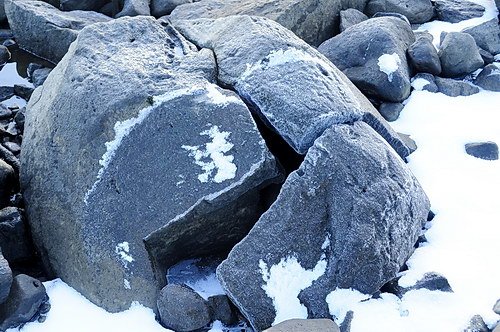
How does freezing water cause the weathering of rocks? The freezing water—
keeps the rocks in place.
makes the rocks last longer.
expands cracks and breaks rocks.
causes rocks to fall in landslides.
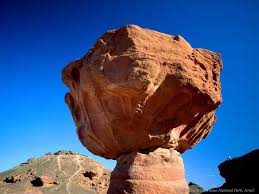
The process that breaks down rocks and other materials on Earth's surface is called
Weathering
Erosion
Deposition
Decomposition

Over long periods of time, deposition may change the Earth’s surface by _____.
forming new land features.
breaking down large rocks into smaller ones.
washing away beaches.
moving topsoil.

A cliff formed near the ocean. Which statement best describes how this cliff formed?
Warm air melted the rock.
Sun rays evaporated the rock.
Ocean waves washed away rock.
Plant roots pushed away the rock.


What causes the greatest erosion effect on our beaches?
Waves
Gravity
Glaciers
Wind

What is an enormous mass of ice moving over land, causing weathering of rock and soil?
A glacier
An iceberg
An ice wedge
A sand dune
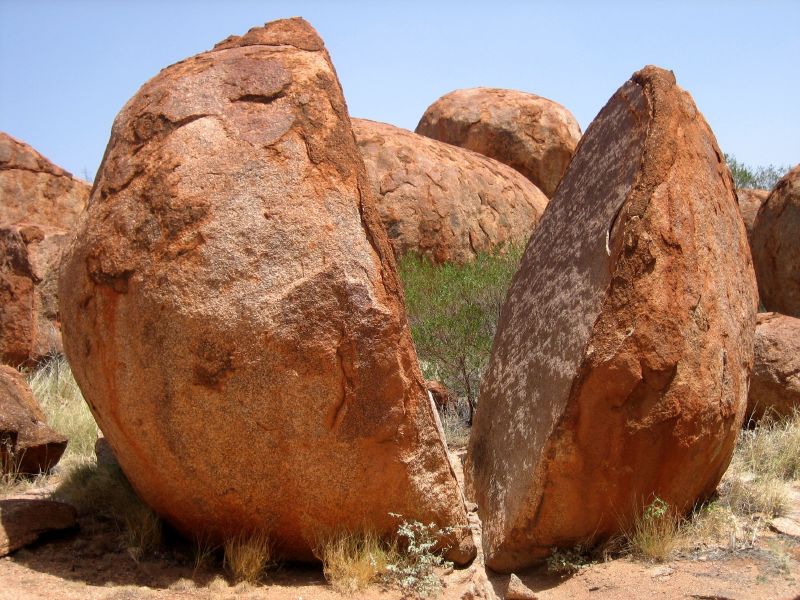
What is the wearing away or breaking down of rocks called?
Deposition
Erosion
Glaciers
Weathering

Which of the following is NOT a slow change to Earth's surface?
Weathering
Erosion
Deposition
Landslides

A delta is formed by the action of -
weathering
erosion
deposition
condensation
Some agents of weathering are water, wind, ice, temperature and plant roots.
true
false


_____ is the process by which soil and sediment (weathered rock) are transported (moved) from one place to another by water, wind, glaciers, and gravity
Erosion
Deposition
Weathering
Running Water
What is the small broken down pieces of rock called?
popcorn
grime
sediment

Rocks being picked up and carried downstream is an example of ____________.
weathering
erosion
deposition
Rocks being picked up and carried downstream is an example of ____________.
weathering
erosion
deposition

Glaciers dropping rock and sand to form terminal moraines
weathering
erosion
deposition

Which type of weathering occurs when natural forces, such as wind, water and temperature change mechanically crumbles or breaks down rock into smaller pieces? (think of a hammer as a clue)
Chemical
Physical

Which type of weathering occurs when rocks are chemically broken down or dissolved by substances in the environment?
Physical
Chemical

Which process of weathering has plants grow roots into crevices of rock and cause the rock to break apart?
carbonation
root wedging
hydratoin
oxidation

Which type of weathering occurs when living things mechanically break down (crack, dig etc.) rocks and minerals?
Chemical
Physical

Which process of chemical weathering has oxygen react with minerals, especially those that contain iron, and cause them to break down?
**Rust is an example of this process.**
Oxidation
Carbonation
Hydation

Which process of chemical weathering has carbon from the air or in the soil dissolve in water to make a weak acid that can dissolve rock?
(This weathering can create caves and sinkholes)
Carbonation
Hydrolysis
Oxidation
Which process of chemical weathering has carbon from the air or in the soil dissolve in water to make a weak acid that can dissolve rock?
(This weathering can create caves and sinkholes)
Carbonation
Hydrolysis
Oxidation

Which process of chemical weathering has rock absorb water, swell and become softer and easier to break apart?
Oxidation
Hydration
Carbonation


Which could contribute to acid precipitation (acid rain)?
abrasion and all forms of oxidation
root wedging and animal burrowing
volcanoes and burning fossil fuels

Lichen moss( plants)secretes an acid that breaks down rock.
Physical/Mechanical Weathering
Chemical Weathering

The process in which sediment settles out (drops to the bottom) of the water or wind that is carrying it
Weathering
Erosion
Sedimentation
Deposition

Waves dropping sand onto land until a beach is formed is an example of...
physical weathering
erosion
deposition
chemical weathering
Waves dropping sand onto land until a beach is formed is an example of...
physical weathering
erosion
deposition
chemical weathering

Rain washing away (moving) soil from a hillside is an example of...
physical weathering
erosion
deposition
chemical weathering

Weathering can be natural or man-made.
Which of the following causes of the Dust Bowl were due to HUMAN IMPACT?
1.Over-tilling the land and overgrazing of animals
2.Severe heat and drought for almost a decade
3.High winds in the area
All answer options
1 and 3
1

Which best describes the surface of the earth over billions of years?
High mountains gradually wear down until most of the earth is at sea level
High mountains stay side by side for billions of years with little change
Flat surface is gradually pushed up into higher and higher mountains until the earth is covered with mountains
High mountains gradually wear down as new mountains are continuously being formed, over and over again

What always plays the main role in a landslide, regardless of the cause?
Mud
Gravity
Wind

Why do so many landslides occur near mountains, rather than in flat areas?
Mountains have lots of rocks.
People like to build their houses near mountains.
Gravity allows the dirt to slide down mountains quickly.

The force that can move objects downhill is ...
deposition
gravity
temperature

Watery clay slides down a mountain. This is an example of a ...
creep
rockslide
mudslide

This fence was built strait years ago. Which type of erosion happens very slowly?
mudslide
creep
landslide

GRAVITY MAKES GLACIERS MOVE.
TRUE
FALSE

Which letter has a higher speed?
A
B

Which letter is there more deposition occurring?
A
B

Which letter has the lowest speed?
A
B

Which letter has the most weathering and erosion occurring?
A
B

What kind of river produces meanders like the ones in the image?
Young
Old

What would the river channel look like from B to B'


What is a meander?
A straight river
A bend in the river
The start of a river
The flow of the river

Deposition on the inside of a river creates a...
cliff side for teens to jump
sandy shallow area for little kids

Erosion of the river bank creates a
Slip off slope
river cliff

An Ox-bow lake is a....
Bend in the river
Lake left by an old meander
Slip off slope
River cliff

What would the river channel look like from C to C'


What is the ultimate driving force for W.E.D.?
The tides
The moon
The sun

