
 Worksheets
Continental Drift and Plate Tectonics
Total questions: 150
Worksheet time: 1hrs 27mins
The theory of continental drift states that all the continents were once part of one big landmass called Pangaea. Who was the scientist that came up with this theory?
Harry Hess
Bill Nye
Alfred Wegener
Albert Einstein
Which of the following evidence was used to support theory of continental drift?
A) Continents fit together like a puzzle
B) Similar fossils were found on separate continents
C) Different types of rock, mountain structures, landforms are found all over the world.
D) All of the above
E) Only A and B
Why was Alfred Wegener unable to explain his theory?
He couldn't explain how the continents drifted.
He couldn't explain why similar fossils on different continents were separated
He couldn't explain why similar geological structures found were found on different continents.
He couldn't explain why the continents fit together like a puzzle.
If you took rock samples from the Mid-Atlantic Ridge, the youngest rock would be
located where the plates collide
located at the place where rocks are furthest from the rift valley
Located at the center of the ridge (rift valley), where oceanic crust is formed
none of the above; all the rocks would be the same age
Seafloor Spreading occurs at a
convergent boundary
divergent boundary
transform boundary
continental boundary
Tectonic plates float on top of the
crust
asthenosphere
lower mantle
outer core

The San Andres Fault is an example of a
convergent boundary
divergent boundary
transform boundary
subduction zone

What type of plate boundary is shown in this picture
a convergent oceanic-oceanic boundary
a divergent oceanic-oceanic boundary
a convergent oceanic-continental boundary
a divergent oceanic-continental boundary

This picture shows
a transform boundary where one continental crust is sliding past another continental crust
a convergent boundary where one continental crust is moving towards another continental crust and mountains are forming
a divergent boundary, where one oceanic crust is moving away from another oceanic crust
a convergent boundary where one oceanic crust is moving toward a continental crust
At which type of boundary do you find most earthquakes form
divergent boundary between two oceanic plates
transform boundary between two oceanic plates
convergent boundary at a subduction zone
transform boundary between two continental plates sliding past each other

This map shows volcanic and earthquake activity. Where is the highest concentration of activity?
all along the Atlantic Ocean
all along the Pacific Ocean
all along the coast of Africa
all along Indian Ocean
What is the densest type of crust?
continental crust
oceanic crust
mantle crust
convergent crust
In a tectonic plate demonstration during class, Mrs. Smith
pushes two pieces of modeling clay together. What kind of
plate boundary was the teacher demonstrating?
Convergent
Earthquake
Equator
Divergent
What is the Theory of Continental Drift?
New continents are continually being created
and destroyed.
The layout of the continents is the same today
as it has always been
The continents have always been separate but
may one day drift together to form a single
continent
All the continents were once one continent that
broke up and drifted apart over hundreds of
millions of years
Where does magma rise to the top to become new crust?
one plate splits into two distinct plates
one plate grinds against another plate
two plates separate and move apart from one
another.
two plates meet and collide with one another.
When crust is neither created nor destroyed, what boundary is it formed along?
convergent
divergent
collisional
transform
What type of tectonic plate boundary involves a collision of plates?
transform
divergent
convergent
obstructive
Where do most volcanoes occur?
convergent boundaries
in deserts
on coastal plains
divergent boundaries
What is responsible for the volcanoes and mountain ranges?
Weathering
Super-nocturnal tides
Hurricanes
Plate Tectonics
When tectonic plates of more density and less density collide, what happens?
The plate that is more dense fractures.
The plate that is more dense rises.
The plate that is less dense subducts.
The more dense plate subducts.
Continents to continent plate boundaries produce what feature when they collide?
Rift Valleys
Mid-ocean ridges
Tall mountain ranges
Deep-sea trenches
What type of boundary exists when 2 plates are pulling apart?
Convergent
Transform
Obtrusive
Divergent
Where do volcanoes and earthquakes occur?
Under the flat surface of plates
Above the flat surface of the plates
Along plate boundaries
At the center of plate
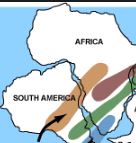
What do these color strips show between South America and Africa with the Theory of Plate Tectonics?
Similar cultures
Similar fossils
Similar languages
Similar weather
Alfred Wegener proposed the Theory of Continental Drift. Which one of these does NOT support the theory Wegener proposed?
Fossils that were similar were found on different continents.
Bacteria was found all over the world.
Shape of continents fit together to form a supercontinent called Pangea
Climate seen as glacial or ice sharring are found all over the world.
Rift Valley is a feature of what plate boundary?
Obtrusive
Divergent
Transform
Convergent
Why does the Ring of Fire around the Pacific Ocean have the most volcanoes?
boundary plates
divergent plate
convergent plates
transform plates
What is the theory of continental drift?
New crust is being created at mid-ocean ridges and is pushing away old crust.
The continents have always stayed in their current location.
The same fossils of plants and animals can be found on the same continents.
The continents had once been joined in a single landmass and have since drifted apart.
Which two continents did Wegener notice fit together like pieces of a puzzle?
Africa and North America
South America and Africa
South America and Europe
Asia and South America
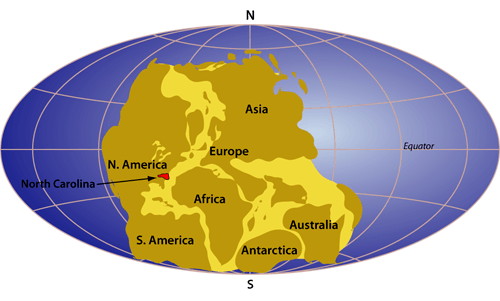
What was the name of the super continent that existed 250 million years ago?
Pangea
Eurasia
Wegenerland
Disneyland
Why did people not believe in Wegener's theory about continental drift?
There was a competing theory at the time that was more believable.
There was no data showing the continents ever moved.
The scientists did not know the force responsible for moving the continents.
The scientist presenting the data was unreliable.
How did fossil evidence support Wegener's hypothesis of continental drift?
Similar fossils are found along continental margins that appear to join together.
Fossils are found in areas where present-day climate could not have supported the organisms that made the fossils.
Similar fossils of land-dwelling dinosaurs are found on continents separated by oceans.
All of the above.
Which of the following statements is false?
Continental crust is less dense than oceanic crust.
Continental crust is made of granite.
Continental crust is made of basalt..
Continental crust is thicker than oceanic crust.
Plates move away from one another at ________ boundaries.
divergent
transform
convergent
submergent
What is the term for a heavier, denser plate sliding under a less dense plate?
submersion
plate boundary
acceleration
subduction
The crust and the uppermost mantle make up the _________.
lithosphere
asthenosphere
mesosphere
thermosphere
The longest mountain chain in the world, the mid-Atlantic ridge, was produced by which boundary?
divergent
allegiant
convergent
transform
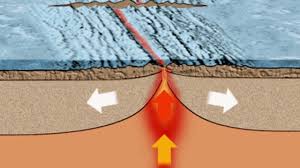
In sea-floor spreading, molten material rises from the mantle and erupts
along the edges of all the continents.
along mid-ocean ridges.
in deep-ocean trenches.
at the north and south poles.

Most geologists think that the movement of Earth’s plates is caused by _______
convection.
continental drift.
subduction.
conduction.

Below is a picture of sea-floor spreading. How are the ocean crusts moving?
Converging
Diverging
Sliding
No movement
Earth's lithospheric plates at a rate of a few _____________ every year.
centimeters
miles
kilometers
yards
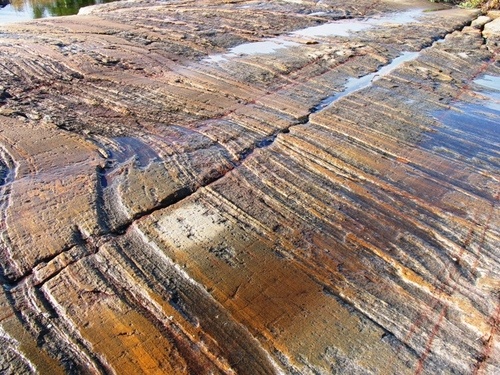

The Himalayas are an example of what happens at a?
convergent boundary
divergent boundary
transform boundary
allegiant boundary
Internal processes continually build up the surface of the earth, while __________________ processes break it down.
Atmospheric
Hydrogeological
External
Volcanic
Earth's internal processes are driven primarily by what?
Heat and convection currents
Ocean currents
Weathering and erosion
Earthquakes and volcanoes
Why was the theory of plate tectonics initially rejected?
It didn't explain how continents move
It did not explain formation of islands
It was based upon false statements
There was no data to support the hypothesis
Which of the following is NOT evidence of continental drift?
Continents fit together like puzzle pieces
Volcanic activity
Fossil evidence
Mineral, rock, and glacial deposit evidence
Which of the following is evidence that mountain ranges on different continents were once connected?
They have the same climate
They are inhabited by similar wildlife
They are the same age
They have no trees beyond a certain height
Some fossils found on Antarctica required a tropical climate to live. How does this support the theory of continental drift?
The climate at the poles of the earth is cold, meaning that Antarctica used to be closer to the equator.
The climate at the poles of the earth was once warm
The equator used to be at the poles of the earth
The earth's orientation was once such that the poles of the earth were closer to the sun
Glacial deposits are found in what areas, indicating a different climate at one time?
Oceans
Tundras
Deserts
Deciduous forests
At what rate do continents continue to move?
About 7 feet a year
About 2 centimeters per year
They are not moving
About 15 feet per year
Why don't present day continents fit perfectly together?
Weathering and erosion of coastlines
They have been twisted by earthquakes
Fossils
Human actions have changed the shape of coastlines


Ocean crust is made of _______ and is _______ dense than continental crust.
basalt, less
basalt, more
granite, less
granite, more
Most tectonic plates have both oceanic and continental crust. How are they different?
Oceanic is thinner and less dense than continental.
Continental is thinner than more dense than oceanic.
Continental is thicker and less dense than oceanic.
Oceanic is thicker and more dense than continental.

What type of boundary is illustrated in the diagram?
Convergent
Divergent
Transform

What type of crust is involved in the illustration?
Oceanic-Oceanic
Continental-Continental
Oceanic-Continental

What type of boundary is illustrated in the diagram?
Convergent
Divergent
Transform

What layer is labeled #6 in the diagram?
lithosphere
mesosphere
asthenosphere
outer core
What layer is labeled #7 in the diagram?
lithosphere
mesosphere
asthenosphere
outer core
Which number represents the crust?
1
2
3
4

What type of boundary is illustrated in the diagram?
Convergent
Divergent
Transform
What two theories led the way for the modern Theory of Plate Tectonics? (Select two)
Law of Superposition
Theory of Continental Drift
Theory of Uniformtarianism
Sea-floor Spreading
Which landform is not supported by the MODERN Theory of Plate Tectonics?
Faults
Volcanoes
Canyons
Mountains
What layer of semi-liquid rock do the tectonic plates slowly float?
lithosphere
mesosphere
asthenosphere
crust
Which of the following WAS NOT a piece of evidence that Alfred Wegener considered when forming his model of continental drift?
the interaction between the Earth's lithospheric plates and the asthenosphere
the fit of the east coast of South America and the west coast of Africa
fossils of the same species match across the seas
similar mountain ranges on different continents
similar ancient climates evidence matches on present-day continents
In which of the following regions is plate subduction dominant.
around the edges of the Pacific Ocean
down the middle of the Atlantic Ocean
along the Appalachian Mountains of the US northeast
at the North and South Poles
A satisfactory mechanism for continental drift was finally discovered when data from ___________________ provided clues to how continents moved.
seafloor mapping
sea level rise
volcanic activity
atmospheric pollution levels

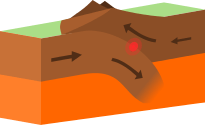

What land feature forms at a subduction zone
Deep sea trench
earthquakes
mountains
more land
Which statement best describes Earth's outer layer?
Earth's outer layer is made up of a soft solid material.
Earth's outer layer is made up of hard, solid rock.
Earth's outer layer is a combination of hard, solid rock and a soft, solid material.
Earth's outer layer is made up of hard, solid rock or water; it depends on where you go.

Which statement best describes what Earth's outer layer is like underneath the soil and water in the image?
Underneath both the soil and the ocean, Earth’s outer layer is made of sand and water.
Underneath both the soil and the ocean, Earth’s outer layer is made of hard, solid rock.
Underneath the soil, Earth’s outer layer is made of hard, solid rock. Underneath the ocean, Earth’s outer layer is made of sand.
Underneath both the soil and the ocean, Earth's outer layer is made of water.

The team is drilling underground at sites 1 and 2. Where will the team find hard, solid rock?
They will find hard, solid rock below site 1. At site 2, they will find water and sand.
They will find hard, solid rock below site 2. At site 1, they will find plants and soil.
They will find hard, solid rock below both sites.
They will find hard solid rock at neither of these sites; they will find water below both of them.

Which diagram shows what happens at a convergent plate boundary?
A
B
A and B
None of the above

Dr. Mendoza and his team are studying two plates that are far apart from each other. However, these two plates used to be next to each other. What happened to the gap that was created by the plates moving apart?
Sand and dirt filled in the gap.
Soft, solid rock from underneath the plates rose and hardened, adding new solid rock.
A new plate from underneath filled in the gap.
Ocean water filled in the gap.

The plate boundary shown in the image is a ______ boundary because...
Convergent; the plates are moving away from each other.
Convergent; the plates are moving towards each other.
Divergent; the plates are moving towards each other.
Divergent; the plates are moving away from each other.
What is Earth's outer layer made of?
Soft Solid Rock
Hard Solid Rock
Water
Water & Sand

GPS data shows that two plates moved apart. Which diagram shows what happened between the two plates as they moved away from each other.
Diagram A: A new plate from underneath filled in the gap that was created by the plates moving apart.
Diagram B: Sand and dirt filled in the gap that was created by the plates moving apart.
Diagram C: Ocean water filled in the gap that was created by the plates moving apart.
Diagram D: Soft, solid rock from underneath the plates rose and hardened, adding solid rock to the edges of both plates.
The place where two plates meet.
Plate
Continent
Plate Boundary
Landform
Cross Section
A diagram that shows what the inside of something looks like.
A diagonal portion of a larger object.
When two line are drawn over each other at a 900 angle.
A piece of a pizza.
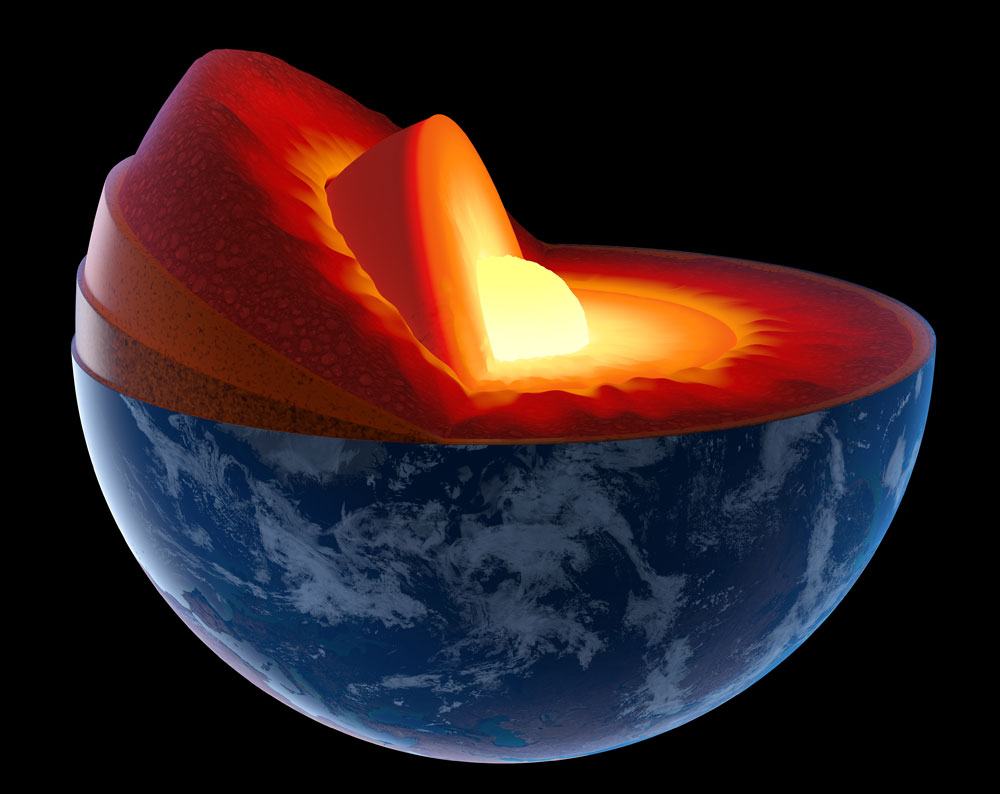
Outer Layer
Crust
Mantle
Outer Core
Inner Core
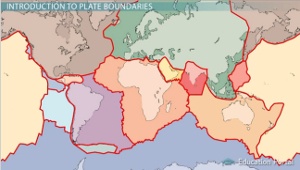
Plate Boundary
The place where two plates meet; most volcanoes and earthquakes occur here.
The location where the food falls onto the table.
Where one country ends and another begins.
The edge of your patella.
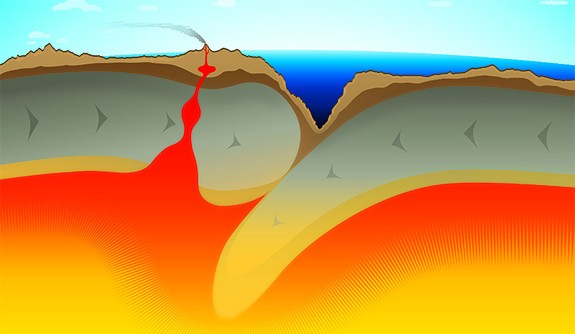
Tectonic Plate
One of the very large sections of hard rock that make up Earth's outer layer.
A new song release from "P-late."
An object that is used for serving food on.
Round, smooth portions of the Mantle.
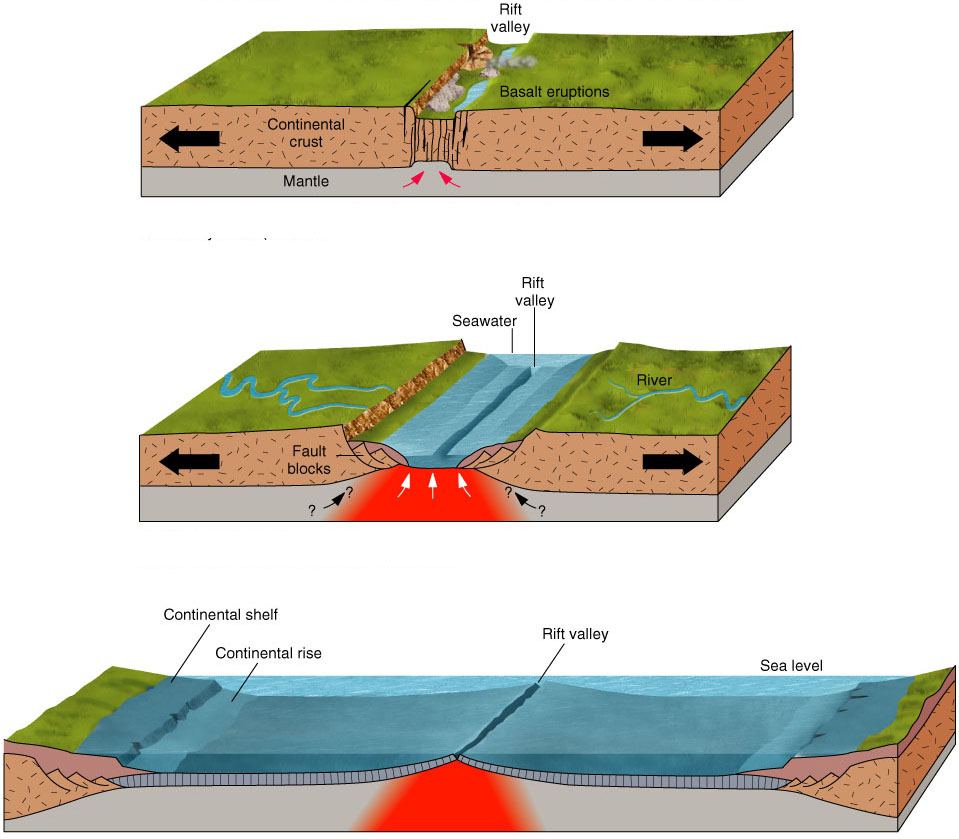
Divergent?
Convergent?
Transform?
Classic?
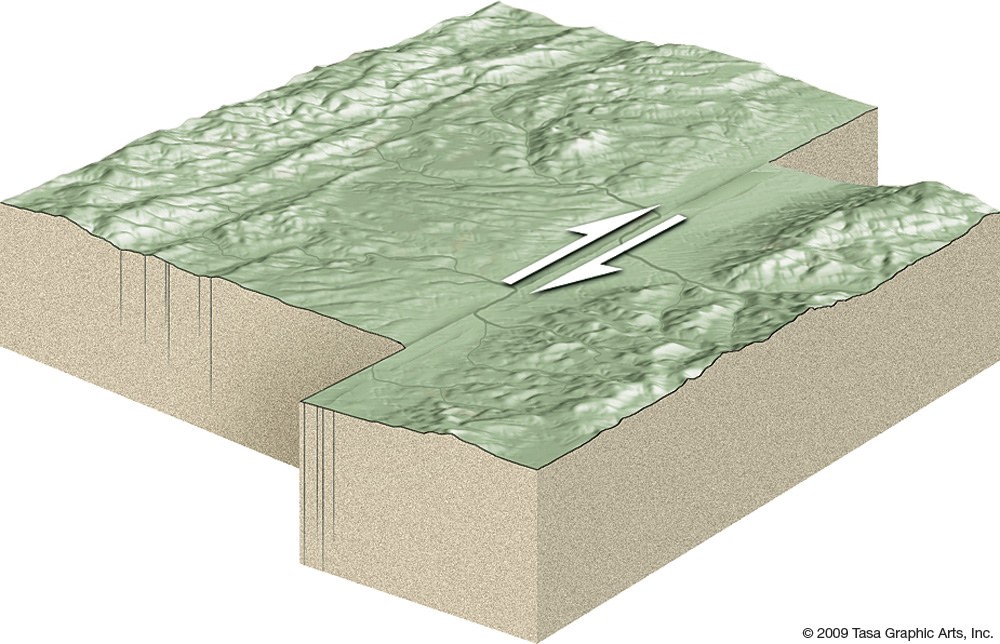
Transform?
Divergent?
Convergent?
Classic?
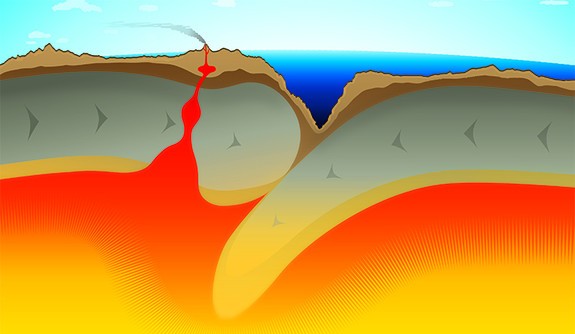
At which boundary do you find a trench?
Transform
Divergent
Convergent
Strike-Slip
Which statement best describes Earth's outer layer?
Earth's outer layer is made up of a soft solid material.
Earth's outer layer is made up of hard, solid rock.
Earth's outer layer is a combination of hard, solid rock and a soft, solid material.
Earth's outer layer is made up of hard, solid rock or water; it depends on where you go.

One of the very large sections of hard, solid rock making up Earth's outer layer?
Mantle
Pattern
Inner core
Plate
An earthquake is…
the slow plate motion that is constantly happening to the plates.
the sudden shaking of Earth's surface.
the reason that plates have any motion.
a mild geologic hazard.
Plate motion is caused by earthquakes that push the plates around.
True
False

What best describes Earth's mantle?
Liquid, melted rock below the outer layer.
The hard, solid rock beneath the plates.
Liquid, melted rock on which the plates move.
The soft, solid rock on which the plates move.
Geologists look for _____ in geologic events and landforms to better understand Earth's outer layer.
Solutions
Unexpected changes
Patterns
Fossils
"Converge" means...
To drift apart
To move towards each other
To slip by each other
To stop
"Diverge" means...
To move in different directions
To move towards each other
To slip past something
To stop

Dr. Raisa and her team of geologists have been studying GPS data that shows that two plates moved apart. Which diagram shows what happened between the two plates as they moved away from each other?
Diagram A: A new plate from underneath filled in the gap that was created by the plates moving apart.
Diagram B: Sand and dirt filled in the gap that was created by the plates moving apart.
Diagram C: Ocean water filled in the gap that was created by the plates moving apart.
Diagram D: Soft, solid rock from underneath the plates rose and hardened, adding solid rock to the edges of both plates.

Patterns on this map tell us that . . .
volcanic activity and earthquakes can cause damage to buildings and hurt people.
volcanic activity and earthquakes happened in similar areas.
volcanic activity and earthquakes happened in random locations all over the map.
volcanic activity and earthquakes happened in the following order: volcanic activity, earthquake, volcanic activity, earthquake, and so on.

Similar rock formations have been discovered in Brazil and South Africa. These rock formations were formed at the same time and are made of the same types of rocks. What could explain how these rocks got so far apart?
Brazil and South Africa are parts of different plates. The plates were sometimes pushed far apart by earthquakes, and soft, solid rock from underneath got added to the edges of the plates.
Brazil and South Africa are parts of different plates. The plates floated away from each other across the ocean.
Brazil and South Africa are parts of different plates. The plates slowly moved apart as new plates from underneath got added between them over millions of years.
Brazil and South Africa are parts of different plates. The plates slowly moved far apart as soft, solid rock from underneath got added to the edges of the plates over millions of years.
What kind of rock makes up the outer layer under the ocean?
Hard solid rock
soft solid rock
Sand, clay, and dirt
Basalt rock
Which piece of evidence could we use to assume that two continents used to be connected?
The presence of earthquakes on one of the continents
Identically shaped bodies of water on both continents
Similar climates for both continents
identical landforms and similar rock formations on both continents
Based on what we know about plate motion today, how did the plates move in the past?
They moved suddenly and rapidly to their current locations
They moved slowly over time to the positions they are in now
earthquakes caused the plates to move to their current locations
none of the above

What is Earth's outer layer underneath the surface in the image?
sand and water
hard solid rock
sand
water
What does heat do when convection currents are moving?
Sinks
Rises
Stays in place
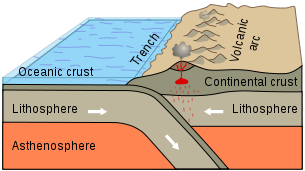
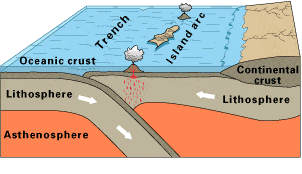
Observe this diagram of a plate boundary. One statement BEST describes what is happening. It is that
the oceanic crust is melting.
the less dense oceanic crust is subducting under the more dense oceanic crust
volcanic islands are forming.
the tectonic plates are moving away from each other.
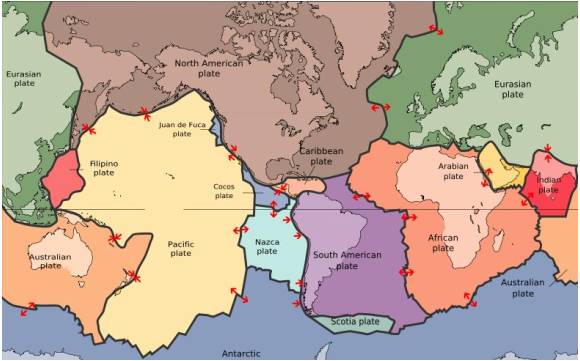
The map in the picture shows tectonic plate boundaries. This map would be useful in predicting the location of future
droughts
hurricanes
earthquakes
tornadoes
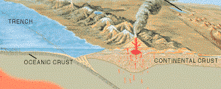
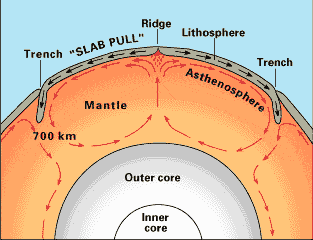
What is the source of energy that drives plate movement?
the subducton of the sea floor
the different densities of the oceanic and crustal plates
convection currents in the asthenosphere
the friction force between the plates that move past each other
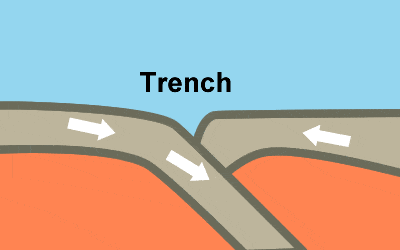
The Marianas Trench, where the Pacific Plate descends under the leading edge of the Eurasian Plate, is the deepest sea floor in the world. These ocean trenches form when two oceanic plates collide
and the older, less dense of the two plates rides over the edge of the older plate.
when convection currents in the mantle force the older plate downward.
and the younger, denser of the two plates, rides over the edge of the older plate.
and the plates are approximately the same age and density.
Cross Section
A diagram that shows what the inside of something looks like.
A diagonal portion of a larger object.
When two line are drawn over each other at a 900 angle.
A piece of a pizza.
Outer Layer
Crust
Mantle
Outer Core
Inner Core
Divergent?
Convergent?
Transform?
Classic?

Which statement best describes what Earth’s outer layer is like underneath the surface in the image?
Underneath both the soil and the ocean, Earth’s outer layer is made of sand and water.
Underneath both the soil and the ocean, Earth’s outer layer is made of hard, solid rock.
Underneath the soil, Earth’s outer layer is made of hard, solid rock. Underneath the ocean, Earth’s outer layer is made of sand.
Underneath the soil, Earth’s outer layer is made of water.
Patterns on this map tell us that . . .
volcanic activity and earthquakes can cause damage to buildings and hurt people.
volcanic activity and earthquakes happened in similar areas.
volcanic activity and earthquakes happened in random locations all over the map.
volcanic activity and earthquakes happened in the following order: volcanic activity, earthquake, volcanic activity, earthquake, and so on.

Which statement best describes what Earth’s outer layer is like underneath the surface in the image?
Underneath the soil, Earth’s outer layer is made of water.
Underneath the soil, Earth’s outer layer is made of hard, solid rock. Underneath the ocean, Earth’s outer layer is made of sand.
Underneath both the soil and the ocean, Earth’s outer layer is made of hard, solid rock.
Underneath both the soil and the ocean, Earth’s outer layer is made of sand and water.
Fossil remains of Cynognathus (an extinct large-bodied animal) have been discovered in Argentina and South Africa. When they were living, all the Cynognathus lived together on land, and they could not swim. However, now there is an ocean between the Cynognathus fossils. What could explain how these fossils got so far apart?
Argentina and South Africa are parts of different plates. The plates slowly moved apart as new plates from underneath got added between them over millions of years.
Argentina and South Africa are parts of different plates. The plates floated away from each other across the ocean.
Argentina and South Africa are parts of different plates. The plates slowly moved far apart as soft, solid rock from underneath got added to the edges of the plates over millions of years.
Argentina and South Africa are parts of different plates. The plates were sometimes pushed far apart by earthquakes, and soft, solid rock from underneath got added to the edges of the plates.
moving toward the same place
intersectional
divergent
parallel
convergent
moving apart in different directions
convergent
divergent
evidence of life from the past, such as fossilized bones, footprints, or leaf prints
fossil
a natural spring that sends hot water and steam suddenly into the air from a hole in the ground
hot liquid rock on the surface of Earth
tectonic plate
volcano
lava
magma
the layer of soft, solid rock underneath Earth's plates
mantle
atmosphere
an underwater mountain range formed when two plates move apart
What is Earth's outer layer made of?
Liquid water
Soft clay
Hard, solid rock
Gaseous atmosphere
What is the role of the mantle in plate tectonics?
The mantle provides a soft, solid layer on which tectonic plates can move.
The mantle is a liquid layer that causes tectonic plates to float.
The mantle is responsible for the creation of new tectonic plates.
The mantle acts as a barrier preventing tectonic plate movement.
What happens when two tectonic plates move toward each other?
One plate can go underneath the other plate and sink into the soft rock below.
Both plates collide and create a mountain range.
The plates slide past each other without any interaction.
One plate breaks apart and forms a rift.
What is the difference between oceanic and continental crust?
Oceanic crust is thicker and denser than continental crust.
Oceanic crust is thinner and denser than continental crust.
Oceanic crust and continental crust are the same in thickness and density.
Continental crust is thinner and denser than oceanic crust.


A team of engineers wants to study hard, solid rock under the surface of Earth. The team is considering drilling down in the Indian Ocean (1) and in Sri Lanka (2). Where will the team find hard, solid rock?
under 1 and 2, because Earth’s entire outer layer is made of hard, solid rock
only under 2, because Earth’s outer layer is made of hard, solid rock underneath continents but not under the ocean
neither under 1 nor 2, because there is water underneath both places
neither under 1 nor 2, because there is sand and gravel underneath both places

Which statement best describes Earth's outer layer underneath the surface in the image?
Underneath the soil, Earth's outer layer is made of water.
Underneath both the soil and the ocean, Earth's outer layer is made of sand and water.
Underneath the soil, Earth's outer layer is made of hard, solid rock. Underneath the ocean, Earth's outer layer is made of sand.
Underneath both the soil and the ocean, Earth's outer layer is made of hard, solid rock.


