
 Worksheets
Universe Test Review
Total questions: 72
Worksheet time: 36mins
What is the process that allows stars to produce light and heat energy?
Magnetic field rotation
Nuclear fusion
Energy transformations
Kinetic energy from impacts
What happens next to a small or medium sized star when it has exhausted all its fuel?
Main sequence stage
Planetary nebula
White Dwarf
Red supergiant
Why are nebulas called “star nurseries”?
Because they are places where a lot of stars die.
Because they have a lot of the ingredients needed to sustain a star.
Because stars move into a nebula when they reach middle age.
Because they are the birthplaces of stars.
What are the two most abundant elements found in stars?
Hydrogen and helium
Hydrogen and oxygen
Helium and carbon
Carbon and oxygen
Which of the following stages is the next stage in the life cycle of our Sun?
Supernova
Red Giant
White Dwarf
Neutron Star
What characteristics of a star determines its life cycle?
Color
Temperature
Mass
Brightness
All stars in the universe will go through which of the following stages?
Nebula, protostar, main sequence
Nebula, white dwarf, black dwarf
Protostar, main sequence, supernova
Protostar, red supergiant, neutron star
A ________________ is a dead star that no longer gives off light or heat.
White Dwarf
Black Hole
Neutron Star
A ________________ is a ring-shaped nebula formed by an expanding shell of gas around an aging star.
Neutron Star
Planetary Nebula
Protostar
Red Giant
A (a) is the stage after main sequence for a small to medium mass star when nuclear fuel begins to run out.
The remaining core of a planet-sized star that has exhausted all of its nuclear fuel is known as a (a) .
A (a) is a region of space with a gravitational field so intense that no matter or light can escape.
Ninety percent of stars are in the (a) stage of their life cycle.
A (a) is a young star in the early stages of formation when nuclear fusion begins.
A ________________ is an extremely dense star that results from the gravitational collapse of a high mass star after a supernova.
Planetary Nebula
Black Dwarf
Neutron Star
Red Supergiant
A (a) is a huge cloud of gas and dust in space held together by gravity.
A ________________ is the stage after main sequence for a high to extremely high mass star when nuclear fuel begins to run out.
White Dwarf
Red Supergiant
Black Dwarf
Red Giant
An extremely bright explosion of a high to extremely high mass star is known as a (a) .
The more massive a star is, the longer its life cycle.
True
False
The life cycle of stars is fairly similar to the life cycle of humans. Stars are born, they age, and then eventually die.
True
False
High mass stars burn through their nuclear fuel much more slowly than smaller mass stars do.
True
False
The mass of a star determines the path it takes through the different life cycle stages.
True
False
A star will spend the majority of its life cycle in the protostar stage.
True
False
Our Sun is approximately half way through its life cycle according to astronomers.
True
False
An average mass star will end its life cycle as either a neutron star or a black hole.
True
False
Which of the following characteristics of stars is represented on the HR Diagram?
Temperature and brightness
Size and distance from Earth
Mass and brightness
Location and age
Where would a red supergiant (very bright, cooler temperature) be located on the HR Diagram?
Center
Top left
Top right
Bottom right
Why are white dwarfs located near the bottom and left of center on the HR Diagram?
They are average size, and cooler in temperature.
They are dimmer than most stars and slightly warmer than the average temperature.
They are brighter than most stars and warmer than the average temperature.
They are dimmer than many stars and slightly cooler than the average temperature.
What stage occurs after the main sequence stage for a small to medium mass star?
Supergiant
Giant
White Dwarf
Black Dwarf
The majority of the stars on the HR Diagram belong to which of the following groups of stars?
Main Sequence
Giants
Supergiants
White Dwarfs
Which of the following is an accurate statement about the Sun?
The Sun is among the smallest of all known stars.
The Sun is among the coolest of all known stars.
The Sun is among the brightest of all known stars.
The Sun is an average star in brightness and temperature.
Which of the following correctly lists the color of stars from coolest to hottest?
Blue, white, yellow, red-orange, red
Blue, white, yellow, red, re-orange
Red, red-orange, yellow, white, blue
Red, red-orange, yellow, blue, white
Which of the following is not a category of star represented on the HR Diagram?
White Dwarf
Giant
Supergiant
Supernova
________________ decreases as you move to the right on the H-R Diagram.
Brightness
________________ increases as you move toward the top of the H-R Diagram.
Temperature
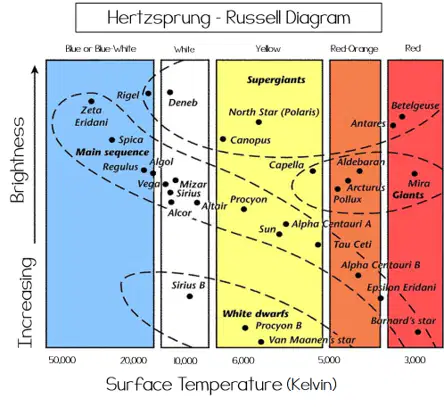
Use the Hertzsprung-Russell Diagram to answer: Which of the following stars is brighter and hotter than the Sun?
Van Maanen’s star
Procyon
Antares
Alpha Centauri B
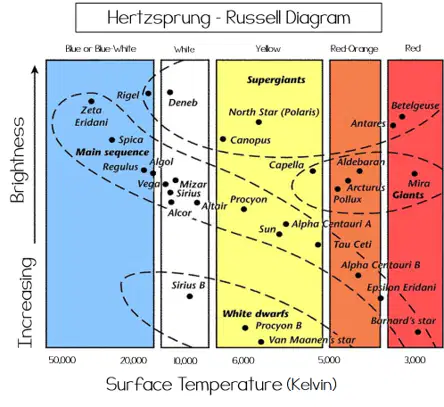
Use the Hertzsprung-Russell Diagram to answer: Which of the following stars is brighter and cooler than the Sun?
Van Maanen’s star
Procyon
Antares
Alpha Centauri B
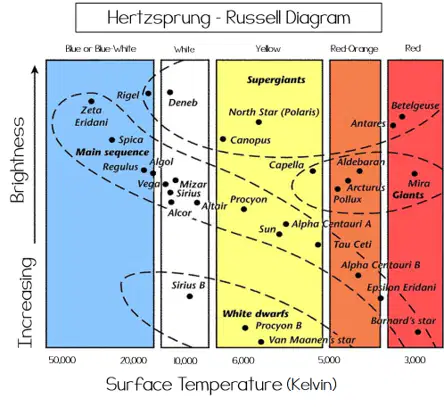
Use the Hertzsprung-Russell Diagram to answer: Which of the following stars is dimmer and hotter than the Sun?
Van Maanen’s star
Procyon
Antares
Alpha Centauri B
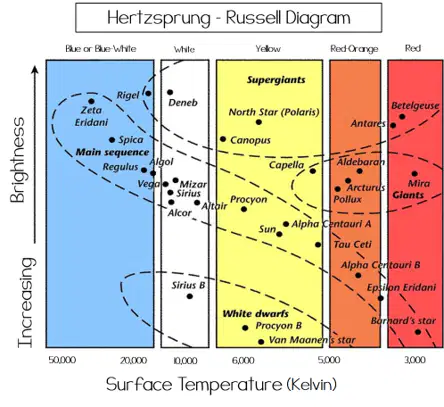
Use the Hertzsprung-Russell Diagram to answer: Which of the following stars is dimmer and cooler than the Sun?
Van Maanen’s star
Procyon
Antares
Alpha Centauri B
The brightness, temperature, and color of stars can be very different even if they look very similar from Earth.
True
False
The Hertzsprung-Russell diagram classifies stars into four major groups based on their brightness and temperature.
True
False
The Hertzsprung-Russell diagram is a graph of the characteristics of stars and not the actual placement of those stars in the sky.
True
False
A star near the top of the Hertzsprung-Russell diagram will be much dimmer than a star near the bottom of the diagram.
True
False
A star near the left side of the Hertzsprung-Russell diagram will be much hotter than a star near the right side of the diagram.
True
False
Approximately 50% of all known stars are in the main sequence stage of their life cycle.
True
False
The color of stars, from hottest to coolest, is blue, white, yellow, red-orange, and red.
True
False
The Sun is an example of a yellow, main sequence star that is average in both brightness and temperature.
True
False
The Sun would be located near the top of the Hertzsprung-Russell diagram because it is average in brightness.
True
False
Giant stars are typically brighter and hotter than the average star.
True
False
Which type of galaxy is considered to be the most abundant in the universe?
Irregular
Elliptical
Spiral
There are equal amounts of all types of galaxies
According to estimations by astronomers, how many light years in diameter are most galaxies in the universe?
Thousands of light years or more
Hundreds of light years
50-100 light years
1-10 light years
What do astronomers presume is located at the center of the Milky Way galaxy?
A giant star
A big bang
Another galaxy
A black hole
What is the name of the galaxy in which we live?
Milky Way galaxy
Andromeda galaxy
Whirlpool galaxy
Black Eye galaxy
Galaxies are classified according to which of the following?
Color
Brightness
Size
Shape
What is a galaxy?
All the matter that scientists have been able to identify
Huge systems of billions of stars, gas, and dust held together with gravity
A cloud of gas and dust that spawns new stars
A burning sphere of gases
A(n) (a) is a huge system of millions or billions of stars, together with gas and dust, held together by gravity.
A(n) _______________ galaxy is a random, scattered type of galaxy that does not form a distinct shape or pattern.
Elliptical
Spiral
The spiral shaped galaxy in which we live is known as the (a) galaxy.
The (a) refers to all of space and everything in it.
A(n) _______________ galaxy is a flat, disk-shaped galaxy with a central bulge and winding “arms” that extend outward.
Irregular
Elliptical
Spiral
A(n) _______________ galaxy is the most abundant type of galaxy that has a smooth, circular or oval shape.
Spiral
Irregular
It has been estimated by astronomers that there are over 200 billion galaxies in the universe.
True
False
Galaxies contain many different characteristics, but they are ultimately grouped and classified by their number of stars.
True
False
Our Sun is located near the center of the Milky Way galaxy.
True
False
There are six main types of galaxies that exist in the universe.
True
False
Astronomers use data and images from telescopes to create a visual representation of what the Milky Way looks like.
True
False
Astronomers predict that there is nothing but empty space at the center of our galaxy.
True
False
Irregular galaxies are the smallest type of galaxies that exist.
True
False
Galaxies can have differences in shape, diameter, and number of stars.
True
False
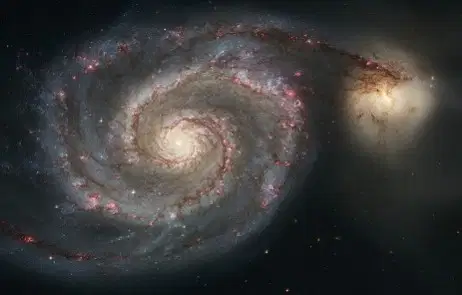
Identify the type of galaxy shown in the image.
(a)
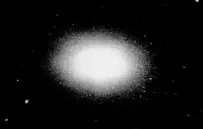
Identify the type of galaxy shown in the image.
(a)
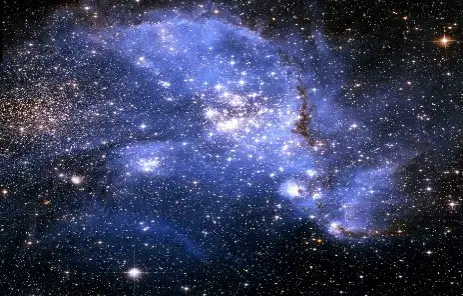
Identify the type of galaxy shown in the image.
(a)

