
 Worksheets
Cell Transport Review Practice
Total questions: 100
Worksheet time: 2hrs 17mins
Particle of movement from an area of lower concentration to an area of higher concentration.
Active transport
Passive transport
Particle of movement from an area of higher concentration to an area of lower concentration.
Active transport
Passive transport
Which type of transport uses energy in the form of ATP to transport substances?
Active transport
Passive transport
Which type of transport does not use energy to transport substances?
Active transport
Passive transport
Which type of passive transport uses transport proteins to transport items such as glucose through the membrane?
Facilitated diffusion
Osmosis
Diffusion
Which type of passive transport focuses on the movement of water through the membrane?
Facilitated diffusion
Osmosis
Diffusion

Which type of diffusion is represented?
Facilitated diffusion
Osmosis
Diffusion
Which type of solution has the same solute concentration inside of and outside of the cell?
Hypertonic
Hypotonic
Isotonic

The cell shrunk in size, which means it was placed in a ____ solution.
Isotonic
Hypertonic
Hypotonic

The cell expanded in size to the point of lysing (bursting), which means it was placed in a ____ solution.
Isotonic
Hypertonic
Hypotonic

The cell shows water moving in and out equally, which means it was placed in a ___ solution.
Isotonic
Hypertonic
Hypotonic
Which organelle controls what goes in and out of a cell?
Nucleus
Ribosomes
Cell Membrane
Golgi Body
Which word best describes the cell membrane?
Permeable
Semi-permeable
Non-permeable
Which type of transport does NOT require energy?
Passive Transport
Active Transport
What type of passive transport is the movement of small molecules from high to low concentration?
(a)
Which word is used to describe when the concentration or amount of substance is equal on both sides of the membrane?
Equity
Equality
Equilibrium
What type of passive transport is the diffusion of water through a membrane?
(a)
Which type of passive transport is when transport proteins are used?
Osmosis
Facilitated Diffusion
Endocytosis
Which type of transport uses energy to move a substance through the cell membrane?
Passive Transport
Active Transport
Which direction does active transport move substances?
Low to high concentration
High to low concentration
What type of active transport is when a cell takes in a substance by surrounding it with the cell membrane?
(a)
What type of active transport is when vesicles release their contents outside of the cell?
(a)

Which type of transport is the picture showing?
Endocytosis
Diffusion
Exocytosis
Facilitated Diffusion

Which type of transport is the picture showing?
Endocytosis
Diffusion
Exocytosis
Osmosis

Which type of transport is the picture showing?
Diffusion
Osmosis
Facilitated Diffusion

Which type of transport is the picture showing?
Endocytosis
Diffusion
Exocytosis
Facilitated Diffusion

A biologist observed a plant cell in a drop of water as shown in diagram A. The biologist added a 10% salt solution to the slide and observed the cell as shown in diagram B.
The change in appearance of the cell resulted from
more salt moving out of the cell than into the cell
more salt moving into the cell than out of the cell
more water moving into the cell than out of the cell
more water moving out of the cell than into the cell

The accompanying diagram represents a cell in water. Formulas of molecules that can move freely across the cell membrane are shown. Some molecules are located inside the cell and others are in the water outside the cell.
Based on the distribution of these molecules, what would most likely happen after a period of time?
The concentration of O₂ will increase inside the cell.
The concentration of O₂ will remain the same inside the cell.
The concentration of CO2 will remain the same inside the cell.
The concentration of CO2 will decrease outside the cell.
The energy an organism requires to transport materials and eliminate wastes is obtained directly from
starch
hormones
02
CO2

The accompanying diagram represents movement of a large molecule across a membrane.
Which process is best represented in this diagram?
active transport
diffusion
protein building
gene manipulation

An investigation was set up to study the movement of water through a membrane. The results are shown in the diagram below.
Based on these results, which statement correctly predicts what will happen to red blood cells when they are placed in a beaker containing a water solution in which the salt concentration is much higher than the salt concentration in the red blood cells?
The red blood cells will absorb water and increase in size.
The red blood cells will lose water and decrease in size.
The red blood cells will first absorb water, then lose water and maintain their normal size.
The red blood cells will first lose water, then absorb water, and finally double in size.

A red onion cell has undergone a change, as represented in the diagram below.
This change is most likely due to the cell being placed in
distilled water
salt water
light
darkness
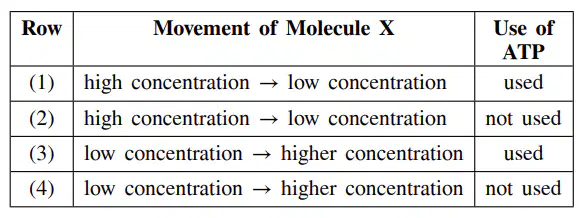
Molecule X moves across a cell membrane by diffusion. Which row in the chart below best indicates the relationship between the relative concentrations of molecule X and the use of ATP for diffusion?
Row (1)
Row (2)
Row (3)
Row (4)
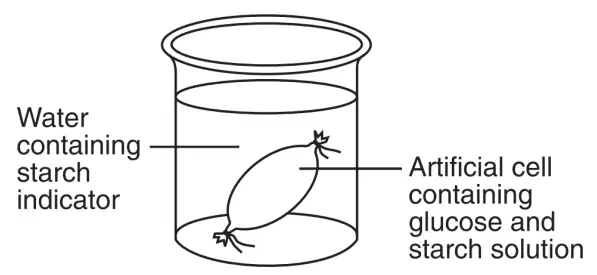
Base your answers to the following questions on the laboratory setup illustrated below and on your knowledge of biology.
This laboratory setup would most likely be used to demonstrate
carbohydrate synthesis
active transport
diffusion
dehydration

Base your answer to the following questions on the information below and on your knowledge of biology.
A student prepared four different red blood cell suspensions, as shown in the chart below.
Which suspension would contain red blood cells that would appear wrinkled and reduced in volume?
A
B
C
D
A substance is most likely to diffuse into a cell when
it is a large organic food molecule such as protein or starch
it is enclosed in an organelle such as a vacuole
the concentration of the substance is greater outside the cell than inside
the pH of the substance is greater than the pH of the cell
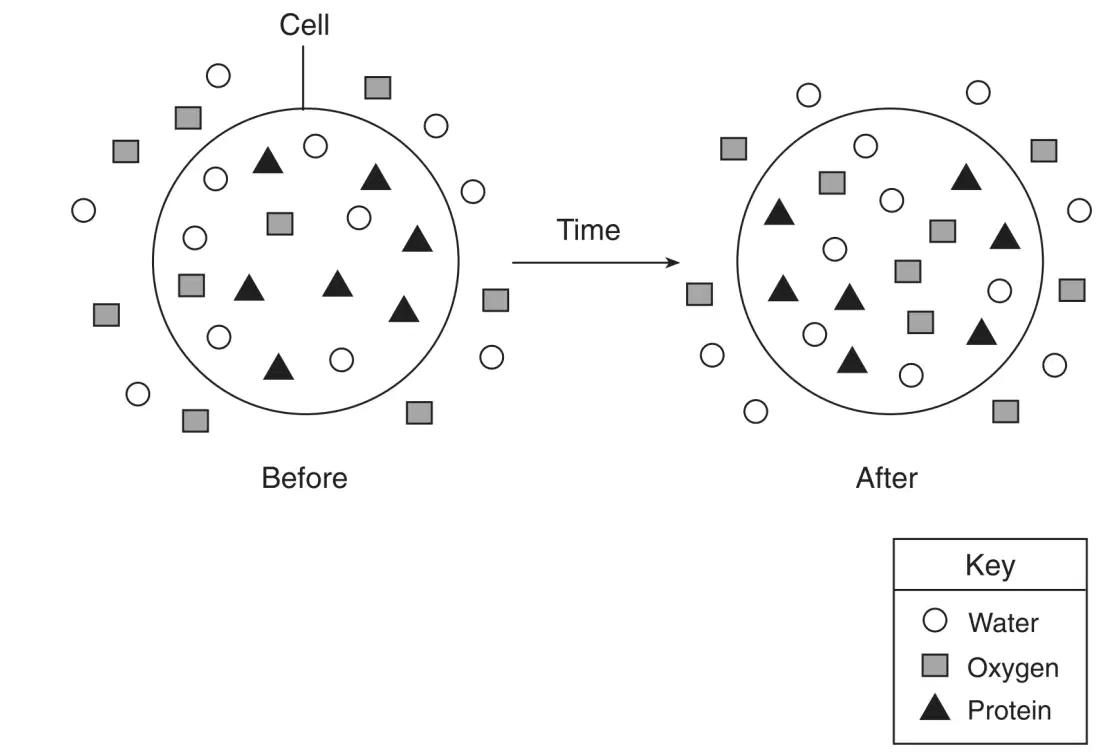
The diagram below represents the distribution of some molecules inside and outside.
Which factor prevented the protein molecules from moving out of the cell?
temperature
pH
molecule size
molecule concentration
Which substance can enter a cell by diffusion without having to be digested?
water
protein
starch
fat

Red onion cells undergo the change represented in the diagram below.
This change is most likely caused by the cell being transferred from...
distilled water to starch indicator
distilled water to salt water
salt water to tap water
salt water to distilled water
Students are observing particles moving against the concentration gradient in a lab investigation. Which type of transport are they observing?
osmosis
active Transport
facilitated diffusion
diffusion
What is the definition of OSMOSIS?
Diffusion of water through a selectively permeable membrane
Molecular structure that surrounds the cell and controls what enters and leaves the cell
Movement of molecules across the cell membrane against the concentration gradient
Movement of molecules across the cell membrane from an area of high concentration to low concentration
What is the definition of LIPID BILAYER?
Molecular structure that surrounds the cell and controls what enters and leaves the cell
Movement of molecules across the cell membrane against the concentration gradient
Diffusion of water through a selectively permeable membrane
Movement of molecules across the cell membrane from an area of high concentration to low concentration
What is the definition of ACTIVE TRANSPORT?
Movement of molecules across the cell membrane against the concentration gradient
Diffusion of water through a selectively permeable membrane
Molecular structure that surrounds the cell and controls what enters and leaves the cell
Movement of molecules across the cell membrane from an area of high concentration to low concentration

Identify the following structure
Phospholipid
Cell
Cell membrane
Protein

What is the name of 'A' found on the structure below
Lipid Bilayer (cell membrane)
Protein
Phosphate hydrophilic heads
Lipid hydrophobic tails

What is the name of 'B' found on the structure below
Protein
Lipic bilayer
Phosphate hydrophilic heads
Lipid hydrophobic heads

What is the name of 'C' found on the structure below
Phosphate hydrophilic heads
Lipid hydrophobic tails
Lipid bilayer
protein

What is the name of 'D' found on the structure below
Lipid hydrophobic tails
Protein
Lipid bi layer
Phosphate hydrophilic heads
Which answer correctly describes the lipid bilayer?
lipids are hydrophobic; phosphates are hydrophobic
lipids are hydrophilic; phosphates are hydrophilic
lipids are hydrophobic; phosphates are hydrophilic
lipids are hydrophilic; phosphates are hydrophobic
Why would the cell need energy to move molecules across the membrane?
the molecule is going against the concentration gradient
the molecule is to large to pass through the membrane
the lipid membrane requires energy anytime something is moving across the membrane
In passive diffusion, substances always move...
from an area of higher concentration to an area of lower concentration
from an area with more of the molecules to an area with fewer of the molecules
from an area of lower concentration to an area of higher concentration
from an area with fewer of the molecules to an area with more of the molecules
What is the definition of FACILITATED DIFFUSION?
Movement of molecules across the cell membrane from an area of high concentration to low concentration
Diffusion of water through a selectively permeable membrane
Movement of molecules across the cell membrane against the concentration gradient
Molecular structure that surrounds the cell and controls what enters and leaves the cell

The following cells have been placed in different solutions.
Make a prediction of what will happen.
(check all that are correct)
Isotonic-- the cell will maintain size
hypotonic-- the cell will increase in size
hypertonic-- the cell will decrease in size
In 2007, a young mom in Sacramento died after participating in a water-drinking contest. The goal was outlast others and not use the restroom while the participants continued to drink 8 oz of water every 15 minutes. She did win the contest, but complained as she got home about pain. Later that day, she died.
Explain using the following words, what could have taken place at the cellular level.
Osmosis
CellMembrane
WaterSolute
Hyptertonic
Hypotonic
Solvent
Equilibrium or Homeostasis
The diffusion of water molecules through a selectively permeable membrane is:
Homeostasis
Osmosis
Active Transport
Equilibrium
All matter is composed of very small particles called:
Molecules
Ions
Solutes
Isotopes
The movement of molecules from a place where there is a greater/higher concentration to an area where there is lesser/lower concentration is:
Homeostasis
Diffusion
Endocytosis
Active Transport
A selectively permeable membrane
allows all substances to enter and leave
prevents all substances from entering or leaving
allows certain size substances to enter and leave
allows only waste materials to leave
A solution in which the concentration of solutes is the same inside and outside of a cell is a _____________________ solution.
hypertonic
hypotonic
isotonic
homeotonic
If a red blood cell is placed in a solution that has a concentration gradient higher than the red blood cell, this type of solution is called:
Isotonic
Hypotonic
Hypertonic
Homeotonic
If a red blood cell is placed in a hypotonic solution, it will eventually
shrink up
swell and burst
no change will occur
swell and not burst
When substances move in and out of cells using only their own kinetic energy this is called:
Active Transport
Passive Transport
Activation Energy
Selective Transport
Osmosis is a type of
turgor pressure
homeostasis
active transport
facilitated diffusion
An example of diffusion is
water molecules moving into a plant cell after rain
red food coloring moving through water until the water is pink
water molecules leaving the cells of a freshwater fish, when placed in a saltwater tank
none of the above
Which way will water molecules move if a red blood cell is placed in distilled water?
Out of the red blood cell
Into the red blood cell
Water molecules will move in and out at the same rate
No water molecules will move
Because the human body is 60% water, an important process which helps humans and all living things maintain a “normal” internal cellular environment even when external surroundings are constantly changing is:
diffusion
osmosis
active transport
carrier transport
Molecular movement continues even when there is no overall change in concentration. This is referred to as:
active transport
passive transport
homeostasis
equilibrium
The difference in the concentration of a substance across a space is called:
kinetic energy gradient
solvent gradient
concentration gradient
dynamic equilibrium
Cell "eating" is referred to as which of the following?
phagocytosis
exocytosis
pinocytosis
passive transport
Cell "drinking" is referred to as which of the following?
phagocytosis
pinocytosis
exocytosis
passive transport
A cell that is 90% water and 10% solute is placed in a solution that is 90% water and 10% solute. Which of the following is correct?
it is hypertonic because water is exiting the cell.
it is isotonic because the concentration is the same inside and outside the cell.
it is hypotonic because water is entering the cell.
it is hypertonic because water is entering the cell.
A cell that is 80% water and 20% solute is placed in a solution that is 60% water and 40% solute. Which of the following is correct?
It is isotonic because the concentration is the same inside and outside the cell.
It is hypertonic because water is exiting the cell.
It is hypotonic because water is entering the cell.
It is hypertonic because water is entering the cell.
A cell that is 70% water and 30% solute is placed in a solution that is 75% water and 25% solute. Which of the following is correct?
It is isotonic because the concentration is the same inside and outside the cell.
It is hypertonic because water is exiting the cell.
It is hypotonic because water is entering the cell.
It is hypertonic because water is entering the cell.
What can happen to a cell in a hypotonic solution?
It can shrink and shrivel up.
It can swell and burst.
Nothing will happen.
All of these are correct.



