
 Worksheets
7th-Geology (All)
Total questions: 63
Worksheet time: 1hrs 3mins
A hot spot is a volcanically active area. A volcanic island can form over a hot spot. Which would you expect to find beneath the hot spot?
a rift zone
a mantle plume
a divergent boundary
a convergent boundary
Before lava reaches the surface, the molten material is called
rock.
liquid fire.
volcanic ash.
magma.

What is magma called when it reaches the surface of Earth?
Lava
viscosity
toxic gas


As magma rises towards the surface it collects in a 'pocket' called a _____ _____ .
magma chamber
side vent
main vent
lava chamber

Scientists think that convection currents that move the plates flow in Earth's
Continental crust
Oceanic crust
mantle
outer core
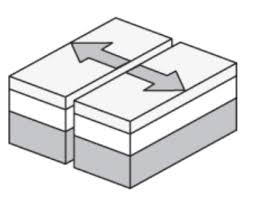

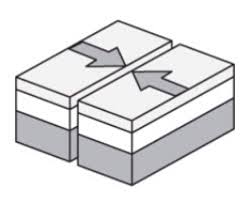

Which student correctly identified the geologic process that formed the Himalayan mountains?
1
2
3
4
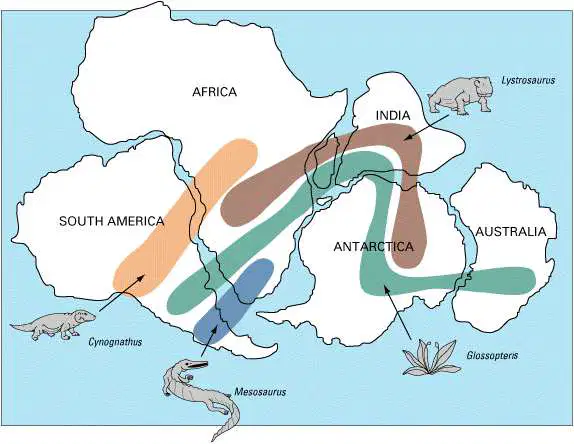
Two hundred and twenty-five million years ago, all of today's continents were part of a single continent known as Pangaea. The map below shows the positions of some of these continents. There is a significant amount of evidence that can be used to support the theory that Pangaea existed. Which of the following explains how the map shows evidence for the existence of Pangaea?
The continents' shapes do not fit together very well, but some continents have the
same fossils.
The continents' shapes do not fit together very well, and each continent has completely
different fossils.
The continents' shapes fit together well, and some continents have the same fossils.
The continents' shapes fit together well, but each continent has completely different
fossils.
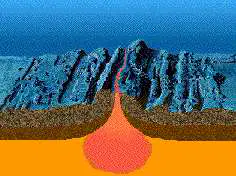
The diagram below shows some activity at a mid-ocean ridge.
Which of the following best describes the process shown in the diagram?
Solid rock liquefies as it reaches the surface and flows outward.
Tectonic plate motion forces magma downward.
Magma moves upward and crystallizes, forming new rock.
Tectonic plates move closer to each other, which forms magma.
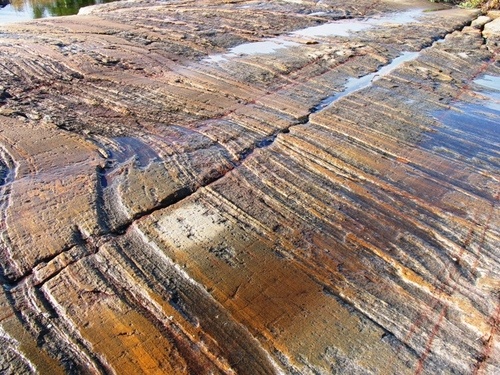

The Himalayas are an example of what happens at a?
convergent boundary
divergent boundary
transform boundary
allegiant boundary

This diagram shows a subduction zone. What type of plate boundary is shown in the image, and what type of landform is likely to occur here?
divergent boundary; a trench
convergent boundary; continental volcanic mountains
divergent boundary; island volcanic arc
convergent boundary; folded mountains

What two crustal features occur near every subduction zone?
Volcanoes and Trenches
Rift Valleys and Mid Ocean Ridges
Volcanoes and Rift Valleys
Mid Ocean Ridges and Trenches
A divergent boundary on land creates what feature?
Mid Ocean Ridge
Rift Valley
Subduction Zone
Deep Ocean Trench
A divergent boundary in the ocean creates what feature?
Mid Ocean Ridge
Rift Valley
Deep Ocean Trench
Subduction Zone

What is happening in the picture?
layers of the Earth are changing positions
the inner and outer core are solid
convection currents are causing the tectonic plates to move
the mantle is growing

Choose all the crustal features that apply at an oceanic-continental convergent boundary. (2)
Mid-ocean ridge
Trench
Volcanic mountains
rift valley


A mid-ocean ridge is located at the boundary of two oceanic plates. Which diagram correctly models the relative plate motion on each side of a mid-ocean ridge?


What kind of landform is created when a continent starts to get torn apart?
Volcanic Island
Deep Sea Trench
Mid-ocean Ridge
Rift Valley
Mountains

What geological feature would an oceanic-continental convergent boundary create?
volcanic mountains
mountains
volcanic islands


Tectonic Plate movement is caused by ______________.
the rotation of the Earth
ocean tides
convection currents in the mantle
the moon's gravity
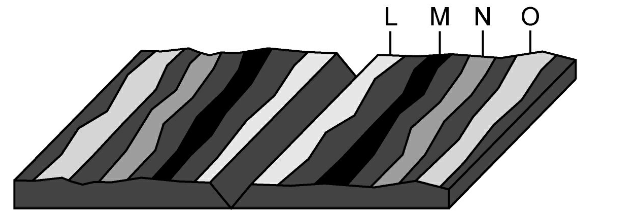

What geologic feature/event would most likely occur at a divergent boundary between two oceanic plates?
Rift Valley
Mid-Ocean Ridge
Island Arc
Flat Land

Divergent _________, transform __________ and convergent ____________.
Collide, slide, divide
Divide, collide, slide
Divide, slide, collide
Slide, collide, divide.

This is an image of .....
lithosphere
Pangaea
subduction zone
Wegener

What geologic feature is pictured and what type of boundary forms it?
Folded Mountains formed by a convergent boundary with continental to continental crustal interaction
Folded Mountains formed by a divergent boundary with oceanic to continental crusatal interaction
Volcanic Mountains formed by divergent boundary with continental to continental crustal interaction
Island Arc formation formed by a divergent boundary with an oceanic to oceanic crustal interaction

New oceanic crust (sea floor) is created at this boundary.
Divergent Oceanic
Divergent Continental
Convergent Oceanic
Transform

What moves outwards from the focus in all directions during an earthquake?
Lava flows
Seismic waves
Tsunami waves
Wind gusts
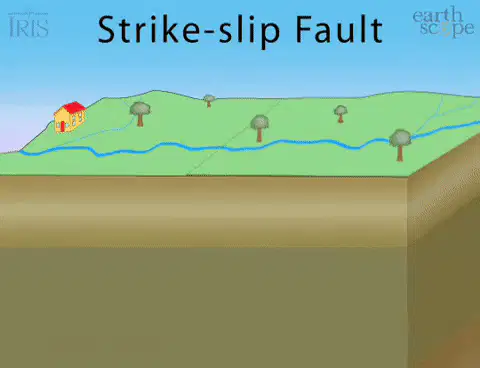
What type of stress is built up at a fault during convergence of tectonic plates?
Tensional stress
Shear stress
Compressional stress
Gravitational stress
Label the epicenter, focus and fault on the diagram
focus
fault
epicenter
Label the epicenter, focus and fault on the diagram
focus
fault
epicenter


The diagram shows rock that is being deformed by one type of stress. What type of stress is shown in the diagram?
faulting
tension
shear stress
compression
On which type of plate would you find thinner, denser rock?
oceanic plate
continental plate
lithosphere plate
rocks on all plates have the same thickness and density.

This diagram shows how a volcanic island arc forms. Which types of tectonic plates are found at an island arc? AND name the type of plate boundary shown.
oceanic plate and oceanic plate; convergent boundary
oceanic plate and oceanic plate; divergent boundary
oceanic plate and continental plate; convergent boundary
oceanic plate and continental plate; divergent boundary
Convection is:
the rising of warm and sinking of cool
the rising of cool and sinking of warm

At a divergent boundary, what crustal feature forms in the ocean?
Mountain
Volcano
Mid-ocean ridge
rift valley

What type of boundary is shown?
Divergent
Convergent
Transform

What type of boundary is shown?
Divergent
Convergent
Transform


The point where one plate slides beneath another is known as the ______________.
lithosphere
Pangaea
subduction zone
tectonic
Wegener

In what type of boundary is the only feature created going to be Mountains?
Oceanic to Oceanic Convergence
Oceanic to Continental Convergence
Rift Valleys
Continental to Continental Convergence

When one tectonic plate is pulled under another and into the mantle, it's called:
A Subduction Zone
A Transform Boundary
A Ridge
A Folded Mountain

When a divergent boundary occurs underneath the ocean, it's called a:
Rift Valley
Mid-Ocean Ridge
Subduction Zone
Fault Block Mountain

Which of these boundaries can form Volcanoes? (choose all that apply)
Oceanic to Oceanic Convergence
Oceanic to Continental Convergence
Continental to Continental Convergence
Transform Boundaries


What type of fault is this?
normal fault
reverse fault
strike-slip fault

What type of wall is 'A"?
Hanging wall
Foot wall
What type of wall is "B"?
Hanging wall
Foot wall

What type of fault is this?
Normal
Reverse
Strike-slip

What type of fault is this?
Normal
Reverse
Strike-slip

