wayground logo

Free Printable Worksheets

Font size

S
M
L
XL
Worksheets

Unit 2 Review

Total questions: 90

Worksheet time: 3hrs 35mins

Name
Class
Date
1.
Robert Hooke, Anton van Leeuwenhoek, Theodor Schwann, Rudolf Virchow, and Matthias Schliden were all responsible for what theory?
a)
The Theory of Gravity
b)
The Theory of Relativity
c)
The Cell Theory
d)
The Theory of Continental Drift
2.
What tool do you use to view the cells?
a)
metric ruler
b)
centrifuge
c)
microscope
d)
telescope
3.
All living things are made up of...
a)
cells
b)
cell tissues
c)
organ
d)
organ systems
4.
All cells come from___________ cells.
a)
pregnant
b)
pre-existing
c)
paternal
d)
pin size
5.
Rocks are not living because
a)
they never move
b)
they aren't needed for humans
c)
they are not made of cells
d)
they don't break down
6.
what is a cell classified as?
a)
a basic unit of structure and function of all living organisms
b)
a unit based on only plants and animals that are living
7.
Who looked at cork and named the cell?
a)
Robert Hooke
b)
Van Leeuwenhoek
c)
Robert Brown
d)
Francesco Redi
8.
Which scientist did NOT contribute to the cell theory?
a)
Anton Van Leeuwenhoek
b)

Robert Hooke
c)
Albert Einstein 
d)

Matthias Schleiden
9.
Cells are often called "the ____ of life."
a)
bread
b)
road map
c)
building blocks
d)
meaning
10.
A plant and an animal are both living things. According to the Cell Theory, what can you conclude about these two very different organisms?
a)
Plants have cells but animals do not.
b)
They are both made of one or more cells. 
c)
They both come from the same kind of cell.
d)
They both come from a non-living organism.
11.

  There are three parts to the cell theory. Which is NOT one of those parts?

a)

All organisms are composed of one or more cells.

b)

The cell is the basic unit of structure and organization in organisms.

c)

Cells spontaneously arise from carbon and nutrients carried in the bloodstream.

d)

All cells come from pre-existing cells.

12.
Which of the following scientists was the first to observe bacteria?
a)
Anton van Leuwenhoek
b)
Matthais Schleiden
c)
Robert Hooke
d)
Theodor Schwann
13.

A cell without a true nucleus

a)

Prokaryotic

b)

Eukaryotic

14.

A cell that has a true nucleus

a)

Prokaryotic

b)

Eukaryotic

15.
Which of the following is not a characteristic of a Prokaryotic cell?
a)
unicellular
b)
floating DNA
c)
very small
d)
complex
16.

Bacteria is an example of a(n)

a)

prokaryotic cell.

b)

eukaryotic cell.

17.
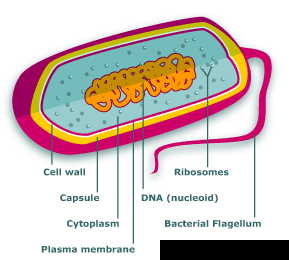
Which type of cell?
a)
Prokaryote
b)
Eukaryote
18.

Plants and animal cells are examples of ___ cells

a)

prokaryotic cells

b)

eukaryotic cells

c)

both eukaryotic and prokaryotic

d)

neither

19.
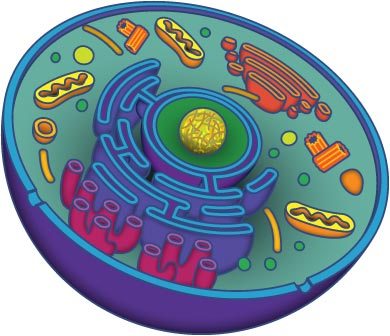
This is a picture of:
a)
Prokaryote
b)
Eukaryote
20.

Prokaryote or Eukaryote?

Unicellular or Multicellular?

Orange Tree

a)

Prokaryote

Unicellular

b)

Eukaryote

Unicellular

c)

Eukaryote

Multicellular

21.

Which organelle contains genetic material?

a)

Endoplasmic Reticulum

b)

Golgi Complex

c)

Nucleolus

d)

Nucleus

22.
What organelle is called the "powerhouse" of a cell?

a)
Endoplasmic Reticulum
b)
Nucleus
c)
Mitochondria
d)
Nucleolus
23.
What is the function of the vacuole?
a)
Sac that stores water, nutrients, and waste products
b)
Sac filled with digestive chemicals
c)
Jelly-like substance within the plasma membrane
d)
stack of membranes that packages chemicals
24.
What is the function of nucleus?
a)
Structure that organizes motion of chromosomes. 
b)
Structure that contains DNA and directs the cell 
c)
Membrane that surrounds and protects the cell 
d)
Stack of membranes that packages chemicals
25.
Where does photosynthesis occur?
a)
mitochondria
b)
stomata
c)
xylem
d)
chloroplast
26.
I make proteins for the cell. What am I?
a)
ribosome
b)
mitochondria
c)
chloroplast
d)
lysosome
27.
What can only be found in plant cells?
a)
Cell membrane
b)
Vacuole
c)
Chloroplast
d)
Mitochondrion
28.
The two kinds of cells are Prokaryotes and Eukaryotes. How are they different?
a)
Prokaryotes have a nucleus.
b)
Eukaryotes have a nucleus.
c)
Prokaryotes are plant cells.
d)
There is no difference.
29.
What cell part is NOT found in all cells?
a)
Cell Wall
b)
Cell Membrane
c)
Cytoplasm
d)
Genetic Material
30.
Complex cell. Can be plant or animal. Contains membrane bound organelles. 
a)
Eukaryotic Cell
b)
Prokaryotic Cell
c)
Bacteria
d)
Blood cell
31.
This organelle takes food and turns it into ENERGY for plant and animal cells.
a)
Chloroplast
b)
Mitochondria
c)
Lysosome
d)
Ribosome
32.
The site of photosynthesis
a)
ribosome
b)
mitochondria
c)
chloroplast
d)
nucleus
33.
Where are proteins made?
a)
Golgi body
b)
Mitoichondria
c)
Chromosomes
d)
Ribosomes
34.
A rigid layer that lies outside the cell's  membrane is...
a)
Cytoskeleton
b)
Cilia
c)
Cell Wall
d)
Flagella
35.
Only eukaryotic cells have....
a)
membrane-bound organelles 
b)
DNA
c)
ribosomes
d)
cell membranes 
36.
What is the fluid inside a cell called? 
a)
Endoplasimic Reticulum
b)
Orange Juice
c)
Water
d)
Cytoplasm
37.
Which of these is NOT a part of the Cell Theory?
a)
All cells are independent.
b)
Cells are the basic unit of living things. 
c)
All living things are one or more cells.
d)
Cells come from cells.
38.
This organelle eliminates waste. 
a)
Nucleus
b)
ER
c)
Vacuole
d)
Lysosome
39.
This is a double layer of phospholipids that creates a barrier between the cells internal and external environments; it controls what comes in or out of the cell (selective permeable)
a)
Nucleus
b)
Cilia
c)
Cell membrane
d)
Flagella
40.
You are made up of...
a)
eukaryotic cells
b)
prokaryotic cells
c)
plant cells
d)
bacterial cells
41.

Particle of movement from an area of lower concentration to an area of higher concentration.

a)

Active transport

b)

Passive transport

42.

Particle of movement from an area of higher concentration to an area of lower concentration.

a)

Active transport

b)

Passive transport

43.

Which type of transport uses energy in the form of ATP to transport substances?

a)

Active transport

b)

Passive transport

44.

Which type of transport does not use energy to transport substances?

a)

Active transport

b)

Passive transport

45.

Which type of passive transport uses transport proteins to transport items such as glucose through the membrane?

a)

Facilitated diffusion

b)

Osmosis

c)

Diffusion

46.

Which type of passive transport focuses on the movement of water through the membrane?

a)

Facilitated diffusion

b)

Osmosis

c)

Diffusion

47.

Which type of passive transport occurs when molecules move randomly from high to low concentration like color dye in a beaker?

a)

Facilitated diffusion

b)

Osmosis

c)

Diffusion

48.

Which type of diffusion is represented?

a)

Facilitated diffusion

b)

Osmosis

c)

Diffusion

49.

Which type of diffusion is represented?

a)

Facilitated diffusion

b)

Osmosis

c)

Diffusion

50.

Which type of diffusion is represented?

a)

Facilitated diffusion

b)

Osmosis

c)

Diffusion

51.

Which type of solution has a greater solute concentration INSIDE of the cell?

a)

Hypertonic

b)

Hypotonic

c)

Isotonic

52.

Which type of solution has a greater solute concentration OUTSIDE of the cell?

a)

Hypertonic

b)

Hypotonic

c)

Isotonic

53.

Which type of solution has the same solute concentration inside of and outside of the cell?

a)

Hypertonic

b)

Hypotonic

c)

Isotonic

54.

The cell shrunk in size, which means it was placed in a ____ solution.

a)

Isotonic

b)

Hypertonic

c)

Hypotonic

55.

The cell expanded in size to the point of lysing (bursting), which means it was placed in a ____ solution.

a)

Isotonic

b)

Hypertonic

c)

Hypotonic

56.

The cell shows water moving in and out equally, which means it was placed in a ___ solution.

a)

Isotonic

b)

Hypertonic

c)

Hypotonic

57.

Which type of active transport uses transport proteins to help pump molecules across the membrane?

a)

Membrane pumps

b)

Endocytosis

c)

Exocytosis

58.

Which type of active transport is displayed?

a)

Endocytosis

b)

Exocytosis

59.

Which type of active transport uses a vesicle to allow a large molecule to exit the cell?

a)

Endocytosis

b)

Exocytosis

60.

___ is reached when there are stable internal and external cell conditions.

a)

Energy

b)

Active transport

c)

Homeostasis

d)

Passive transport

61.

Which gas do plants give off after photosynthesis?

a)

Oxygen

b)

Carbon

c)

Nitrogen

d)

Hydrogen

62.
Plants need ________from the air for photosynthesis
a)
oxygen
b)
soil
c)
carbon dioxide
d)
sugar
63.
The products of photosynthesis are
a)
water and carbon dioxide
b)
oxygen and water
c)
sugar and cabon dioxide
d)
oxygen and sugar (glucose)
64.
The main source of energy for all life comes from ____.
a)
the Earth
b)
the moon
c)
the sun
d)
the food we eat/make
65.

In which organelle of the plant cells does photosynthesis occur?

a)

Nucleus

b)

Chloroplast

c)

Mitochondria

d)

Vacuole

66.

In which organelle does cellular respiration occur in animal and plant cells?

a)

Chloroplast

b)

Nucleus

c)

Mitochondria

d)

Vacuole

67.
What is the purpose of cellular respiration?
a)
to break down food
b)
to create energy in the body
c)
to release energy from food
d)
there is none; it's a waste of time
68.
What is the correct equation for cellular respiration?
a)
6O2 + C6H12O6 -> 6CO2 + 6H2O + Energy
b)
6O2 + C6H12O6 + Energy -> 6CO2 + 6H2O
c)
6CO2 + 6H2O -> 6O2 + C6H12O6 + Energy
d)
6CO2 + 6H2O + Energy -> 6O2 + C6H12O6
69.

you breathe in oxygen for

a)

photosynthesis

b)

fermentation

c)

mitosis

d)

cellular respiration

70.

Cellular respiration is different from fermentation in that respiration needs...

a)

oxygen

b)

carbon dioxide

71.
Cellular Respiration's goal is to
a)
make water
b)
make ATP
c)
make glucose
d)
make  oxygen
72.
Which of the following is the correct equation for PHOTOSYNTHESIS?
a)
CO+ light + H2O --> O+ Sugar
b)
CO+ sugar + H2O --> O+ light
c)
O2 + light + H2O --> CO+ Sugar
d)
CO+ O2 + H2O --> Light+ Sugar
73.
Cellular respiration occurs in both plants and animals.
a)
true
b)
false
74.

The powerhouse of the cell is the...

a)

Mitochondria

b)

Golgi Apparatus

c)

Nucleus

d)

Chloroplast

75.
Glucose is...
a)
A product of photosynthesis and cellular respiration
b)
A reactant of photosynthesis and cellular respiration
c)
A product of photosynthesis and a reactant of cellular respiration
d)
A reactant of photosynthesis and a product of cellular respiration
76.
ATP is...
a)
A form of energy the cell can use that is produced by cellular respiration
b)
A kind of sugar produced in photosynthesis
c)
A battery
77.
Products are...
a)
Substances present at the beginning of a chemical reaction
b)
substances present at the end of a chemical reaction
78.
Reactants are...
a)
Substances present at the beginning of a chemical reaction
b)
substances present at the end of a chemical reaction
79.

What is the process in which plants capture the energy in sunlight and use it to make food?

a)

cellular respiration

b)

carbon dioxide

c)

glucose

d)

photosynthesis

80.

What are the products of photosynthesis?

a)

water and carbon dioxide

b)

oxygen and glucose

c)

oxygen and carbon dioxide

d)

oxygen and water

81.

What are the reactants of photosynthesis?

a)

carbon dioxide and oxygen

b)

water and oxygen

c)

carbon dioxide and water

d)

oxygen and glucose

82.

Pigment in green plants that captures the energy in sunlight is called __________.

a)

pigment

b)

chlorophyll

c)

stomata

d)

green thing

83.

The main source of energy for all life comes from ________

a)

the Earth

b)

the Moon

c)

the Sun

d)

the food we eat/make

84.

The organic molecule that is the cell's primary form of energy?

a)

Glucose

b)

ATP

c)

ADP

d)

GMP

85.

Which organelle does cellular respiration happen in?

a)

Nucleus

b)

Mitochondria

c)

Chlorophyll

d)

Chloroplast

86.
Cellular respiration is...
a)
the process by which cells break down glucose into energy. 
b)
the process by which cells break light down into energy. 
c)
the process by which cells communicate with other cells. 
87.

True or False: Cellular Respiration is a chemical reaction.

a)

True

b)

False

88.

What are the reactants of cellular respiration?

a)

carbon dioxide and oxygen

b)

water and oxygen

c)

carbon dioxide and water

d)

oxygen and glucose

89.

What are the products of cellular respiration?

a)

water and carbon dioxide

b)

oxygen and glucose

c)

oxygen and carbon dioxide

d)

oxygen and water

90.

True or False?: The products of photosynthesis are the reactants for cellular respiration.

a)

True

b)

False