
 Worksheets
AP Macro Final exam Review
Total questions: 60
Worksheet time: 1hrs 15mins
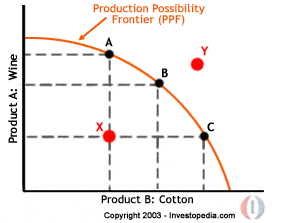

The opportunity cost of a good is
its price in dollars and cents.
the alternative goods forgone.
the price of alternative goods foregone.
none of the other options
Countries will export goods and services that they can produce at lower costs. This is called —
oligarchy
monopoly
comparative advantage
capitalism

The basis of trade based from the lowest opportunity cost is considered as ____.
Factor Endowment
Adam Smith Theory
Comparative Advantage
Absolute Advantage


What are factors (besides price) that determine demand
income, prices of related goods, demand curve
consumer taste, market size, decisions by businesses
demand curve, market size, income
market size, income, consumer taste/style
As income rises...
demand decreases
demand increases
demand is unchanged
demand fluctuates
Which of the following would cause the demand curve to
shift to the right?
a popular toys loses appeal
Suppliers expect higher prices in the future
price of a substitute good decreases
the average annual income increases
What might cause the supply curve to shift left?
price of a complementary good decreases
large number of producers enter the market
computer processing improves production
a new law is passed requiring all new motorcycles to have back-up cameras
Which of the following leads to an decrease in supply?
an increase in the cost of raw materials
diminishing marginal returns
a decrease in the cost of raw materials
a change in the law of supply
Which of these do the producers of an item hope to achieve when adopting new technology?
a shift of the supply curve for that item to the left
repeal of the subsidy for that item
inelasticity of supply of that item
a shift of the supply curve for that item to the right
GDP = C+I+G+(X-M)
GDP = C+I+G+(X-M)
GDP = C+I+G+(X-M)
GDP = C+I+G+(X-M)
Nominal GDP is not a good measure of economic output. Why?
Nominal GDP does not adjust for price changes over time.
Nominal GDP does not capture true economic activity.
Nominal GDP is not able to be used to make international comparisons.
Real GDP is obtained by
Nominal GDP minus GDP deflator.
Nominal GDP divided by GDP deflator multiplied by 100.
Nominal GDP multiplied by price level.
Nominal GDP divided by CPI.
GDP deflator
Evaluates inflation by utilizing present production basket
Shows real GDP growth on the basis of current production
The GDP deflator is in real terms while the CPI is in nominal terms
If operators are fired and replaced with computer technology, the operators would be considered
frictionally unemployed
structurally unemployed
cyclically unemployed
dissatisfiededly unemployed dissatisfiededly unemployed
Cyclical unemployment
Describes recent college graduates
Lasts longer than 6 months
Describes employees moving from one job to another
Increases inflation Increases inflation
If auto workers lose their jobs as the industry becomes far more technically intensive and capital intensive, what form of unemployment occurs?
Cyclical
Seasonal
Frictional
Structural
To measure the average price level of items that consumers actually buy, the Bureau of Labor and Statistics use the
Gross Domestic Product
Unemployment Rate
Consumer Price Index
National Production Rate
If the price of imported Canadian lumber increases
AS shifts left (decrease)
AS shifts right (increase)
AD shifts left (decrease)
AD shifts right (increase)
Shifters of aggregate demand include
Change in consumer spending
Change in investment spending
Change in government spending
Change in net exports
Assume that the economy is at long run equilibrium and that the government increases spending. In the short run, AD will increase. In the long run, what will happen?
AD will decrease
AS will decrease
AD will increase
AS will increase
Assume the economy is in long run equilibrium and trading partners increase the price of oil, a key resource
AD will shift right and an inflationary gap will result
AD will shift left and a recessionary gap will result
AS will shift right and an inflationary gap will result
AS will shift left and a recessionary gap will result
No change will result
Assume the economy is in long run equilibrium and the government increases spending on healthcare
AD will shift right and an inflationary gap will result
AD will shift left and a recessionary gap will result
AS will shift right and an inflationary gap will result
AS will shift left and a recessionary gap will result
No change will result
A decrease in interest rates resulting in the increase in capital stock will likely cause which of the following in the long-run?
Decrease in only aggregate demand
Increase in only aggregate demand
Increase in only aggregate supply
Increase in aggregate demand, aggregate supply, and long-run aggregate supply
__________ occurs in the economy when unemployment and inflation are both high.
Hyperinflation
Disinflation
Deflation
Stagflation


What are capital goods?
goods that are produced in the capital
the factories, machinery, and technology used to produce goods and services
goods that are produced without natural resources
goods that are produced by the government

Why should countries invest in developing capital goods?
they shouldn't, it is too expensive
because capital goods cannot be sold to other countries
when countries invest in capital goods, they are providing better facilities, resources, and/or materials for the people who perform the labor, which creates a more productive workforce leading to greater economic growth (higher GDP).
because capital goods are less expensive than private goods

What are the 4 factors that lead to a country’s economic growth?
investment in human capital, investment in physical capital, land (natural resources), entrepreneurship
good international relations, a democratic president, strict laws, freedom of press
a powerful military, strong dictatorial leadership, communist regime, little personal freedom
a monarchy, the World Bank, a parliamentary democracy, personal freedom
The long run Philips curve is also known as the
real output rate
natural rate of inflation
natural unemployment rate
real interest rate
Which of the following is LEAST likely to affect the long-run growth of an economy?
Investment in physical capital
Research and development
Education and training
A specific tax on luxury goods
Stable and efficient institutions
The annual difference between a country's exports and imports is called what?
Net Exports
High Exports
Low Exports

