
 Worksheets
Gr.10 Revision
Total questions: 100
Worksheet time: 2hrs 41mins


Bacteria are prokaryotes, meaning they ________.
lack a nucleus
are very large
contain no DNA
have a cytoplasm


A substance that is used to PREVENT viral diseases is called?
Vaccine
Antibiotics
Hydrogen Peroxide

A substance that blocks the production of bacteria or treats bacterial infections is called?
Asprin
Antibiotic
Band-Aid

Bacterial moves around with this
Flagellum
Pili
Capsid
DNA
Archaea have genes that are more similar to
Eukaryotes than to those of bacteria
Prokaryotes
bacteria
human genes
Some bacteria have a small circular strand of DNA separate from their main chromosome called a (a)
What is the purpose of a bacterium's flagellum?
to help it move
to swish in the wind
to look pretty
to make the bacterium camouflage
What is the protective protein coat of a virus?
Both Eukaryotes and Prokaryotes contain DNA.
True
False
True/False: Antibiotics are used to treat prokaryotic (bacterial) infections, NOT viral infections.
True
False
Choose the description that fits the lysogenic cycle.
the virus remains dormant (inactive) for a long time
symptoms occur quickly (within 2 days)
the virus does not need a host cell
the virus only infects bacteria

What type of bacteria is pictured?
spirillium
coccus
bacillus
What is the job of the cell wall in bacteria?
To provide protection
To make protiens
To hold organelles in place
To hold water and nutrients
Bacteria can become resistant to antibiotics
True
False
single celled organism that lacks a nucleus
bacteria
cell wall
flagellum
endospore
a structure produced by prokaryotes, such as bacteria, in unfavorable conditions; a thick wall encloses the DNA and some of the cytoplasm.
bacteria
cell wall
endospore
microscope

What image does this represent?
influenza
e. coli
bacteriophage
tuberculosis
Bacteria are decomposers that cause decay.
Decomposers are organisms that...
break down alive organisms and return them to the soil
break down dead organisms and return them to the soil
break down dead organisms and return them to the the sun
none of the above
The use of what modern technology has cause the rise in resistant bacteria
vaccines
antibiotics
fertilizers
solar panels

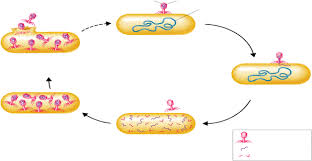
Which viral life cycle kills its host cell by lysing (bursting)?
Lysogenic Cycle
Lytic Cycle
Binary Fission
Conjugation
T/F The influenza virus (flu) is an example of a virus that goes through the lytic cycle.
True
False
Antibiotics work to cure viruses?
True
False
what do viruses infect?
a specific type of host cell
any plant cell
any animal cell
only eukaryotes
How do viruses replicate?
by using a host cell
by replicating with another virus
by using the mitochondria of a host cell
inside the cell wall of the host cell
Which cell type's structure contains the a protein coat, genetic information, an envelope, a tail(sheath), and tail fibers.
virus
fungi
bacteria
animal
What is in a vaccine?
Antibodies
Jeff Bezos and the Illuminati's Microchips
Deactivated Viruses
Living Viruses
Which is the most similar to Eukaryotes?
Viruses
Antibodies
Bacteria
Archaea
Which of these involves direct transfer of a plasmid from cell to cell?
Conjugation
Transduction
Binary fission
Transformation
The viral infection cycle that will most rapidly cause cell destruction is called the _______ cycle.
lysogenic
lysozyme
lytic
lysol
Prokaryotic cells reproduce
Sexually
Asexually

What is the name of feature #2?
Cell wall
Pilli
Flagella
DNA
This classification of organisms was not found until 1970 and are extremists that can live in places like deep sea vents and geysers.
Protista
Bacteria
Archaea
Fungi
A process by which prokaryotes reproduce asexually
binary fission
cellular respiration
pasteurization
decomposers
Bacteria reproduce by-
binary fission
conjugation
All the above

Which part of the bacteria adheres to surfaces?
pili
nucleoid region
capsule
ribosome
What is the fundamental difference between the lytic and lysogenic cycle?
one explains how bacteria reproduce and the other viruses
how the virus attaches to the host
the method of viral replication (one kills the cell and the other lays dormant in the host's DNA)
location of the genome
what material are found in most bacterial cell wall?
cellulose
chitin
peptidoglycan
amylose
Peptidoglycan is a unique macromolecule found in bacterial _____________.
cell walls.
capsules.
cell membranes.
slime layers.
Archaea
cannot cause disease in humans.
are most genetically related to bacteria.
contain a nucleus.
lack peptidoglycan in their cell wall.
Obtain/Construct their energy source through chemical reactions
Chemoautotrophs
Photoautotrophs
Heterotrophs
Chemoheterotrophs

What part of the virus is the DNA?
Which cycle kills the host cell immediately?
Lytic
Lysogenic
A virus that hides within the host cell for up to years is going through the _______ cycle.
Lytic
Lysogenic
Antibiotics ________ treat viral infections.
can
cannot
Pilus
Where DNA is housed
Helps hold organelles in place
Attaches bacteria to a surface
Protects cell from its surroundings
What are prions?
Mobile segments of DNA
Viruses that invade bactera
Misfolded versions of normal brain protein
Tiny molecules of RNA that infect plants
What is the function of reverse transcriptase in retroviruses?
To degrade host DNA to prevent integration.
To replicate viral DNA into RNA for protein synthesis.
To convert viral RNA into DNA for integration into the host genome.
To enhance the immune response of the host.
Bacteria can obtain their nutrition by
photosynthesis.
chemosynthesis.
heterotrophy.
all of the above
Which of the following makes archaebacteria different from other monerans?
absence of peptidoglycan
two chromosomes
existence of organelles
aerobic
I am single celled. I am prokaryotic. I have a cell wall that's not made of peptidoglycan. I also live in very extreme conditions. Which domain do I belong in?
Bacteria
Archea
Eukarya
I have a cell wall that's made of peptidoglycan. I live in most conditions. I am also a single celled prokaryote. Which Domain do I belong to?
Domain Archaea. Only archaea live in most places like the mouth and skin of humans.
Domain bacteria. Only bacteria have cell wall made of peptidoglycan
Domain Eukarya. Only Eukarya are prokaryotes with cell walls.
Where do anaerobic bacteria live?
Where there is a lot of oxygen
Where there is no oxygen
Where there is a lot of carbon dioxide
Where there is no carbon dioxide
How do heterotrophs get their energy?
By breaking down/eating other organisms
By breaking down chemicals such as methane
By doing photosynthesis
By creating energy via the power of meditation

What structure is labelled B?
Pili
Cell Wall
Plasma membrane
Capsule
What structure is labelled F?
Cytoplasm
Pili
Plasmid
Plasma membrane
What structure is labelled G?
Cytoplasm
Pili
Capsule
Flagellum
What is another name for natural selection?
survival of the biggest
survival of the fastest
survival of the smartest
survival of the fittest
What does "Survival Of the Fittest" mean?
The best adapted organisms
The biggest organisms
The fastest organisms
The smartest organisms
Selective Breeding is the same as Natural Selection.
False
True
have the ability to interbreed.
1. The process of choosing parent organisms for desired characteristics is called
natural selection
Artificial selection
random selection
genetic manipulation
Which statement is true comparing natural selection and artificial selection?
In natural selection, traits benefit humans and in artificial selection, the traits benefit the species
In natural selection, traits benefit the species and in artificial selection, the traits benefit humans
In natural and artificial selection, the process takes hundreds of years to occur
In natural and artificial selection, nature determines what traits will be passed down to offspring.
Said the the earth was millions of years old ( deep time ).
Hutton
Lyell
Lamark
Malthus
Wrote Principles of Geology
Hutton
Lyell
Lamark
Malthus
Stated that acquired trait can be passed on.
Hutton
Lyell
Lamark
Malthus
Populations can be controlled by war, famine, or disease.
Hutton
Lyell
Lamark
Malthus
The ability to survive and reproduce is called
evolution
adaption
trait
fitness
Members of the same species competing for food, mates, and resources
struggle for existence
struggle for extinction
struggle for cardio fitness
struggle for extermination
Although Darwin did not know about genes, he could see that animals of the same species who had slight variations that helped them to survive longer could produce more offspring than animals who were not as well equipped. Which of the following could be an example of a variation that would help a group of animals survive?
black bears in a region that was always covered with snow
turtles with long necks on an island where the food source was elevated
choosing a cat to take home from an animal shelter
planting a certain kind of flower to attract butterflies
A. The different species of giant tortoise were dispersed randomly on each island as a result of genetic drift.
B. The different species of giant tortoise were a product of Lamarkian evolution and developed adaptations as a result.
C. The different species of giant tortoise were descended from South American giant tortoises with developed adaptations.
D. The different species of giant tortoise were originally located on the mainland with specific physical traits for particular
habitats.
Which of the following is Thomas Malthus’ contribution to Charles Darwin’s theory of evolution?
The earth is of a very old age proven by the number of rock layers.
The earth’s geography has been shaped by slow processes
Organisms mutate new parts as they need them.
Populations tend to overpopulate and compete.

Wrote "Principles of Geology". Geologic events that occurred in the past will continue to occur in the future.
Malthus
Hutton
Lyell
Lamarck
Wallace

One of the first theories of evolution. Organisms can acquire traits over their lifetime.
Malthus
Hutton
Lyell
Lamarck
Wallace
Which scientist contributed ideas about carrying capacity and populations?
Malthus
Mendel
Robert Hooke
Schleiden
Which scientist coined the term Uniformitarianism (same process used over millions of years)?
Malthus
Hardy-Weinberg
Darwin
Lyell
Which of the following is Thomas Malthus’ contribution to Charles Darwin’s theory of evolution?
The earth is of a very old age proven by the number of rock layers.
The earth’s geography has been shaped by slow processes
Organisms mutate new parts as they need them.
Populations tend to overpopulate and compete.

