
 Worksheets
BL 150 Final Exam
Total questions: 145
Worksheet time: 1hrs 22mins
Which is an example of a nonpolar covalent bond?
The bond between two hydrogen atoms within one molecule of H2.
The bond formed when potassium (K) donates an electron to chlorine (Cl) to become charged K+ and Cl-
The bond formed between the oxygen and hydrogen of one water molecule (H2O).
The bond formed between complementary base pairs in DNA
Which is an example of an ionic bond?
The bond between two hydrogen atoms within one molecule of H2.
The bond formed when potassium (K) donates an electron to chlorine (Cl) to become charged K+ and Cl-
The bond formed between the oxygen and hydrogen of one water molecule (H2O).
The bond formed between complementary base pairs in DNA
Which is an example of a hydrogen bond?
The bond between two hydrogen atoms within one molecule of H2.
The bond formed when potassium (K) donates an electron to chlorine (Cl) to become charged K+ and Cl-
The bond formed between the oxygen and hydrogen of one water molecule (H2O).
The bond formed between complementary base pairs in DNA
Which is an example of a polar covalent bond?
The bond between two hydrogen atoms within one molecule of H2.
The bond formed when potassium (K) donates an electron to chlorine (Cl) to become charged K+ and Cl-
The bond formed between the oxygen and hydrogen of one water molecule (H2O).
The bond formed between complementary base pairs in DNA
Which of the following elements forms four covalent bonds and is an important building block for all organic molecules?
oxygen
nitrogen
sulfur
carbon
hydrogen
Sodium hydroxide is a strong base. When dissolved in water, it will produce:
an equal concentration of H+ and OH- ions
a higher concentration of H+ than OH- ions
a higher concentration of OH- than H+ ions
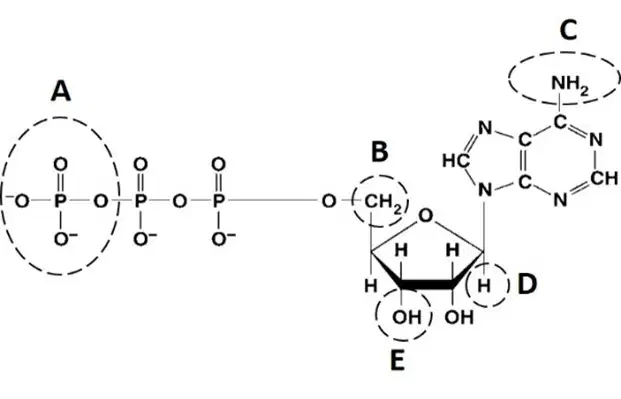
In the molecule shown, which letter indicates a hydroxyl group?
A
B
C
D
E
Water molecules are able to form hydrogen bonds because _____________.
oxygen has two electrons in its outer shell
the water molecule is shaped like a tetrahedron
the hydrogen and oxygen unequally share electrons within the water molecule
the hydrogen and oxygen atoms in water detach easily from each other
Which of the following statements concerning saturated fats are true? Choose all and only those that apply. Points awarded for correct choices. Points deducted for incorrect choices.
Saturated fats have multiple double bonds in the carbon chains of their fatty acids.
Saturated fats generally solidify at room temperature.
Saturated fats contain more hydrogen than unsaturated fats having the same number of carbon atoms.
Saturated fats are hydrophilic
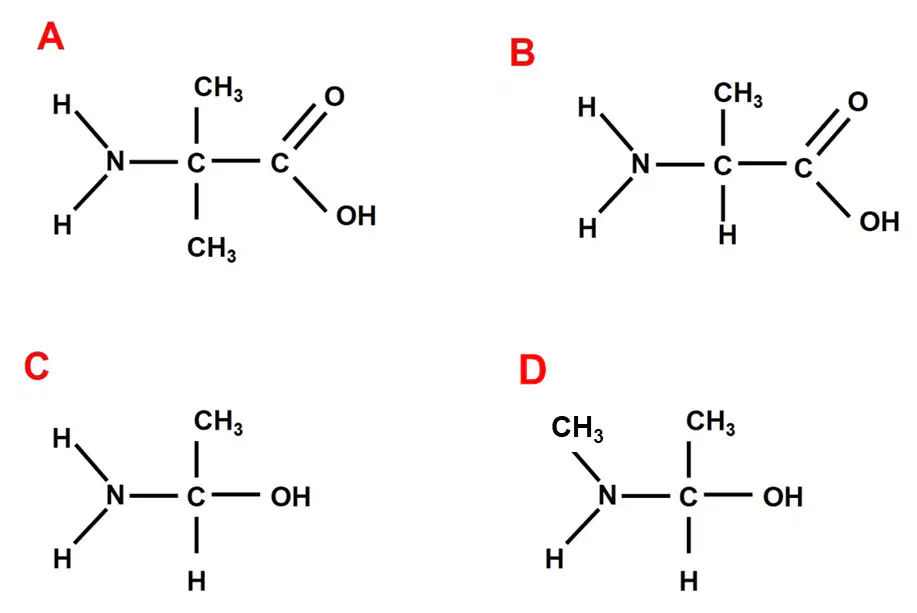
Which of the following is a correct structural representation for the amino acid alanine, which has a –CH3 group as its “R” group?
A
B
C
D
What is the function of nucleic acids?
Stores genetic information
Provides structure and catalyzes chemical reactions
Stores energy and, as steroid hormones, allows cells to communicate with each other
What is the function of proteins?
Stores genetic information
Provides structure and catalyzes chemical reactions
Stores energy and, as steroid hormones, allows cells to communicate with each other
What is the function of lipids?
Stores genetic information
Provides structure and catalyzes chemical reactions
Stores energy and, as steroid hormones, allows cells to communicate with each other
All of the following organic molecules are true polymers except ___________.
proteins
nucleic acids
lipids
carbohydrates
A newly discovered cell is found to have a cell membrane, DNA, and ribosomes. This new cell could be ______________.
prokaryotic cell only
eukaryotic cell only
either a prokaryotic or eukaryotic cell
T/F: Membrane phospholipids are entirely hydrophobic
True
False
A cell with 1% salt is placed in a beaker containing a 3% salt solution. The cell membrane is permeable to water but not to salt. The surrounding solution would be _______ compared to the inside of the cell.
hypotonic
hypertonic
isotonic
A cell with 1% salt is placed in a beaker containing a 3% salt solution. The cell membrane is permeable to water but not to salt. Water will move ________.
into the cell
out of the cell
T/F: Phospholipids do not readily interact with each other, and so it takes energy to assemble them into the bilayer structure of the plasma membrane.
True
False
During osmosis, water molecules ______________.
move from low to high concentration
move from high to low concentration
do not move
Membrane proteins ______________________________.
can be embedded in the cell membrane
can move molecules across the cell membrane
can be attached to the surface of the cell membrane
all of the above
The Na+-K+ pump ______________.
moves molecules down their concentration gradients
is a peripheral membrane protein
is an example of facilitated diffusion
moves Na+ ions out of the cell
occurs in the absence of ATP
Which of the following statements is true regarding cholesterol?
It has both polar and nonpolar regions.
It is a component of many animal cell membranes.
It keeps cell membranes fluid when temperatures decrease (i.e., get colder).
Tay-Sachs disease is a human genetic abnormality that results in cells accumulating and becoming clogged with very large and complex lipids, which would normally be enzymatically broken down in people without this disease. Which cellular organelle or structure must be defective in this condition?
Lysosome
Nucleolus
Golgi apparatus
Mitochondria
Rough ER
Proteins synthesized in the endoplasmic reticulum are not being properly modified, packaged, or transported to their correct destinations within the cell. Which cellular organelle or structure is most likely defective?
Lysosome
Nucleolus
Golgi apparatus
Mitochondria
Rough ER
Certain cells exhibit a significant reduction in protein synthesis and folding due to a lack of membrane-bound ribosomes. Which cellular organelle or structure is most likely defective?
Select one:
Lysosome
Nucleolus
Golgi apparatus
Mitochondria
Rough ER
Cells in an individual exhibit significantly reduced production of ribosomal RNA (rRNA), leading to impaired protein synthesis. Which cellular organelle or structure is most likely malfunctioning?
Lysosome
Nucleolus
Golgi apparatus
Mitochondria
Rough ER
An individual suffers from a metabolic disorder characterized by extremely low levels of ATP, leading to fatigue and muscle weakness. Which cellular organelle or structure is most likely malfunctioning?
Lysosome
Nucleolus
Golgi apparatus
Mitochondria
Rough ER

What does structure A indicate in the image?
(a)

What does structure B indicate in the image?
(a)
What does structure C indicate in the image?
(a)
What does structure D indicate in the image?
(a)
What is the most likely pathway that will be taken by a newly synthesized protein if that protein will eventually be secreted by a cell?
Rough ER→ mitochondria→Golgi apparatus→ plasma membrane
Rough ER→ Smooth ER->Golgi apparatus→ plasma membrane
Rough ER→smooth ER→Golgi apparatus→ nucleus
Golgi apparatus→ smooth ER→ lysosome
Which structures are part of the endomembrane system?
nuclear envelope
golgi apparatus
chloroplast
endoplasmic reticulum
lysosomes
What is the main function of the Golgi apparatus in the endomembrane system?
Synthesizing proteins
Breaking down cellular waste
Modifying, sorting, and packaging proteins and lipids
Synthesizing ATP for energy
Which structure within the endomembrane system is primarily responsible for detoxification and lipid synthesis?
Rough endoplasmic reticulum
Smooth endoplasmic reticulum
Nuclear envelope
Lysosomes
Cyanide binds with at least one molecule involved in producing ATP. If a cell is exposed to cyanide, most of the cyanide would be found within the __________________.
mitochondria
ribosomes
endoplasmic reticulum
lysosome
In a DNA double helix, the nucleotides of the same strand are joined by (a) bonds.
In a DNA double helix, nitrogenous bases on opposite strands of the DNA double helix are joined by __________ bonds.
phosphodiester
hydrogen
ionic
All of the following could be part of a DNA nucleotide except _____________.
phosphate group
nitrogenous base
deoxyribose
ribose
T/F: In eukaryotic cells, the process of transcription occurs in the nucleus
true
false
The central dogma of molecular biology describes the flow of genetic information in a cell. Which of the following represents the correct sequence of events in the central dogma?
RNA → DNA → Protein
DNA → RNA → Protein
Protein → RNA → DNA
DNA → Protein → RNA
The promoter of a gene ____________.
is located after the gene
indicates the location of introns within the gene
allows for termination of transcription
is where RNA polymerase binds to start transcription
Which of the following factors is required to initiate transcription in prokaryotes?
Transcriptional activator proteins
Mediator complex proteins
Sigma factor
All of the above
If RNA splicing does not occur on a primary transcript, then ____________.
the mRNA would not last long in the cell
the mRNA would produce a longer than normal protein
the mRNA would not be able to leave the ribosome
the primary transcript would not be produced
a ribosome would not be able to bind to the mRNA
This protein binds to a site in the DNA far from the promoter to stimulate transcription.
General Transcription factors
RNA polymerase
Transcriptional activator proteins
spliceosome
ribosome
This regulatory protein binds to the promoter region and can inhibit transcription by preventing RNA polymerase from binding
transcriptional repressor proteins
general transcription factors
Transcriptional activator proteins
spliceosome
ribosome
Which of the following is involved in the process of post-transcriptional regulation by modifying mRNA stability or translating efficiency?
RNA polymerase
Small interfering RNAs (siRNAs)
Ribosomal RNA (rRNA)
RNA helicase
Spliceosome
In eukaryotic cells, which modification is commonly made to mRNA to promote its stability and facilitate translation initiation?
Histone acetylation
Ribosome assembly
3' poly-A tail addition
5' cap addition
In eukaryotic cells, which modification is made to mRNA at the 5' end to protect it from degradation and assist in translation initiation?
Histone acetylation
Ribosome assembly
3' poly-A tail addition
5' cap addition
Which RNA molecule contains information that is translated into protein
mRNA
small nuclear RNA
microRNA (miRNA) and small-interfering RNA (siRNA)
Which RNA molecule is involved in RNA processing
mRNA
small nuclear RNA
microRNA (miRNA) and small-interfering RNA (siRNA)
Which RNA molecule can prevent translation of a protein
mRNA
small nuclear RNA
microRNA (miRNA) and small-interfering RNA (siRNA)

Shown are amino acids interacting to form α-helix or β-pleated sheet. This represents the ____ level of protein.
Primary
Secondary
Tertiary
Quaternary
When a protein is denatured __________.
its amino acid sequence is changed
it loses its shape
its activity/function increases
the protein is immediately degraded by the cell
Translation occurs in the cytoplasm of __________.
prokaryotes
eukaryotes
both prokaryotes and eukaryotes
neither prokaryotes nor eukaryotes
Which of the following is true of the tRNA's anticodon?
It is where an amino acid attaches to the tRNA.
Its sequence is antiparallel and complementary to an mRNA codon.
It is an unnecessary part of the tRNA that gets spliced out to produce a functional tRNA
It is found at the 3' end of the tRNA sequence.

Shown is a ribosome with mRNA. The 3 tRNA binding sites are numbered. Which number represents the site where a tRNA carrying the next amino acid will bind?
1
2
3
Shown is a ribosome with mRNA. The 3 tRNA binding sites are numbered. Where does the tRNA bind briefly before exiting the ribosome?
1
2
3
Place the following list of events in the correct order in which they occur during initiation of translation.
Initiation factors bind to mRNA → tRNA carrying methionine binds → Small ribosomal subunit binds → Large ribosomal subunit binds
Initiation factors bind to mRNA → Small ribosomal subunit binds → tRNA carrying methionine binds → Large ribosomal subunit binds
Small ribosomal subunit binds → Initiation factors bind to mRNA → tRNA carrying methionine binds → Large ribosomal subunit binds
tRNA carrying methionine binds → Small ribosomal subunit binds → Initiation factors bind to mRNA → Large ribosomal subunit binds
(a) refers to reactions which synthesizes (builds) complex molecules from simpler ones.
We are _______________ because we obtain both our energy and our carbon from chemical/organic compounds.
photoautotrophs
photoheterotrophs
chemoautotrophs
chemoheterotrophs
A chemical reaction that has a positive change in free energy (ΔG>0) is ____________.
exergonic
endergonic
spontaneous
not possible
Which of the following best illustrates the second law of thermodynamics in a biological system?
A plant converting sunlight into glucose during photosynthesis
A cell using energy to maintain its organized structure
A protein folding into its functional shape
Heat being released during cellular respiration
T/F: The effects of a competitive inhibitor on an enzyme can be reversed by increasing the amount of substrate present.
True
False
T/F: The effects of a noncompetitive inhibitor on an enzyme can be reversed by increasing the amount of substrate present.
True
False
When small molecules are put together to make macromolecules, ___________.
ATP is synthesized
ATP is broken down into ADP + Pi
In a metabolic pathway, which of the following occurs when the end product of the pathway accumulates?
The pathway speeds up to produce more product.
The end product activates the first enzyme in the pathway.
The end product binds to an allosteric site and inhibits the activity of an enzyme in the pathway.
The end product breaks down to reduce its concentration in the cell.
T/F: Each enzyme can bind to different substrates, catalyzing a variety of reactions.
True
False
Covalent bonds differ from ionic bonds in that _________.
Electrons are shared between atoms in covalent bonds but are transferred to one of the atoms in an ionic bond
Covalent bonds always involve atoms with identical electronegativities, while ionic bonds involve atoms with different electronegativities.
Covalent bonds occur within the same molecule while ionic bonds occur between different molecules.
None of the above
Would an element with three electron shells and containing a single electron in its outermost shell be more inclined to form a covalent or ionic bond?
Covalent
Ionic
Electronegativity is the tendency to attract (a) .
Attraction between adjacent molecules of water by virtue of hydrogen bonds is called (a) .
Which of the following is NOT one of the three basic tenets of the cell theory?
All organisms are made up of cells
All cells come from preexisting cells
All cells contain a nucleus
The cell is the fundamental unit of life
Which of the following is a key difference between passive and active transport?
Passive transport requires energy, while active transport does not.
Active transport moves molecules against their concentration gradient, while passive transport moves molecules down their concentration gradient.
Both passive and active transport require the use of transport proteins.
Passive transport involves the movement of molecules through the lipid bilayer, while active transport occurs only through the cell membrane.
Mitochondria are present in:
animal cells only
plant cells only
both animal and plant cells
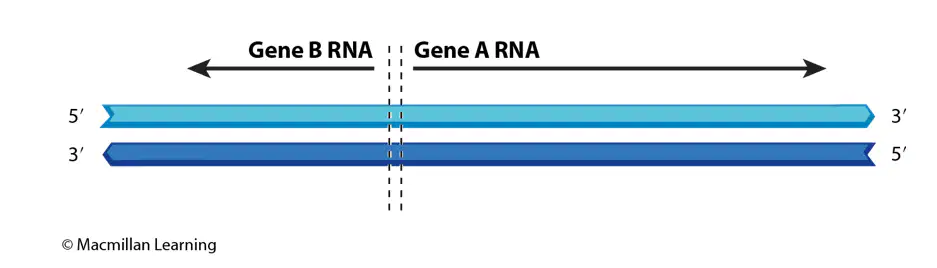
Genes can be coded on either strand of DNA. Consider the transcribed regions of two genes (Gene A and Gene B). The arrows represent the regions of the genes that are transcribed and the direction in which transcription occurs. For Gene A, which strand will be the template strand?
The top strand as shown in the diagram
The bottom strand as shown in the diagram
What would happen if an enhancer sequence were mutated so that its binding partner was always bound and recruiting the RNA polymerase complex?
transcription wouldn't change
no transcription would occur, as the site is now blocked to other proteins
transcription would occur continuously
no transcription would occur because the mediator complex could not form
T/F: a template strand of DNA and a newly transcribed RNA molecule are antiparallel
true
false
Which of the following are three key mechanisms of RNA processing in eukaryotes?
Addition of the 5′ cap
addition of the poly(A) tail
protein folding
RNA splicing
formation of ribosomes
What ultimately determines the three-dimensional shape of a protein?
The number of amino acids in the protein
The sequence of amino acids in the protein
The type of bonds between the amino acids
The presence of a functional group in the protein
If a mutation blocked the function of the signal recognition particle, making it unable to bind signal sequence, what would result?
All proteins would end up in the mitochondria or chloroplast.
All proteins would end up in the nucleus.
All proteins would be secreted from the cell.
All proteins would be translated on free ribosomes in the cytoplasm.
Which of the following is a way proteins can acquire new functions in the course of evolution?
The addition of lipid tails to proteins
Mutation and natural selection
Protein folding into a linear shape
The removal of amino acids at random
How can combining different folding domains result in a protein acquiring a new function?
Folding domains allow a protein to break down into smaller polypeptides.
New folding domains can provide additional functions to the protein.
Folding domains prevent proteins from mutating.
Combining domains removes the protein's ability to fold.
Of the following choices, which can be a product of a catabolic reaction?
A lipid like cholesterol
A nucleic acid like RNA
A motor protein like myosin
An amino acid like tryptophan
A complex carbohydrate like cellulose
Consider the following scenario: A biologist working in a lab adds a compound to a solution that contains an enzyme and its substrate. This compound binds to the enzyme and decreases the rate at which the enzyme converts substrate to product. However, this decrease can be overcome by increasing the concentration of substrate in the reaction mix.
The compound binds to the active site of the enzyme.
The compound is an allosteric inhibitor.
The compound is an allosteric activator.
The compound is a catalyst for the reaction.
Which of the following do enzymes change?
ΔG
reaction rate
types of product
activation energy
laws of thermodynamics
when a molecule is oxidized, it:
gains electrons
loses electrons
following the completion of the citric acid cycle, the energy that was originally stored in glucose is now contained in which of the following?
O2
Proton gradient
Acetyl coA
FADH2
Pyruvate
Without oxygen, which of the following could NOT occur?
Fermentation
Glycolysis
Electron transport chain
All of the above
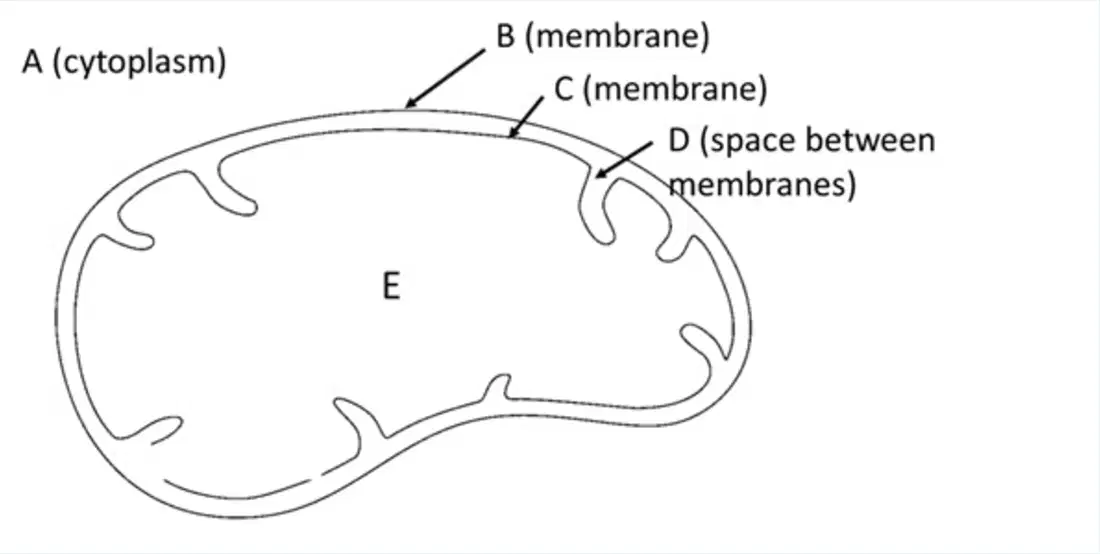
Where does the citric acid cycle occur?
A
B
C
D
E
Where does pyruvate oxidation occur?
A
B
C
D
E
Where does glycolysis occur?
A
B
C
D
E
Where is there a high concentration of H+? (Driving proton gradient and synthesis of ATP)
A
B
C
D
E
During the electron transport chain, energy is used to:
produce NADH and FADH2
move a hydrogen to NAD+
generate a H+ (proton) concentration gradient across a membrane
remove an electron from hydrogen
Which cellular respiration molecule has the most free energy?
Pyruvate
Glucose
CO2
Acetyl CoA
The movement (flow) of H+ (protons) through ATP synthase leads to
Co-transport ATP into the mitochondria
the production of ATP
hydrolysis of ATP into ADP + Pi
In order for cellular respiration to continue, the inputs for the reactions must be regenerated or recycled. Which of the following is TRUE for how those inputs are regenerated?
NAD+ is regenerated during glycolysis
FAD is regenerated by the electron transport chain
ADP is regenerated by cellular work (anabolic, uphill reactions)
Other than glucose, what molecules can be used as a source of carbon and energy in cellular respiration?
Fats
Proteins
Other sugars
All of the above
Low levels of ATP leads to (inactivation/activation) of the enzyme phosphofructokinase-1 (PFK-1) and an (increase/decrease) in glycolysis
inactivation, increase
inactivation, decrease
activation, increase
activation, decrease
what molecule is the terminal (last) electron acceptor in the electron transport chain?
(a)
ATP is produced during the
Calvin cycle
Citric acid cycle
CO2 is produced during the
Calvin cycle
Citric acid cycle
NADPH is required during the
Calvin cycle
Citric acid cycle
T/F: plants that need more ATP but not NADPH will predominantly use non-cyclic (linear) electron flow
True
False
Where are photosystems located in the chloroplast?
Thylakoid membrane
Stroma
Lumen (thylakoid inner space)
Where does a high concentration of H+ (protons) form?
Thylakoid membrane
Stroma
Lumen (thylakoid inner space)
Where does the calvin cycle take place?
Thylakoid membrane
Stroma
Lumen (thylakoid inner space)
As electrons move through non-cyclic (linear) electron flow ____________.
CO2 is fixed into a carbohydrate
NADPH is converted into NADP+
a H+ concentration gradient forms
The electrons gain energy
How do plants protect themselves against the damaging effects of reactive oxygen species (ROS)?
antioxidants
cyclic electron flow through photosystem I
Accessory pigments
All of the above
Put the following events in the correct order they occur in the G-protein coupled receptor pathway:
A- Adenylyl cyclase is activated
B- cAMP is produced
C- GPCR receptor binds to and activates a G protein
D- Signaling molecule binds to the GPCR receptor
(a)
phosphatases stop cell signaling by:
degrading receptors
removing phosphate groups from active kinases
adding phosphate groups to kinases
preventing signaling molecules from binding to their receptors
Which of the following is true regarding the activation of the MAPK pathway?
It involves kinases that are activated sequentially
It results in changes in gene espression
It is tightly regulated by GTP hydrolysis
All of the above
Which of the following events occur during receptor kinase signaling?
Receptors dimerize after signal molecules bind
Receptors become phosphorylated by using ATP
The signaling molecule binds to the receptor in the cytoplasm

Shown is an image of GPCR signaling pathway. Which letter indicates adenylyl cyclase?
A
B
C
D
E
Certain signaling molecules can influence the movement of ions into the cell directly by binding to and activating _________.
receptor tyrosine kinases
ion channel receptors
intracellular receptors
G-protein coupled receptors
Mutations in DNA that cause too much cell signaling and promotes uncontrolled cell growth causes normal cells to become (a) cells.
T/F: microtubules and microfilaments are static. That is, once they are formed, they remain unchanged
True
False
T/F: The basal lamina is a specialized layer of the ECM to which epithelial cells attach?
True
False
_______ are components of cilia and flagella of eukaryotic cells
intermediate filaments
microtubules
microfilaments
T/F: A reduced form of a molecule contains more chemical energy than an oxidized form?
True
False
In oxidation-reduction reactions (redox reactions), __________ are ______________during reduction.
neutrons; gained
electrons; lost
protons; gained
neutrons; lost
electrons; gained
What is a key difference between adherens junctions and desmosomes?
Adherens junctions attach cells to the extracellular matrix, while desmosomes attach cells to other cells.
Adherens junctions connect to actin microfilaments, while desmosomes connect to intermediate filaments.
Adherens junctions are made of integrins, while desmosomes are made of cadherins.
Adherens junctions are buttonlike attachments, while desmosomes form a belt around cells.
(a) is the enzyme that replicates DNA.
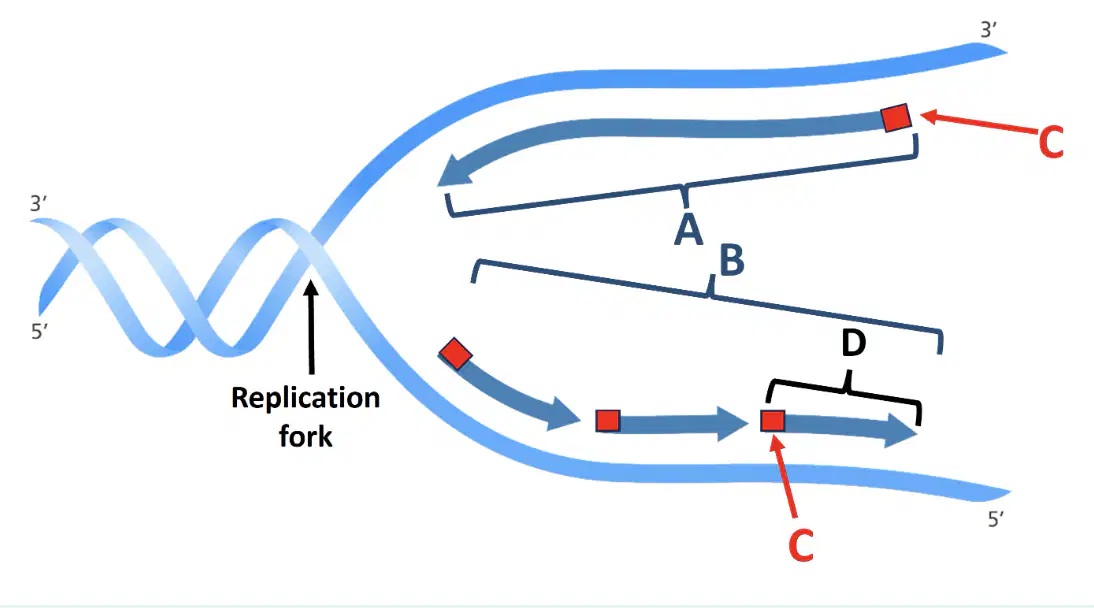
Which letter represents the okazaki fragment?
A
B
C
D
Which letter represents the lagging strand?
A
B
C
D
Which letter represents the leading strand?
A
B
C
D
Which letter represents the RNA primer?
A
B
C
D
Actin microfilaments are important for cell division. Which process in cell division would most be affected if actin microfilament function was inhibited?
Condensation of chromosomes
Lining up of chromosomes at the center of the cell
Formation of a contractile ring leading to two daughter cells
Separation of sister chromatids
Formation of the mitotic spindle
At which stage of mitosis is the nuclear envelope completely absent from the cell(s)? choose all that apply
Anaphase
Metaphase
Telophase
Prophase
Which of the following would promote progression through the cell cycle?
Increased expression of cyclins at different stages of the cell cycle
Binding of cyclins to CDKs
Phosphorylation of target proteins by CDKs
All of the above
Mutations in the p53 gene produce a nonfunctional p53 protein. This would ________.
stop the cell from progressing through the cell cycle
automatically cause the cell to undergo apoptosis
increase the risk of the cell becoming cancerous
make it easier for the cell to detect and repair DNA damage
Normal (non-cancerous) cells express _______.
proto-oncogenes
tumor supressor genes
oncogenes
the term (a) refers to the sum of all genetic information in the cell or organism
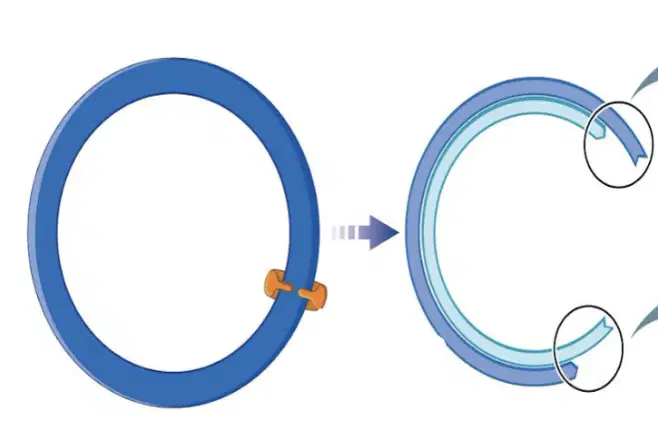
which enzyme was responsible for converting the circular DNA from the form on the left to the form on the right?
RNA polymerase
Restriction enzyme
DNA polymerase
DNA ligase
(a) is the enzyme that cuts the targeted DNA during DNA editing
T/F: individuals who are heterozygous for a gene have two different alleles for that gene
True
False
To repair a mismatched nucleotide in which order do the necessary enzymes act?
DNA polymerase, DNA polymerase, MutS, nuclease
MutS, DNA polymerase, ligase, nuclease
MutS, nuclease, DNA polymerase, DNA ligase
nuclease, DNA polymerase, MutS, DNA ligase
Which of the following is true for gene families?
Genes of the gene family have unrelated functions
Genes of the gene family arose from different genes that randomly evolved to become similar to each other
They arise from duplications that mutate and diverge from one another
(a) is a method in which individuals can be distinguished from each other by the unique number and pattern of tandem repeats that they each have. These results can be seen by gel electrophoresis.
What is the difference between gene expression and gene regulation?
Gene expression determines when, where, and how much a gene is transcribed, while gene regulation produces proteins from RNA.
Gene expression refers to the process of transcribing DNA into RNA and translating RNA into protein, while gene regulation controls when, where, and how much gene expression occurs.
Gene expression occurs only in RNA, while gene regulation occurs only in DNA.
Gene expression produces proteins, while gene regulation prevents DNA from being transcribed.
How are regulatory transcription factors different from general transcription factors?
Regulatory transcription factors are specific to one or a subset of protein-coding genes, while general transcription factors are the same for all protein-coding genes.
Regulatory transcription factors are involved in DNA replication, while general transcription factors regulate translation.
General transcription factors are specific to one gene, while regulatory transcription factors act on all genes.
General transcription factors bind to enhancers, while regulatory transcription factors bind to promoters.
How can one protein-coding gene code for more than one polypeptide chain?
By increasing the rate of transcription
Through alternative splicing and RNA editing
By duplicating the gene in the genome
Through random removal of nucleotides during translation
How does DNA methylation (addition of methyl groups to cytosine in CpG islands near promoter regions) affect gene expression?
It increases gene expression by making DNA more accessible to transcription factors.
It decreases gene expression by repressing transcription near promoter regions.
It has no effect on gene expression.
It increases gene expression by loosening the DNA from histone proteins.
Which of the following are ways gene expression can be influenced after mRNA is processed and leaves the nucleus?
Enhancing the DNA replication process and modifying histones.
Small regulatory RNAs, altering the 5′ cap, and deleting the poly(A) tail.
Increasing the number of ribosomes and modifying tRNA.
Splicing out introns and increasing transcription rates.

