
 Worksheets
Environmental Science 1st Semester Final
Total questions: 65
Worksheet time: 16hrs 15mins

What is the correct order (starting from the surface) of Earth’s layers?
crust, outer core, inner core, mantle
mantle, outer core, inner core, crust
crust, mantle, outer core, inner core
outer core, inner core, crust, mantle
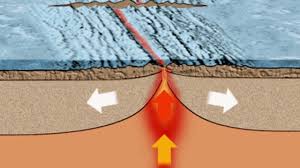
In sea-floor spreading, molten material rises from the mantle and erupts
along the edges of all the continents.
along mid-ocean ridges.
in deep-ocean trenches.
at the north and south poles.

The process by which the ocean floor sinks beneath a deep-ocean trench and back into the mantle is known as _______
convection.
continental drift.
subduction.
conduction.

Most geologists think that the movement of Earth’s plates is caused by _______
convection.
continental drift.
subduction.
conduction.
The geological theory of _______ states that pieces of Earth’s lithosphere are in constant, slow motion.
subduction
plate tectonics
deep-ocean trenches
sea-floor spreading
A place where two plates slip past each other, moving in opposite directions, is known as a _______
transform boundary
divergent boundary.
convergent boundary.
rift valley.
Scientists think that convection currents flow in Earth’s
continents.
mantle.
lithosphere.
inner core.

The place where two plates come together is known as a _______
transform boundary.
divergent boundary.
convergent boundary.
rift valley.

Below is a picture of sea-floor spreading. How are the ocean crusts moving?
Converging
Diverging
Sliding
No movement

This "sphere" has Earth's water
Geosphere
Hydrosphere
Atmosphere
Biosphere
This "sphere" has Earth's rocks
Geosphere
Hydrosphere
Atmosphere
Biosphere
This "sphere" has Earth's living things
Geosphere
Hydrosphere
Atmosphere
Biosphere
This "sphere" has Earth's air
Geosphere
Hydrosphere
Atmosphere
Biosphere
What is climate?
the condition of the atmosphere at any given time and place
cloud cover and temperature
precipitation and humidity at a given time and place
weather conditions in an area over a long period of time
The Earth's crust is broken into pieces called
glass
rocks
plates
lava
Melted rock inside the Earth is called
magma.
water.
fire.
surface.
When magma flows out of the volcano it is called
air
water
egg shells
lava
Drag the labels to the correct the locations on the diagram.
convergent boundary
Mid-ocean Ridge
slab pull
trench
divergent boundary
Label each plate boundary.
Latitude lines measure
distance north and south of the equator
distance east and west of the equator

Which feature of the grid system is identified on the map in RED?
The equator
The prime meridian
The southern hemisphere
The eastern hemisphere

Which feature of the grid system is identified on the map in YELLOW?
The equator
The prime meridian
The southern hemisphere
The eastern hemisphere

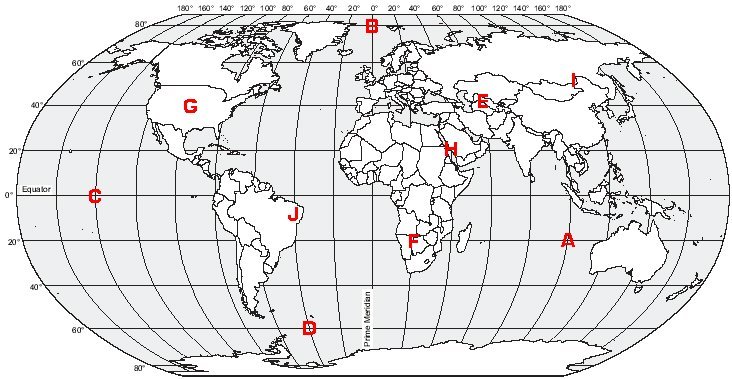

The lines in this diagram are:
Latitude Lines
Longitude Lines
Parallels
Meridians

What is the contour interval of this map?
10
20
30
40

Match the topographic map to its profile.


Hotter, less dense magma near the core...
rises.
sinks.
The plates of the crust move because...
volcanoes erupt violently.
of the weight of the oceans.
of convection currents in the mantle.
of the moon's gravity.

Which layer of the Earth is the LEAST DENSE?
crust
mantle
outer core
inner core
Alfred Wegener thought which 2 continents looked like puzzle pieces that could fit together?
Antarctica and Asia
South America and Africa
South America and Australia
Africa and Pangaea
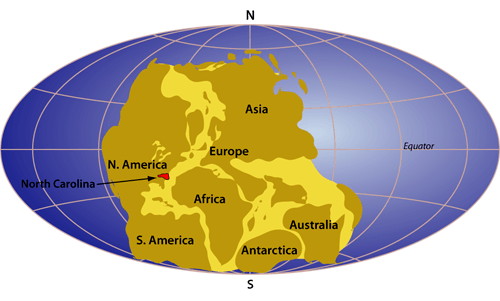
What is this a picture of?
Eurasia
Laurasia
Pangaea
Cornucopia
Hotspot: Identify and correctly label the layers of the Earth by dragging and dropping the labels to the correct spot. Note: only 4 labels will be used.
Reorder the layers of the Earth from least dense to most dense, from left to right.
Crust
Mantle
Outer Core
Inner Core
If an object has a mass of 20 grams and a volume of 5 mL, what is its density (g/mL)?
If the mass of an object remains the same and the volume decreases, the density will (a) .
Who is the person credited with developing the theory of continental drift
Harry Hess
Alfred Wegener
Galileo Galilei
Isaac Newton

According to the continental drift hypothesis, the presence of similar fossils in South America and Africa supports which scientific idea?
Animals easily and frequently travel from Africa to South America.
Species of animals probably traveled between continents on natural rafts (such as trees destroyed in tsunamis).
Land bridges once existed that connected the continents.
South America and Africa were once connected together.
The two types of crust are the denser (a) crust and the least denser (b) crust.

What is the force that moves the continents?
Conduction
Convection
Radiation
Conveyor belts

Match the plate boundary to its diagram.

Divergent

Convergent

Transform
Imagine you're a scientist on a mission to Mars! 🚀 You've discovered a mysterious Martian rock. To impress your fellow astronauts, you decide to calculate its density. How would you do it?
D = Vm
D = m + V
D =mV
D = m−V
Which layer is the most dense layer of the earth?
mantle
crust
inner core
outer core
Match the following topographic map with its description.

Steep south side

Two peaks, with east side higher

Gentle slope on all sides

Round hill with two peaks
If 1° = 70 miles, how many miles north of the equator is 3°?
140 miles North
350 miles North
210 miles North

