wayground logo

Free Printable Worksheets

Font size

S
M
L
XL
Worksheets

Fall Midterm Review 24-25

Total questions: 165

Worksheet time: 5hrs 30mins

Name
Class
Date
1.

A phospholipid has two parts. What are they called?

a)

Hydrophilic Head, Hydrophobic Tail

b)

Hydrophobic Head, Hydrophilic Tail

2.
"Water Fearing" 
a)
Hydrophobic
b)
Hydrophilic 
c)
Hydroelectric 
d)
Hydroloric
3.
___________ form the two layers of the cell membrane. 
a)
Carbohydrates 
b)
Proteins 
c)
Phospholipids 
d)
Cholesterol
4.

Which of the following is a function of the cell membrane?

a)

breaks down lipids, carbohydrates, and proteins from foods

b)

stores water, salt, proteins, and carbohydrates

c)

synthesizes proteins and other macromolecules

d)

regulates the movement of materials into and out of the cell

5.

Which term describes the relatively constant internal physical conditions of an organism?

a)

cell specialization

b)

homeostasis

c)

permeability

d)

unicellularity

6.

Which of the following are embedded in the phospholipid bilayer and help substances pass through?

a)

lipids

b)

proteins

c)

cholesterol

d)

carbohydrates

7.
The type of cellular transport that requires no energy.
a)
Active Transport
b)
Protein Pumps
c)
Passive Transport
d)
Endocytosis
8.
Most of the cell membrane is made of...
a)
Lipids
b)
Carbohydrates
c)
Proteins
d)
Nucleic acids
9.
Phospholipid heads are...
a)
Hydrophobic
b)
Hydrophilic
10.
The _____ in the plasma membrane prevents the fatty acids tails from sticking together. 
a)
carbohydrate chains
b)
cholesterol
c)
proteins
d)
lipids
11.
Hydrophilic portion of cell membrane?
a)
A
b)
C
c)
D
d)
12.

What is the function of the smooth endoplasmic reticulum?

a)

To store genetic material

b)

To make proteins

c)

To make lipids

d)

To get rid of waste

13.
A ribosome can be best described as...
a)
a protein factory
b)
a trash collector
c)
the powerhouse of the cell
d)
the brain of the cell
14.
Where can you find ribosomes? 
a)
only in prokaryotic cells
b)
only in plant cells
c)
only in eukaryotic cells
d)
in both prokaryotic and eukaryotic cells
15.
I am the "power house" of the cell. I make most of the energy!
a)
mitochondria
b)
vacuole
c)
lysosome
d)
nuceus
16.
I am found in plant cells. I am rigid, strong & stiff. I give support to the plant cell.  I give the cell it's box shape
a)
cell membrane
b)
cell wall
c)
chlorophyll
d)
mitochondria
17.
Contains chlorophyll and is where photosynthesis takes place. Found in plant cells only.
a)
mitochondria
b)
chloroplast
c)
vacuole
d)
cytoplasm
18.

PROKARYOTIC cells do NOT have

a)

membrane bound organelles

b)

cell membrane

c)

DNA

d)

ribosomes

19.

Which of the following structures is ALWAYS found in both eukaryotic and prokaryotic cells?

a)

nucleus

b)

mitochondria

c)

ribosomes

d)

cell wall

20.
What type of cell has a nucleus? 
a)
eukaryotic
b)
prokaryotic 
21.
This small structures break down materials in the cell.
a)
Cholorplasts
b)
Ribosomes
c)
Lysosomes
d)
Golgi Body
22.

G1, S, G2 are all part of what stage of the cell cycle?

a)

Cytokinesis

b)

Interphase

c)

Mitosis

d)

Telophase

23.

What phase of mitosis is shown in the image?

a)

Anaphase

b)

Telophase

c)

Prophase

d)

Metaphase

24.

Which of the following is not a phase in mitosis?

a)

S phase

b)

Prophase

c)

Metaphase

d)

Anaphase

25.

Through a microscope, you observe chromatids aligning in the center of the cell. What phase of mitosis is this cell in?

a)

Telophase

b)

Anaphase

c)

Metaphase

d)

Prophase

26.

Which of the following does NOT occur during mitosis?

a)

Condensation of the chromosomes

b)

Separation of sister chromatids

c)

Replication of the DNA

d)

Spindle formation

27.

Cell A has half as much DNA as cells B, C, and D in a mitotically active tissue. Cell A is most likely in which phase of the cell cycle?

a)

G1

b)

S

c)

G2

d)

M

28.

Which of the following represents an incorrect description?

a)

Anaphase: movement of chromosome to opposite poles of cell

b)

Metaphase: the nuclear envelope disappears

c)

Prophase: chromosomes become more tightly coiled

d)

Metaphase: chromosomes line up on the equatorial plane of the cell

29.

In a human diploid (2n) cell containing 46 chromosomes, mitosis results in the formation of two diploid daughter cells containing ____ chromosomes.

a)

92

b)

23

c)

46

d)

0

30.

What phase of mitosis is shown in the image?

a)

Anaphase

b)

Prophase

c)

Metaphase

d)

Telophase

31.

The chromatids of a double-stranded chromosome are held together at a region known as the

a)

Spindle

b)

Endoplasmic Reticulum

c)

Centriole

d)

Centromere

32.

Which statement correctly describes mitotic cell division?

a)

Two identical daughter nuclei are formed.

b)

Two genetically different daughter nuclei are formed.

c)

Four haploid cells are formed.

d)

Four identical daughter nuclei are formed.

33.

Which phase of mitosis is shown in the image?

a)

Anaphase

b)

Metaphase

c)

Telophase

d)

Prophase

34.

Which of the following is an accurate definition of cytokinesis?

a)

Division of the centrioles

b)

Division of the cytoplasm

c)

DNA replication

d)

Normal cell growth

35.

The life of a cell is called the cell cycle. Which period of the cell cycle is where cells grow and perform their normal functions?

a)

Interphase

b)

Mitosis

c)

Cytokinesis

d)

Cell Division

36.

The two resulting cells of mitosis are ______

a)

different from the starting cell and identical to each other.

b)

different from the starting cell and different from each other.

c)

identical to the starting cell and different from each other.

d)

identical to the starting cell and identical to each other.

37.

What is the correct order of the cell cycle?

a)

m phase - interphase - cytokinesis

b)

interphase - m phase - cytokinesis

c)

cytokinesis - m phase - interphase

d)

interphase - cytokinesis - m phase

38.

What is the correct order of interphase?

a)

G1 - S - G2

b)

G1 - G2 - S

c)

S - G1 - G2

d)

G2 - G1 - S

39.

What is the correct order of mitosis?

a)

telophase - metaphase - prophase - anaphase

b)

prophase - anaphase - metaphase - telophase

c)

metaphase - anaphase - telophase - prophase

d)

prophase - metaphase - anaphase - telophase

40.

How many cells are produced at the end of mitosis?

a)

1

b)

2

c)

3

d)

4

41.

How many cells are produced at the end of meiosis?

a)

1

b)

2

c)

3

d)

4

42.

What types of cells go through mitosis?

a)

gametes

b)

somatic cells

c)

every cell in the body

43.

What types of cells go through meiosis?

a)

every cell in the body

b)

somatic cells

c)

gametes

44.

What is the product of mitosis?

a)

haploid cells

b)

diploid cells

45.

What is the product of meiosis?

a)

haploid cells

b)

diploid cells

46.

What type of cells have the same number of chromosomes at the end of cell division?

a)

haploid cells

b)

diploid cells

47.

What type of cell has half the number of chromosomes at the end of cell division?

a)

haploid cells

b)

diploid cells

48.

Which process produces genetically identical cells?

a)

mitosis

b)

meiosis

49.

Which process produces genetically different cells?

a)

mitosis

b)

meiosis

50.
a)

prophase

b)

metaphase

c)

anaphase

d)

telophase

51.

a)

prophase

b)

metaphse

c)

anaphase

d)

telophase

52.

a)

prophase

b)

metaphase

c)

anaphase

d)

telophase

53.

a)

prophase

b)

metaphase

c)

anaphase

d)

telophase

54.

When does crossing over occur?

a)

prophase of mitosis

b)

prophase 2 of meiosis

c)

prophase 1 of meiosis

d)

metaphase 1 of meiosis

55.

When does independent assortment occur?

a)

metaphase of mitosis

b)

metaphase 2 of meiosis

c)

metaphase 1 of meiosis

d)

prophase 1 of meiosis

56.

Cytokinesis is part of mitosis?

a)

True

b)

False

57.

The cell membrane is selectively permeable, which means

a)

All materials can enter and leave the cell.

b)

The cell manually sorts through all materials.

c)

Certain things can enter the cell while others cannot.

d)

Only certain cells can interact with the cell.

58.

Which type of cellular transport moves from low concentrations to high?

a)

Active Transport

b)

Osmosis

c)

Passive Transport

d)

Facilitated Diffusion

59.

Cell transport in which waste or hormones are released through the cell membrane using energy.

a)

Endocytosis

b)

Sodium Potassium Pump

c)

Passive Transport

d)

Exocytosis

60.

The sodium potassium pump moves sodium and potassium

a)

in the same direction from a low concentration to high.

b)

in opposite directions from an low concentration to high.

c)

together from a high concentration to low.

d)

outside the cell.

61.

Large molecules such as glucose move across the cell membrane through protein channels, without the use of energy, during

a)

active transport

b)

osmosis

c)

facilitated diffusion

d)

bulk transport

62.

Diffusion of water across a cell membrane.

a)

Osmosis

b)

Active Transport

c)

Protein Channel

d)

Pinocytosis

63.

Engulfing a large substance and moving it inside the cell using energy

a)

endocytosis

b)

photosynthesis

c)

exocytosis

d)

diffusion

64.

The movement of molecules from an area of high concentration to low concentration without using energy

a)

Facilitated Diffusion

b)

Active Transport

c)

Exocytosis

d)

Passive Transport

65.

The state of maintaining a relatively stable internal balance

a)

homeostasis

b)

hypertonic

c)

hypotonic

d)

semipermeable

66.

Diffusion is the movement of

a)

particles from low to high concentration

b)

particles from high to low concentration

c)

water from low to high concentrations

d)

water from high to low concentrations

67.
Trophic levels are represented by 
a)
squares
b)
circles
c)
pyramids
d)
lines
68.
In the energy pyramid here, how much of the energy in each level gets lost as heat or used by the organism for survival?
a)
80%
b)
90%
c)
10%
d)
20%
69.
The arrows in a food chain or web represents what?
a)
They point to the organism that is being eaten.
b)
It shows how sunlight flows within an ecosystem.
c)
They show what direction the energy is flowing between organisms. 
d)
They represent how water is transferred within a habitat.
70.
Organisms that create their own energy from sunlight or chemicals
a)
Herbivore
b)
Omnivore
c)
Autotroph
d)
Heterotroph 
71.
What does a food web represent?
a)
All connections of energy flow throughout all organisms in a habitat.
b)
The specific ways that mutualism is carried out.
c)
A single pathway or energy flow between organisms. 
d)
How carnivores get their food. 
72.
The image provided is an example of a(n):
a)
Producer
b)
Autotroph
c)
Consumer
d)
Insect
73.

Which of the following would be the definition of a scavenger/detritivore?

a)

Animals that eat insects.

b)

Organisms that feed on rocks, recycling the nutrients back into the ground.

c)

Organisms that eat only plants

d)

Things that feed on dead, rotting organisms (roadkill)

74.
Which of the following would provide the most energy in an ecosystem?
a)
Producers
b)
Herbivore
c)
Omnivore
d)
Carnivore
75.
A wolf eats a rabbit, that just ate some berries.  What would you call the rabbit?
a)
Producer
b)
Omnivore
c)
Primary Consumer
d)
2nd order Heterotrph
76.
During ____________, _____________ convert light energy into the chemical energy in sugar molecules. 
a)
chemosynthesis, consumers
b)
chemosynthesis, producers
c)
photosynthesis, producers
77.
What type of organisms are the first step in a food chain?
a)
Consumers
b)
Predators
c)
Producers
78.
How does an animal use the energy from the food consumes?
a)
To fuel its life processes such as respiration, digestion, and growth. And some energy is given off as heat.
b)
Only to move.
c)
To grow in weight. 
79.
Why can't the top level contain a large number of organisms?
a)
Because as energy moves from the bottom to the top level, less and less energy is available to higher levels.
b)
Because the original energy from producers is the total energy available to all the organisms in the energy pyramid.
c)
because only about ten percent of the energy available at one level is transferred to the next level.
d)
all of the above
80.
Where does the energy from an ecosystem come from?
a)
Trees
b)
Sun
c)
Plants
d)
Water
81.
Which habitat exhibits the greatest biodiversity?
a)
A habitat with 15 different species with about 300 individuals each
b)
A habitat with 10 different species with about 75 individuals each
c)
A habitat with 4 different species with about 150 individuals each
d)
A habitat with only one species with about 2000 individual
82.
Currently sharks are on a rapid decline due to overfishing. If sharks go extinct will this affect the biodiversity of the ocean?
a)
No, sharks are not important.
b)
No, sharks will only affect the seal populations.
c)
Yes, it will disrupt the entire food chain in the ocean.
d)
Yes, but only a little.
83.
Why is biodiversity so important?
a)
Because all species depend on each other to survive, so if one becomes extinct another species that relies on it could go extinct as well
b)
Because it’s better to have only one variation of each species.
c)
Because it better to only have a few species on Earth.
d)
Honestly, I have no idea what biodiversity is!
84.
Which of the following is not a reactant of photosynthesis?
a)
carbon dioxide
b)
oxygen
c)
water
d)
sunlight
85.
Which of the following is an energy storage molecule?
a)
ATP
b)
oxygen
c)
glucose
d)
carbon dioxide
86.
What kind of organism does photosynthesis?
a)
heterotroph
b)
autotroph
c)
autotrophs and heterotrophs
d)
fungi
87.
In which organelle does cellular respiration occur?
a)
mitochondria
b)
chloroplast
c)
ribosome
d)
nucleus
88.
What type of organism does cellular respiration?
a)
autotroph
b)
heterotroph
c)
autotrophs and heterotrophs
d)
detrivores
89.
Glucose goes into which of the following reactions?
a)
photosynthesis
b)
cellular respiration
90.
In which organelle does photosynthesis occur?
a)
mitochondria
b)
chloroplast
c)
ribosome
d)
lysosome
91.
The release of energy is the purpose of which reaction?
a)
photosynthesis
b)
cellular respiration
92.
Energy storage is the goal of which reaction?
a)
photosynthesis
b)
cellular respiration
93.
Which of the following is the source of almost all energy on earth?
a)
ATP
b)
glucose
c)
sunlight
d)
oxygen
94.
What is cellular respiration?
a)
transporting material
b)
talking with someone on a cell phone
c)
breaking food down to get the energy
d)
storing energy as a lipid
95.
What is a major source of energy for cellular respiration?
a)
DNA
b)
water
c)
the cell membrane
d)
glucose
96.
What are all the products of cellular respiration?
a)
carbon dioxide
b)
carbon dioxide and water
c)
carbon dioxide, water & energy
d)
carbon dioxide, water, energy & glucose
97.
Photosynthesis is a process that makes _________.
a)
energy from food
b)
space to live
c)
life easier
d)
energy from light
98.
Which of the following is the correct equation for PHOTOSYNTHESIS?
a)
6CO2 + 6H2O --> 6O+ C6H12O6
b)
6CO+ C6H12O6 + 6H2O --> O
c)
6O2 + 6H2O --> 6CO+ C6H12O6
d)
C6H12O6 + 6O2 ---> 6H2O + 6CO2 
99.
In which way are photosynthesis and cellular respiration different?
a)
Cellular respiration stores ATP, while photosynthesis releases ATP.
b)
Cellular respiration produces oxygen, while photosynthesis uses oxygen.
c)
Photosynthesis releases energy, while cellular respiration stores energy.
d)
Photosynthesis used carbon dioxide, while cellular respiration produces carbon dioxide.
100.
How can photosynthesis be related to cellular respiration?
a)
What's produced by one is needed for the other
b)
They both produce the same products
c)
They both have the same reactants (need the same things)
d)
These 2 processes have nothing in common
101.
Why is photosynthesis important?
a)
creates oxygen for animals to breath
b)
creates energy for heterotrophs to use
c)
creates food for plants to use
d)
all of these are correct
102.

Which type of organism would MOST likely benefit directly from increased levels of CO2?

a)

mushroom

b)

tree

c)

bird

d)

fish

103.

True or False:


Animal cells can perform photosynthesis.

a)

True

b)

False

104.
What are the products of photosynthesis?
a)
water and carbon dioxide
b)
oxygen and glucose
c)
oxygen and carbon dioxide
d)
oxygen and water
105.
What is the pigment in chloroplasts that performs photosynthesis?
a)
Chlorosynthesis
b)
Chlorophyll
c)
ADP
d)
Electron Transport
106.
What is the correct equation for cellular respiration?
a)
6O2 + C6H12O6 -> 6CO2 + 6H2O + Energy
b)
6O2 + C6H12O6 + Energy -> 6CO2 + 6H2O
c)
6CO2 + 6H2O -> 6O2 + C6H12O6 + Energy
d)
6CO2 + 6H2O + Energy -> 6O2 + C6H12O6
107.

A decrease in the amount of oxygen available will....

a)

not have an effect on the amount of energy produced during cellular respiration
b)

decrease the amount of glucose produced during cellular respiration

c)

cause the amount of water produced during cellular respiration to increase

d)

decrease the amount of energy produced during cellular respiration

108.
Where will the water go?
a)
Into the cell
b)
Out of the cell
c)
Equally in & out - it's isotonic
d)
There is no water
109.
Mr. Slug was salted. Where was there more solute immediately after salting?
a)
Outside of the slug
b)
Inside of the slug
c)
There was no solute anywhere
110.
A blood cell is placed into the jar, as seen. Where will the water go?
a)
Into the cell
b)
Out of the cell
c)
Equally in & out - it's isotonic
d)
The water is a lie
111.
Osmosis is the movement of _____ across a membrane.
a)
food
b)
energy
c)
oxygen
d)
water
112.
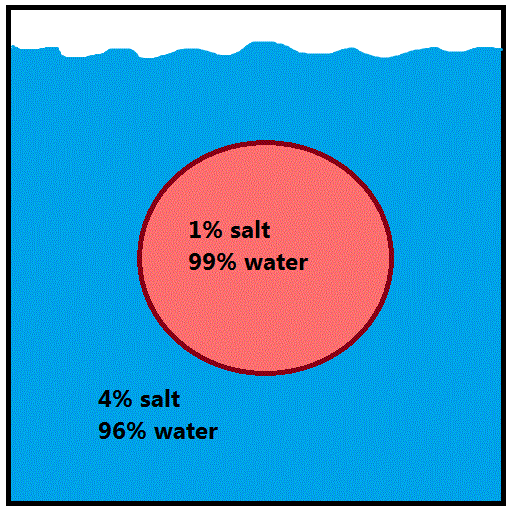
 If a cell containing 5% salt is placed into a glass of water with 20% salt, the water is _______ compared to the cell.
a)
hypertonic
b)
hypotonic
c)
isotonic
113.
 An animal cell placed in a hypertonic (salty) solution will
a)
Stay the same
b)
Shrink- get smaller
c)
Swell- get bigger
114.
During osmosis
a)
water moves from high to low concentration
b)
large or oddly shaped molecules move across a cell membrane
c)
water moves when energy is used
d)
proteins are built
115.
HYPO means...
a)
Low
b)
High
c)
Equal
d)
Fat
116.
ISO means...
a)
Low
b)
A lot
c)
Equal
d)
Mammal
117.
What happens if someone gives you a 90% salt saline drip?
a)
Your cells will shrivel and you'll die
b)
Your cells will swell and you'll die
c)
Nah you'll be fine.
118.
Why can't you drink salt water?
a)
It's hypertonic to your cells
b)
It's hypotonic to your cells
c)
It's isotonic to your cells
d)
It's paratonic to your cells
119.
Permeable means
a)
things can pass through
b)
the concentration levels are different
c)
it is permanent
d)
things are stuck
120.
_______ regulates what enters and leaves a cell.  
a)
Cell Membrane
b)
Nucleus
c)
Mitochondria
d)
Cytoplasm
121.
The cell below is in a _________ solution.
a)
Hypotonic
b)
Hypertonic
c)
Isotonic
122.
The cell below is in a _____________ solution.
a)
Hypertonic
b)
Hypotonic
c)
Isotonic
123.

The head of phospholipids are

a)

hypotonic

b)

hydrophbic

c)

hypertonic

d)

hydrophilic

124.

What is the plasma membrane made of?

a)

sugars

b)

phospholipids

c)

nucleic acids

d)

proteins

125.
A homozygous dominant dog with brown fur is crossed with a heterozygous dog with brown fur. What are the percentages of the possible genotypes?
a)
100% BB
b)
75% BB and 25%Bb
c)
50 % BB and 50% Bb
d)
50% Bb and 50% bb
126.
Genotype refers to the ...
a)
physical expression of the genes
b)
the possible combination of alleles in a gene
c)
whether an allele is dominant or recessive
d)
how an organism will appear
127.
An offspring will receive how many alleles from each parent to determine a specific trait?
a)
one
b)
two
c)
three
d)
five
128.
Which of the following is a phenotype?
a)
BB
b)
Bb
c)
bb
d)
Blue eyes
129.
having two of the same genes for the trait (sometimes called purebred).
a)
homozygous
b)
hetrozygous
c)
protein
d)
chromosome
130.
having two different genes for a trait (sometimes called hybrid).
a)
protein
b)
homozygous
c)
heterozygous
d)
genotype
131.
Magda is a tall, 11 year old drummer. She has a scar on her right cheek. She is good at swimming. Which of her traits did Magda most likely inherit?
a)
height
b)
the scar
c)
ability to swim
d)
ability to play drums
132.
Two brown eyed parents (Bb) have a baby. What is the chance the baby is blue eyed?
a)
0 %
b)
25%
c)
50%
d)
75%
133.
G = green, g = yellow
The genotype for a yellow plant is...
a)
GG
b)
Gg
c)
gg
d)
all of the choices result in yellow
134.
An allele whose trait only shows up when no dominant allele is present.
a)
hidden allele
b)
dominant allele
c)
recessive allele
d)
present allele
135.
Two heterozygous (Tt) tall pea plants are crossed. Which describes their offspring?
a)
50% tall and 50% short
b)
75%tall and 25% short
c)
100%short
136.
W=white hair
w= non-white hair
If you cross a horse with WW and a horse with ww what fraction of the offspring would be expected to have white hair?
a)
none
b)
3/4
c)
1/2
d)
all
137.

Punnett Square #1

In plants tall is dominant to short.

Cross two heterozygous plants.

What is the genotypic ratio?

a)

1:2:1

b)

2:2

c)

3:1

138.

Punnett Square #1

In plants tall is dominant to short.

Cross two heterozygous plants.

What is the phenotypic ratio?

a)

1:2:1

b)

2:2

c)

3:1

139.

Which of the choices is heterozygous?

a)

BB

b)

Bb

c)

bb

140.

Which of the choices is homozygous recessive?

a)

BB

b)

Bb

c)

bb

141.

Which of the choices is homozygous dominant?

a)

BB

b)

Bb

c)

bb

142.

Which of the choices are dominant? (there may be more than one)

a)

BB

b)

Bb

c)

bb

143.

Which of the choices is recessive?

a)

BB

b)

Bb

c)

bb

144.

The ratio of homozygous dominant to heterozygous

to homozygous recessive offspring

a)

Genotypic Ratio

b)

Phenotypic Ratio

c)

Monohybrid Cross

d)

Homologous Pair

145.
Aa, DD, bB, yy are all examples of
a)
genotypes
b)
phenotypes
146.
Which of the following genotypes is heterozygous?
a)
Bb
b)
BB
c)
bb
d)
B
147.
Which of the following genotypes is homozygous dominant?
a)
A
b)
Aa
c)
AA
d)
aa
148.
An organism’s genetic makeup, or allele combinations
a)
Recessive
b)
Genotype
c)
Phenotype
d)
Heterozygous
149.

A white mouse with red eyes is crossed with a black mouse with brown eyes. The white mouse is recessive for both of its traits. The black mouse is dominant for both of its traits.

This cross would be

a)

BBEE x bbee

b)

BBEe x BbEe

c)

BbEE x BbEe

d)

BBee x BBEE

150.
What goes in box 3
a)
Aabb
b)
AABB
c)
AAbb
d)
aaBb
151.

What goes in box 15

a)

aabb

b)

AABB

c)

aaBB

d)

AAbb

152.
Using the dihybrid cross and key provided, what is the probability of the offspring being tall and white?
a)
9
b)
2
c)
3
d)
6
153.
In a dihybrid cross
a)
one trait is crossed.
b)
two traits are crossed.
c)
four boxes are needed for the punnett square.
d)
mom's alleles are dominant.
154.

Based off this punnett square, what fraction of the offspring will have wrinkled, yellow seeds?

a)

9/16

b)

3/16

c)

1/16

d)

16/16

155.
Which of the following genotypes is heterozygous?
a)
Bb
b)
BB
c)
bb
d)
B
156.

A way to predict genetic probability using two different

sets of alleles on two different chromosomes.

a)

Co-Dominance

b)

Incomplete Dominance

c)

Monohybrid Cross

d)

Dihybrid Cross

157.
Using the dihybrid cross and key provided, what is the probability of the offspring being tall and white?
a)
9
b)
2
c)
3
d)
6
158.
In a dihybrid cross
a)
one trait is crossed.
b)
two traits are crossed.
c)
four boxes are needed for the punnett square.
d)
mom's alleles are dominant.
159.

AA and Aa always show up as

a)

dominant

b)

recessive

160.
What are the possible genotypes for this cross?
a)
TT = 25% Tt= 50% tt=25%
b)
all tall
c)
TT= 75% tt = 25%
d)
Tt = 100%
161.
This is an example of a ______________.
a)
phenotype
b)
genotype
c)
xenotype
d)
base pairs
162.
What goes in box 6
a)
AaBB
b)
AABB
c)
aaBB
d)
AAbb
163.
What is another way of saying "purebred"?
a)
homozygous
b)
dominant
c)
recessive
d)
heterozygous
164.

What is considered to be the phenotype?

a)

Double stranded chromosomes

b)

The physical trait that is expressed

c)

The combination of genes

d)

All of the genetic information

165.

Select the following options that represent a genotype.

a)

Rr

b)

Round peas

c)

Smooth peas

d)

rr