
 Worksheets
UNIT 5-7 QUIZIZZ
Total questions: 156
Worksheet time: 2hrs 38mins


Which best describes stars located in area A
Bright and Hot
Cooler and bright
Dim and hot
Dim and colder

Which description best describes area B
Brighter and Hotter
Brighter and Cooler
Dimmer and cooler
Dimmer and Hotter

Which best describes stars in area C
Brighter and Hotter
Brighter an Cooler
Dim and Hotter
Dim and Cooler

Which best describes area D?
Brighter and Cooler
Brighter and Hotter
Dimer and Cooler
Dimmer and Hotter

The Hertzsprung-Russell diagram graphs stars' luminosity and ....
color
size
temperature
distance
A giant structure that contains dust, gasses, and hundreds of billions of stars.
Our solar system
The universe
A nebula
A galaxy
Which of the following choices orders the components of the universe correctly from largest to smallest?
planet, star, solar system, galaxy, universe
galaxy, universe, solar system, star planet
universe, galaxy, solar system, planet, star
universe, galaxy, solar system, star, planet
How many stars are in our Solar System?
Hundreds
Billions
One
Eight
Galaxies are classified according to their ___________.
shape
size
color
distance from Earth
A star's temperature determines its ________.
size
color
name
health
What type of galaxy is the Milky Way?
Spiral
Elliptical
Irregular
Transition


All stars begin their life as a
Main Sequence
Nebula
Protostar
Black Dwarf

The stage after the main sequence star:
red giant
nebula
white dwarf
black dwarf
When nebula is big and hot enough is collapses on itself and ...................... is made
white dwarf
supernova
protostar
planetary nebula
A stellar nebula is made up of...
clouds of gas
clouds of gas and dust
stars
planets
Our sun is
A High Mass Star
Average Star
Supernova
Giant
Larger stars (stars with more mass) have a ___________ life cycle than smaller stars.
Longer Life span
Shorter Life span
_________ is the force that causes dust particles to stick together in a nebula
Fusion
Fission
Gravity
Nuclear
Stars use _____ as fuel.
Carbon
hydrogen
Oxygen
Uranium
The color of a star is determined by it’s
size
Temperature
Composition
distance from earth
In the death of a massive star gravitational collapse is so complete that no energy or matter can escape. This is called a _______
neutron star
black dwarf
black hole
supernova
Helium is the result of hydrogen atoms combining in nuclear _____.
gravity
fusion
fission
stellar harmony
Hotter stars appear to be
red
blue
yellow
green
What is the densest type of star?
main sequence star
neutron star
white dwarf
black dwarf star


What holds a galaxy together?
pressure
glue
gravity
planets
The classification of Galaxy is based on its observable characteristics. Which of these characteristics is used to classify galaxies?
shape
temperature
types of forces
chemical elements

What Seasons is position A?
Northern Hemisphere (Summer)/ Southern Hemisphere (Winter)
Northern Hemisphere (Fall)/ Southern Hemisphere (Winter)
Northern Hemisphere (Spring)/ Southern Hemisphere (Fall)
Northern Hemisphere (Winter)/ Southern Hemisphere (Summer)
What Seasons is position B?
Northern Hemisphere (Summer)/ Southern Hemisphere (Winter)
Northern Hemisphere (Fall)/ Southern Hemisphere (Spring)
Northern Hemisphere (Spring)/ Southern Hemisphere (Fall)
Northern Hemisphere (Winter)/ Southern Hemisphere (Summer)
What Seasons is position C?
Northern Hemisphere (Summer)/ Southern Hemisphere (Winter)
Northern Hemisphere (Fall)/ Southern Hemisphere (Spring)
Northern Hemisphere (Spring)/ Southern Hemisphere (Fall)
Northern Hemisphere (Winter)/ Southern Hemisphere (Summer)
What Seasons is position D?
Northern Hemisphere (Summer)/ Southern Hemisphere (Winter)
Northern Hemisphere (Fall)/ Southern Hemisphere (Spring)
Northern Hemisphere (Spring)/ Southern Hemisphere (Fall)
Northern Hemisphere (Winter)/ Southern Hemisphere (Summer)

Which part of the Earth is receiving the most direct Sunlight?
Northern Hemisphere
Southern Hemisphere
Polar Hemisphere
MidAtlantic Hemisphere
Which part of the Earth is receiving the the least direct Sunlight?
Northern Hemisphere
Southern Hemisphere
Polar Hemisphere
MidAtlantic Hemisphere

What happens during the Summer Solstice?
Most direct sunlight
Least direct sunlight
Moderate sunlight
temperate sunlight
What happens during the Summer Solstice?
shortest day
longest day
easy day
slow day
What happens during the Winter Solstice?
shortest day
longest day
easy day
slow day
What happens during the Winter Solstice?
Most direct sunlight
Least direct sunlight
Moderate sunlight
temperate sunlight

What happens during the Autumnal/Vernal Equinoxes?
Equal day and Night
Longer Days, shorter nights
Shorter Days, longer nights
Indirect sunlight
The REVOLUTION around the Sun and the TILT on the Earth's axis cause what?
Seasons
Rain
Tidal Waves
Moon Phases.
There would be no seasons if there was no ____________.
tilt
rotation
moon
Saturn
What causes day and night and spins on it's own access?
Rotation
Revolution
Orbit
Moon Phases
What is it called when an object moves around another object, also referred to as orbiting? For Earth it's 365 days or 1 year.
Revolution
Rotation
Moon's Gravity
Lunar Phases
Our Earth is split into 2 hemispheres. The Northern Hemisphere and the Southern Hemisphere. Which one do WE live in?
Northern Hemisphere
Southern Hemisphere

Does our Earth sit straight up and down, or is it tilted?
The Earth is tilted
The Earth is NOT tilted
How long does 1 full rotation take?
365 days
12 hours
1 year
24 hours
The Earth's rotation causes what on Earth?
Day & Night
Seasons
Wind
Ocean tides
What do we call Earth's orbit (go around the sun)?
Rotation
Spin
Revolution
How long does it take the Earth to go around the sun 1 time?
365 1/4 days (1 year)
365 days
24 hours
24 years
Which season has the longest days?
Winter
Spring
Fall
Summer

At position 2, when the Earth is pointed at the sun, what season is it in the Northern Hemisphere?
Winter
Fall
Summer
Spring
At position 4, when the Earth is pointed AWAY from the sun, what season is it in the Northern Hemisphere?
Winter
Fall
Summer
Spring
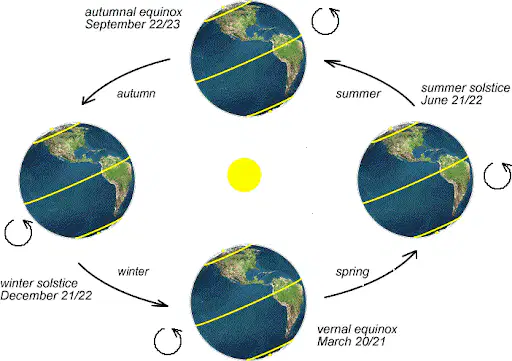
What causes the Earth's seasons?
The moon's orbit around the Earth
The distance between the Earth and the sun
The Earth's orbit around the sun combined with its axial tilt
The Earth's rotation on its axis
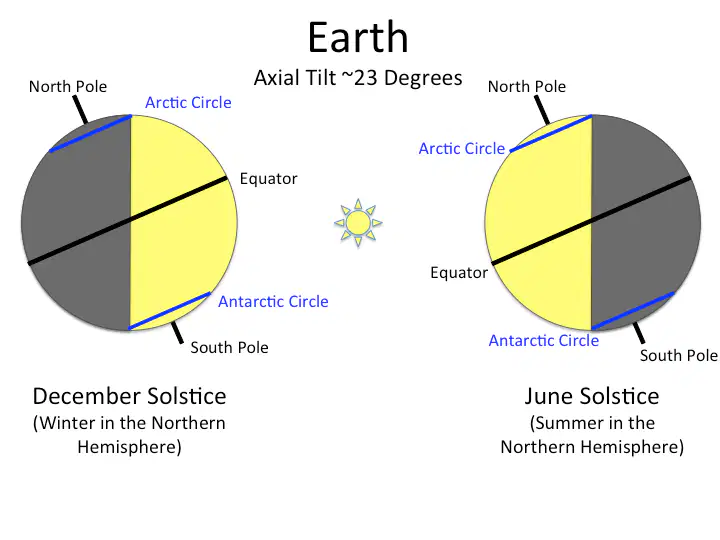
What is the significance of the Earth's axial tilt?
It affects the temperature of the Earth's core
It determines the strength of the Earth's magnetic field
It causes day and night
It influences the distribution of sunlight, leading to seasons
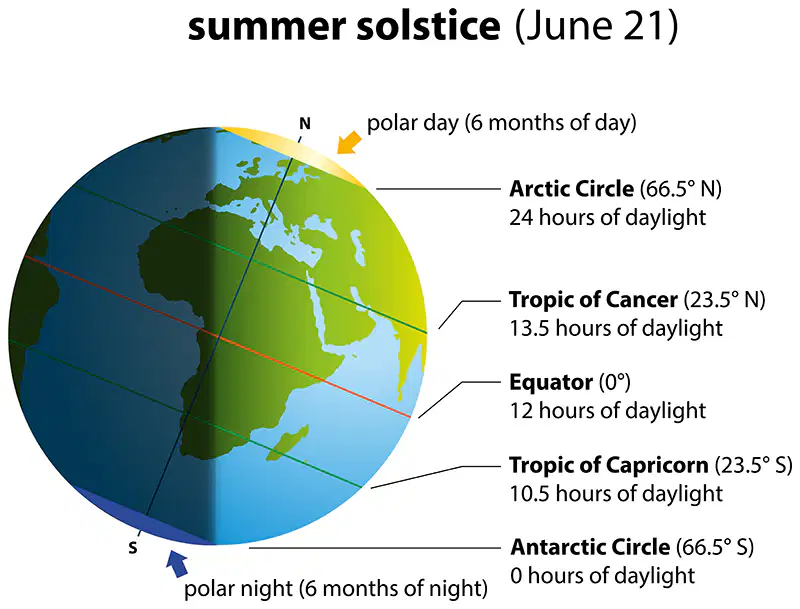
What are solstices?
The two days of the year when day and night are of equal length
Times of the year when the sun reaches its highest or lowest point in the sky at noon
Times of the year when the Earth's axis is tilted neither toward nor away from the sun
Points in the Earth's orbit where it is closest and farthest from the sun

What are equinoxes?
The two days of the year when day and night are of equal length
The longest and shortest days of the year
The points in the Earth's orbit where the Earth's axis is tilted directly towards or away from the sun
The two points in the Earth's orbit where it is closest and farthest from the sun

How does Earth's rotation affect day and night?
It results in one side of the Earth facing the sun while the other faces away, creating day and night
It leads to the occurrence of solstices and equinoxes
It changes the Earth's distance from the sun
It causes the seasons to change

What is the effect of Earth's axial tilt on daylight?
It decreases the amount of daylight during equinoxes
It increases daylight uniformly throughout the year
It causes longer days in summer and shorter days in winter
It has no effect on daylight

How does Earth's orbit around the sun cause seasons?
It does not cause seasons; seasons are caused by the moon
In combination with its axial tilt, it affects the distribution of sunlight on the Earth's surface
By causing variations in solar radiation
By changing the Earth's distance from the sun
What role does the moon play in the Earth's seasons?
It affects the Earth's tilt
It has no significant effect on the Earth's seasons
It has a primary role in the change of seasons
It causes the Earth to orbit the sun
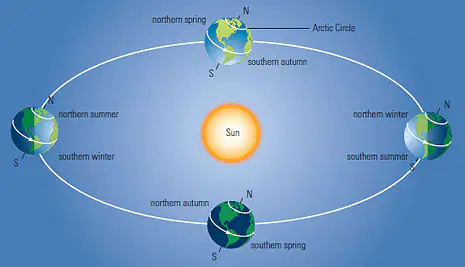
Why do different parts of the Earth experience seasons at different times?
Due to the moon's gravitational pull
Because of the Earth's axial tilt and its orbit around the sun
Due to the varying distance of Earth from the sun
Because of the Earth's round shape
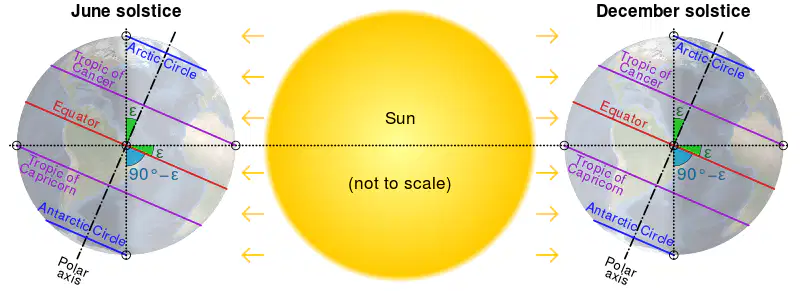
What happens during the summer solstice in the Northern Hemisphere?
The Northern Hemisphere is tilted away from the sun
The Earth is at its closest point to the sun
The Northern Hemisphere experiences the shortest day of the year
The Northern Hemisphere is tilted closest to the sun
What is the primary reason for the change in seasons on Earth?
The Earth's rotation on its axis
The gravitational pull of the moon
Solar flares and sunspots
The Earth's orbit around the sun and its axial tilt

How does the axial tilt of the Earth affect seasons?
It causes the Earth to move closer or farther from the sun
It changes the direction of the Earth's rotation
It has no effect on seasons
It influences the angle and intensity of sunlight reaching different parts of the Earth
What is the effect of the Earth's orbit and tilt on the seasons?
They result in variations in temperature and weather patterns
They change the Earth's magnetic field
They have no effect on seasons
They cause the Earth to experience only two seasons
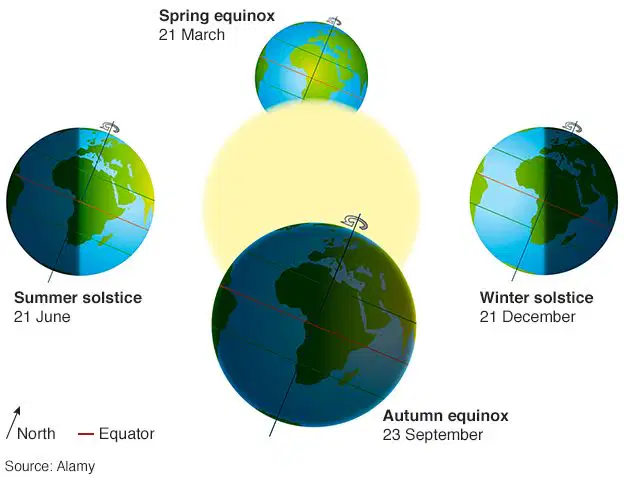
During which event do we experience equal lengths of day and night?
Solstices
Equinoxes
When the Earth is closest to the sun
When the Earth's axis is perpendicular to its orbit

What is a difference between spring and neap tides?
Spring tides occur when the earth and sun are IN LINE with the new or full moon.
Spring tides occur when moon in 3rd or 1st quarter phases
Spring tides are LOWER than neap tides
Spring tides occur in Spring and neap tides can occur in any season

Which body has the greater effect on Earth's tides?
Sun
Saturn
Moon
Venus
The rise and fall of ocean water that occurs every 12.5 hours or so are called _____.
waves
tides
gravity
phases
the line between Earth and the sun is at right angles to the line between Earth and the moon. The sun’s pull is at right angles to the moon’s pull causing a ____ _____.
Spring Tide
High Tide
Neap Tide
Low Tide
The sun, the moon, and Earth are nearly in a line during a new moon. The gravity of the sun and the moon pull in the same direction causing a ______ ____
Spring Tide
Neap Tide
High Tide
Low Tide

_______are daily changes in ocean water.
Waters
Tides
Colors
Earths
A[n] ______________ tide occurs when the sun is at right angles to the line between Earth and the moon.
high
neap
low
spring
A[n] ___________ tide occurs when the sun, Earth, and the moon are nearly in a line.
spring
high
low
neap

Wha type of tide would this arrangement of earth-moon-sun create?
full moon tide
new moon tide
neap tide
spring tide

A plate boundary is a place where two tectonic plates meet. There are several types of tectonic plate boundaries. Which statement below shows the correct definition of a tectonic plate boundary?
At a divergent boundary, plates separate.
At a transform boundary, plates move apart.
At a convergent boundary, plates slide past each other.
At a divergent boundary, one plate sinks under another plate.

Identify this type of plate movement
Divergent Boundary
Convergent Boundary
Transform Boundary
None
Tectonic plates can be made of continental crust or oceanic crust, or a combination of the two. Besides their locations, how else are these two kinds of crust different?
Continental crust is thinner than oceanic crust.
Continental crust is thicker than oceanic crust.
Tectonic plates made of continental crust are larger than plates made of oceanic crust.
Tectonic plates made of continental crust are smaller than plates made of oceanic crust.
__________ describes the large scale movement of the Earth’s lithosphere.
Crust Displacement
Mantle Movement
Plate Tectonic
None
This scientist was the first to develop the idea of continental drift.
Wegener
Einstein
Copernicus
Hawking

Identify this type of plate movement
Divergent Boundary
Convergent Boundary
Transform Boundary
None
Around 200 – 250 million years ago ______ started to break into separate plates.
Oceans
China
Pangea
None
Two plates moving or sliding by each other.
Divergent Boundary
Convergent Boundary
Transform Boundary
None
Two plates collide
Divergent Boundary
Convergent Boundary
Transform Boundary
None

Identify this type of plate movement
Divergent Boundary
Convergent Boundary
Transform Boundary
None
The movement of the tectonic plates is caused by
the rotation of the Earth.
convection currents in the Mantle
the gravity of the iron-nickel core.
the Moho discontinuity.
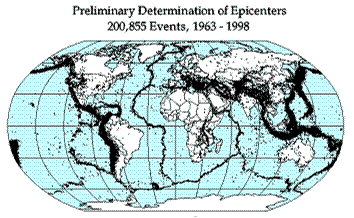
Earthquake epicenters (center of where the earthquakes started) were mapped for a 35 year period in the diagram above. The black dots indicate these epicenters. The black dots appear along what feature on Earth?
hot spots
plate boundaries
rift zones
sea floor spreading
The San Andreas Fault in California is known as an active earthquake area. What type of
boundary is it?
Converging
Diverging
Transform
Sea Floor Spreading

Which of the following images best shows a divergent plate boundary
A
B
C
D
The Mid-Atlantic Ridge, the Great African Rift Valley and Iceland were formed as a result of what boundary interaction?
Continental-Continental Convergent
Continental-Oceanic Convergent
Divergent
Transform
Scientists at the time rejected Wegener’s hypothesis of continental drift because he could not
explain how or why Earth’s continents move.
True
False

Who was the scientist that proposed the idea that Pangaea existed?
Sir Isaac Newton
Stephen Hawking
Albert Einstein
Alfred Wegener

The name of the supercontinent that Alfred Wegener proposed was called...
Pangaea
Rodinia
Rodimus Prime
Optimus Prime
Pangaea began to break up about.....
65 million years ago
100 million years ago
250 million years ago
1 billion years ago

What drew Wegener's curiosity pertaining to South America and Africa?
They look to be the same shape
They look like they fit like puzzle parts
They are about the same size
They have the same latitude

Wegener found the remains of ancient organisms that lived on multiple continents. He correlated these fossils from location to location. What did this help support?
The continents were once together
The continents are moving
The continents are drifting
All of these were in support of Pangaea

Wegener found the rocks on multiple continents that were the same type, age and color. He correlated these rocks from location to location. What did this help support?
The continents were once together
The continents are moving
The continents are drifting
All of these were in support of Pangaea

Wegener found the mountain ranges on multiple continents that were the same type, age and color. He correlated these mountain ranges from location to location. What did this help support?
The continents were once together
The continents are moving
The continents are drifting
All of these were in support of Pangaea

Wegener found coal in Antarctica. Coal forms from plants. How is this paleoclimate data support of Pangaea?
The continents were once together
The continents are moving
The continents are drifting
All of these were in support of Pangaea

Wegener found glacial evidence in the amazon. Glaciers are found in cold climates. How is this paleoclimate data support of Pangaea?
The continents were once together
The continents are moving
The continents are drifting
All of these were in support of Pangaea

What was the biggest problem with Wegener's proposed idea of Pangaea?
He did not have any evidence it was together
He did not know how the continents moved
There were no problems with his theory
Alfred Wegener’s theory that the continents were once all together forming a single landmass (Pangaea) but have since drifted apart.
Plate Tectonics
Continental Drift
Moving Earth
Earth's Interiod
Why did Wegener think the continents fit together like puzzle pieces.
Fossils matched up.
Mountains matched up.
The coastlines of Africa and South America are mirror images.
None of the above.
Why is the location of fossils of reptiles on opposite continents evidence of continetal drift?
Reptiles were poor swimmers.
Plant seeds could not move by wind.
Similar species could evolve at the same time.
Similar climates.
Where did Wegener find evidence of glaciers supporting his idea of continental drift?
In arctic regions
In tropical regions
All over the world
He did not find any glacial evidence.
Where did Wegener find evidence coal (formed by tropical plants) supporting his idea of continental drift?
In arctic regions
In tropical regions.
He did not find coal.
All over the world.
Convergent Boundary
Plates move apart.
Plates move together.
Plates slide past each other.
Plates do not move.
Subduction
Less dense plate sinks under more dense plate.
More dense plate sinks under less dense plate.
Plates collide and push up.
Plates move apart.
What features form at convergent boundaries between 2 continental pieces of crust?
Large Mountain Ranges
Volcanoes
Volcanic Islands
Nothing
What features form at convergent boundaries between 2 oceanic pieces of crust?
Large Mountain Ranges
Volcanic mountains
Volcanic Island chains
Rift Valley
What features form at convergent boundaries between an ocean plate and a continental plate?
Large Mountains
Volcanic Mountains
Volcanic Island Chain
Rift Valley
How do plates move at divergent boundaries?
Away
Together
Slide Past
No movement
At divergent boundaries plates separate allowing magma to flow and form new ocean floor. This is called
Sea floor spreading
Oceanic Crust
Magma pillows
Volcanoes.
What features form at a divergent boundary between 2 pieces of continental crust?
Sea Floor Spreading
New sea floor
Rift Valley
Mountains
How do plates move at a transform boundary?
Away
Together
Slide Past
No movement
What major feature forms at a transform boundary?
Fault
Mountain
Valley
Volcano
What major event may occur at a transform boundary?
Volcanic Eruption
Mountain building
Earthquake
Tsunami

