Worksheets
Benchmark 2 Review 2024
Total questions: 156
Worksheet time: 2hrs 5mins
What Are The Three Main Types Of Rocks?
Igneous, Depository, Metamorphic
Depository, Igneous, Sedimentary
Metamorphic, Igneous, Depository
Igneous, Metamorphic, Sedimentary
How are metamorphic rocks formed?
Heating and cooling
Deposition
Heating and pressure
Materials gathering and pressing together
How are igneous rocks formed?
Sediment forming together
Heating and pressure
Cooling
Deposition
How are sedimentary rocks formed?
Heating and pressure
Sediment forming together
Weathering
Cooling
Rocks can turn into any other rocks?
True
False
Minerals and rocks are the same?
True
False
Rocks have four main characteristics that are used to classify them?
True
False
What are the four characteristics used to classify rocks?
Formation, mineral composition, erosion
Formation, mineral composition, texture, color
Streak, mineral composition, color, texture
Formation, mineral composition, texture, erosion
What are rocks made of?
Salt
Minerals
Other rocks
Sand
The color of a rock is a result of its chemical composition?
True
False
What is texture determined by?
Color
Erosion
The size, shape, and pattern of its grains
The look of it
What are grains?
The grains are the particles of minerals that give a rock its texture
Lines
Bumps, lines, and dots
It's chemical composition
The rocks cycle follows a specific order?
True
False
What can cause rocks to change?
The Earth's orbit around the sun
Environmental conditions
The minerals falling apart
Internal conditions
No rock lasts forever
True
False

Paleontology is the study of (a) , from dinosaurs to prehistoric plants, mammals, fish, insects, fungi, and even microbes.

Using info on the previous slide, answer the next 3 questions.
While fossils reveal what ancient living things looked like, they keep us guessing about...
color
sounds
bone structure
age

Which of the following happened to most once living things?
scavengers ate them
they turned into fossils
wind and weather preserved them

True or False: Most fossils on earth will never be found
True
False

Over millions of years, sedimentary layers form from which of the following?
sand
silt
dead plants & animals
molten lava

From the previous slide: Once a species becomes extinct it ____________ from the fossil ______________ and the geologic column ends.
disappears, record
flourishes, column
appears, book

How does a Carbon Film form to create a fossil?
space left by a dying organism fills in with minerals
gas and liquid from a decaying organism is squeezed out an a film of carbon is left as an outline
original remains are preserved in amber
fossils in the form of footprints, trails and burrows become fossilized
Do you feel that you've learned much about fossils and paleontology from this lesson?
Nothing at all
Not much
Some
Very much


What is this?
blizzard
drought
dust storm

What is this?
drought
dust storm
earthquake

What is this?
dust storm
earthquake
fire

What is this?
earthquake
fire
flooding

What is this?
fire
flooding
fog

What is this?
flooding
fog
heatwave

What is this?
fog
heatwave
hurricane

What is this?
heatwave
hurricane
ice

What is this?
hurricane
ice
lightning

What is this?
ice
lightning
storm

What is this?
lightning
storm
thunderstorm

What is this?
storm
thunderstorm
tornado

What is this?
thunderstorm
tornado
tsunami

What is this?
tornado
tsunami
volcano

What is this?
tsunami
volcano
bilzzard

What is this?
volcano
blizzard
drought
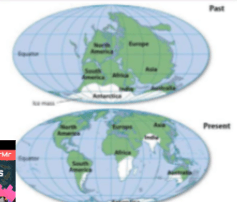
(a) was proposed by (b) and suggested that the (c) are in constant motion.
The earth's plates, rigid slabs of rock, "float" on the ___ .
asthenosphere
lithosphere
mantle
granitic rock
The earth's outer shell is divided into slabs of rock called ______ .
continental plates
crustal plates
trench plates
tectonic plates
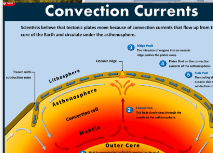
What is a driving force behind the movement of the plates?

Place each label in the correct category.
older
granite
less dense
younger
basltic
recycles
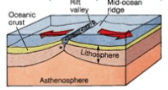
divergent
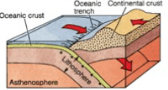
convergent
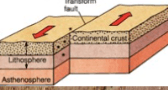
transform
At which plate boundary is new crust formed?
divergent
convergent
continental
transform
What type of crusts are involved with one plate subducting beneath another?
continental and continental
Oceanic and continental
oceanic and divergent
continental and convergent
What types of landforms are formed at convergent boundaries?
PICK TWO
volcanoes
new crust
Trenches
rift valley
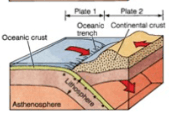
What is the WHOLE AREA called where the oceanic crust goes beneath the continental crust?
subtraction zone
section zone
secondary zone
subduction zone
At which boundary is crust neither consumed or created?
divergent
convergent
transform
oceanic
Drag the labels to the correct the locations on the diagram.
convergent boundary
Mid-ocean Ridge
slab pull
trench
divergent boundary

The majority of the world's earthquakes and volcanoes occur along the _ .
(a)
Select ALL the reasons for plate movement.
Polar Reversal
Convection Currents
Ridge Push
Slab Pull

What happens where an oceanic plate converges with a continental plate?
The denser oceanic plate slides on top of the less dense continental plate.
The denser oceanic plate slides under the less dense continental plate.
The less dense oceanic plate slides past the denser continental plate.
The less dense oceanic plate slides under the denser continental plate.

At what type of plate boundary are most high continental mountains formed?
convergent boundary
hotspots
divergent boundary
transform boundary
mid-ocean ridges

What kind of plate movement created the Himalayan Mountains?
convergence of oceanic crust with continental crust.
divergence between two continental crustal plates.
transform movement between oceanic and continental crustal plates.
convergence of two plates composed of continental crust.

What type of boundary occurs where two plates move together, causing one plate to descend into the mantle beneath the other plate?
transform fault boundary
convergent boundary
divergent boundary
hotspots

Deep ocean trenches are associated with:
mid-ocean ridge systems.
transform fault boundaries.
subduction zones.
rift zones.

Rift valleys, like the Great African Rift Valley, form as a result of:
crustal compression.
divergent boundaries
convergent boundaries
subduction zones

A mid-ocean ridge is an example of what type of plate boundary?
convergent zone
divergent zone
transform zone
subduction zone

The youngest rocks on the ocean floor are typically located near what feature?
a mid-ocean ridge
a subduction zone
on an island arc
a deep-sea trench

A rift valley is evidence of which kind of plate boundary?
convergent boundary
transform boundary
divergent boundary
hotspot

What kind of plate boundary occurs where two plates grind past each other without destroying or producing new lithosphere?
divergent boundary
hotspots
convergent boundary
transform boundary

Which type of plate boundary is in the southern California region?
passive margin
divergent boundary
convergent boundary
transform boundary
A resource that we can use more than once is called a _____ resource.
Renewable
Nonrenewable
Reusable
Recyclable
Which of the following is NOT a natural resource
iPads
Trees
Wind
Fossil fuels
True or False: It is possible to make more nonrenewable resources in our lifetime.
True
False
What is deforestation?
Cutting down trees in a forest.
Planting new trees on empty land.
Using trees to produce oxygen.
Looking for new types of medicine in a forest.
Which of the following is a renewable resource?
Solar power
Wood from trees
Oil used for gasoline
Coal that powers a factory
Where are fossil fuels found?
In the Earth
In the forest
In animals
In the atmosphere
Fossil fuels are produced over _____ of years.
Hundreds of millions of years
Thousands of years
hundreds of years
every year
What do we need to use solar power for our electricity?
Solar panels
Sun panels
Solar engines
A sun motor
Why are trees considered natural resources?
People use them to make paper, lumber, fuel, and other products.
They provide shade.
They are a source of firewood
They can grow back after they are cut down.
True or False: Glass is a natural resource.
False
True
Which of these is the most sensible way to conserve natural resources?
Walk or ride your bike when you can, instead of driving in the car.
Stop using all electricity.
Never ride in the car.
Don't use any products made from trees.
How does recycling conserve resources?
It allows us to reuse things instead of making new ones.
It means there will be less garbage trucks driving around.
We can recycle everything, even food!
There will be no more trash at the dump.
One example of a natural resource could be:
Which of these is classified as a renewable resource?
Natural gas
Minerals
Plants
Crude oil
Sunlight is a _________ resource
Renewable
Nonrenewable
Select all the renewables.
Air
Natural Gas
Wind
Rocks and Minerals
Fish
How long do you think it takes a renewable resource to come back?
How long does oil take to form?
100 years
1,000 years
A few months
Millions of years
Why isn't oil found everywhere on Earth, and only in certain places?
Since natural gas is formed from dead plants, it's a renewable resource.
True
False
How long does it take non-renewable resources to come back?
All of the following are considered renewable energy sources EXCEPT –
Wind
Coal
Biomass
Solar
The wise use of natural resources is called
Biomass
Conservation
Production
Restoration
What is the difference between renewable and nonrenewable resources?
Renewable resources can be replaced faster than non-renewable.
Non-renewable resources can be replaced by more resources.
non-renewable resources cannot be used by humans.
Renewable resources are renewed into something new.
Natural Resource
Human Resource
Plants



Which part of the image of rocks will hold more water?
Right
Left
Center
This is the flow of underground water when it reaches the surface.
Groundwater
Spring
Geyser
Well

What percent of the Earth is Fresh Water?
97%
45%
22%
3%
Which example is a form of precipitation?
Dew
Fog
Frost
Hail
In which area would the rate of evaporation be the lowest?
Over the ocean
Over the mountains
Over the rainforest
Over the desert
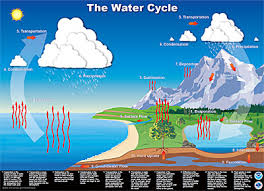
As a part of the water cycle, water from Earth's surface enters the clouds and finally falls back to the ground in the form of rain. What is the correct sequence of processes water undergoes?
Evaporation, Condensation, Precipitation
Precipitation, Condensation, Evaporation
Condensation, Evaporation, Precipitation
Evaporation, Precipitation, Condensation
What would happen if the Sun is removed from the water cycle?
The water cycle would not include precipitation but would continue with groundwater flow.
The water cycle would no longer occur because the Sun provides the energy for evaporation and transpiration.
The water cycle would no longer occur because the Sun provides energy for the formation of clouds.
The water cycle would not include evaporation and transpiration but would continue with condensation.

A student draws a model to represent the precesses involved in the water cycle, as shown. To which process is the formation of clouds related?
Condensation
Evaporation
Freezing
Melting

The image shows various stages in the water cycle. During which stage does water flow back towards the sea as runoff?
W
X
Y
Z