wayground logo

Free Printable Worksheets

Font size

S
M
L
XL
Worksheets

AP Bio Unit 6 - DNA Replic & Protein Synth

Total questions: 180

Worksheet time: 3hrs 0mins

Name
Class
Date
1.

The picture below shows the steps of DNA replication beginning with step one and ending with step three.


​Because you are reusing the old, or parent, DNA strand DNA replication is said to be

a)

Semi- Conservative

b)

Semi-discontinuous

c)

Continuous

d)

Fully-Conserveative

2.

The picture below shows an enzyme unwinding and unzipping DNA.

​What is the name of this enzyme?

a)

DNA Helicase

b)

DNA Ligase

c)

DNA polyermase

d)

RNA Polymerase

3.

Which enzyme is responsible for adding the free nucleotides to the replicating DNA? ​

a)

DNA Helicase

b)

DNA Ligase

c)

DNA polyermase

d)

RNA Polymerase

4.

Which letter in the picture below depicts the leading strand in DNA replication?

a)

A

b)

C

c)

B

d)

None of the above

5.

Which letter in the picture below depicts the lagging strand in DNA replication?

a)

A

b)

C

c)

B

d)

None of the above

6.

Which letter in the picture below depicts the replication fork in DNA replication?

a)

A

b)

C

c)

B

d)

None of the above

7.

Okazaki fragments appear on which strand of DNA during DNA replication?

a)

lagging

b)

leading

8.

The directionality of DNA is said to be ___________, because it is side by side by goes in opposite directions.

a)

Anti-directional

b)

Parallel

c)

Anti-parallel

d)

Anti-uniform

9.
Which of the following must happen first in order for DNA replication to occur?
a)
DNA polymerase binds to the leading strand
b)
DNA is unwound
c)
Hydrogen bonds form between bases
d)
chromosomes condense
10.
Which of the following is required for DNA replication to occur?
a)
DNA helicase
b)
DNA ligase
c)
DNA polymerase
d)
all of these
11.

Which enzyme is responsible for forming phosphodiester bonds between the Okazaki fragments?

a)

Ligase

b)

Helicase

c)

DNA Polymerase 1

d)

DNA Polymerase 3

12.

Which enzyme is responsible for adding nucleotides to the free three prime end

a)

Helicase

b)

Topoisomerase

c)

DNA Polymersase 3

d)

DNA Polymersase 1

13.

The separation of the two single strands of DNA creates a ‘Y’ shape?

a)

enzyme

b)

unzip

c)

A replication fork

14.
At what point in the cell cycle does DNA replication occur and why?
a)
before a cell divides, to provide each of the two resulting cells with a complete set of DNA instructions
b)
before a cell divides, to ensure that the DNA will fit into the resulting cells
c)
during cell division, to ensure that the DNA will fit into the resulting cells
d)
after a cell divides, to provide each of the two resulting cells with a complete set of DNA instructions 
15.
Order of replication
a)
3, 2, 1, 4
b)
2, 1, 4, 3
c)
2, 3, 1, 4
d)
3, 4, 1, 2
16.
Which sequence of DNA bases would pair with this partial strand
CAT TCA CTG
a)
ATG TGA CAG
b)
TAC ACT GTC
c)
GTA AGT GAC
d)
CAT TCA CTG
17.
Which of the following units are repeatedly joined together to form a strand of DNA?
a)
amino acids
b)
nucleotides
c)
fatty acids
d)
polysaccharides
18.
The enzyme that unwinds the DNA to prepare for replication
a)
helicase
b)
replicase
c)
polymerase
d)
synthase
19.
DNA replication results in two DNA molecules,
a)
each one with two original strands
b)
each one with two new strands
c)
each one with one new strand and one original strand
d)
one with two new strands and the other with two original strands
20.
In what phase of the cell cycle does DNA replication take place?
a)
G1
b)
S
c)
G2
d)
M
21.
Which enzyme is responsible for adding nucleotides?
a)
Topoisomerase
b)
DNA Polymerase
c)
Ligase
d)
Primase
22.
The process of DNA replication is called semi conservative because it results in
a)
none of these
b)
Two DNA molecules.  One original molecule and one with two new strands
c)
two exact copies with new strands
d)
two identical molecules, each with 1 original strand and one new.
23.
Enzyme that unwinds the DNA
a)
ligase
b)
DNA Polymerase
c)
primase
d)
helicase
24.
Seals the Okazaki fragments together
a)
DNA Polymerase
b)
ligase
c)
helicase
d)
primase
25.
synthesizes a short fragment of RNA that allows DNA polymerase III to bind
a)
ligase
b)
DNA polymerase I
c)
primase
d)
helicase
26.
removes the RNA primer and adds DNA nucleotides to fill in the gap
a)
DNA polymerase III
b)
ligase
c)
primase
d)
DNA polymerase I
27.

direction new nucleotides are synthesized on the new strand

a)

5' to 3' (new nucleotides added to the 3' end)

b)

3' to 5' (new nucleotides added to the 5' end)

c)

3' to 5' (new nucleotides added to the 3' end)

d)

5' to 3' (new nucleotides added to the 5' end)

28.

What are the three components of a nucleotide?

a)

sugar, hydrogen, nitrogen base

b)

sugar, oxygen, nitrogen base

c)

sugar, phosphate, nitrogen base

d)

sugar, phosphate, protein

29.
If a DNA molecule is 18% Guanine which of the following is correct
a)
18% cytosine, 32% adenine, 32% thymine
b)
32% cytosine, 18% adenine, 32% thymine
c)
18% cytosine, 64% adenine, 64% thymine
d)
32% cytosine, 32% adenine, 18% thymine
30.

The enzyme that unwinds a segment of the DNA molecule is...

a)

DNA polymerase

b)

DNA ligase

c)

RNA primase

d)

DNA polymerase III

e)

helicase

31.

DNA replication results in two identical daughter molecules each consisting of one old (original) strand and one newly-synthesized strand.

a)

False that it is False

b)

True that it is False

32.

The point where separation of the DNA occurs is called the replication fork.

a)

True that it is True

b)

True that it is False

33.

The picture below shows an enzyme unwinding and unzipping DNA.

​What is the name of this enzyme?

a)

DNA Helicase

b)

DNA Ligase

c)

DNA polyermase

d)

RNA Polymerase

34.

Match he nucleotide with its complementary nucleotide. (DNA to DNA).


Adenine -

a)

Thymine

b)

Guanine

c)

Cytosine

35.

Match he nucleotide with its complementary nucleotide. (DNA to DNA).


Cytosine-

a)

Thymine

b)

Guanine

c)

Adenine

36.

Which enzyme is responsible for adding the free nucleotides to the replicating DNA? ​

a)

DNA Helicase

b)

DNA Ligase

c)

DNA polyermase

d)

RNA Polymerase

37.

Which is the first step?

a)

DNA Helicase unwinds original DNA strand

b)

RNA Primase lays down RNA primer for new nucleotide bases.

c)

DNA polymerase builds new strands by bring in new nucleotide bases.

d)

Ligase knits together fragments on lagging strand

38.

Which letter in the picture below depicts the leading strand in DNA replication?

a)

A

b)

C

c)

B

d)

None of the above

39.

Which letter in the picture below depicts the lagging strand in DNA replication?

a)

A

b)

C

c)

B

d)

None of the above

40.

Which letter in the picture below depicts the replication fork in DNA replication?

a)

A

b)

C

c)

B

d)

None of the above

41.

Okazaki fragments appear on which strand of DNA during DNA replication?

a)

lagging

b)

leading

42.
What does DNA stand for?
a)
Deoxyribonucleic acid
b)
Denitrogenous acid
c)
Deribonucleic acid
d)
Diribonucleic acid
43.
How would the DNA sequence GCTATA be transcribed to mRNA?
a)
GCUAUA
b)
CGATAT
c)
CGAUAU
d)
GCUTUT
44.
Which sequence of DNA bases would pair with this partial strand
ATG TGA CAG
a)
ATG TGA CAG
b)
TAC ACT GTC
c)
GTA AGT GAC
d)
CAT TCA CTG
45.
The two strands of nitrogenous bases in DNA are joined by which type of bond?
a)
polar bonds
b)
ionic bonds
c)
covalent bonds
d)
hydrogen bonds
46.
X outlines a(n) ___________.
a)
amino acid
b)
nitrogen base 
c)
nucleotide
d)
nitrogen base pair
47.
the process of making a copy of DNA
a)
transcription
b)
double helix
c)
DNA replication
d)
replication fork
48.
What are the gaps between the newly synthesized DNA on the lagging strand called?
a)
Okazaki fragments
b)
Polymer gaps
c)
Helicase fragments
d)
Acidic gaps
49.
What is the shape of DNA?
a)
Double helix
b)
Triple helix
c)
Flat, bilayer
d)
Three-pronged rigid ladder
50.
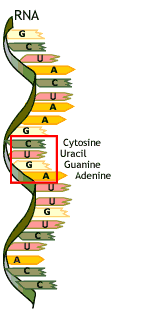
In RNA, Uracil pairs with ______. 
a)
cytosine
b)
adenine
c)
guanine
d)
thymine
51.

A researcher identifies a strand of a genetic material that has the sequence ACCGTA. What is the substance, and how is it identified?

a)

DNA - it contains the bases A, T, G, and C.

b)

DNA - it contains GTA.

c)

RNA - it contains the bases A, T, G, and C.

d)

RNA - it contains the bases A, U, G, and C.

52.

What is the DNA complement to this DNA sequence: TGA GCC TTA GGA?

a)

UCT CGG UUT CCT

b)

ACT CGG AAT CCT

c)

ACU CGG AAU CCU

d)

TGA CGG TTA GGA

53.
The enzyme that unzips the DNA to prepare for replication
a)
helicase
b)
replicase
c)
polymerase
d)
synthase
54.
DNA replication results in two DNA molecules,
a)
each one with two original strands
b)
each one with two new strands
c)
each one with one new strand and one original strand
d)
one with two new strands and the other with two original strands
55.

Which enzyme fixes the Okazaki fragments?

a)

Helicase

b)

Polymerase

c)

Ligase

d)

Primerase

56.

DNA polymerase is able to build the new DNA ______ along the leading strand.

a)

continuously

b)

only in short fragments

c)

very slowly

d)

prokaryotically

57.
Which enzyme is responsible for adding nucleotides?
a)

Helicase

b)

DNA Polymerase

c)

Ligase

d)

Primase

58.
Based on the diagram, how many origins of replication are represented?
a)
1
b)
2
c)
3
d)
4
59.
Based on the diagram, the enzyme (represented in gray) is most likely...
a)

DNA polymerase

b)

Ligase

c)

Primase

d)

Helicase

60.

Which enzyme is responsible for checking DNA for errors, and fixing it?

a)

DNA Polymerase

b)

Primase

c)

Helicase

d)

RNA Polymerase

61.

Okazaki fragments are found on the _______________ strand

a)

Leading

b)

Lagging

62.

DNA is built in this direction

a)

5' to 3' (new nucleotides added to the 3' end)

b)

3' to 5' (new nucleotides added to the 5' end)

c)

3' to 5' (new nucleotides added to the 3' end)

d)

5' to 3' (new nucleotides added to the 5' end)

63.

DNA Replication occurs during which phase of the cell cycle?

a)

G 1 phase

b)

S phase

c)

G 2 phase

d)

Mitotic phase

64.

During transcription, which type of RNA is responsible for copying a gene on the DNA and bringing it out of the nucleus?

a)

tRNA

b)

mRNA

c)

rRNA

d)

dRNA

65.

When __________ bond together, they form a protein.

a)

Amino Acids

b)

Peptide Bonds

c)

Ribose

d)

Nucleotides

66.

A string of nucleotides that contains the information to make a specific protein is called a ________.

a)

Ribose

b)

Amino Acids

c)

tRNA

d)

Gene

67.

During translation, which type of RNA is responsible for delivering amino acids to the ribosome?

a)

mRNA

b)

rRNA

c)

tRNA

d)

dRNA

68.

There are a total of ____ different amino acids.

a)

20

b)

1

c)

4

d)

unlimited

69.

mRNA is created during this process of ___________.

a)

Translation

b)

Transcription

c)

Replication

d)

Delivery

70.

How many amino acids are found on one tRNA?

a)

20

b)

4

c)

1

d)

3

71.

What would be the mRNA sequence to this DNA strand: AACTGAA?

a)

UUGACUU

b)

TTGACTT

c)

AACTGAA

d)

AACUGAA

72.

Which process is shown in this diagram?

a)

Replication

b)

Transcription

c)

Recombination

d)

Translation

73.

The DNA sequence ATCAGCGCT is part of a gene. How many amino acids are coded for by this message?

a)

3

b)

9

c)

20

d)

1

74.

Which process is being shown in this diagram?

a)

Replication

b)

Transcription

c)

Respiration

d)

Translation

75.

In RNA, adenine pairs with ______.

a)

cytosine

b)

uracil

c)

guanine

d)

thymine

76.

Where does the process of translation occur?

a)

nucleus

b)

mitochondria in cytoplasm

c)

ribosome in cytoplasm

d)

chloroplast in cytoplasm

77.

What is the name of 3 bases on mRNA?

a)

Anticodon

b)

Codon

c)

Protein

d)

Nucleotide

78.

Where in the cell does transcription occur?

a)

nucleus

b)

cytoplasm

c)

ribosome

d)

mitochondria

79.

If GUA was on the mRNA, what was on the DNA?

a)

GTA

b)

CAT

c)

CAU

d)

CTU

80.

If AAU is a codon, what would be on the tRNA?

a)

AAT

b)

TTA

c)

AAU

d)

UUA

81.

Amino acids are held together by _______ bonds.

a)

hydrogen

b)

peptide

c)

ionic

d)

james

82.

Which number in the diagram labels a tRNA molecule? (Click diagram to enlarge)

a)

6

b)

8

c)

9

d)

10

83.

What does letter R in the diagram indicate? (Click diagram to enlarge)

a)

Amino Acid

b)

DNA

c)

Ribosome

d)

mRNA

84.

Where does TRANSCRIPTION occur?

a)

Nucleus

b)

Ribosome

c)

Cytoplasm

d)

Mitochondria

85.

What does DNA Polymerase do? What does DNA Ligase do? What does DNA Helicase do?

4 lines
86.

How many nucleotides equal 1 amino acid?

a)

1

b)

2

c)

3

d)

4

87.

TRANSCRIBE this DNA sequence: TACGTTACT

(a)  

88.

Which organelle makes proteins?

(a)  

89.
What is the term for a three-nucleotide sequence that codes for an amino acid?
a)

base

b)

codon

c)

amine

d)

serine

90.

This process to go from DNA to mRNA is
(a)  

Choose from the below words
transcription
translation
replication
synthesis
91.
The process to go from mRNA to a protein is called
(a)  
Choose from the below words
translation
transcription
rRNA
replication
92.
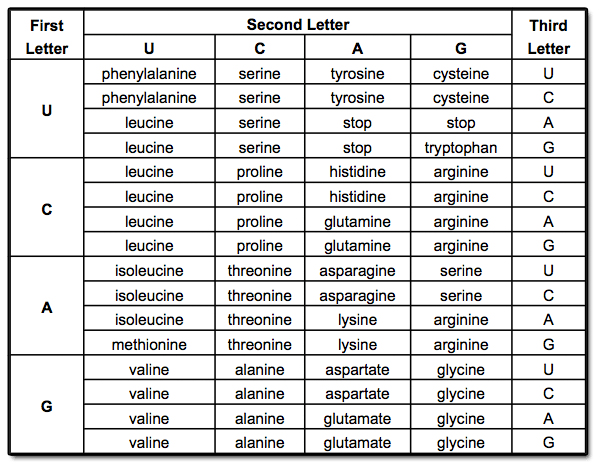
What amino acid is represented by the codon UUA?
a)

Phenylalanine

b)

Tyrosine

c)

Leucine

d)

Stop codon

93.
Which of the following molecules is made during transcription?
a)

DNA

b)

tRNA

c)

protein

d)

mRNA

94.
Which of the following bases is found only in RNA?
a)

Adenine

b)

Guanine

c)

Thymine

d)

Uracil

95.
Which form of RNA carries amino acids from the cytoplasm to the ribosome?
a)

amino RNA

b)

ribosomal RNA

c)

transfer RNA

d)

messenger RNA

96.

What would be the complementary DNA strand for the following nucleotide sequence?
TCG ATA CGA

(a)  

97.
Which of the following terms means that in each molecule of DNA made during replication there is one original strand and one new strand?
a)

Antiparallel

b)

Semi-conservative

c)

Complementary base-pairing

98.

Proteins are chains of amino acids bonded together. Which is the correct sequence for making proteins?

a)

Information in DNA is transcribed into mRNA and then translated into protein

b)

Information in DNA is formed into protein directly.

c)

Information in DNA is translated into mRNA then Transcribed into proteins

d)

Information in RNA uses thermal energy to make protein

99.

A change in a DNA sequence(order) that affects genetic information.

a)

Recessive trait

b)

Mutation

c)

Allele

100.
How many amino acids are coded for by this sequence of nucleotides:
ATG GGA ACT CCA
a)

4

b)

2

c)

6

d)

12

101.

What amino acid would be added to the protein being formed during translation if the DNA codon reads "GGA?"

a)

Isoleucine

b)

Stop

c)

Methionine

d)

Proline

102.
DNA polymerase is a(n)
a)

lipid

b)

enzyme

c)

sugar

d)

starch

103.

What enzyme is used to make mRNA?

a)

DNA Polyerase

b)

Primase

c)

Ligase

d)

RNA Polymerase

104.

Which organelle is the location where protein is made?

a)

Ribosome

b)

Nucleus

c)

Cytoplasm

d)

Nucleotide

105.

During transcription, this type of ribonucleic acid is responsible for copying the DNA and brining it out of the nucleus.

a)

tRNA

b)

mRNA

c)

rRNA

d)

dRNA

106.

When these bond together, they form a protein

a)

Amino Acids

b)

Peptide Bonds

c)

Ribose

d)

Nucleotides

107.

Which of the following is the complementary mRNA sequence to this DNA strand: AACTGAA

a)

UUGACUU

b)

TTGACTT

c)

AACTGAA

d)

AACUGAA

108.
What is the term for a three-nucleotide sequence that codes for an amino acid?
a)
base
b)
codon
c)
amine
d)
serine
109.
The process to go from DNA to mRNA is _______
a)
translation
b)
transcription
c)
replication
110.
The process to go from mRNA to a protein is called ____
a)
transcription
b)
rRNA
c)
replication
d)
translation
111.
Genetic info flows in one direction. Which best represents this flow?
a)
DNA-protein-RNA
b)
Protein-RNA-DNA
c)
RNA-protein-DNA
d)
DNA-RNA-protein
112.
What is the location in the cell for transcription?
a)
nucleus
b)
cytoplasm
c)
ribosome
d)
mitochondria
113.

What brings the amino acids to the ribosome to assemble a protein?

a)
mRNA
b)
tRNA
c)
rRNA
d)

DNA

114.

How many nucleotides code for 1 amino acid?

a)

1

b)

2

c)

3

d)

4

115.

What is the location in the cell for translation?

a)

Cytoplasm

b)

Nucleus

c)

Lysosome

d)

Golgi apparatus

116.

Set of three nucleotides in a tRNA molecule that binds to a complementary mRNA codon during translation

a)

Anti-codon

b)

Codon

c)

Amino acid

d)

Bases

117.

In RNA, the base thymine is replaced with this base that will bond Adenine instead in RNA.

a)

Cytosine

b)

Guanine

c)

Uracil

d)

Ribose

118.
What amino acid is represented by the codon UUA?
a)
Phenylalanine
b)
Tyrosine
c)
Leucine
d)
Stop codon
119.
RNA is read in sections called:
a)
Triplets
b)
Genes
c)
Codons
d)
Genes
120.
Transcription is a process that in eukaryotic cells takes place in the:
a)
Nucleus
b)
Cytoplasm
c)
Golgi Apparatus
d)
Rough E.R.
121.
Transcription begins at sequences called
a)
Start Codons
b)
Promoters
c)
Origins
d)
Introns
122.
Transcription produces RNA by copying the:
a)
Coding Strand
b)
Template Strand
123.
RNA polymerase creates RNA in the _________ direction
a)
5' to 3'
b)
3' to 5'
124.
What is the RNA synthesized from a section of DNA with the code: GATTACA ?
a)
CUAAUGU
b)
GATTACA
c)
GAUUCA
d)
CTAATGA
125.
The enzyme that produces RNA in Transcription is called
a)
RNA Polymerase
b)
DNA Polymerase
c)
Transcriptase
d)
RNA Intrase
126.
Splicing is accomplished by:
a)
Spliceosomes
b)
DNA Ligase
c)
RNA Polymerase I
d)
SSBPs
127.
What is not done after Transcription?
a)
Chunking of mRNA into codons
b)
Intron Splicing
c)
5' Cap addition
d)
Poly A-tail added
128.
Translation is a process in eurkaryotic cells takes place in the:
a)
Cytoplasm
b)
Nucleus
c)
Nucleolus
d)
Golgi Bodies
129.
tRNA molecules move through the ribosome in the order:
a)
A-P-E
b)
E-P-A
c)
E-A-P
d)
P-E-A
130.
tRNA molecules match the mRNA codons with a(n):
a)
Codon
b)
Anti-Codon
c)
Intron
d)
Methylated Cap
131.
Translation begins with a(n):
a)
Start Codon
b)
Intron
c)
Promoter
d)
Origin
132.
The codon 5'-UAC-3' would have an anti-codon match:
a)
3'-AUG-5'
b)
3'-TAC-5'
c)
5'-AUG-3'
d)
5'-CAU-3'
133.
When the Ribosome reaches ________________ the process of translation stops
a)
Stop Codon
b)
Okazaki Fragment
c)
Terminator
d)
taq Polymerase
134.
The first tRNA molecule moves through the __________ sites in the ribosome
a)
A-P-E
b)
P-E
c)
E-P-A
d)
A-P
135.
Translation is a process that produces
a)
mRNA
b)
Protein
c)
Polypeptide Chains
d)
tRNA
136.
The process of copying a gene's DNA sequence into a sequence of RNA is called:
a)
Transcription
b)
Translation
c)
Splicing
d)
Protein Synthesis
137.
Which of the statements below is false?
a)
The genetic code is overlapping.
b)
The genetic code is universal.
c)
Degenerate codons specify the same amino acids.
d)
The genetic code is triplet.
138.
The amino acid sequence of a polypeptide chain comprises the ____ structure of the protein.
a)
Primary
b)
Secondary
c)
Tertiary
d)
Quaternary
139.
RNA contains which bases?
a)
adenine, guanine, uracil, cytosine
b)
thymine, guanine, cytosine, uracil
c)
thymine, uracil, cytosine, guanines
d)
adenine, uracil, guanine, thymine
140.
Which of the following is an example of the degeneracy of the genetic code?
a)
The genetic code is not degenerate
b)
A given amino acid has more than one codon
c)
Codons can specifies more than one amino acid
d)
The first base specifies the amino acid
141.

An mRNA codon with the sequence 5'-GAC-3' would be matched by a tRNA anti-codon with the sequence:

a)

3'-GAC-5'

b)

3'-CUG-5'

c)

5'-GAC-3'

d)

5'-CUG-3'

142.

Which organelle is the location where protein is made?

a)

Ribosome

b)

Nucleus

c)

Cytoplasm

d)

Nucleotide

143.

During transcription, this type of ribonucleic acid is responsible for copying the DNA and brining it out of the nucleus.

a)

tRNA

b)

mRNA

c)

rRNA

d)

dRNA

144.

When these bond together, they form a protein

a)

Amino Acids

b)

Peptide Bonds

c)

Ribose

d)

Nucleotides

145.

mRNA occurs during this process

a)

Translation

b)

Transcription

c)

Replication

d)

Delivery

146.

Which of the following is the complementary mRNA sequence to this DNA strand: AACTGAA

a)

UUGACUU

b)

TTGACTT

c)

AACTGAA

d)

AACUGAA

147.
What is the term for a three-nucleotide sequence that codes for an amino acid?
a)
base
b)
codon
c)
amine
d)
serine
148.
The process to go from mRNA to a protein is called ____
a)
transcription
b)
rRNA
c)
replication
d)
translation
149.
Genetic info flows in one direction. Which best represents this flow?
a)
DNA-protein-RNA
b)
Protein-RNA-DNA
c)
RNA-protein-DNA
d)
DNA-RNA-protein
150.
What is the location in the cell for transcription?
a)
nucleus
b)
cytoplasm
c)
ribosome
d)
mitochondria
151.

Which organelle contains rRNA and reads the mRNA to synthesize a protein?

a)

Ribosome

b)

Nucleus

c)

Cytoplasm

d)

Nucleotide

152.

What brings the amino acids to the ribosome to assemble a protein?

a)
mRNA
b)
tRNA
c)
rRNA
d)

DNA

153.

In RNA, A matches with

a)

U

b)

T

c)

G

d)

C

154.

What is protein synthesis?

a)

the taking apart of proteins

b)

the making of proteins

c)

the making of RNA

d)

the making of DNA

155.

After the mRNA is formed, what happens?

a)

It moves out of the nucleus and into the cytoplasm.

b)

It binds permanently with DNA molecule.

c)

It disassembles and the process repeats.

d)

It moves out of the nucleus and then out of the cell.

156.

What is the job of mRNA?

a)

To take the code out of the nucleus

b)

To unzip the DNA so it can replicate

c)

To carry the amino acid to the ribosome

157.

Which of the following are types of RNA?

a)

transfer RNA

b)

ribosomal RNA

c)

messenger RNA

d)

All of the above

158.

When does the protein stop growing in length?

a)

when the mRNA sends a signal to stop

b)

when a stop codon is reached

c)

When the tRNA signals for it to stop

159.
DNA never leaves the nucleus
a)
True
b)
False
160.
Proteins are made of which molecule?
a)
Amino Acids
b)
Lipids
c)
Carbohydrates
161.

Where does TRANSCRIPTION occur?

a)

Nucleus

b)

Ribosome

c)

Cytoplasm

d)

Mitochondria

162.

On which molecule can an anticodon be found?

a)

mRNA

b)

DNA

c)

tRNA

d)

rRNA

163.

How many codons equals 1 amino acid?

a)

1

b)

2

c)

3

d)

4

164.

A polypeptide is a sequence of ____________________ held together by a ______________ bond.

a)

amino acids; peptide

b)

fatty acids; ionic

c)

proteins; hydrogen

d)

fatty acids; covalent

165.

TRANSCRIBE this DNA sequence: TACGTTACT

a)

AUGCAAUGA

b)

ATGCAATGA

c)

AUGGATUGA

d)

TACGTTACT

166.
In RNA, Uracil pairs with ______. 
a)
cytosine
b)
adenine
c)
guanine
d)
thymine
167.
The process to go from DNA to mRNA is _______
a)
translation
b)
transcription
c)
replication
168.
The process to go from mRNA to a protein is called ____
a)
transcription
b)
rRNA
c)
replication
d)
translation
169.

DNA is the template for

a)

amino acids

b)

tRNA

c)

mRNA

d)

sugars

170.
The main function of tRNA is to...
a)
carry a message that, when translated, forms proteins
b)
form a portion of ribosomes
c)
string together complementary RNA and DNA strands
d)
bring amino acids from the cytoplasm to the ribosomes
171.
What amino acid is represented by the codon UUA?
a)
Phenylalanine
b)
Tyrosine
c)
Leucine
d)
Stop codon
172.

What is the location in the cell for translation?

a)

nucleus

b)

mitochondria

c)

cytoplasm

d)

chloroplast

173.
The function of ______ is to combine with proteins to form ribosomes.
a)
rRNA
b)
tRNA
c)
mRNA
d)
DNA
174.
The principle shown in the image is called what?
a)
Transcription
b)
The Central Dogma
c)
Translation
d)
The Principle of Proteins
175.
Which of these nitrogenous bases is NOT in RNA?
a)
Uracil
b)
Thymine
c)
Cytosine
d)
Guanine
176.

Which organelle is the location where protein is made?

a)

Ribosome

b)

Nucleus

c)

Cytoplasm

d)

Nucleotide

177.

Insertion, deletion, and substitution are all examples of a change in a genetic sequence which is also referred to as (a)

a)

Gene

b)

Amino Acid

c)

Ribose

d)

Mutation

178.

When these bond together, they form a protein

a)

Amino Acids

b)

Peptide Bonds

c)

Ribose

d)

Nucleotides

179.

There are a total of ____ different amino acids

a)

20

b)

1

c)

4

d)

unlimited

180.
One human disease is caused by a change in one codon in a gene from GAA to GUA. The disease is a result of 
a)
a mutation
b)
crossing-over
c)
a meiosis error
d)
polyploidy