
 Worksheets
Unit 3 Practice
Total questions: 74
Worksheet time: 53mins
The relative proportion of individuals within the different species of a given area
species richness
evolution
species evenness
phylogeny
The number of species in a given area
species richness
evolution
species evenness
phylogeny
The process by which individuals move from one population to another and thereby alter the genetic composition of both populations
genetic drift
gene flow
bottleneck effect
founder effect
Examples of this ecosystem service include regulating environmental conditions such as nutrient cycling and removing carbon from the atmosphere giving us more time to address climate change.
provisioning
regulating
cultural
supporting
Ecosystem service where goods are produced that humans can use directly
provisioning
regulating
cultural
supporting
Natural ecosystems provide services such as pollination, pest control, and water filtration that would be extremely costly for humans to generate.
provisioning
regulating
cultural
supporting
What is a change brought about by a physical, chemical, or biological agent that impacts population size or community structure?
resistance
stability
disturbance
resilience
What is the ability of an ecosystem to recover after it has undergone a disturbance?
resistance
stability
disturbance
resilience
Which of the following are examples of natural disturbances? (Select ALL that apply!)
tornado
tsunami
volcano
earthquake
urbanization

What is genetic diversity?
Diversity within a species
# of species and abundance in the community
How many different habitats are in a region
What is habitat diversity?
Diversity within a species
# of species and abundance in the community
How many different habitats are in a region
What is species diversity?
Diversity within a species
# of species and abundance in the community
How many different habitats are in a region

Which is NOT a part of CHIPPO?
Human population
Income (affluence)
Climate change
Pollution
Overharvesting

Organisms that are successful in a new environment due to access to abundant resources and no predators
threatened
keystone
endangered
least concern
invasive
The arrows in a food chain or web represents what?
They point to the organism that is being eaten.
It shows how sunlight flows within an ecosystem.
They show the direction the energy is flowing between organisms.
They represent how water is transferred within a habitat.


Consumers that eat only plants
Carnivores
Omnivores
Herbivores
Scavengers
Consumers, such as vultures, that feed on the bodies of dead organisms
Carnivores
Omnivores
Herbivores
Scavengers
A food _______ is a series of events in which one organism eats another and obtains energy.
chain
web
pyramid
plate

In the food web above, what organism is a tertiary consumer?
Fox
Frog
Vole
Grass
Which of the following has the correct order of the trophic levels for a food web or chain.
herbivores-decomposer-autotrophs-carnivores-
decomposer-carnivores-autotrophs-herbivores
producer-tertiary consumer-secondary consumer-primary consumer
producer-primary consumer-secondary consumer-tertiary consumer-decomposer

A worm is a/an
autotroph
heterotroph

Arrows in a food web represent...
eating
sunlight
energy
matter
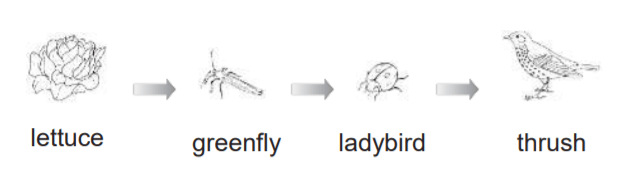
Who is the producer?
lettuce
greenfly
ladybird
thrush
Which model below correctly represents the flow of energy in a food chain?
plants --> insects --> salmon --> bears
insects --> plants --> bears --> salmon
bears --> salmon --> insects --> plants
salmon --> bears --> plants --> insects
The amount of energy producers provide primary consumers is 55,000 joules. The amount of energy the primary consumers provide the secondary consumers is 5,500 joules. Based on the 10% rule, how much energy is provided to tertiary consumers?
550,000 J
5,500 J
550 J
55 J
The amount of energy producers provide primary consumers is 55,000 joules. The amount of energy the primary consumers provide the secondary consumers is 5,500 joules. Based on the 10% rule, how much energy is provided by the producers?
550,000 J
5,500 J
550 J
55 J

The food web below shows some of the feeding relationships among organisms in Arctic waters.
Which organisms would receive the least amount of total energy available?
seals
shrimp
baleen whales
toothed whales

The figure below shows a food chain that might exist in a meadow.
What would happen if the frog population decreased?
the snakes would have less to eat and the owls would eventually have less to eat
there would be fewer beetles
the plants would increase in number
owls would start eating beetles
Identify a food chain from the food web
hawk -> spider -> grasshopper -> plants
sun -> spider -> grasshopper -> weasel -> hawk
sun -> plants -> grasshopper -> spider -> shrew -> weasel -> owl
owl -> weasel -> shrew -> spider -> grasshopper -> plants -> sun

Identify the producers in the food web.
algae, phytoplankton
octopus, limpet
starfish, shark
seagull, octopus
Identify a primary consumer in the food web.
algae, phytoplankton
limpet
starfish
octopus

What is incorrect about the shape of this food pyramid?
the producers should contain the most energy and most biomass
the primary consumers should contain the most energy and most biomass
the secondary consumers should contain the most energy and most biomass
the tertiary consumers should contain the most energy and most biomass

Which statement correctly describes how energy flows in the food web?
energy flows from the grass to the rabbit to the fox
energy flows from the grasshopper to the mouse to the bird
energy flows from the grasshopper and mouse to the plants
energy flows from the grass to the owl and fox
If we eat a salad, what statement best fits our role in energy flow?
producer
primary consumer
secondary consumer
decomposer
The food web below shows some of the feeding relationships among organisms in Arctic waters.
Which organisms are the producers?
seals
shrimp
baleen whales
phytoplankton
If we eat a steak, what statement best fits our role in energy flow?
producer
primary consumer
secondary consumer
decomposer
What is the definition of an ecosystem?
A group of animals of the same species living in the same place.
All the plants and animals living in the same place.
All organisms living in the same place and the abiotic factors that affect them.
Which of the following is not a biotic factor in an ecosystem?
wind
algae
dead skunk
oak tree
Which of the following would be included in a system?
inputs and outputs
boundaries
interactions
components

In this ecosystem model, what is missing?
plants
the top predator
abiotic factors
consumers
In the mid 1900's, the wolves of Yellowstone were deeply affected by humans and their population significantly decreased-- making them endangered, and eventually removing them completely from the Yellowstone ecosystem. The removal of wolves, the top predator, caused what to happen to the biodiversity within Yellowstone?
A trophic cascade affected the entire food web in Yellowstone, causing some organisms to experience decreases, and others to grow rapidly.
Biodiversity increased when the wolves disappeared and more species were able to flourish without the wolves.
A trophic cascade irreversibly ruined the ecosystem in Yellowstone--destroying biodiversity forever.
The biodiversity of the park was not affected when the wolves were removed.

Which of the following is NOT true of the included graphs?
The reintroduction of wolves led to a decline in the beaver population.
The reintroduction of wolves led to an increase in the elk population.
The ecosystem was healthier after wolves were reintroduced.
The reintroduction of wolves led to a decline in the bison population.
How did the kelp forest ecosystem change after sea otters were removed?
sea urchin population increased
the kelp population decreased
sea stars increased because there were more sea urchins to eat
the phytoplankton population decreased
The trophic cascade in Yellowstone had many causes and affects. Which answer below most accurately shows the changes in the ecosystem due to the reintroduction of wolves?
wolves reintroduced-> deer population increased -> tree and vegetation cover decreased
wolves reintroduced-> beaver population decreased -> tree and vegetation cover increased
wolves reintroduced-> deer population decreased -> tree and vegetation cover increased -> beaver population increased
wolves reintroduced-> deer population decreased -> beaver population decreased -> songbird population increased
What was the primary question the ecologists sought to answer with his starfish experiment?
How do predators influence the structure of ecosystems?
How do starfish reproduce?
What determines the population size of starfish?
What was the apex predator in the ecosystem?
The original hypothesis of food chains was
the green hypothesis
the bottom up hypothesis
energy flow hypothesis
Keystone hypothesis
What was the unexpected result of removing starfish from the ecosystem?
starfish population increased
number of species decreased
the ecosystem was unchanged
number of species increased
What term did Robert Paine coin to describe the influence of a single species on an ecosystem?
Apex predator
Dominant species
Keystone species
Primary species
What was the main finding of the ecologists research on sea otters?
Sea otters are primary producers
Sea otters have little to no impact on the ecosystem
Sea otters indirectly controlled the sea urchins
Sea otters directly controlled the sea urchins
What happened to the kelp forest when the sea otters were removed?
Kelp forests became more diverse
Kelp forests disappeared
Kelp forests thrived
Kelp forests were unchanged
What do ecologists call the effect of one species affecting multiple levels in a food chain?
direct
indirect
no effect
neutral effect
What did ecologists call the effect of one species on multiple levels of a food chain?
Trophic cascade
Food chain reaction
direct effect
Keystone effect
What broader implication does the study of keystone species and trophic cascades have for ecology?
It indicates that predators have no significant role in ecosystems
It shows that all species have equal impact on ecosystems
It highlights the importance of top down regulation in ecosystems
It suggests that ecosystems are primarily controlled by the producers
What is the role of keystone species in an ecosystem?
They have no effect on the ecosystem
They have a disproportionately large effect on the abundance and number of species
They are the most abundant species
They are always apex predators.
Fill in the blank: Not all species in an ecosystem have strong interactions. The removal of some species has ______ effect on others.
a large
a little or no
a moderate
a significant
Which of the following statements is true about apex predators?
They are always preyed upon by others
They are at the top of a food web and are not preyed on by others
They have no effect on the ecosystem
They are the most numerous species.
Keystone species are critical to maintaining what in an ecosystem?
The number of predators
The diversity and stability
The amount of sunlight
The water levels
What happens when a keystone species is removed from an ecosystem?
Nothing changes
Only the keystone species is affected
It causes changes in the type and number of species
The ecosystem becomes more stable.
Fill in the blank: Many keystone species are ______ predators.
secondary
apex
primary
tertiary
Which of the following is NOT a characteristic of keystone species?
A) They have a large effect on their ecosystem
B) They are always the most numerous species
C) They can be apex predators
D) They help maintain ecosystem stability.
What is required to understand how species numbers and population sizes are regulated in an ecosystem?
Short-term observations
Experiments conducted over long time periods
Immediate assumptions
Quick surveys
Fill in the blank: The removal of some species has little or no effect on others because not all species have ______ interactions.
strong
weak
temporary
permanent
What is the risk of ignoring the role of apex predators in ecosystems?
Ecosystems will remain stable
The prey of predators will increase
Ecosystems would gain diversity
It could lead to significant changes in an ecosystem
The keystone species of yellowstone is which of the following?
Elk
Grizzly bears
Wolves
Black bears

