
 Worksheets
Unit 1 - Introduction to Biology
Total questions: 74
Worksheet time: 2hrs 28mins
The maintaining of an organism’s internal environment is called:
Which of the following is NOT a characteristic of life?
Reproduces
Made up of one or more cells
Movies
Requires energy
Which helps maintain a dog's homeostasis?
Sleeping
Panting
Eating
Hunting
What is a claim?
A guess
A conclusion based on evidence
A statement or conclusion that answers a question asked in an experiment
An observation
What is evidence?
A statement or conclusion that answers a question asked in an experiment
Data collected in a scientific experiment to test a claim
A conclusion based on results of an experiment
Why your evidence supports your claim
What is reasoning?
A statement or conclusion that answers a question asked in an experiment
Why your evidence supports your claim
Data collected in a scientific experiment to test a claim
A testable prediction

You should never ______ chemicals in the lab.
taste
touch
smell
all of the above

Keeping your work area neat and clean is important because:
My teacher is a neat-freak
I won't lose my supplies in the clutter.
It keeps the room from looking messy.
It helps prevent accidents.

What is the CORRECT procedure for students to follow if a chemical is spilled?
Stand back and advise the teacher of the spill.
Run madly out of the room.
Splash large amounts of water onto the spill.
Immediately ask to go to the restroom.

You should report accidents to the teacher __.
after the class is over
immediately
the following day
never

When you finish working with chemicals, biological specimens, and other lab substances, always
wipe your hands on your clothes
wipe your hands on a towel
wash your hands thoroughly with soap and water
treat your hands with skin lotion
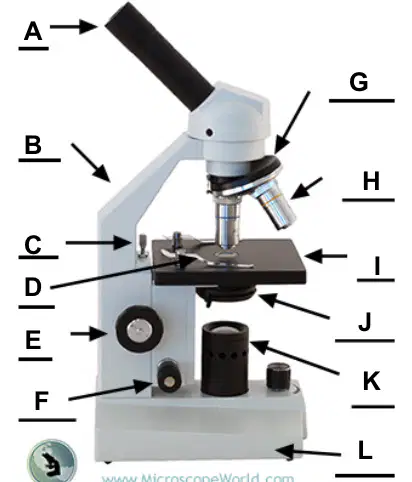
Label the part of the microscope. What is part A?
eyepiece lens
Body Tube
Stage Clips
objective lens
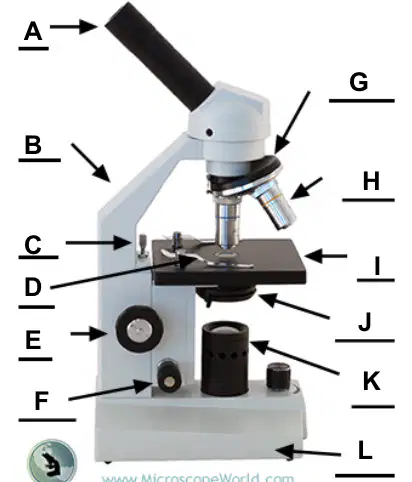
Label the part of the microscope. What is part B?
eyepiece lense
Arm
Base
Objective Lens
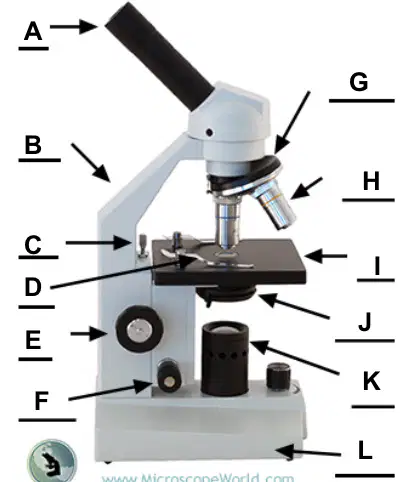
Label the part of the microscope. What is part D?
stage
stage clips
base
objective lens
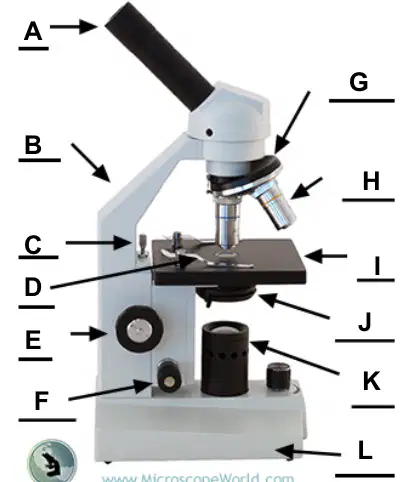
Label the part of the microscope. What is part E?
diaphragm
coarse adjustment knob
objective lens
fine adjustment knob
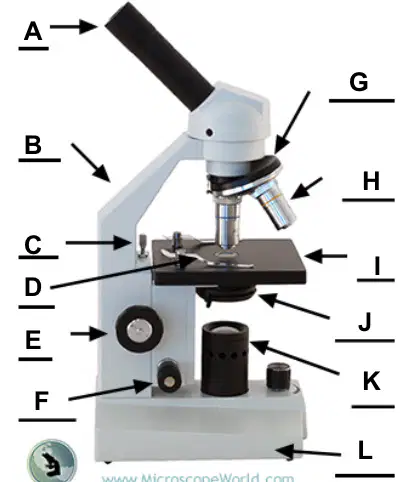
Label the part of the microscope. What is part F?
stage
coarse focus knob
fine focus knob
eyepiece tube
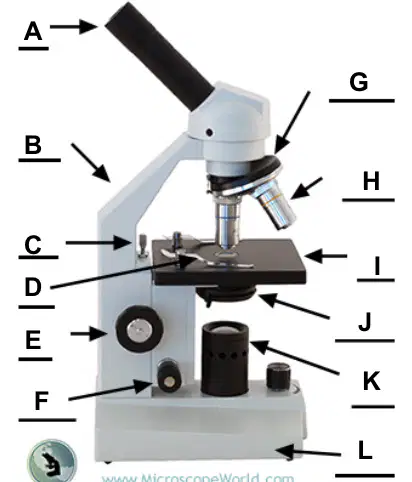
Label the part of the microscope. What is part H?
stage
objective lens
body
fine focus knob
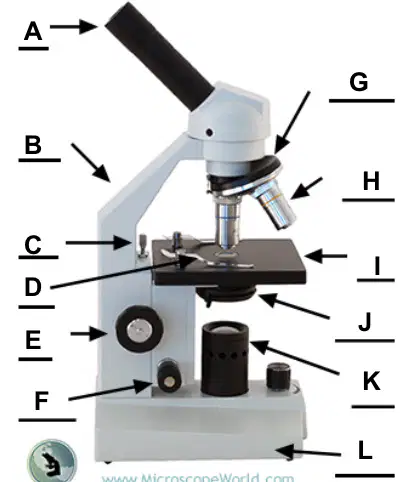
Label the part of microscope. What is part J?
Stage Clips
Base
Fine Focus Knob
Diaphragm
Microscopes allow us to view objects in great _____________.
detail
magnification
objective
body
The greater the ___________________, the smaller the field you are actually viewing.
detail
objective
magnification
body
The microscopes we used in class had three ________________ which allows different amounts of magnification.
detail
magnification
objectives
body
When carrying a microscope, place one hand on the ________ and one on the _________.
focus knob
body/arm
stage
foot/base
The smallest objective we used in class was _____X.
two
three
four
five

What piece controls the amount of light that enters the microscope ?
Aperture
Diaphragm
Light Source
Arm
When observing a specimen using the 10x eyepiece and the high-powered objective (40x), what is the total magnification that the specimen is being observed?
400X
40X
100X
4000X
Which knob CANNOT be turned when observing a specimen using the high-powered objective?
coarse adjustment
fine adjustment
nosepiece adjustment
objective adjustment
Which of the following is a term used to describe all the chemical reactions that take place in a living thing?
A plant growing towards a light source is an example of which of the following?
attracting a mate
destroying infectious germs
responding to a stimuli
obtaining moisture from the air
YOU are a multicellular organism but an amoeba is a unicellular organism.

Which characteristic of living things is represented in the picture?
Respond to stimuli
Grow and develop
Evolution
Made of cells


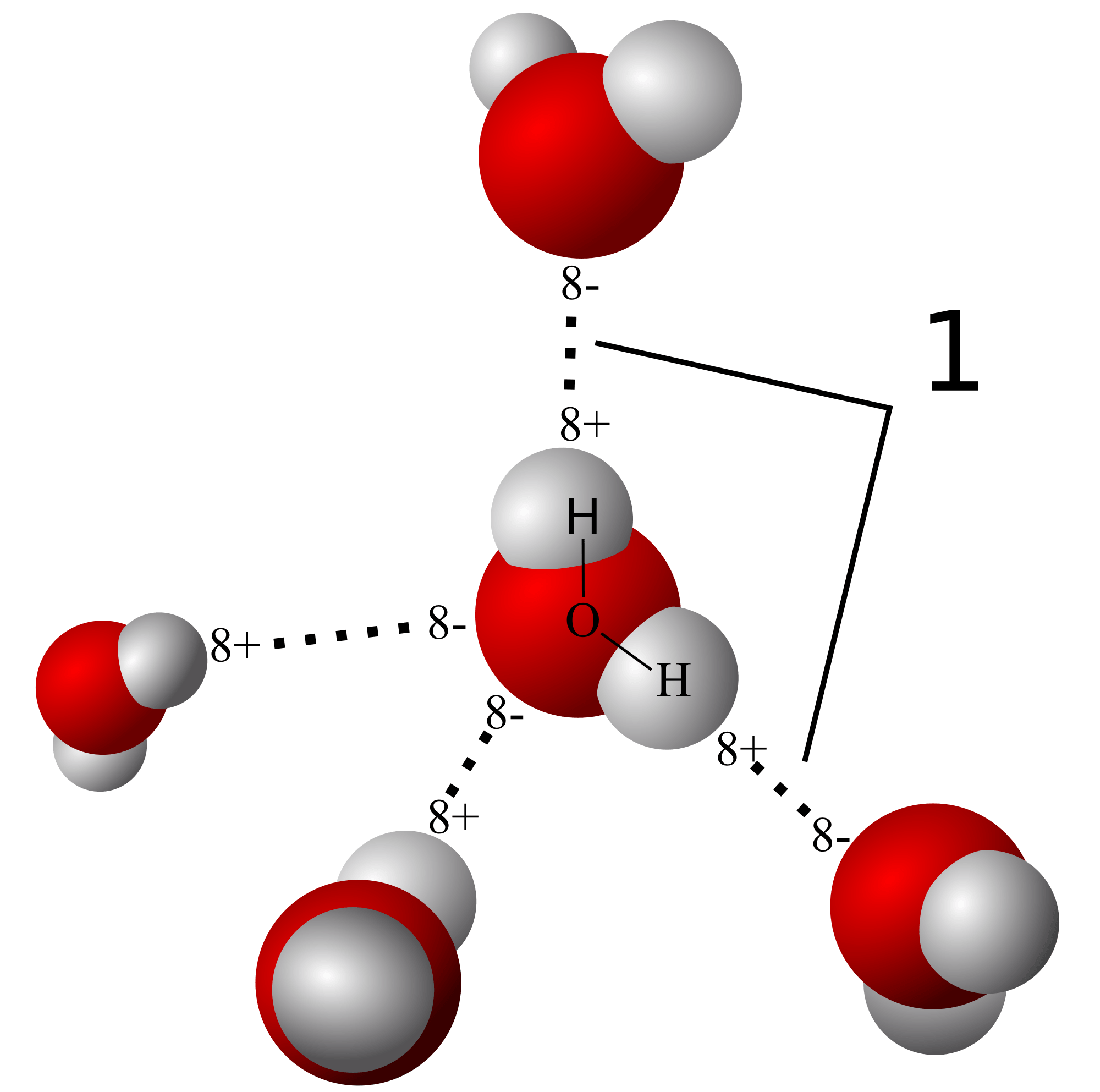
How many hydrogen atoms are in a water molecule?
5
1
2
0
The bond that holds the Oxygen and Hydrogen atoms together in a water molecule is a ________ bond.
ionic
Hydrogen
Covalent
Weak

The prefix hydro- means
earth
water
sun
cells
The suffix -philic means
hating
loving
cells
Philis
The suffix -phobic means
fear
loving
pho
phone
Dehydration synthesis forms macromolecules, in which large compounds are built by joining smaller ones.
The smaller units, or _____, join together to form _____.
polymers, monomers
monomers, polymers
molecules, atoms
cells, molecules
Four groups of organic compounds found in living things are
water, vitamins, minerals, air
carbon, hydrogen, oxygen, and nitrogen
sunlight, chlorophyll, photosynthesis, and glucose
carbohydrates, lipids, nucleic acids, and proteins
Single sugar molecules are called _____.
monosaccharides
disaccharides
triglycerides
polysaccharides
Large macromolecules formed from monosaccharides are called _____.
disaccharides
triglycerides
polysaccharides
glucose
Which macromolecule is used to store and transmit hereditary/genetic information?
carbohydrates
lipids
nucleic acids
proteins

Nucleic acids are composed of monomers called _____.
starch
glycerol
DNA
nucleotides

Proteins are composed of monomers called _____.
monosaccharides
glycerol molecule
nucleotides
amino acids

A ______________ is a large molecule.
Micromolecule
Polymer
Amino Acid
Macromolecule
Which of the following elements are found in all macromolecules? (Select all that apply).


Which of the following are examples of carbohydrates? (Select all that apply).
Bread
Pasta
Olive Oil
Cheese
Nucleic acids make up which of the two molecules listed below?
FDA
RNA
DNA
FDR

An avocado is an example of a which macromolecule?
Carbohydrate
Lipid/Fat
Protein
Nucleic Acid
This macromolecule breaks down into sugars such as glucose.
Lipids/Fats
Nucleic Acids
Protein
Carbohydrates
How how carbohydrates and lipids similar?
both contain C, H, O, N, P and store energy
both contain C, H, O, N and give energy
both contain C, H, O, N, S and store energy
both contain C, H, O and give energy
The substance that binds to an enzyme is called a?
Polypeptide
Co-enzyme
Vitamin
Substrate
Which of the following best explains why enzymes are necessary for reactions in our cells?
The reactions are too slow to meet the needs of the cell if enzymes are missing.
Enzymes supply the oxygen necessary for the reactions.
Enzymes change reactants from solid to liquid during the reactions.
The reactions take up too much space in the cell if enzymes are missing.
Changes in pH and temperature can ___________________ an enzyme which causes it to lose its shape and affects its function.
puncture
denature
double
delete
The ____________________ mechanism describes how each substrate must fit into the enzyme.
lock and key
hammer and nail
jigsaw puzzle
seesaw
What is the purpose of an enzyme?
control how many reactions occur
raise activation energy
give permission for the reaction
speed up chemical reactions
Where do substrates bind to an enzyme?
calcium channels
active site
receptor molecules
voltage-gated channels

