
 Worksheets
G6 End of Term1 Review
Total questions: 125
Worksheet time: 1hrs 24mins
What is the thinnest layer of the Earth?
Mantle
Inner Core
Crust
Outer Core
Your feet are on
The crust
The mantle
The inner core
The outer core
Earhquakes takes place on
The crust
The mantle
The inner core
The outer core
The thickest layer of the Earth is
The crust
The mantle
The inner core
The outer core
It is made up of melted rock
Crust
Mantle
Core
Lithosphere
It is as hot as the surface of the Sun
Crust
Mantle
Inner Core
Outer Core
It is totally liquid
Crust
Mantle
Outer core
Inner core
The inner core is:
Solid
Liquid
Gaseous
Plastic
The hottest layer of the Earth is
The crust
The mantle
The outer core
The inner core
As you get farther from the center of the Earth, the temperature _____________.
increases
decreases
stays the same
switches between hotter and cooler
If the earths mantles were completely solid____ plates could not move around
dinner
tectonic
mountain
earth
How are Sedimentary rocks formed?
Compaction and cementation of sediments
Application of heat and pressure
The cooling of molten rock
How are Metamorphic rocks formed?
Compaction and cementation of sediments
Application of heat and pressure
The cooling of molten rock
How are igneous rocks formed?
Compaction and cementation of sediments
Application of heat and pressure
The cooling of molten rock
What are sedimentary rocks made of?
Sediments, fossils and clay
Sediments, Dead organisms and fossils
Fossils, dead organisms, clay
What does SEDIMENT mean?
Large pieces of rock and soil
A bunch of rocks
Small pieces of rock and soil
What does deposition mean?
When sediments travel to an area
When sediments settle in an area after being transported
When sediments cement together
What does compaction mean?
When the weight of sediments from above squash lower sediments
When lower sediments move to make room for other sediments
When sediments travel to a new area
Chalk is an example of
Sedimentary rock
Igneous rock
Metamorphic rock
Sandstone is an example of
Sedimentary rock
Igneous rock
Metamorphic rock
Granite is an example of
Sedimentary rock
Igneous rock
Metamorphic rock
Obsidian is an example of
Sedimentary rock
Igneous rock
Metamorphic rock
Marble is an example of
Igneous rock
Sedimentary rock
Metamorphic rock
Quartzite is an example of
Sedimentary rock
Igneous rock
Metamorphic rock
What does intrusive mean?
Within the earth
On earths surface
At earths core
What does extrusive mean?
Within the earth
On earths surface
At earths core
How can you identify an intrusive rock?
Small crystals
Large crystals
Fine grained crystals
How can you identify an Extrusive rock?
Small crystals
Large crystals
Fine grained crystals
Minerals are..
Naturally occurring element
Man made element
A combination of both naturally and man made elements
Metamorphic rocks are made from
Sedimentary rocks
Igneous rocks
What are the three types of rocks that are part of the rock cycle?
hard, soft, and brittle
sand, stone, and volcanic
dactylic, iambic, and spondaic
igneous, metamorphic, and sedemantary
What do you need in order for igneous rock to form?
a volcano
a mountain
a glacier
a canyon
What do granite and basalt have in common?
They're sedimentary rocks
They're metamorphic rocks
They're igneous rocks
They're formed by erosion
What is the difference between magma and lava?
Magma is very hot, lava is cool.
Magma is motlen rock within the earth: lava is molten rock on the earth's surface.
Magma is molten rock on the earth's surface; lava is molten rock within the earth.
Magma is cool, lava is very hot.
Which of these is a sedimentary rock?
granite
obsidian
sandstone
quartzite
What can you infer about metamorphic rocks from their name?
They form deep within the earth
They form on the earth's surface
They form under heat and pressure
They have changed in some way
Where might you find mountains of metamorphic rock?
Near volcanoes
At the boundaries between tectonic plates
Buried under bodies of water
Near any landscape that has been eroded
What has to happen to sediment in order for it to become sedimentary rock?
It has to bond and harden.
it has to be buried deep within the earth.
It has to be around a volcanic eruption
It has to be washed away by wind and rain.

Sedimentary rock is most similar to which of the following?
A
B
C
D
When does a sedimentary rock become a metamorphic rock?
When it's left alone over a long period of time
When it erupts out of a volcano
When its sediments bond together
When it's subjected to intense heat and pressure
Animal extinction is an effect of climate change and global warming.
True
False
Acid rain is an effect of global warming.
True
False
Global warming is the reduction of temperature in the Earth.
True
False
Climate change means changes in global temperatures.
True
False

What is this?
Drought
Acid rain
Ice caps melting
Fossil fuels

What is this?
Fossil flues
Acid rain
Car fumes
Greenhouse effect

What is this?
Forest fires
Destruction of natural habitats
Endangered species
Flood

Flood
Ice caps melting
Extinction
Forest fires

What is this?
Deforestation
Fossil fuels
Forest fires
Drought

What is this?
Greenhouse effect
Industries
Car fumes
Fossil fuels

What is the mnemonic used to remember Living Processes?
Ms Gren
Mrs Gran
Mrs Gren
Mr Gren
What does the M stand for?
Movemnt
Movement
Movemunt
Movment
What does the R stand for?
Respriton
Respiration
Reproduce
Reprdce
What does the S stand for?
Senstivity
Sensitivity
Sensetevety
Sensitivitee
What does the G stand for?
Grwth
Groath
Growth
Growt
What does the E stand for?
Excretiom
Excretion
Exreteion
Excreteion
What does the N stand for?
Neutrition
Nutrition
Nutrion
Neution
HOW MANY LIFE PROCESSES ARE EXHIBITED BY LIVING THINGS ?
SEVEN
FIVE
SIX
EIGHT

WHAT IS THE LIFE PROCESS SHOWN IN THE IMAGE ?
GROWTH
RESPIRATION
MOVEMENT
NUTRITION
WHICH ANIMAL MOVES ON LAND ?
ELEPHANT
SHARK
SEA HORSE
FOX

WHICH IS THE RESPIRATORY ORGAN FOR AN EARTHWORM ?
LUNGS
NOSE
SKIN
GILLS

WHAT IS THE LIFE PROCESS SHOWN HERE?
NUTRITION
RESPIRATION
GROWTH
MOVEMENT
ANIMAL AND BIRDS MOVE IN SEARCH OF ?
FOOD
WATER
SHELTER
ALL THE ABOVE
THE FOOD THAT WE EAT GIVES US....
ENERGY
OXYGEN
ALL THE ABOVE
NONE OF THESE
HUMAN BEINGS EXHIBIT INCREASE IN HEIGHT UNTIL WE BECOME....
OLD
ADULT
BABY
BOY / GIRL
WHAT IS THE KEY WORD USED TO REMEMBER ALL THESE LIFE PROCESSES?
(a)

Rigid layer surrounding a plant cell
Cell Membrane
Cytosplasm
Cell Wall
Chloroplast
Vacuole

What kind of cell is in the diagram?
plant cell
nerve cell
root cell
blood cell

Thick gel-like fluid inside of the cell
Chloroplast
Cytoplasm
Mitochondria
Golgi Bodies
Controls what comes in and out of the cell
Cytoplasm
Cell Wall
Cell Membrane
Nucleus

Contains chlorophyl and makes food from sunlight
Chloroplast
Cytoplasm
Mitochondria
Cell wall
Contains a cell wall, chloroplasts, and one large vacuole.
Animal Cell
Plant Cell
Bacteria Cell
Virus Cell

Controls the activities of the cell
Nucleolus
Cell wall
Nucleus
Cytoplasm


The DNA of a cell is found in the __________.
large vacuole
chloroplast
nucleus
cell wall

Which of these organelles do animal cells not have?
Nucleus
Chloroplasts
Cell membrane
Cytoplasm

This organelle is where plants do photosynthesis.
Cell Wall
Nucleus
Chloroplast
Vacuole

Animal cells can be distinguished from plant cells easily because of which of the following?
Animal cells have nucleus and plant cells do not.
Plant cells have cytoplasm and animal cells do not.
Only plant cells have cell membrane around them.
Only plant cells have large central vacuoles and cell walls.
What is the purpose of genes, or DNA?
stores hereditary information to tell what the plant or animal is
makes proteins
reduces energy
produce sugars
What is the function of the cytoplasm?
helps keep organelles in place
stores water and nutrients
transports material in the cell
provides energy for the cell
What is the correct levels of organisation?
organ, organ system, tissue, cell, organism
tissue, cell, organ, organ system, organism
cell, tissue, organ, organ system, organism
cell, tissue, organ, organism, organ system
What are known as the 'building blocks' of life?
Organs
Humans
Cells
Atoms
What do multiple organs make up?
Tissue
Organ Systems
The Human Body
Which two of the below are examples of organ systems?
The Digestive System
The Brain
The Lungs' Pleural Membrane
The Cardiovascular System
What magnification should you start with when using a light microscope?
the lowest
the middle
the highest
it doesn't matter
How are multicellular and unicellular organisms different?
Multicellular organisms have more than one cell and are smaller than unicellular organisms
Unicellular organisms have one cell and are smaller than multicellular organisms.
Multicellular organisms have one cell and are larger than unicellular organisms.
Unicellular organisms have more than one cell and are larger than multicellular organisms

What is this cell under a microscope?
animal cell
plant cell
Examples of organ systems are -
circulatory system
respiratory system
muscular system
nutrition system
nervous system
What are groups of similar body cells working together called?
specialised cells
tissues
organs
organ systems
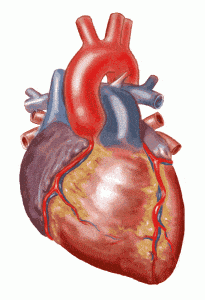
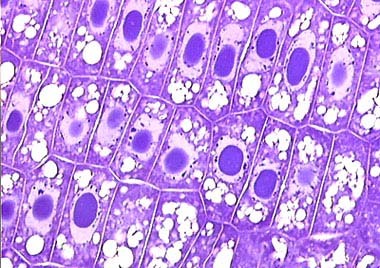
The function of the human excretory system is to -
break food into small molecules that the body can absorb
dispose of wastes and control body fluid composition
move materials from the environment into the body
produce enzymes the body needs to break down food

The table summarizes some of the structures and functions of the human body. What terms should replace Y?
protects the body from germs
allows the body to match the temperature of the environment
provides a way for carbon dioxide to leave the body
allows the body to move
To show students that gravity is not the only force that helps move food through the body, the teacher does a headstand and eats a cookie. Which is responsible for moving the food to the stomach?
chewing by the teeth
movement of the tongue
squeezing by the esophagus
contraction of the stomach
Which system moves oxygen to the cells and obtains structures that help the body fight infections?
muscular system
digestive system
circulatory system
endocrine system
The nervous system is most like which cell organelle?
mitochondria
nucleus
chloroplast
cell membrane
The cell wall is most like which organ system?
nervous
excretory
respiratory
integumentary
The function of the digestive system is most like which cell organelle?
cell membrane
mitochondria
nucleus
cytoplasm
The function of the chloroplast is to -
convert food into energy a cell can use
control the functions of a cell and control genetic traits
convert radiant energy into chemical energy through photosynthesis
store water and nutrients

Which system is this?
Nervous
Respiratory
Circulatory
Digestive

The functions are the skeletal system are
To support the body, protect the organs, store calcium, and produce blood cells
to regulate the composition of body fluids by removing metabolic wastes and retain the balance of water, salt, and other nutrients
to regulate and maintain bodily functions by producing hormones and releasing them into the blood stream
to enable the diffusion of oxygen into the bloodstream and the removal of carbon dioxide from the bloodstream
What are the 2 organs in the skeletal system?
muscles and joints
joints and bones
heart and lungs
kidney and pancreas

Where is new blood cells created?
In the scapula
In bone marrow, located inside the bone
In the patella
In bone marrow, located inside the muscle tissue

What is cartilage?
joints that connect bone to tissue
Connective tissue that acts as balance for the body
Connective tissue near joints that act as a shock absorber
a piece of tissue that is attached to the scapula

Where is cartilage, a connective tissue, located?
Outside of the bone
Around the muscle fibers
In between bone and joints
In between muscle and bone

How many bones are in the adult human body?
260
280
208
206

What are the joints in the skeletal system?
Ball and socket, gliding, pivot, fused, hinge
ball ad socket, screw, wrench, metatarsals
ball and socket, gliding, immovable (fused) and juking
None of the choices are correct

identify the skeletal bone in the picture that is highlighted green and blue; also known as the breastbone
clavilce
Sternum
Rib Cage
verterbrae

Identify the skeletal bone in the picture; has immovable (fused) joints
ribs
tibia
femur
cranium

Identify the skeletal bone in the picture highlighted green
fibula
femur
tibia
phalanges

Identify the skeletal bone in the picture highlighted blue
mandible
humerus
cranium
femur

Identify the skeletal bone in the picture highlighted red that is the upper arm or forelimb, forming joints at the shoulder and the elbow
ribs
phalanges
patella
humerus

Identify the skeletal bone in the picture highlighted in green; cartilage surrounds this bone to act as a shock absorber
femur
mandible
humerus
patella

Identify the skeletal bone in the picture highlighted in red
sternum
ribs
femur
vertebrae

Identify the skeletal bone in the picture highlighted in orange
ribs
mandible
vertebrae
humerus

What bone makes up your fingers and your toes?
phalanges
tibia
femur
scapula

What bone is also known as your shoulder blade?
Sternum
Scapula
Thorax
Vertebrae

What bone is also known as your collar bone and links the sternum?
scapula
vertebrae
humerus
clavicle

