
 Worksheets
Types of Bonds
Total questions: 75
Worksheet time: 1hrs 3mins
There are 3 main types of chemical bonds: covalent, ionic, and metallic.
False
True
Covalent bonds occur when electrons are shared between 2 atoms and the bond is classified as polar or nonpolar.
Ionic bonds occur when one atom gives up one or more electrons and another atom accepts the electron.
Metallic bonds occur between 2 metal atoms of the same or different elements.
What are covalent bonds?
What are ionic bonds?
What are metallic bonds?
pick 2
is the way that metal atoms are kept together within a metal material. A metallic bond is a type of chemical bond similar to a covalent bond. Atoms in metals are held together by forces caused by the valence electrons
A polar covalent bond usually involves 2 different types of atoms and occurs when one atom has a stronger pull on the electron, or a greater electronegativity. The (a) atom will have a slightly (b) charge and the other atom(s) will be slightly positive which results in poles on the molecule.
What is the difference in nonpolar and polar covalent bonds?
Pauling Units (PU) are used to measure the (a) of a (b) .
Polar bonds have a measurement of 0.5-1.9 PU.
Non-polar bonds have a measurement of <0.5PU.
So polar non-polar has less than 0.5PU.
Ionic bonds occur when one atom (a) or more electrons and another atom (b) the electron. (c) ions attract each other resulting in a bond. The positively charged atom is called a cation and is usually a metal. The negatively charged atom is an anion and is usually a non-metal.
Ionic bonds are giving to each other. Here. Have this electron. The other said thank you. I'll accept it. One of the electrons being shared by the ionic bond is the positive
The positive atom will have more protons than electrons
Which is the Positive atom?
anion and usually is a metal
anion and usually is a non-metal
cation and usually is a metal
cation and usually is a non-metal

If an atom has more electrons than protons, it is negative This is
anion and usually is a metal
anion and usually is a non-metal
cation and usually is a metal
cation and usually is a non-metal
So Ionic is sharing of atoms. One might be a positive cation atom. It will have more protons than electrons. It is usually a
drink
metal
non metal
flower
So Ionic is sharing of atoms. One might be a positive cation atom. It will have more protons than electrons. It is usually a metal. The anion, the non metal one, will have more electrons than protons meaning it is negatively charged atom.
drink
true I guess
non metal
flower
If an atom loses an electron it lost a negative. So it should become
If an atom gains an electron it gained a negative. So it should become

Covalent shares so their outer cloud both might touch or connect like this picture where the ionic are crossing over to the other. The covalent sharing it at the same time. Both won't let go. It is sharing between non metal and
nonmetal or metalloid

Metallic of between metals of course. They seem to be a big brotherhood that of electrons joining together, The metallic atoms all lose their electrons and they are now all packed together. The atom is now positively charged bc they lost the electrons. The electrons all left and join together. Left their master atom. But the master happy if it likes being positive.
described as sea of electrons
occur between 2 metal atoms of the same or different elements. The metals give up electrons which causes them to have a positive charge. The electrons hover near the metals and are all attracted to the same area, which basically bonds them together. These floating electrons are what allows metals to conduct electricity well and be malleable.
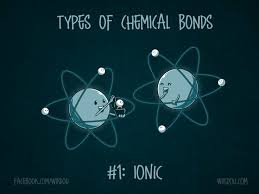
A chemical bond that is formed between oppositely charged ions.
compound
ion
covalent bond
ionic bond
The force that holds together atoms to form a substance.
compound
ion
chemical bond
ionic bond
A covalent bond in which electrons are shared unequally is
polar.
polyatomic.
ionic.
a double bond.
A compound formed as a result of electron sharing is called a(n)
ionic compound
ion
molecule
metal
In a nonpolar covalent bond, electrons are shared:
equally
unequally
between two metals
between a metal and a non-metal
What kind of bond would form between 2 oxygen atoms
Ionic
Polar Covalent
Metallic
Nonpolar Covalent
What do we call the outermost electrons of an atom used in forming chemical bonds?
Neutrons
Ions
energy levels
Valence electrons

Which type of bond involves an atom stealing an electron and another donating an electron?
Ionic bonds
Covalent bonds
Metallic bonds
Nonpolar bonds
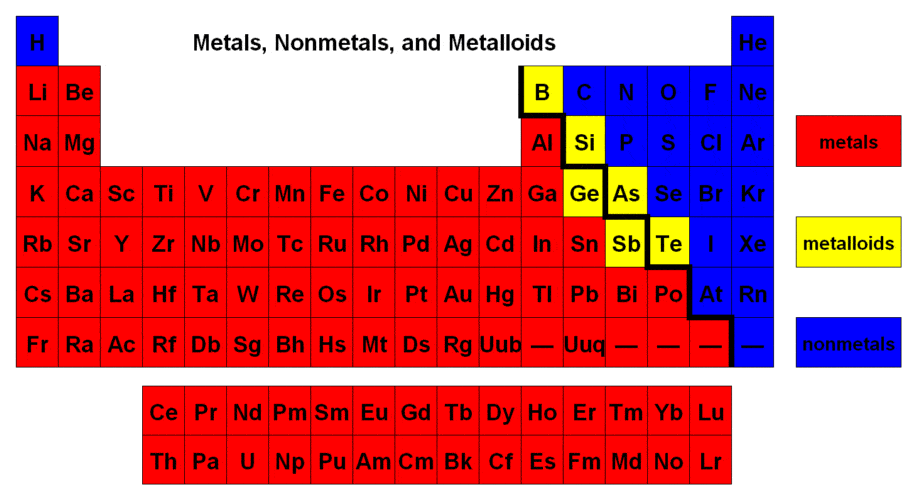
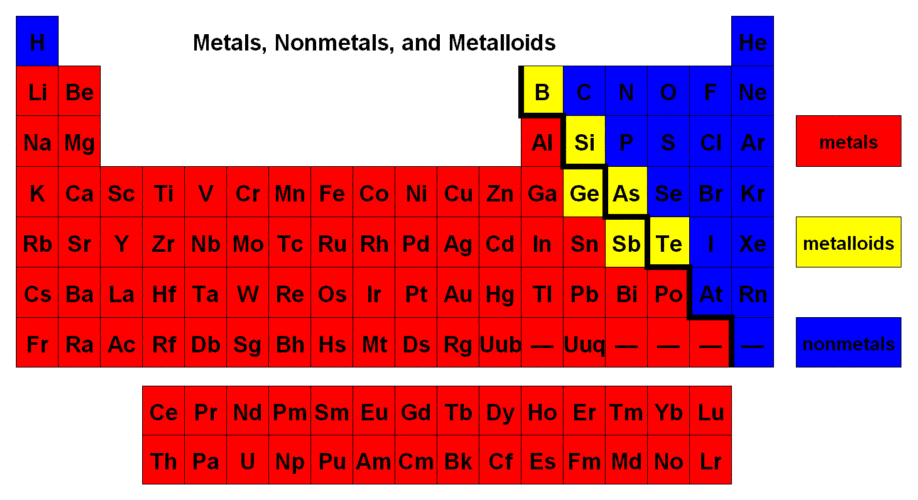
Which type of bond would occur between the following elements: Calcium (Ca) and Nickel (Ni)
ionic
covalent
metallic
Which type of bond would occur between the following elements: Magnesium (Mg) and Iodine (I)
ionic
covalent
metallic
Which type of bond would occur between the following elements: Nitrogen (N) and Sulfur (S)
ionic
covalent
metallic
Which type of bond would occur between the following elements: Chromium (Cr) and Oxygen (O)
ionic
covalent
metallic
Which type of bond would occur between the following elements: Hydrogen (H) and Sulfur (S)
ionic
covalent
metallic
Which type of bond would occur between the following elements: Cobalt (Co) and Zinc (Zn)
ionic
covalent
metallic
Which type of bond would occur between the following elements: Manganese (Mn) and Selenium (Se)
ionic
covalent
metallic
Which type of bond would occur between the following elements: Iron (Fe) and Sulfur (S)
ionic
covalent
metallic
Which type of bond would occur between the following elements: Boron (B) and Oxygen (O)
ionic
covalent
metallic
Which type of bond would occur between the following elements: Nickel (Ni) and Copper (Cu)
ionic
covalent
metallic
Which type of bond would occur between the following elements: Copper (Cu) and Iodine (I)
ionic
covalent
metallic
How is an ionic bond formed?
Sharing of electrons
Delocalised electrons
Transfer of electrons

Look at this picture- Which type of diagram is shown which has all the electrons in the different energy levels.
Bohr's Diagram
Lewis Dot Diagram

This type of diagram shows only the electrons located in the elements outer most energy level.
Bohr Diagram
Lewis Dot Diagram
This picture shows that Lithium has this many electrons in it's outer shell.
zero
1
If Lithium has only 1 electron in its outer level, then what Group number is Lithium in?
Group 8
Group 14
Group 2
Group 1
All of the elements in a Group or Family all have the SAME
atomic mass
number of valence electrons
chemical symbol
atomic number

What type of bonding does this picture show?
Ionic
Covalent

What type of bonding does this picture show?
Ionic
Covalent
Generally, atoms form bonds so that _______________.
Each atom loses its electrons
Each atom has a stable electron configuration
Each atom has an unstable electron configuration
Each atom gains electrons
Generally low melting and boiling points
Ionic compounds
Covalent compounds
Generally high melting & boiling points
Ionic compounds
Covalent compounds
Can be a solid, liquid, or gas at room temperature
Ionic compounds
Covalent compounds
Always a solid at room temperature
Ionic compounds
Covalent compounds
Poor electrical conductivity
Ionic compounds
Covalent compounds
Conducts electricity well when melted or dissolved
Ionic compounds
Covalent compounds
Valence electrons are shared
Ionic bonds
Covalent bonds
Valence electrons are transferred
Ionic bonds
Covalent bonds
Carbon and Oxygen will make a ___________ bond.
ionic
covalent
metallic
NaCl
ionic
covalent
metallic
In which type of compound do valence electrons flow freely between nuclei?
Ionic
Metallic
Covalent
Hydrogen
Which type of compound conducts electricity when dissolved in water?
Ionic
Metallic
Covalent
Hydrogen
What is the charge of a potassium ion?
-1
+1
Neutral
+2
How many valence electrons does a potassium atom have?
1
2
3
4
What type of compound has a 'sea of electrons' flowing between positively charged nuclei?
Ionic
Metallic
Covalent
Hydrogen

Which element is shown losing an electron in the diagram?
Chlorine
Oxygen
Potassium
Hydrogen

Which element is shown gaining an electron in the diagram?
Chlorine
Oxygen
Potassium
Hydrogen
Identify the type of bond based on the description: Results from an almost equal sharing of electrons between atoms.
Ionic
Polar Covalent
Nonpolar Covalent
Metallic
To draw an electron dot structure, one must know the:
number of valence electrons in each atom
atomic mass of each atom
bond length of each atom
ionization energy of each atom
An octet is equal to
2 electrons
4 electrons
6 electrons
8 electrons
Ionic compounds always have an overall net charge of ______.
-1
+1
0
it varies

