
 Worksheets
Physical Science Midterm Review 24-25
Total questions: 80
Worksheet time: 2hrs 20mins

The vertical axis of a line graph is called the __________.
slope
line of best fit
x-axis
y-axis

The horizontal axis of a line graph is called the __________.
slope
line of best fit
x-axis
y-axis
The base unit of metric length.
Meter
Liter
Gram
The base unit of metric volume.
Meter
Liter
Gram
The base unit of metric mass.
Meter
Liter
Gram

Explain the motion from 0-1s
Stationary
Constant speed
Constant acceleration
Non-constant acceleration
Explain the motion from 8s onwards. The blue line runs along the x-axis. Hint: What is the velocity from 8s onwards.
Stationary
Constant speed
Constant acceleration
Constant deceleration

Explain the motion
Stationary
Constant speed
Constant acceleration
Non-constant acceleration
Which of these velocity vs. time graphs shows an object changing direction?


This velocity vs. time graph shows an object...
(Hint: For this graph, the velocity is 0 m/s!)
not moving
moving with constant velocity
moving with changing velocity

This velocity vs. time graph shows an object...
not moving
moving with constant velocity
moving with changing velocity

This velocity vs. time graph shows an object...
not moving
moving with constant velocity
moving with changing velocity

This position vs. time graph shows an object...
not moving
moving with constant velocity
moving with changing velocity

This position vs. time graph shows an object...
not moving
moving with constant velocity
moving with changing velocity

This velocity vs. time graph shows an object...
not moving
moving with constant velocity
moving with changing velocity

This position vs. time graph shows an object...
not moving
moving with constant velocity
moving with changing velocity

This position vs. time graph shows an object...
not moving
moving with constant velocity
moving with changing velocity

This position vs. time graph shows an object...
not moving
moving with constant velocity
moving with changing velocity

This position vs. time graph shows an object...
speeding up
slowing down

What is the shape of a velocity graph for constant velocity?
diagonal line
flat line
parabola
Which graph shows an object that doesn't move in the beginning?


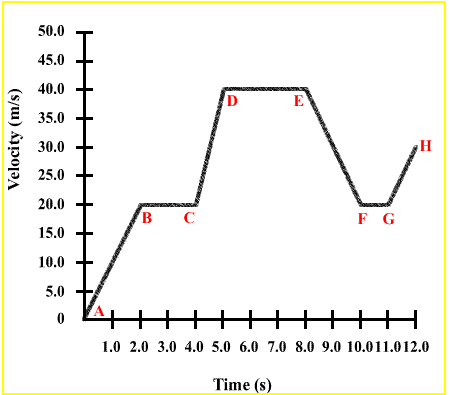
Velocity measurements are given in units of...
displacement / time
time2 / displacement
displacement / time2
time / displacement
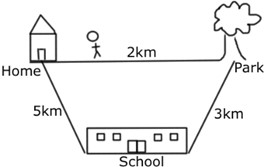
Jerry walked from home to school, then from the school to the park. What is his total distance?
2 km
5 km
8 km
10 km
What does the b mean in y=mx+b?
Slope
Nothing
x-intercept
y-intercept

What does "m" stand for in the slope formula?
y axis
slope
y coordinate
x coordinate
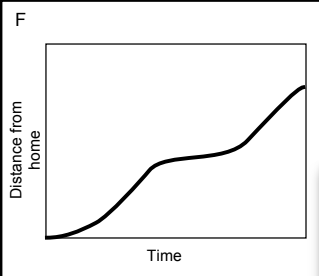
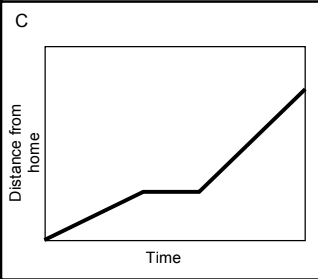
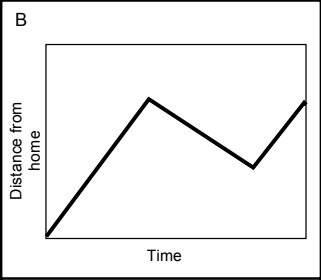
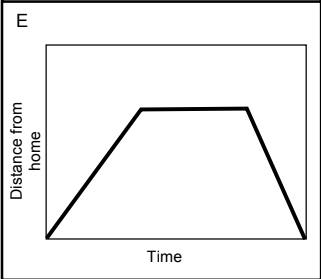
Deb walked to the ice cream shop. Sat and ate her ice cream and then went for a run.
Which graph matches this motion?
What is the formula for calculating speed?
speed = timedistance
speed = distancetime
speed=distance × time
speed = distance + time
a=timevfinal−vinitial
Mark slams on the brakes after traveling 25 m/s. It takes him 3 seconds to come to a complete stop. What is his acceleration?
8.33 m/s2
-8.33 m/s2
75 m/s2
-75 m/s2

Calculate the speed of the runner represented by the SOLID line in Graph B.
2.5 yd/sec
5 yd/sec
30 yd
4 sec

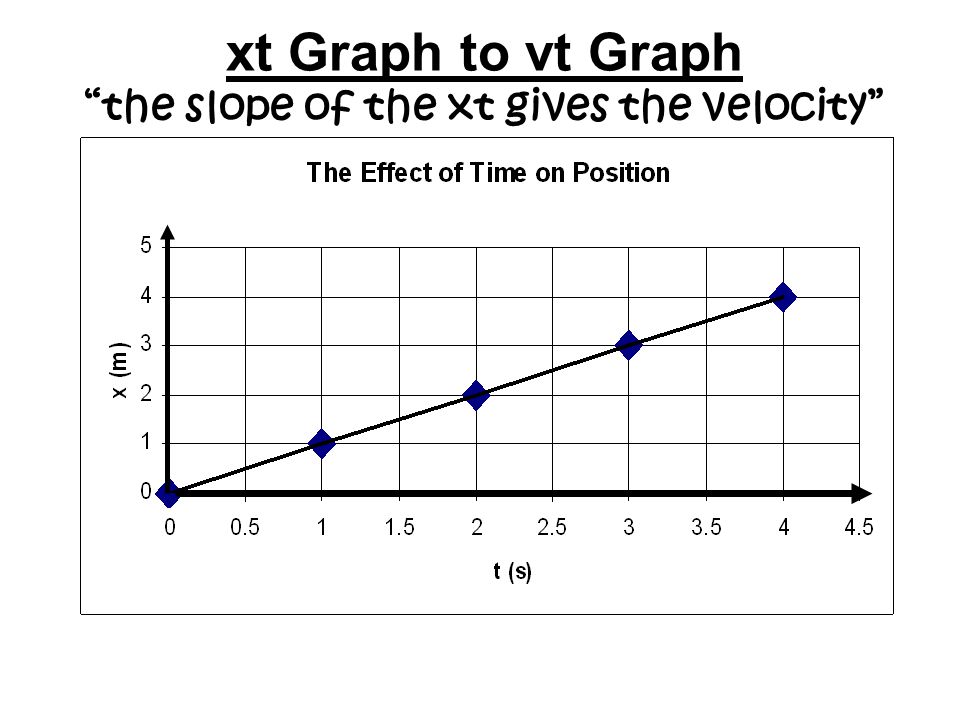
How fast is this object moving?
1 meter
1 meter /second
2 meters/second
4 seconds
Mark slams on the brakes after traveling 25 m/s. It takes him 3 seconds to come to a complete stop. What is his acceleration?
8.33 m/s2
-8.33 m/s2
75 m/s2
-75 m/s2
How much time did it take Matthew to slow down to a complete stop, after traveling at 30 m/s. His acceleration is -12 m/s2
2.5 s
360 s
.4 s
-2.5 s
Georgia is jogging with a velocity of +4 m/s when she accelerates at +2 m/s2 for 3 seconds. How fast is Georgia running now?
10 m/s
2.6 m/s
9 m/s
3.5 m/s

The SI unit for acceleration is
mph
ft/sec
m/s2
m/s
The equation for acceleration is...


The graph shows
positive velocity that's getting faster
negative velocity that's getting faster
negative velocity that's getting slower
positive velocity that's getting slower

The graph shows
positive velocity that's getting faster
negative velocity that's getting faster
negative velocity that's getting slower
positive velocity that's getting slower

The graph shows
positive velocity that's getting faster
negative velocity that's getting faster
negative velocity that's getting slower
positive velocity that's getting slower

The graph shows
positive velocity that's getting faster
negative velocity that's getting faster
negative velocity that's getting slower
positive velocity that's getting slower

The graph shows
positive velocity that's getting faster
negative velocity that's getting faster
negative velocity that's getting slower
positive velocity that's getting slower

The graph shows
positive velocity that's getting faster
negative velocity that's getting faster
negative velocity that's getting slower
positive velocity that's getting slower

The graph shows
positive velocity that's getting faster
negative velocity that's getting faster
negative velocity that's getting slower
positive velocity that's getting slower

The graph shows
positive velocity that's getting faster
negative velocity that's getting faster
negative velocity that's getting slower
positive velocity that's getting slower

Calculate the slope from 20-30 seconds
1 m/s/s
0.83 m/s/s
2 m/s/s
0.5 m/s/s
Calculate the slope from 30-50 seconds
1.25 m/s/s
0.83 m/s/s
0.5 m/s/s
-1.25 m/s/s



State Newtons First Law
the rate change of momentum
the rate change of velocity
an object will remain at rest or move along a straight line with constant speed, unless it is acted upon by a force

In the free-body diagram, which of the following is the gravitational force acting on the balloon?
5120 N
950 N
1520 N
4050 N

normal force & gravitational force
normal force & frictional force
What is an example of kinetic energy?
A bird sitting in a tree
A bouncy ball on the table
A car driving on the highway
A book on shelf
Which has more potential energy?
A bird in a tree
A car in the garage
An airplane before takeoff
A child on a swing
Total energy in a closed system will always change with the motion of an object.
True; energy is destroyed due to friction
False; energy cannot be destroyed, only transferred.
What is the equation for kinetic energy?
KE = 1/2 Mass X Velocity squared
KE = Speed (m/s) + height (m)
KE = Distance (m) / time (s)
KE = Mass (g) * gravity * height (m)

What situation describes the initial (i) and final (f) state shown by the energy bar graph.
A phone falls from a table (i) to the floor (f)
A ball is thrown straight up (i) into the air (f)
A car driving on a flat road (i) accelerates (f)
A golf pro swings his driver with a mass of 0.75 kg at a velocity of 60 m/s. What is the kinetic energy of the club?
22.5 J
It doesn't have kinetic energy-it has potential energy.
2,700 J
1,350 J
What is the gravitational potential energy equation (weight = mass X acceleration due to gravity)?
PE = mass X velocity
PE = weight X speed
PE = weight X height
PE = height X weight
Which of the following has the GREATEST IMPACT on the kinetic energy of an object and why?
Mass because very small and very large things can't have the same kinetic energy.
Velocity because its value is squared.
Height because it can be a very large number.
The acceleration due to gravity because it is acceleration which is more than velocity.
The acceleration of an object due to gravity on Earth is:
The same as its velocity
9.8 m/s2
It depends on the mass of an object
Equal to its kinetic energy
A marble is given potential energy by being placed at Location W. When the marble is released, it rolls down the track.
At which location does the marble have maximum kinetic energy? Select the correct location on the image.
Formula for velocity
v = d*t
v = d/t
v = m*t
v = m/t
Formula for force
F = m*a
F = m/a
F = d*a
F = d/a
SI unit for energy
Joules
Watts
Newtons
meters
What is the formula for Acceleration (a)?
a = F / m
a = Δv / t
a = m × g
a = P / V
What is the formula for Weight (W)?
W = 1/2 mv^2
W = P / t
W = m × g
W = F × d

